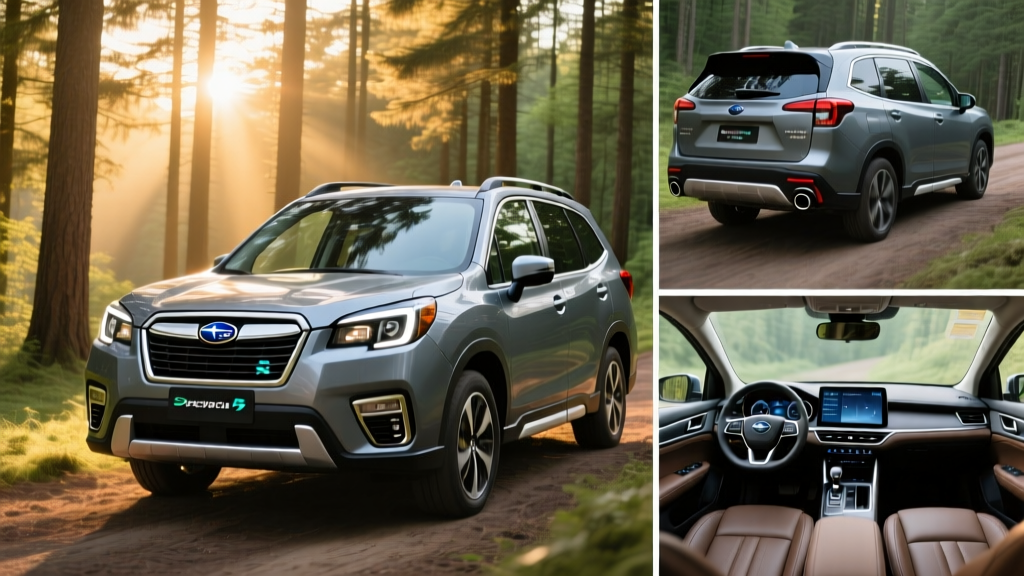
The 2026 Subaru Forester Touring Hybrid pairs Subaru's proven symmetrical all-wheel drive with a refined gasoline-electric hybrid powertrain. As the top-trim offering in the newly hybridized Forester lineup, the Touring Hybrid targets buyers who want the fuel savings of electrification without the lifestyle changes a plug-in hybrid or full EV demands. No charging cables, no range anxiety, no home electrical upgrades — just fill up with gas and drive.
But does the Touring Hybrid's premium price justify its efficiency gains over the base Forester? And how does its real-world MPG compare to the EPA sticker? We break down every number that matters.
HEV vs PHEV: What the Forester Hybrid Actually Is
Before we dig into specs, let's clear up a common confusion. The 2026 Forester Touring Hybrid is a conventional hybrid (HEV), not a plug-in hybrid (PHEV). This distinction matters enormously for your ownership experience.
Conventional Hybrid (HEV) — Forester Touring Hybrid
- No plug — the battery charges via regenerative braking and the gasoline engine
- Small battery (~1.1 kWh usable) — assists the engine, doesn't drive the car solo for meaningful distances
- Measured in MPG — fuel economy improvement over a gas-only model
- No federal EV tax credit eligibility under IRS §30D
Plug-In Hybrid (PHEV) — e.g., Toyota RAV4 Prime
- Plugs into a wall outlet or Level 2 charger — 18–42 miles of electric-only driving
- Larger battery (18–22 kWh) — can operate as a full EV for daily commutes
- Measured in MPGe (electric mode) + MPG (gas mode)
- May qualify for up to $7,500 federal tax credit (subject to income, MSRP, and battery-sourcing rules)
If you were hoping the Forester offered a plug-in variant for 2026, it doesn't. Subaru has committed to the HEV route for the Forester, prioritizing simplicity and AWD reliability over electric-only range. For a Subaru PHEV, you'd need to look at the Crosstrek Hybrid (limited availability) or wait for Subaru's upcoming EV expansion.
Fuel Economy: EPA Ratings and Real-World MPG
The headline number for any hybrid is fuel economy. Here's what the EPA says and what you can actually expect from the 2026 Forester Touring Hybrid:
| Metric | EPA Rating | Real-World Expectation |
|---|---|---|
| City | 35 MPG | 33–37 MPG (hybrids often beat EPA in stop-and-go) |
| Highway | 33 MPG | 29–32 MPG (hybrid advantage shrinks at sustained speed) |
| Combined | 34 MPG | 31–35 MPG (varies with terrain, temperature, driving style) |
Source: EPA Fuel Economy
Compared to the non-hybrid 2026 Forester (EPA 26 city / 33 highway / 29 combined), the Touring Hybrid delivers roughly a 17% improvement in combined fuel economy. Over 15,000 annual miles at $3.50/gallon, that translates to approximately $350–$450 in annual fuel savings — meaningful, but not transformative enough to recoup the Touring Hybrid's premium over a base Forester purely on fuel cost.
Powertrain: Engine, Motor, and Combined Output
The 2026 Forester Touring Hybrid uses Subaru's updated hybrid system, which integrates an electric motor into the Lineartronic CVT transmission. Here's the full powertrain breakdown:
| Specification | 2026 Forester Touring Hybrid |
|---|---|
| Engine | 2.5L flat-4 (Boxer), direct injection |
| Engine Output | 180 hp / 178 lb-ft torque |
| Electric Motor | Integrated AC synchronous motor |
| Combined System Output | 194 hp |
| Transmission | Lineartronic CVT with electric motor integration |
| Drivetrain | Symmetrical AWD (standard) |
| Hybrid Battery | ~1.1 kWh lithium-ion (not plug-in) |
| 0–60 mph | ~8.1 seconds (est.) |
| Towing Capacity | 1,500 lbs |
| Cargo Volume (behind rear seats) | 28.9 cu ft |
The 14-hp bump from the electric motor may seem modest, but it fills in the torque gap at low RPM where the 2.5L Boxer engine feels sluggish. The result is noticeably improved acceleration from stops and smoother highway merging. Subaru's symmetrical AWD remains fully functional — the hybrid system doesn't compromise the Forester's signature all-weather capability.
Pricing, Trims, and Tax Credit Eligibility
The Touring Hybrid sits at the top of the 2026 Forester lineup. Here's where it lands on price:
- 2026 Forester Touring Hybrid MSRP: ~$41,995 (including destination)
- Base Forester (gas): ~$31,095
- Forester Sport Hybrid: ~$36,995
- Forester Limited Hybrid: ~$38,995
The Touring trim adds Nappa leather, a 12.3-inch digital gauge cluster, Harman Kardon audio, heated rear seats, a panoramic moonroof, and Subaru's DriverFocus distraction-mitigation system. It's the most luxurious Forester Subaru has ever offered.
Battery Warranty, Reliability, and Replacement Cost
Hybrid battery longevity remains a top concern for buyers switching from a pure gas car. Subaru backs the Forester Hybrid's battery system with strong coverage:
Hybrid Battery & Component Warranty
- Hybrid Battery: 8 years / 100,000 miles (10 years / 150,000 miles in CARB states — CA, NY, MA, and others adopting California emissions standards)
- Hybrid System Components: 8 years / 100,000 miles (inverter, motor, control modules)
- Powertrain Warranty: 5 years / 60,000 miles
- Basic Warranty: 3 years / 36,000 miles
Subaru's hybrid system in the 2026 Forester is evolutionarily related to the system used in the Crosstrek Hybrid and the e-Boxer platform sold globally since 2019. Toyota, which co-developed aspects of Subaru's hybrid architecture through their corporate partnership, has demonstrated that modern nickel-metal-hydride and lithium-ion hybrid batteries routinely last 150,000–200,000+ miles before significant degradation.
Replacement cost if out of warranty: A hybrid battery pack replacement for the Forester Hybrid is estimated at $2,500–$4,000 (parts and labor) based on comparable Subaru and Toyota hybrid systems. Individual module replacement (if supported) can reduce that to $800–$1,500. For context, this is far less than a full EV battery replacement ($8,000–$20,000+), and the small HEV battery is far less likely to need replacement within the vehicle's lifespan.
Who Should Buy the Forester Touring Hybrid vs. an EV or Gas Model
Choose the Forester Touring Hybrid If:
- You want 34 MPG combined without changing your fueling habits
- You live in a cold or mountainous region where AWD and ground clearance matter year-round
- You can't install a home charger (apartment, street parking, no garage)
- You want premium features (Nappa leather, Harman Kardon) in a compact SUV
- You tow occasionally (1,500 lbs) and don't want EV range loss from towing
Look at a PHEV or Full EV Instead If:
- You want electric-only commuting (PHEV: 30–42 mi; BEV: 250–350 mi)
- You have home charging access and want $0.04–$0.06/mile "fuel" cost
- You want federal tax credits up to $7,500 (PHEV/BEV only)
- You want one-pedal driving and instant electric torque
- Your daily commute is under 40 miles (a PHEV covers it entirely on electricity)
The Forester Touring Hybrid occupies a specific niche: it's the electrified choice for people who don't want to think about electrification. You get real fuel savings (roughly 5 MPG better combined than the gas Forester), improved low-end response, and zero behavioral change. But you also pay a ~$10,900 premium over the base gas Forester — a gap that fuel savings alone won't close within typical ownership.
The Touring trim's value proposition rests on its luxury features, not just its hybrid powertrain. If you'd buy a Forester Touring anyway for the Nappa leather and premium audio, the hybrid powertrain is a bonus. If you're strictly optimizing for fuel cost, the Sport Hybrid or Limited Hybrid delivers identical MPG at a lower price.
Pros and Cons at a Glance
✓ Pros
- 34 MPG combined — 17% better than the gas Forester
- Standard symmetrical AWD with no hybrid compromise
- 8-year/100,000-mile hybrid battery warranty
- Touring trim luxury (Nappa leather, 12.3" cluster, HK audio)
- No charging infrastructure needed — works like any gas car
- Subaru's EyeSight safety suite standard
✗ Cons
- ~$42,000 MSRP — steep for a compact SUV
- No federal tax credit (HEV, not PHEV/BEV)
- Highway MPG falls below EPA estimate at 70+ mph
- 1,500-lb towing limit (less than some gas competitors)
- No plug-in option in the Forester lineup for 2026
- Fuel savings (~$400/yr) don't offset the premium over base trim
Frequently Asked Questions
How many MPG does the 2026 Subaru Forester Touring Hybrid get?
The EPA rates the Forester Touring Hybrid at 35 city / 33 highway / 34 combined MPG. In real-world driving, city mileage often exceeds the EPA rating thanks to regenerative braking, while highway mileage at speeds above 70 mph typically drops to 29–32 MPG. Cold weather can reduce all figures by 5–10%.
Is the Forester Hybrid a plug-in? Can I charge it at home?
No. The Forester Touring Hybrid is a conventional hybrid (HEV). You never plug it in. The small lithium-ion battery charges through regenerative braking and the gasoline engine. If you want plug-in capability with electric-only range, you'd need to look outside the Forester lineup — Subaru does not offer a Forester PHEV for 2026.
Does the Forester Touring Hybrid qualify for any tax credit?
It does not qualify for the federal IRS §30D Clean Vehicle Credit, which requires a plug-in vehicle with at least 7 kWh of battery capacity. The Forester Hybrid has approximately 1.1 kWh. Some states offer hybrid-specific rebates — check your state's energy or environmental agency website for current programs.
How long will the hybrid battery last, and what does replacement cost?
Subaru warranties the hybrid battery for 8 years / 100,000 miles (10 years / 150,000 miles in CARB states). Based on data from Toyota's long-running hybrid systems (which share engineering DNA with Subaru's), modern hybrid batteries commonly last 150,000–200,000+ miles. If replacement is needed out of warranty, expect $2,500–$4,000 for a full pack, or less for individual module replacement.
Hybrid vs PHEV vs EV — which should I choose?
Choose the HEV (Forester Hybrid) if you want fuel savings with zero lifestyle change — no plugs, no charging, no range planning. Choose a PHEV if you have home charging and a commute under 40 miles — you'll drive electric daily and use gas only for road trips, plus you may qualify for a $7,500 federal credit. Choose a full EV if you want the lowest per-mile fuel cost, zero tailpipe emissions, and have reliable charging access at home or work.
Is the Forester Touring Hybrid reliable?
Subaru's hybrid system is derived from proven technology co-developed with Toyota, the industry leader in hybrid reliability. The 2.5L Boxer engine is a carryover design with a long service history. Subaru's standard 5-year/60,000-mile powertrain warranty and 8-year hybrid component coverage provide strong protection. IIHS typically rates the Forester highly for crash safety, and EyeSight driver-assist comes standard.