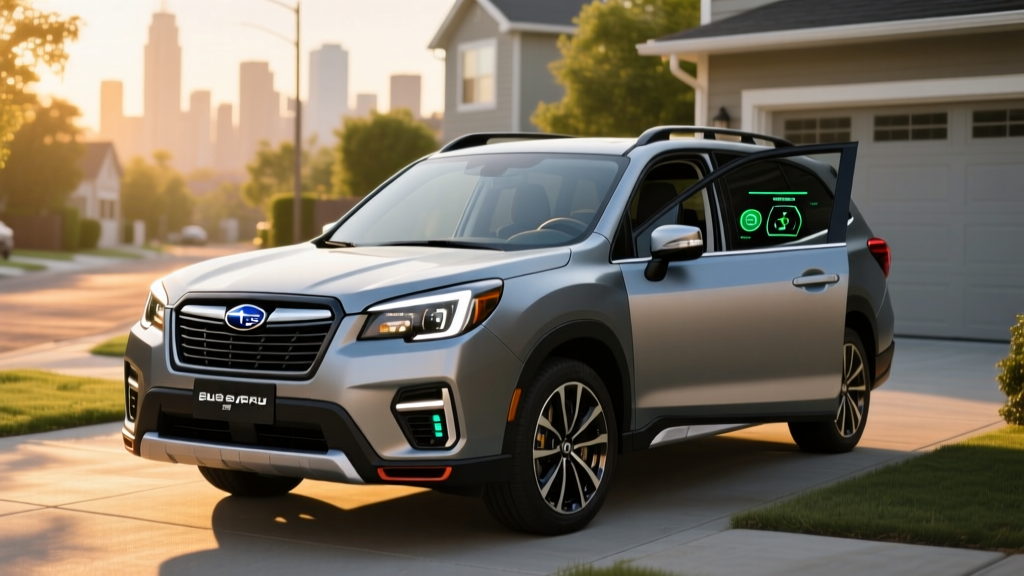
The 2026 Subaru Forester Sport Hybrid arrives as a compelling option for compact-SUV shoppers who want all-wheel drive, better fuel economy, and zero changes to their refueling routine. Unlike a plug-in hybrid or full battery-electric vehicle, the Forester Hybrid is a conventional hybrid (HEV) — meaning you never plug it in. You simply fill up with gas and let the hybrid system handle the rest.
But with Toyota's RAV4 Hybrid and Honda's CR-V Hybrid dominating this segment, does the Forester Sport Hybrid earn its place? Here's everything you need to know about its powertrain, fuel economy, pricing, and long-term ownership outlook.
HEV vs. PHEV: What Kind of Hybrid Is the Forester Sport?
Before diving into specs, it's critical to understand what you're buying. The 2026 Forester Sport Hybrid is a conventional hybrid (HEV), not a plug-in hybrid (PHEV). Here's the difference:
| Feature | HEV (Forester Hybrid) | PHEV (e.g., Toyota RAV4 Prime) |
|---|---|---|
| Plug-in charging? | No — self-charging via regen & engine | Yes — plug in for EV-only miles |
| Electric-only range | Less than 1 mile at low speed | 30–42 miles typical |
| Battery size | ~1.1 kWh (small buffer) | 18–20 kWh |
| Federal tax credit | Not eligible | Up to $7,500 (subject to §30D rules) |
| Best for | Drivers who can't charge at home | Drivers with home charging & short commutes |
The Forester Hybrid uses its small battery and electric motor to assist the gas engine, capture energy from braking (regenerative braking), and enable brief electric-only movement at very low speeds. It cannot drive meaningful distances on electricity alone. If you want EV-only commuting, you'd need to look at a PHEV or a full BEV — the Forester does not offer a plug-in variant for 2026.
Powertrain Specs: Engine, Motor, and Combined Output
Subaru pairs its familiar 2.5-liter flat-four (Boxer) engine with an electric motor integrated into the transmission. The result is a powertrain that feels responsive around town while maintaining Subaru's signature symmetrical all-wheel drive.
| Specification | 2026 Forester Sport Hybrid |
|---|---|
| Engine | 2.5L Boxer 4-cylinder |
| Engine output | ~180 hp / 176 lb-ft torque |
| Electric motor output | ~27 hp (integrated in transmission) |
| Combined system output | ~194 hp |
| Transmission | Lineartronic CVT |
| Drivetrain | Symmetrical AWD (standard) |
| Hybrid battery | ~1.1 kWh lithium-ion |
| 0–60 mph (est.) | ~8.5 seconds |
| Towing capacity | 1,500 lbs |
The combined ~194 hp doesn't make the Forester Sport Hybrid a performance SUV, but it provides adequate acceleration for merging and passing. The electric motor fills in low-end torque that the naturally aspirated Boxer engine lacks, making stoplight-to-stoplight driving feel peppier than the non-hybrid Forester. The CVT is smooth but can drone under hard acceleration — typical for Subaru's Lineartronic unit.
Fuel Economy: EPA Ratings and Real-World MPG
This is the Forester Hybrid's main selling point. Subaru's hybrid system prioritizes fuel efficiency without requiring any behavioral changes from the driver.
| Driving Cycle | EPA Estimate | Real-World Expectation |
|---|---|---|
| City | 35 MPG | 33–37 MPG (hybrids often beat EPA in city) |
| Highway | 33 MPG | 30–33 MPG (AWD drag, boxy aero hurt hwy efficiency) |
| Combined | 34 MPG | 31–35 MPG |
How many MPG does the Forester Sport Hybrid get? The EPA rates it at 35 city / 33 highway / 34 combined. That's a meaningful improvement over the gas-only Forester, which returns around 26 city / 33 highway / 29 combined — roughly a 5 MPG gain in mixed driving.
In real-world driving, conventional hybrids tend to exceed their EPA city estimates because stop-and-go traffic maximizes regenerative braking and electric motor assist. Highway driving is where the Forester's boxy shape and permanent AWD system work against it — expect numbers closer to 30–32 MPG on long road trips at 70+ mph. In cold weather, the engine runs more frequently to heat the cabin, which can temporarily drop city MPG into the low 30s until the powertrain reaches operating temperature.
How Does It Compare to Rivals?
The compact hybrid SUV segment is competitive. Here's how the Forester Sport Hybrid stacks up against its two biggest rivals on paper:
| Spec | Subaru Forester Sport Hybrid | Toyota RAV4 Hybrid (AWD) | Honda CR-V Hybrid (AWD) |
|---|---|---|---|
| Combined MPG | 34 | 39–41 | 37–40 |
| Combined HP | ~194 | 219 | 204 |
| AWD System | Mechanical (symmetrical) | Electronic (rear motor) | Electronic (rear motor) |
| Cargo (rear seats up) | ~28.9 cu ft | ~37.5 cu ft | ~36.3 cu ft |
| Starting MSRP (hybrid) | ~$36,000 | ~$34,500 | ~$36,000 |
The Forester Hybrid trails both the RAV4 and CR-V in fuel economy — a consequence of Subaru's mechanical AWD system, which is always engaged and adds drivetrain loss compared to the on-demand electronic AWD used by Toyota and Honda. Where Subaru fights back is visibility (excellent outward sightlines thanks to thin pillars), standard AWD across all trims, and available EyeSight driver-assist technology.
Pricing, Trims, and Tax Credit Eligibility
The 2026 Forester Sport Hybrid slots into the middle of the Forester lineup. Based on Subaru's pricing structure, expect the Sport Hybrid to start around $36,000–$37,500 MSRP (including destination), with the top Touring Hybrid reaching approximately $41,000–$42,000.
Does the Forester Hybrid qualify for any tax credit? No. The federal §30D Clean Vehicle Credit applies only to plug-in electric vehicles (PHEVs and BEVs) with qualifying battery capacity and domestic sourcing requirements. As a conventional hybrid, the Forester Sport Hybrid is not eligible for the federal EV tax credit. Some states or local utilities may offer small rebates for hybrid purchases — check your state energy office or utility provider for current programs. Consult IRS guidance on clean vehicle credits for full eligibility rules.
Battery Warranty, Reliability, and Replacement Cost
Is the Forester Hybrid reliable? Subaru's hybrid system is relatively simple compared to PHEV or BEV powertrains. The small ~1.1 kWh battery undergoes shallow charge/discharge cycles — it rarely drops below 40% or charges above 80% state of charge, which dramatically reduces degradation. Toyota has proven this architecture over decades with the Prius and RAV4 Hybrid, and Subaru's partnership with Toyota (which supplies hybrid components) bodes well for longevity.
What does battery replacement cost? If the hybrid battery fails outside of warranty, expect a replacement cost of approximately $2,000–$4,000 for the battery module itself, plus labor. This is far less than a full EV battery replacement because the hybrid battery is small (~1.1 kWh vs. 60–100 kWh in a BEV). Most hybrid batteries in modern vehicles last well beyond 150,000 miles under normal driving conditions.
Subaru's EyeSight driver-assist system (standard on all trims) includes adaptive cruise control, lane-keeping assist, pre-collision braking, and lane departure warning. Note that EyeSight is an SAE Level 2 driver-assist system — it requires the driver to remain fully engaged with hands on the wheel and eyes on the road at all times. It is not autonomous driving.
Who Should Buy the Forester Sport Hybrid?
Pros
- Standard symmetrical AWD — superior traction in snow and rain
- Excellent outward visibility and comfortable ride
- No plug-in required — zero change to refueling habits
- ~5 MPG improvement over gas-only Forester
- Strong safety ratings and standard EyeSight ADAS
- 8-year/100,000-mile hybrid warranty (10/150k in CARB states)
Cons
- Lower MPG than RAV4 Hybrid and CR-V Hybrid
- Smaller cargo area than key rivals
- No federal tax credit eligibility
- CVT drone under hard acceleration
- 1,500-lb towing limit (less than some competitors)
Decision Framework
Choose the Forester Sport Hybrid if: You live in a snowy or rainy climate where Subaru's mechanical AWD shines, you can't charge at home, and you value visibility and ride comfort over maximum MPG.
Choose the RAV4 Hybrid instead if: You prioritize fuel economy (39–41 MPG combined) and cargo space, and electronic AWD is sufficient for your conditions.
Choose a PHEV (e.g., RAV4 Prime) if: You have home charging and a short commute — you could drive months without using gas.
Choose a full EV if: You have reliable home charging, want zero tailpipe emissions, and are ready to adopt DC fast charging for road trips.
Frequently Asked Questions
How many MPG does the 2026 Subaru Forester Sport Hybrid get?
The EPA rates the Forester Sport Hybrid at 35 city / 33 highway / 34 combined MPG. In real-world city driving with frequent stops, many owners report exceeding the EPA city estimate. Highway driving at sustained speeds typically yields 30–33 MPG.
Does the Forester Hybrid need to be plugged in?
No. The Forester Sport Hybrid is a conventional hybrid (HEV). It charges its small battery through regenerative braking and the gas engine. You never plug it in — just fill up at any gas station as usual.
Is the Forester Hybrid available as a plug-in hybrid (PHEV)?
No. For the 2026 model year, Subaru does not offer a plug-in hybrid Forester. If you want a Subaru PHEV, the Crosstrek was previously offered as a PHEV but has been discontinued. For PHEV compact SUVs, consider the Toyota RAV4 Prime or Hyundai Tucson PHEV.
How long will the hybrid battery last?
Subaru's hybrid battery is designed to last the life of the vehicle under normal use. The battery is warranted for 8 years/100,000 miles (10 years/150,000 miles in CARB states). Real-world data from similar Toyota-sourced hybrid systems shows batteries routinely lasting 150,000+ miles without significant degradation.
Is the Forester Hybrid good in snow?
Yes — this is one of Subaru's strongest advantages. The symmetrical AWD system is always active, providing consistent torque distribution to all four wheels. Combined with the Forester's 8.7 inches of ground clearance and available all-weather tires, it's one of the most capable compact SUVs in winter conditions.
Does the Forester Hybrid qualify for any tax incentives?
The Forester Hybrid does not qualify for the federal §30D Clean Vehicle Credit, which is reserved for plug-in vehicles. Check your state energy office and local utility for any hybrid-specific rebates that may apply in your area. See fueleconomy.gov for current incentive listings.
Hybrid vs. PHEV vs. EV — which is right for me?
Hybrid (HEV): Best if you can't charge at home and want better MPG with zero lifestyle change. PHEV: Best if you have home charging and a commute under 30–40 miles — you'll drive mostly on electricity. Full EV (BEV): Best if you want the lowest per-mile fuel cost, zero tailpipe emissions, and have access to home or workplace charging. Each step up in electrification increases upfront cost but decreases operating cost.
Sources: EPA fuel economy data via fueleconomy.gov, Subaru of America official specifications, IRS Clean Vehicle Credit guidelines at irs.gov.