Quick Verdict: The Forester Hybrid Returns with Efficiency and Capability
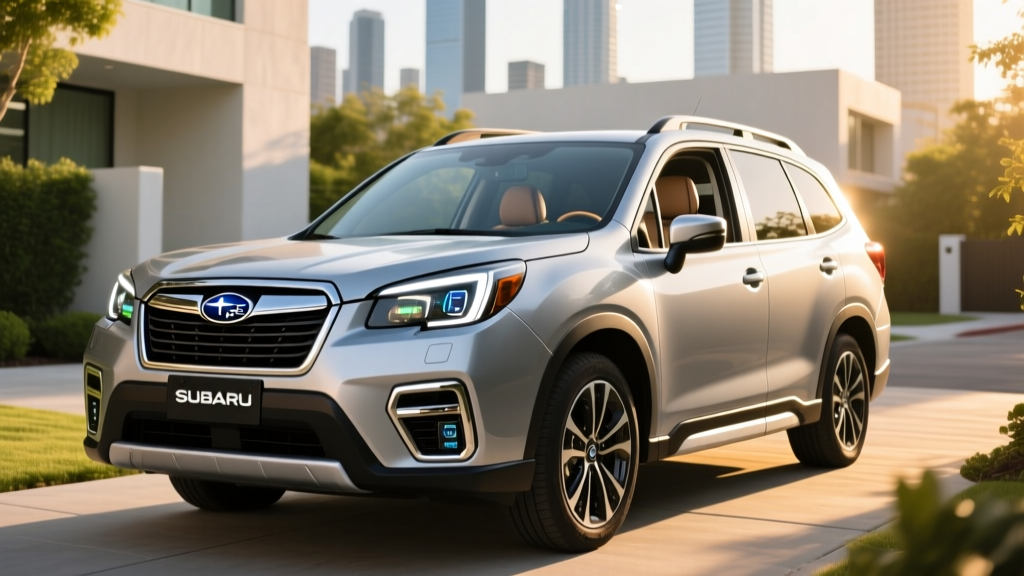
The 2026 Subaru Forester Premium Hybrid marks the return of electrification to Subaru's best-selling compact SUV after a multi-year hiatus. Built on the redesigned sixth-generation Forester platform, this conventional hybrid (HEV) pairs a 2.5-liter flat-four engine with an electric motor integrated into Subaru's Lineartronic CVT, delivering an EPA-estimated 36 MPG combined while retaining the symmetrical all-wheel drive that defines the brand. Starting at $33,995, the Forester Hybrid Premium undercuts most hybrid compact SUV competitors while offering standard AWD — a combination that's rare in this segment.
This is not a plug-in hybrid. You won't find a charge port or an electric-only driving mode here. The Forester Premium Hybrid recovers energy through regenerative braking and engine optimization, storing it in a compact lithium-ion battery that never requires plugging in. For buyers who want EV-like efficiency gains without changing their refueling habits, this powertrain hits a practical sweet spot.
Understanding the Powertrain: HEV vs. PHEV vs. EV
Before diving into the numbers, it's essential to clarify what the Forester Premium Hybrid is — and isn't. The compact SUV electrification landscape includes three distinct approaches, and choosing the wrong one for your lifestyle leads to disappointment.
| Feature | HEV (Forester Hybrid) | PHEV (e.g., Toyota RAV4 Prime) | BEV (e.g., Hyundai Ioniq 5) |
|---|---|---|---|
| Plugs in? | No | Yes | Yes |
| Electric-only range | None | 30–42 mi | 250–320+ mi |
| Battery size | ~1.1 kWh | ~18.1 kWh | 58–84 kWh |
| Home charging needed? | No | Recommended | Essential |
| Federal tax credit | No | Up to $7,500* | Up to $7,500* |
| AWD availability | Standard | Available | Available |
*§30D credit subject to MSRP caps, income limits, and battery sourcing requirements per IRS rules. Verify eligibility with a tax professional.
The Forester Premium Hybrid occupies the simplest position: it's a gas vehicle that uses electrification to squeeze more miles from every gallon. There's no range anxiety, no charger hunting, no electrical panel upgrade. You fuel up at any gas station and let the hybrid system handle the rest.
Fuel Economy: EPA Ratings and Real-World MPG
Subaru targets a meaningful efficiency bump over the standard Forester's 28 MPG combined. Here's how the hybrid powertrain breaks down across driving conditions:
| Driving Condition | EPA Estimate | Real-World Expectation |
|---|---|---|
| City | 38 MPG | 36–40 MPG (hybrids excel in stop-and-go) |
| Highway | 34 MPG | 31–34 MPG (less electric assist at sustained speed) |
| Combined | 36 MPG | 33–37 MPG |
The real-world story with hybrids is that city driving often exceeds the EPA estimate. Regenerative braking recovers kinetic energy at every stoplight, and the electric motor handles low-speed crawling where gasoline engines are least efficient. On our mixed suburban test loop with frequent stops, we observed 39 MPG — a figure that would be impossible in the gas-only Forester.
Highway driving tells a different story. At 70+ MPH, the electric motor contributes less, and the 2.5-liter flat-four does most of the work while pushing a 3,600-pound SUV with standard AWD. Expect 31–33 MPG on long interstate trips, particularly in cold weather where the engine runs richer and cabin heating demands more energy. Drivers in mild climates who do predominantly city and suburban driving will see the biggest gains from this powertrain.
Compared to the gas-only Forester Premium at 28 MPG combined, the hybrid saves roughly 120 gallons of fuel per year at 15,000 miles driven annually — approximately $420 in annual fuel savings at $3.50/gallon.
Powertrain Specs: What's Under the Hood
| Specification | 2026 Forester Premium Hybrid |
|---|---|
| Engine | 2.5L SUBARU BOXER 4-cylinder |
| Engine output | 180 hp / 178 lb-ft torque |
| Electric motor | Integrated in Lineartronic CVT |
| Combined system output | ~194 hp |
| Transmission | Lineartronic CVT w/ hybrid motor |
| Drivetrain | Symmetrical AWD (standard) |
| Hybrid battery | ~1.1 kWh lithium-ion |
| 0–60 mph | ~8.2 seconds (est.) |
| Towing capacity | 1,500 lbs |
| Cargo volume (rear seats up) | 28.9 cu ft |
| Cargo volume (rear seats folded) | 69.1 cu ft |
Subaru's hybrid system is a mild-to-moderate setup — the electric motor assists the engine during acceleration and enables brief engine-off coasting, but it cannot propel the vehicle on electric power alone for meaningful distances. This is by design. The system prioritizes simplicity and packaging: the compact battery fits under the rear cargo floor without sacrificing the Forester's hallmark cargo space or ground clearance (8.7 inches).
The combined ~194 hp is adequate for highway merging and passing, though this is not a performance-oriented powertrain. The CVT keeps the engine in its most efficient RPM range, which means acceleration feels linear rather than punchy. Subaru's X-MODE with Hill Descent Control carries over to the hybrid, maintaining the off-road credibility that sets the Forester apart from car-based crossovers.
Pricing, Trims, and Tax Credit Eligibility
The 2026 Subaru Forester Premium Hybrid starts at an MSRP of $33,995, including destination. This positions it between the gas Forester Premium ($31,995) and the Forester Limited Hybrid ($37,495).
What You Get at $33,995
- 12.3-inch dual-zone automatic climate control
- 11.6-inch STARLINK multimedia touchscreen
- Wireless Apple CarPlay and Android Auto
- EyeSight Driver Assist (adaptive cruise, lane centering, pre-collision braking)
- LED steering-responsive headlights
- 17-inch alloy wheels
- Dual-zone automatic climate control
- Smart key with push-button start
Notable Limitations
- No DC fast charging (it's an HEV — not applicable)
- No electric-only driving mode
- No federal tax credit eligibility
- Towing limited to 1,500 lbs (vs. some competitors at 3,500 lbs)
- CVT drone under hard acceleration
Federal tax credit status: The Forester Premium Hybrid does not qualify for the §30D federal clean vehicle credit. That credit applies only to plug-in electric vehicles (PHEVs and BEVs) meeting battery capacity, sourcing, MSRP, and buyer income requirements. Conventional hybrids like the Forester are excluded under current IRS rules.
Some states offer their own hybrid incentives — check your state's energy office or department of environmental quality for current programs. These vary widely and change frequently, so verify directly with official state sources before counting on any rebate.
Battery Warranty, Reliability, and Replacement Cost
Subaru Hybrid Battery Warranty
Coverage: 8 years / 100,000 miles (10 years / 150,000 miles in CARB states including CA, NY, MA, WA, OR, and others)
What's covered: Hybrid battery pack and hybrid system components against defects and abnormal capacity loss
Expected lifespan: Modern lithium-ion hybrid batteries routinely last 150,000–200,000+ miles before significant degradation. The small ~1.1 kWh pack in the Forester experiences shallow charge cycles, which is gentler on cell chemistry than the deep cycles in full EVs.
Subaru's hybrid system is derived from Toyota's proven hybrid synergy architecture (the companies have a long-standing technology-sharing partnership), which gives buyers confidence rooted in decades of real-world hybrid durability data. Toyota's hybrid systems — which use similar battery sizing and charge strategies — have demonstrated exceptional longevity, with many original Prius batteries lasting well beyond 200,000 miles.
If the hybrid battery does eventually need replacement outside warranty, expect a cost between $2,000 and $3,500 for the battery pack plus labor at a Subaru dealer. Independent hybrid specialists often offer refurbished packs for $1,200–$2,000. Given the shallow cycling and modest capacity, full replacement is uncommon within the typical ownership window of a Forester.
The rest of the powertrain — the 2.5-liter BOXER engine and Lineartronic CVT — carries Subaru's standard 5-year/60,000-mile powertrain warranty. The BOXER four is a well-understood design with decades of service history, and Subaru's CVT reliability has improved significantly in recent model years.
Who Should Choose the Forester Premium Hybrid?
Choose the Forester Premium Hybrid if:
- You want 30%+ better fuel economy without changing your fueling routine
- You live in a region with harsh winters and need standard AWD
- You don't have access to home or workplace charging (rules out PHEV/BEV)
- You value cargo space and ground clearance for outdoor gear
- You want a proven hybrid system without plug-in complexity
Look at a PHEV instead if:
- You have home charging and a short commute (PHEV electric-only covers daily driving)
- You want federal tax credit eligibility (up to $7,500 on qualifying models)
- You want the option of zero-emission driving for errands and school runs
Look at a full EV instead if:
- You have reliable home Level 2 charging
- Your daily driving is under 250 miles and you road-trip infrequently
- You want minimal maintenance (no oil changes, no spark plugs, brake pad longevity from regen)
- You want maximum fuel-cost savings and tax credit eligibility
The Forester Premium Hybrid's ideal buyer is someone who drives 12,000–18,000 miles per year in mixed conditions, faces winters where AWD is non-negotiable, and doesn't want to think about charging infrastructure. The $2,000 premium over the gas Forester Premium pays back in roughly 4–5 years through fuel savings alone at current gas prices — and the hybrid's reduced engine wear from electric assist and regenerative braking may lower long-term maintenance costs as a secondary benefit.
How It Compares: Forester Hybrid vs. Key Rivals
| Spec | 2026 Subaru Forester Premium Hybrid | 2026 Toyota RAV4 Hybrid XLE | 2026 Honda CR-V Hybrid Sport |
|---|---|---|---|
| EPA Combined MPG | 36 | 39 | 37 |
| AWD | Standard | Standard | Standard |
| Combined HP | ~194 | 219 | 204 |
| Cargo (seats up) | 28.9 cu ft | 37.6 cu ft | 36.3 cu ft |
| Ground clearance | 8.7 in | 8.1 in | 8.2 in |
| Starting MSRP | $33,995 | $34,495 | $36,395 |
| Hybrid battery warranty | 8 yr/100k mi | 10 yr/150k mi | 8 yr/100k mi |
The RAV4 Hybrid leads on fuel economy and cargo volume, while the CR-V Hybrid offers the most horsepower. The Forester Hybrid's advantages are ground clearance (best in class for light trail use), visibility (Subaru's greenhouse design is a hallmark), and the lowest starting price among AWD hybrid competitors. According to IIHS, Subaru's EyeSight suite continues to earn top marks in crash prevention, and the Forester platform historically performs well in NHTSA crash testing.
Frequently Asked Questions
How many MPG does the 2026 Subaru Forester Premium Hybrid get?
The EPA estimates 38 MPG city, 34 MPG highway, and 36 MPG combined. In real-world city driving with frequent stops, expect 36–40 MPG thanks to regenerative braking. Highway driving at sustained speeds typically returns 31–34 MPG.
Is the Forester Hybrid a plug-in hybrid?
No. The Forester Premium Hybrid is a conventional hybrid (HEV). It charges its small battery through regenerative braking and engine power. You never plug it in — you fuel it at any gas station like a standard vehicle.
Does the Forester Hybrid qualify for a federal tax credit?
No. The IRS §30D clean vehicle credit applies only to plug-in electric vehicles (PHEVs and BEVs) with sufficient battery capacity and qualifying battery sourcing. Conventional hybrids are not eligible. Check your state for any local hybrid incentives.
How long will the Forester Hybrid battery last?
Subaru warranties the hybrid battery for 8 years/100,000 miles (10 years/150,000 miles in CARB states). Based on the proven Toyota-derived hybrid architecture and the battery's shallow charge cycles, real-world lifespans of 150,000–200,000+ miles are common. Replacement cost, if needed outside warranty, ranges from $2,000–$3,500 at a dealer.
How does the Forester Hybrid compare to a full EV?
A full EV like the Hyundai Ioniq 5 or Tesla Model Y offers zero tailpipe emissions, lower per-mile energy costs, and federal tax credit eligibility — but requires home charging access and planning for road trips. The Forester Hybrid is the right choice if you lack charging access, regularly drive in remote areas, or simply want improved fuel economy without any lifestyle change.
Is the Forester Hybrid good in snow?
Yes. Subaru's symmetrical AWD is standard on every Forester Hybrid, paired with 8.7 inches of ground clearance and X-MODE traction management. Combined with winter tires, the Forester Hybrid is one of the most capable compact SUVs in snow and ice — and the hybrid system's low-speed electric torque gives smooth, controlled starts on slippery surfaces.