Quick Verdict: The Forester Hybrid's Towing Reality
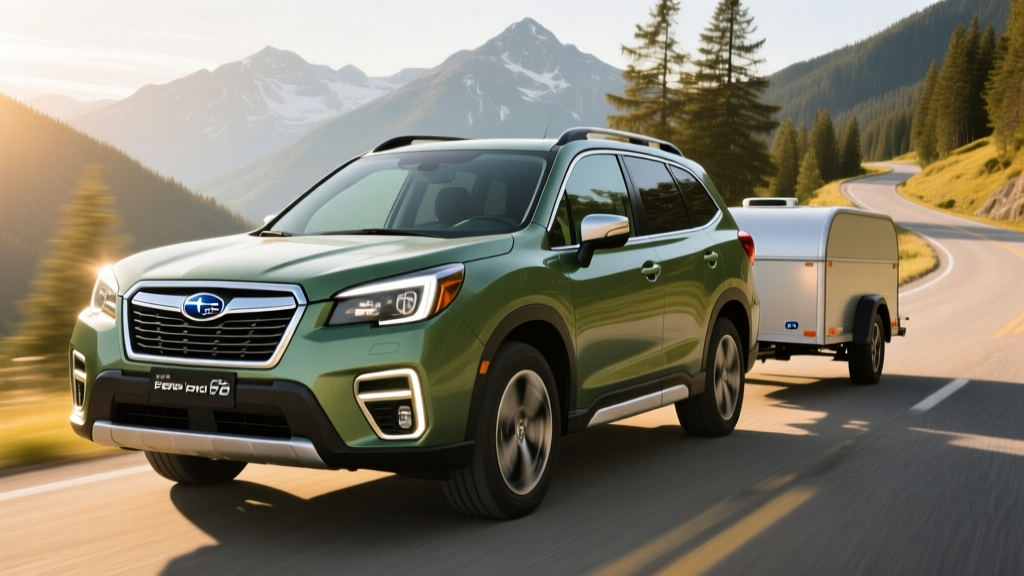
The 2026 Subaru Forester Hybrid pairs Subaru's 2.5-liter boxer engine with an electric motor for a combined 194 horsepower and an EPA-estimated 39 MPG combined. But for buyers specifically searching for Subaru Forester Hybrid towing capacity, the numbers require a careful look. The official maximum towing capacity is 1,500 pounds when properly equipped — identical to the outgoing gas-only Forester and competitive with rivals like the Honda CR-V Hybrid (1,500 lbs) and Toyota RAV4 Hybrid (1,750 lbs).
That 1,500-pound rating covers a small utility trailer, a pair of dirt bikes, or a lightweight pop-up camper. It does not cover a loaded boat trailer, a horse trailer, or a full-size travel camper. If you need 3,500+ pounds of tow rating, you'll need to look at a body-on-frame SUV or a truck — no compact hybrid crossover in this segment offers that.
HEV vs PHEV: Which Forester Hybrid Are We Talking About?
Subaru offers the 2026 Forester as a conventional hybrid (HEV) — not a plug-in hybrid (PHEV). This distinction matters for buyers cross-shopping electrified SUVs:
| Feature | Forester Hybrid (HEV) | Plug-In Hybrid (PHEV) Example: RAV4 Prime |
|---|---|---|
| Needs to plug in? | No — self-charging via regen + engine | Yes — plug in for EV-only miles |
| Electric-only range | N/A (motor assists engine only) | ~42 miles EV-only |
| Battery size | 1.1 kWh (small buffer) | 18.1 kWh usable |
| DC fast charging | No | No (Level 2 AC only) |
| Federal tax credit (§30D) | Not eligible | Not eligible (PHEV battery < 7 kWh threshold for new rules) |
| Best for | Drivers wanting MPG gains with zero behavior change | Drivers with home charging + short commutes |
The Forester Hybrid is a self-charging HEV. You never plug it in. The small 1.1 kWh battery recharges through regenerative braking and the gasoline engine. If you want electric-only commuting, the Forester Hybrid won't deliver that — you'd need a PHEV like the Toyota RAV4 Prime or a full BEV like the Hyundai Ioniq 5.
Powertrain, Horsepower & Towing Specs
| Spec | 2026 Subaru Forester Hybrid |
|---|---|
| Engine | 2.5L 4-cylinder boxer + electric motor |
| Combined horsepower | 194 hp |
| Drivetrain | Symmetrical AWD (standard) |
| Transmission | Lineartronic CVT |
| Towing capacity (max) | 1,500 lbs (properly equipped) |
| Hybrid battery | ~1.1 kWh (lithium-ion) |
| Cargo volume (behind rear seats) | 28.9 cu ft |
| Ground clearance | 8.7 inches |
| Base MSRP (Sport Hybrid trim) | $36,995 |
The 194 combined horsepower is a modest bump over the gas-only Forester's 180 hp. In practice, the electric motor's instant torque improves low-speed responsiveness — useful when merging onto highways or pulling away from a stop with a light trailer attached. The CVT keeps the engine in its most efficient band, and Subaru's standard Symmetrical AWD distributes power to all four wheels, which helps with trailer stability on wet or loose surfaces.
Towing equipment note: The 1,500-lb rating requires the factory-available trailer hitch receiver and a wiring harness. Subaru does not include a factory brake controller option — if your trailer has electric brakes (typically required above 1,000 lbs in many states), you'll need an aftermarket controller installed. Check your state's trailer-brake laws before hitching up.
Fuel Economy: EPA Ratings vs Real-World MPG
| Driving Condition | EPA Estimate | Real-World Expectation |
|---|---|---|
| City | 39 MPG | 37–41 MPG (hybrids often beat EPA in city) |
| Highway | 38 MPG | 34–37 MPG (aero drag + CVT drone at speed) |
| Combined | 39 MPG | 36–39 MPG |
| While towing (est.) | N/A | 22–28 MPG (trailer weight + drag) |
How many MPG does this hybrid get? The EPA rates the 2026 Forester Hybrid at 39 MPG combined — a meaningful improvement over the gas-only Forester's 29 MPG combined. That's roughly 34% better fuel economy in mixed driving.
In real-world driving, Subaru's hybrid system excels in city and suburban conditions where regenerative braking frequently recharges the small battery. Expect to match or slightly exceed the EPA city estimate in stop-and-go traffic. Highway MPG tends to drop below the sticker because the CVT holds the engine at higher RPMs at sustained speeds, and the boxy Forester shape creates more aerodynamic drag than sleeker crossovers.
While towing: Expect fuel economy to drop significantly — typically into the low-to-mid 20s MPG range depending on trailer weight, terrain, and wind. This is normal for any compact SUV towing near its max rating. The hybrid system provides a slight efficiency buffer compared to the gas-only model under load, but don't expect miracles.
Hybrid Battery Warranty, Lifespan & Replacement Cost
Battery Coverage at a Glance
- Hybrid battery warranty: 8 years / 100,000 miles (10 years / 150,000 miles in CARB states)
- Powertrain warranty: 5 years / 60,000 miles
- Bumper-to-bumper: 3 years / 36,000 miles
- Estimated out-of-warranty battery replacement: $2,500–$4,000 (based on comparable Subaru/Toyota hybrid packs)
Is the Forester Hybrid reliable? Subaru's hybrid system is closely related to Toyota's proven hybrid architecture (Subaru and Toyota share engineering through their corporate partnership). The hybrid battery pack is small (~1.1 kWh), which means fewer cells, less thermal stress, and historically lower failure rates compared to larger PHEV or BEV packs.
Toyota and Subaru hybrid batteries routinely last 150,000–200,000+ miles before significant degradation. The 8-year/100,000-mile warranty (extended to 10 years/150,000 miles in states that follow California Air Resources Board emissions rules, including CA, NY, MA, WA, CO, and others) provides strong coverage. If you plan to keep the Forester Hybrid for 10+ years, the battery will likely outlast other major components.
If replacement is needed outside warranty, expect to pay $2,500–$4,000 for a new or remanufactured hybrid battery pack plus labor — significantly less than a full EV battery replacement. Independent hybrid shops often offer remanufactured packs at the lower end of that range.
Pricing, Trims & Tax Credit Eligibility
The 2026 Subaru Forester Hybrid is available in Sport and Touring trims:
- Forester Hybrid Sport: $36,995 MSRP
- Forester Hybrid Touring: $41,995 MSRP
Federal tax credit (§30D): The Forester Hybrid does not qualify for the federal EV tax credit. Under current IRS §30D rules, the credit applies to plug-in electric vehicles (BEVs and qualifying PHEVs) with battery capacities of at least 7 kWh. The Forester Hybrid's ~1.1 kWh pack falls far below this threshold. There is no federal tax credit for conventional HEVs.
State incentives: A handful of states offer modest rebates or HOV-lane access for hybrids, but these programs vary widely and change frequently. Check your state's energy office or DMV website for current hybrid-specific incentives. Some states (like Colorado) offer tax credits that include hybrids, while most do not.
Who Should Choose the Forester Hybrid vs a Full EV or Gas Model?
Choose the Forester Hybrid If:
- You tow a light trailer (under 1,500 lbs) occasionally
- You want AWD and 8.7 inches of ground clearance for snow/dirt roads
- You can't charge at home (apartment, street parking)
- You want 39 MPG without changing any driving habits
- You drive in cold climates where EV range loss is a concern
Look Elsewhere If:
- You need to tow more than 1,500 lbs (look at trucks or a RAV4 Hybrid at 1,750 lbs)
- You want electric-only commuting (get a PHEV or BEV)
- You want the $7,500 federal tax credit (requires a qualifying BEV/PHEV)
- You drive mostly highway miles (the MPG advantage narrows)
Forester Hybrid vs Gas Forester: The hybrid costs roughly $3,000–$4,000 more than the equivalent gas trim. At 39 MPG vs 29 MPG combined, and assuming $3.50/gallon gas with 12,000 miles/year, the hybrid saves approximately $460/year in fuel. That means you'll recoup the premium in roughly 7–8 years — or sooner if gas prices rise. The hybrid also delivers smoother low-speed acceleration and quieter city driving.
Forester Hybrid vs a full EV (e.g., Hyundai Ioniq 5, Tesla Model Y): A BEV eliminates fuel costs entirely, offers faster acceleration, and qualifies for federal/state credits that can erase the price premium. But BEVs sacrifice the Forester's proven AWD system, 8.7-inch ground clearance, and worry-free cold-weather operation. If you regularly drive in sub-zero temperatures, tow even a light trailer, or lack reliable charging access, the Forester Hybrid is the more pragmatic choice.
Frequently Asked Questions
Can the Subaru Forester Hybrid tow a small camper?
Yes, but only lightweight pop-up campers or teardrop trailers under 1,500 pounds (including cargo and water). Most hard-sided travel campers exceed this rating. Always weigh your loaded trailer at a certified scale before towing.
Does the hybrid system reduce towing capacity compared to the gas Forester?
No. The 2026 Forester Hybrid maintains the same 1,500-lb towing rating as the gas-only model. The added hybrid system weight is offset by the electric motor's torque assist.
Do I need to plug in the Forester Hybrid?
No. The Forester Hybrid is a conventional HEV — it self-charges through regenerative braking and the gasoline engine. There is no plug, no charging cable, and no electric-only driving mode.
How does the Forester Hybrid compare to the Toyota RAV4 Hybrid for towing?
The Toyota RAV4 Hybrid has a slightly higher tow rating of 1,750 pounds — 250 lbs more than the Forester Hybrid. If you're consistently near the 1,500-lb limit, the RAV4 Hybrid's extra margin may be worthwhile. However, the Forester offers more ground clearance (8.7" vs 8.1") and standard AWD across all trims.
Will the hybrid battery need replacing during ownership?
Statistically, most owners will never need a hybrid battery replacement. Subaru's hybrid packs are designed to last 150,000+ miles, and the 8-year/100,000-mile warranty (10/150k in CARB states) covers premature failure. If replacement is needed out of warranty, expect $2,500–$4,000.
Does the Forester Hybrid qualify for any tax credit in 2026?
No federal tax credit applies to the Forester Hybrid under current IRS §30D rules, which require plug-in vehicles with 7+ kWh batteries. Some states may offer small hybrid rebates — check your state energy office for current programs.