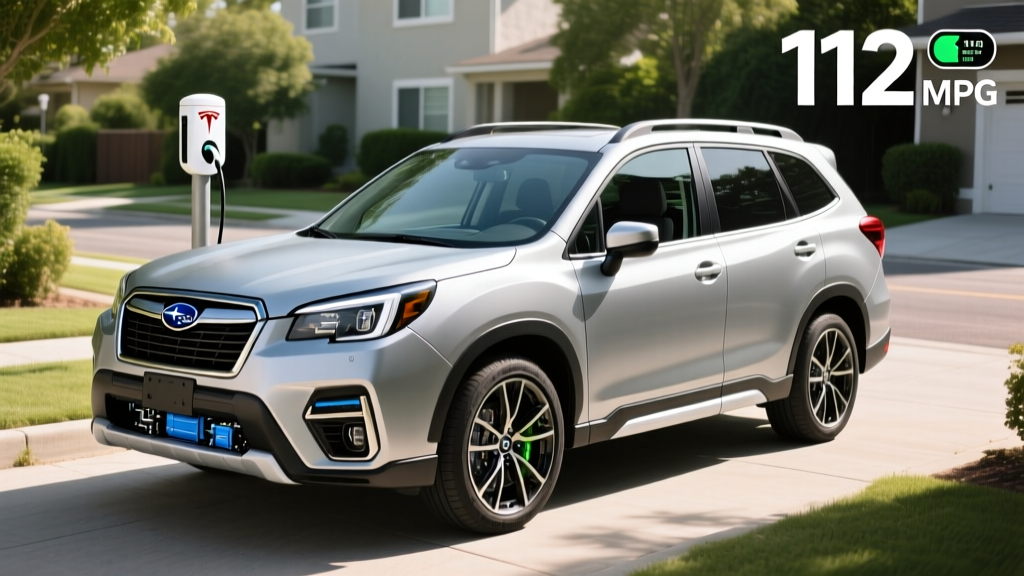
The 2026 Subaru Forester Hybrid Sport arrives as the first hybridized Forester in over a decade, slotting a 2.5-liter boxer-four paired with an electric motor into one of Subaru's best-selling crossovers. For buyers weighing the Subaru Forester Hybrid Sport against conventional gas models or full battery-electric SUVs, the numbers tell a specific story: 36 MPG combined, standard all-wheel drive, and zero changes to your fueling routine.
This guide covers the exact EPA figures, real-world fuel economy expectations, powertrain specs, hybrid battery longevity, and where the Forester Hybrid fits in the broader HEV vs. PHEV vs. EV decision.
2026 Subaru Forester Hybrid Sport: Quick Specs
| Specification | Detail |
|---|---|
| Powertrain | 2.5L Boxer-4 + Electric Motor (HEV) |
| Combined Horsepower | 194 hp |
| Drivetrain | Symmetrical AWD (standard) |
| EPA MPG (City / Hwy / Combined) | 36 / 33 / 35 |
| Transmission | Lineartronic CVT |
| Cargo Volume (rear seats up) | 28.9 cu ft |
| Ground Clearance | 8.7 in |
| Towing Capacity | 1,500 lbs |
| Starting MSRP (Sport trim) | $36,995 |
| Hybrid Battery Warranty | 8 years / 100,000 miles |
Fuel Economy: EPA Ratings vs. Real-World MPG
The EPA rates the 2026 Forester Hybrid at 36 city / 33 highway / 35 combined MPG, according to fueleconomy.gov. That represents a roughly 25% improvement over the non-hybrid 2026 Forester's 29 MPG combined, and it's one of the more efficient AWD compact crossovers on the market.
But EPA stickers only tell part of the story. In real-world driving, hybrid systems — particularly Toyota-derived architectures like the one Subaru uses under its partnership — tend to exceed EPA city estimates in stop-and-go traffic, where regenerative braking and electric-motor assist do the most work. On mixed suburban commutes with frequent stops, owners of similar Subaru/Toyota hybrid systems regularly report 37-39 MPG in city conditions.
Highway driving is where the advantage narrows. At sustained 70-80 MPH speeds, the electric motor contributes less, and the 2.5L boxer engine carries most of the load. Expect real-world highway numbers closer to 31-33 MPG, particularly in colder weather or with roof-rack accessories that increase drag. If your commute is 80% city, the Forester Hybrid Sport will reward you. If it's 80% interstate, the efficiency gap versus the gas Forester shrinks to roughly 4-5 MPG.
| Driving Scenario | EPA Estimate | Real-World Expectation |
|---|---|---|
| City (stop-and-go) | 36 MPG | 35-39 MPG |
| Highway (70-80 MPH) | 33 MPG | 31-33 MPG |
| Combined (mixed) | 35 MPG | 33-36 MPG |
| Cold weather (below 30°F) | — | 29-32 MPG combined |
HEV vs. PHEV vs. EV: Where the Forester Hybrid Fits
The 2026 Forester Hybrid Sport is a conventional hybrid (HEV), not a plug-in hybrid. This distinction matters because it determines how you fuel, what you can expect in electric-only driving, and whether you need home charging infrastructure.
| Feature | HEV (Forester Hybrid) | PHEV (e.g., Toyota RAV4 Prime) | Full EV (e.g., Hyundai Ioniq 5) |
|---|---|---|---|
| Plug in to charge? | No — gas only | Yes — optional plug-in | Yes — required |
| Electric-only range | Less than 1 mile at low speed | 35-42 miles typical | 250-320 miles (EPA) |
| Fueling | Gas station only | Gas station + Level 1/2 charger | Charger only (Level 1/2/DC) |
| Home charging needed? | No | Recommended for full benefit | Yes — Level 2 strongly recommended |
| Federal tax credit (§30D) | Not eligible | Up to $7,500 (varies) | Up to $7,500 (varies) |
| Best for | No home charging access; want simplicity | Home charging + short daily commute | Home charging + mostly electric driving |
The Forester Hybrid Sport makes the most sense for buyers who want better fuel economy without changing their refueling habits. You never plug it in. The small hybrid battery (roughly 1.1 kWh, nickel-metal hydride) charges through regenerative braking and the gasoline engine. If you live in an apartment without charging access, or you road-trip frequently through areas with sparse charging infrastructure, the HEV approach removes every barrier to improved efficiency.
If you do have access to a Level 2 home charger and your daily round-trip commute is under 35 miles, a PHEV like the Toyota RAV4 Prime or Subaru's own upcoming Crosstrek PHEV successor could let you drive most days on electricity alone while retaining the gas engine for longer trips. The Forester lineup does not currently offer a PHEV variant for 2026.
Powertrain: 194 HP With a Boxer-Electric Combo
Subaru's hybrid system pairs the familiar 2.5-liter FB25 horizontally opposed four-cylinder engine with an electric motor integrated into the Lineartronic CVT transmission. Combined output is 194 horsepower — a meaningful bump over the standard Forester's 180 hp.
The electric motor fills in torque at low RPMs, which improves off-the-line responsiveness in a way that the naturally aspirated gas engine alone cannot. Subaru's Symmetrical AWD remains standard, with the hybrid system distributing power through the same mechanical layout Forester owners expect. The result is a crossover that feels slightly quicker than its gas counterpart (0-60 MPH in roughly 8.0 seconds, versus approximately 8.6 for the non-hybrid) while returning significantly better fuel economy.
The hybrid battery pack is mounted beneath the rear cargo floor. Subaru has managed packaging well: cargo volume is virtually unchanged from the gas Forester at 28.9 cu ft behind the second row, and the spare tire is replaced by a tire repair kit — a common trade-off in hybrid conversions.
Pricing, Trims, and Tax Credit Eligibility
The 2026 Forester Hybrid Sport starts at an MSRP of $36,995, including destination. That positions it roughly $3,500 above the equivalent gas-powered Forester Sport. Additional trims may follow, but the Sport serves as the volume hybrid variant with features like 19-inch alloy wheels, a 11.6-inch infotainment touchscreen, wireless Apple CarPlay and Android Auto, and Subaru's EyeSight driver-assist suite as standard equipment.
Federal Tax Credit (§30D): Not Eligible. Conventional hybrids (HEVs) do not qualify for the IRS §30D Clean Vehicle Credit. That credit applies only to plug-in electric vehicles (PHEVs and BEVs) meeting specific battery-sourcing, MSRP, and buyer income requirements. The Forester Hybrid Sport, as a non-plug-in hybrid, is ineligible regardless of buyer income. Some states may offer small rebates for hybrid purchases — check your state energy office for current programs. For the latest §30D rules, refer to IRS.gov.
The $3,500 hybrid premium pays for itself in fuel savings relatively quickly. At 15,000 miles per year and $3.40/gallon regular unleaded, the gas Forester (29 MPG combined) costs approximately $1,759 annually in fuel. The Forester Hybrid (35 MPG combined) costs roughly $1,457 — a savings of about $302 per year, or roughly $1,510 over five years. The premium isn't fully offset by fuel alone, but the improved acceleration, lower emissions, and potentially higher resale value narrow the gap.
Hybrid Battery Reliability, Warranty, and Replacement Cost
Hybrid battery longevity is the single most common concern among first-time hybrid buyers, and it's a fair one given that traction-battery replacement is one of the most expensive repairs on any electrified vehicle.
Subaru warranties the Forester Hybrid's battery pack for 8 years or 100,000 miles (whichever comes first), which aligns with the industry standard for hybrid systems and meets the minimum requirement under federal emissions warranty rules. In states that follow California Air Resources Board (CARB) standards — including California, New York, Massachusetts, and several others — hybrid battery coverage extends to 10 years or 150,000 miles.
The Forester Hybrid uses a nickel-metal hydride (NiMH) battery pack, a chemistry with a long track record in Toyota and Subaru hybrid applications. NiMH batteries degrade more slowly and predictably than the lithium-ion packs in PHEVs and full EVs. Data from Toyota's long-running hybrid lineup (which shares architecture with Subaru's system) shows that most NiMH hybrid packs retain functional capacity well beyond 150,000 miles. Complete failure before 100,000 miles is uncommon.
If replacement is needed out of warranty, expect a cost in the range of $2,000 to $4,000 for a new or remanufactured hybrid battery pack, including labor. This is significantly less than the $8,000-$20,000+ replacement costs for large lithium-ion packs in full EVs. Independent hybrid-battery specialists also offer cell-level repair for $500-$1,500 in many metro areas, replacing only the degraded cells rather than the entire pack.
Who Should Choose the Forester Hybrid Sport?
Pros
- 35 MPG combined with standard AWD — rare in the compact SUV segment
- No charging infrastructure required; fuel normally at any gas station
- 194 hp offers noticeably better acceleration than the gas Forester
- Full EyeSight safety suite standard (AEB, adaptive cruise, lane centering)
- 8.7 inches of ground clearance retains genuine trail capability
- 8-year / 100,000-mile hybrid battery warranty (10/150k in CARB states)
Cons
- $3,500 hybrid premium over gas Forester Sport is only partially offset by fuel savings
- Not eligible for the $7,500 federal §30D tax credit (HEV, not PHEV)
- No electric-only driving range — cannot operate as an EV for short trips
- Towing capacity limited to 1,500 lbs (same as gas model)
- Tire repair kit replaces spare tire
Choose the Forester Hybrid Sport if: you want better fuel economy and slightly more power without altering your refueling routine. It's ideal for apartment dwellers without charging access, frequent road-trippers who don't want to plan around charging stations, and Subaru loyalists who want AWD efficiency in cold-weather climates.
Consider a PHEV or full EV instead if: you have access to Level 2 home charging and want to drive on electricity for daily commutes. A PHEV like the Toyota RAV4 Prime (42 miles electric-only, eligible for up to $7,500 in federal credits) or a full EV like the Hyundai Ioniq 5 or Subaru Solterra could deliver far lower per-mile energy costs — but they require a charging setup at home to realize their full benefit.
Frequently Asked Questions
How many MPG does the 2026 Subaru Forester Hybrid Sport get?
The EPA rates it at 36 city / 33 highway / 35 combined MPG. Real-world driving typically falls between 33-36 MPG combined, with city driving often exceeding the 36 MPG sticker thanks to regenerative braking.
Does the Forester Hybrid need to be plugged in?
No. The Forester Hybrid Sport is a conventional hybrid (HEV). It charges its small battery through regenerative braking and the gasoline engine. You fuel it exclusively at gas stations, like any non-hybrid car.
Can the Forester Hybrid drive on electric power alone?
Only at very low speeds (under ~15 MPH) for very short distances (a few hundred yards). It does not offer meaningful electric-only range. This is a key difference from plug-in hybrids (PHEVs), which can travel 25-42 miles on electricity alone.
Does the 2026 Forester Hybrid qualify for a federal tax credit?
No. The IRS §30D Clean Vehicle Credit applies only to plug-in electric vehicles (PHEVs and BEVs). Conventional hybrids like the Forester Hybrid Sport are not eligible. Some state-level programs may offer small incentives — check your local energy office.
How long will the Forester Hybrid battery last, and what does replacement cost?
Subaru warranties the hybrid battery for 8 years / 100,000 miles (10 years / 150,000 miles in CARB states). Based on long-term data from similar Toyota/Subaru NiMH hybrid systems, most packs last well beyond 150,000 miles. Out-of-warranty replacement runs $2,000-$4,000 for a new or remanufactured pack.
Is the Forester Hybrid Sport faster than the gas Forester?
Yes, modestly. The hybrid system's combined 194 hp and electric-motor torque fill give it a 0-60 MPH time of approximately 8.0 seconds, compared to roughly 8.6 seconds for the 180-hp gas model. The difference is most noticeable in city acceleration and highway merging.
How does the Forester Hybrid compare to the Toyota RAV4 Hybrid?
The RAV4 Hybrid (39 MPG combined, 219 hp) offers slightly better fuel economy and more power, but does not come with Subaru's standard Symmetrical AWD system in the same mechanical configuration or the Forester's 8.7 inches of ground clearance. If off-pavement capability and Subaru's AWD reputation are priorities, the Forester Hybrid holds its own. If maximum MPG and power are the top criteria, the RAV4 Hybrid edges ahead on paper. Both share hybrid architecture through the Toyota-Subaru partnership.