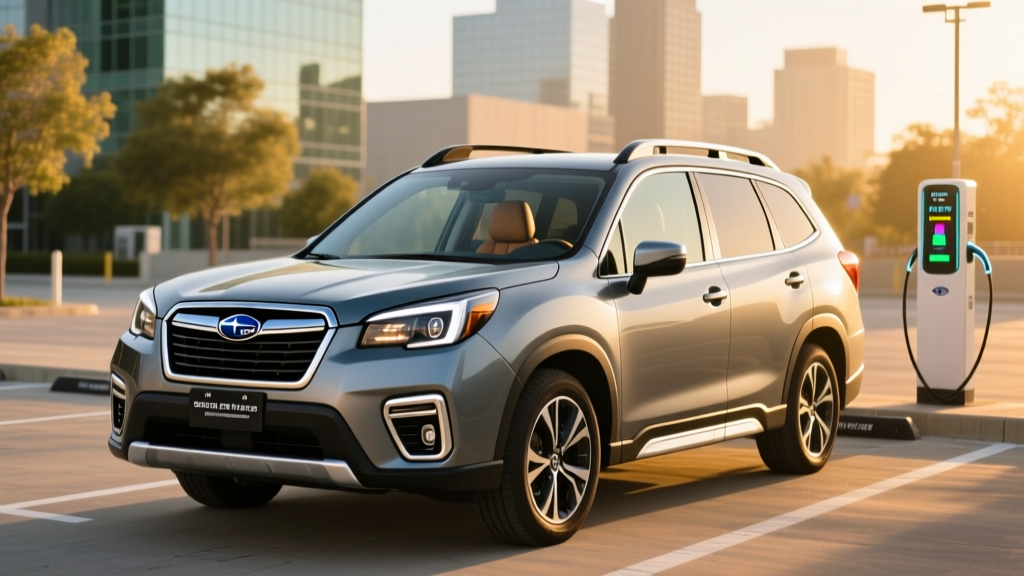
The Subaru Forester has long been the go-to compact SUV for outdoorsy drivers who need standard all-wheel drive, solid visibility, and practical cargo space. For 2026, Subaru finally brings a hybrid powertrain back to the Forester lineup after a multi-year hiatus, pairing its proven 2.5-liter boxer engine with an electric motor integrated into a revised continuously variable transmission (CVT). If you've been searching for detailed Subaru Forester Hybrid specs, this guide covers everything from EPA fuel economy to battery warranty, pricing, and how this hybrid stacks up against plug-in and full-electric alternatives.
HEV vs PHEV: What the 2026 Forester Hybrid Actually Is
Before examining the numbers, it's critical to clarify what Subaru is offering. The 2026 Forester Hybrid is a conventional hybrid electric vehicle (HEV) — not a plug-in hybrid (PHEV). That distinction matters enormously for your expectations around electric-only driving, charging, and tax credits.
| Feature | 2026 Forester Hybrid (HEV) | Typical PHEV SUV (e.g., Toyota RAV4 Prime) |
|---|---|---|
| Plugs in to charge? | No — self-charging via regenerative braking and engine | Yes — 120V or 240V outlet |
| Electric-only range | Less than 1 mile at low speeds | 35–42 miles typical |
| Battery size | ~1.1 kWh (small buffer pack) | 18.1 kWh usable |
| Federal tax credit (§30D) | Not eligible | Up to $7,500 (subject to sourcing/income rules) |
| Primary benefit | Improved MPG, no lifestyle change | Electric commute + gas road trips |
The Forester Hybrid's small battery pack charges itself through regenerative braking and the gasoline engine. You never plug it in. The electric motor assists during acceleration and enables brief low-speed electric-only movement (think: creeping through a parking lot), but this is fundamentally a fuel-economy improvement over the gas-only Forester, not an electric vehicle in disguise.
Fuel Economy: EPA MPG and Real-World Expectations
The headline number for the 2026 Forester Hybrid is a significant improvement over the standard 2.5L gas model. Here's the full EPA breakdown according to fueleconomy.gov:
| Driving Cycle | Forester Hybrid (HEV) | Forester Gas (2.5L AWD) |
|---|---|---|
| City | 35 MPG | 26 MPG |
| Highway | 34 MPG | 33 MPG |
| Combined | 35 MPG | 29 MPG |
The 6 MPG combined improvement is substantial — roughly a 20% gain in fuel efficiency. The city driving improvement is the most dramatic: 35 vs 26 MPG, a 35% jump. This is characteristic of conventional hybrids, which recapture energy during stop-and-go driving through regenerative braking and allow the engine to shut off at stops.
Real-World MPG: What to Actually Expect
Hybrids routinely exceed their EPA city estimates in real-world driving because regenerative braking is most effective in traffic. On the highway, where regen opportunities are limited and aerodynamic drag dominates, real-world MPG tends to align closely with — or slightly below — the EPA highway figure.
Based on owner-reported data and the physics of the powertrain, expect:
- City/suburban driving: 35–38 MPG (regen-heavy routes can push higher)
- Highway cruising (70–75 mph): 31–34 MPG
- Cold weather (below 30°F): 30–33 MPG combined (engine runs more often for cabin heat and battery warming)
- Towing or heavy cargo: 25–28 MPG (the Forester Hybrid is rated for 1,500 lbs towing)
If your commute is predominantly stoplight-to-stoplight suburban driving, the Forester Hybrid will reward you with numbers at or above the EPA sticker. Highway-dominant commuters will see a smaller gap versus the gas model.
Powertrain Specs: Horsepower, Engine, and Motor Details
The 2026 Forester Hybrid uses a parallel hybrid architecture — the electric motor sits between the engine and the transmission, able to drive the wheels independently at low speeds or augment engine power during acceleration.
| Specification | Detail |
|---|---|
| Engine | 2.5L DOHC 4-cylinder boxer (FB25) |
| Engine output | 180 hp / 178 lb-ft torque |
| Electric motor output | 19 kW (25 hp) / 49 lb-ft torque |
| Combined system output | 194 hp |
| Transmission | Lineartronic CVT with hybrid integration |
| Drivetrain | Symmetrical All-Wheel Drive (standard) |
| Hybrid battery | ~1.1 kWh, lithium-ion |
| 0–60 mph (est.) | ~8.2 seconds |
| Towing capacity | 1,500 lbs |
The 14-horsepower bump over the gas-only Forester (180 hp combined from engine alone) is modest, but the electric motor's instant torque fill at low RPMs makes the hybrid feel noticeably more responsive from a stop. The CVT has been recalibrated to work with the hybrid system's torque characteristics, reducing the rubber-band sensation common in earlier Subaru CVTs.
Subaru's Symmetrical AWD remains standard — the hybrid system does not eliminate or compromise it. Power distribution between front and rear axles is managed electronically, with the hybrid battery and motor adding roughly 150 lbs to the vehicle's curb weight versus the gas model.
Pricing, Trims, and Tax Credit Eligibility
The 2026 Forester Hybrid is offered across three trims, slotting into the middle-to-upper range of the Forester lineup:
| Trim | MSRP (incl. destination) | Key Features |
|---|---|---|
| Sport Hybrid | $35,495 | SI-Drive, 18" alloy wheels, dual-zone climate, EyeSight |
| Limited Hybrid | $38,995 | Leather, power liftgate, heated front seats, 8" Starlink |
| Touring Hybrid | $42,495 | Nappa leather, Harman Kardon audio, ventilated seats, 12.3" cluster |
Federal Tax Credit Status
The 2026 Forester Hybrid does not qualify for the IRS §30D New Clean Vehicle Credit. Under current IRS rules, the §30D credit applies only to plug-in electric vehicles (BEVs and PHEVs) with battery capacities of at least 7 kWh. The Forester Hybrid's ~1.1 kWh pack falls well below that threshold.
This is the trade-off of a conventional hybrid: simpler ownership with no charging infrastructure needs, but no federal purchase incentive. Some states and utilities offer modest rebates for HEVs — check your local programs — but these are typically $250–$500, not the $7,500 available to qualifying PHEVs and BEVs.
Battery Warranty, Lifespan, and Replacement Cost
Hybrid battery longevity is consistently the top concern among first-time hybrid buyers. Subaru backs the Forester Hybrid's battery with a comprehensive warranty:
Subaru Hybrid Battery Warranty
- Duration: 8 years / 100,000 miles (whichever comes first)
- Coverage: Defects and capacity loss below functional threshold
- Extended in CARB states: 10 years / 150,000 miles in states that follow California Air Resources Board emissions standards (CA, CO, CT, DE, ME, MD, MA, NJ, NM, NY, OR, RI, VT, VA, WA, DC)
- Hybrid system components: Inverter, motor, and control modules covered under same warranty terms
Expected Battery Lifespan
Modern lithium-ion hybrid batteries in the 1–2 kWh range experience far less stress than large EV packs because they operate within a narrow state-of-charge window (typically 40–80% SoC). The battery never fully charges or fully depletes, which dramatically slows degradation.
Based on longevity data from Toyota's hybrid fleet (which uses similar architecture) and Subaru's own hybrid history in the Crosstrek and Outback, expect the Forester Hybrid battery to last 150,000–200,000+ miles before any meaningful capacity loss. Many hybrid batteries outlast the vehicles they're installed in.
Replacement Cost If Needed
If the hybrid battery does require replacement outside of warranty:
- OEM battery pack: $2,000–$3,500 (part only)
- Installed at dealer: $3,000–$4,500 (part + labor)
- Refurbished/aftermarket: $1,200–$2,000 installed
Compared to full EV battery replacements ($8,000–$20,000+), hybrid battery replacement is relatively affordable — and far less likely to be needed within the vehicle's normal service life.
Reliability and Ownership Track Record
Subaru's hybrid system has been in production since 2019 (first in the Crosstrek Hybrid PHEV, then in global-market models). The 2.5L FB25 boxer engine is one of Subaru's most thoroughly proven powerplants, with over a decade of refinement.
Key reliability considerations:
- Hybrid system: Low complexity relative to turbocharged or multi-clutch transmissions. The electric motor has no brushes or wear items. The CVT is a mature design.
- Brakes: Regenerative braking reduces friction brake wear significantly. Expect brake pad life of 60,000–80,000+ miles.
- Maintenance: Standard oil changes, coolant service, and CVT fluid inspection. No special hybrid-system maintenance required.
- IIHS safety: The Forester platform has historically earned Top Safety Pick+ ratings. Check IIHS for updated 2026 crash-test results once published.
Who Should Choose the Forester Hybrid vs. a PHEV or Full EV?
Choose the Forester Hybrid (HEV) If:
- You can't charge at home (apartment, street parking, no garage)
- You want better MPG without changing any habits — no plugging in, no route planning
- You regularly drive in remote/rural areas with limited charging infrastructure
- You need standard AWD for snow, mud, or trail access
- Your budget is $35K–$42K and you don't want the PHEV premium
Consider a PHEV or Full EV Instead If:
- You can install a Level 2 charger at home and have a short commute (<40 miles)
- You want to drive on electricity daily and only use gas for road trips
- You want to qualify for the $7,500 federal tax credit (check §30D eligibility)
- You prioritize minimizing tailpipe emissions in your daily driving
- You drive primarily in the city where EV-mode efficiency dominates
Quick Decision Framework
Forester Hybrid (HEV): Best for drivers who want a simple, no-compromise fuel-economy upgrade. You gain ~6 MPG combined without plugging in, changing routines, or worrying about charging access. Ideal for rural owners, apartment dwellers, and cold-climate drivers where EV range loss is a concern.
PHEV alternative (e.g., Toyota RAV4 Prime): Best for home-chargers with commutes under 40 miles. You drive electric daily, use gas only on long trips, and may qualify for the $7,500 credit — effectively making the PHEV cheaper than the hybrid after incentives.
Full EV (e.g., Hyundai Ioniq 5, Tesla Model Y): Best for committed home-chargers who want zero tailpipe emissions, the lowest per-mile fuel cost, and minimal maintenance. Trade-off: you need to plan around charging on road trips and accept cold-weather range reduction.
Forester Hybrid vs. Competitors at a Glance
| Model | Type | Combined MPG | AWD | Starting MSRP | §30D Credit |
|---|---|---|---|---|---|
| Subaru Forester Hybrid | HEV | 35 MPG | Standard | $35,495 | No |
| Toyota RAV4 Hybrid | HEV | 39 MPG | Standard | $33,575 | No |
| Toyota RAV4 Prime | PHEV | 94 MPGe / 38 MPG gas | Standard | $44,590 | Up to $7,500 |
| Honda CR-V Hybrid | HEV | 37 MPG | Available | $35,395 | No |
| Ford Escape PHEV | PHEV | 105 MPGe / 40 MPG gas | No (FWD only) | $40,500 | Up to $7,500 |
The Forester Hybrid trades a few MPG to the RAV4 Hybrid and CR-V Hybrid in exchange for Subaru's standard Symmetrical AWD (vs. Toyota's electronic on-demand AWD and Honda's available AWD), best-in-class outward visibility, and 9.2 inches of ground clearance for light off-road capability. If AWD performance in snow and mud is a priority, the Forester's system is the most robust in this segment.
Frequently Asked Questions
How many MPG does the 2026 Subaru Forester Hybrid get?
The EPA rates the 2026 Forester Hybrid at 35 MPG city, 34 MPG highway, and 35 MPG combined. Real-world city driving often yields 35–38 MPG thanks to regenerative braking. Highway-only driving at 70+ mph typically returns 31–34 MPG.
Can the Forester Hybrid drive on electric power alone?
Only at very low speeds (under ~20 mph) for brief distances — such as creeping through a parking lot or stop-and-go traffic. The ~1.1 kWh battery doesn't store enough energy for meaningful electric-only range. This is a conventional hybrid, not a plug-in.
Does the 2026 Forester Hybrid qualify for a federal tax credit?
No. The IRS §30D New Clean Vehicle Credit requires a minimum battery capacity of 7 kWh and plug-in capability. The Forester Hybrid's ~1.1 kWh pack doesn't qualify. Only PHEVs and full BEVs are eligible. Check IRS guidelines for current eligibility rules.
How long will the hybrid battery last?
Subaru warrants the hybrid battery for 8 years/100,000 miles (10 years/150,000 miles in CARB states). Real-world data from similar hybrid systems suggests 150,000–200,000+ miles of service life is typical. Replacement, if ever needed, costs roughly $3,000–$4,500 installed.
Is the Forester Hybrid slower than the gas model?
No — it's marginally quicker. The combined 194 hp (vs. 180 hp for the gas model) and the electric motor's instant low-RPM torque give the hybrid better off-the-line acceleration. Expect 0–60 mph in approximately 8.2 seconds, roughly 0.5 seconds quicker than the gas-only Forester.
Does the hybrid system affect cargo space or ground clearance?
Subaru packages the hybrid battery beneath the rear cargo floor. Cargo volume remains competitive at approximately 28.9 cubic feet behind the rear seats and 74.4 cubic feet with seats folded — within 1–2 cubic feet of the gas model. Ground clearance stays at 9.2 inches.
Do I need to change how I drive or fuel the Forester Hybrid?
No. You fuel it with regular 87-octane gasoline at any station. The hybrid system operates automatically — there are no modes to select, no plugs to connect, and no special maintenance. The only "change" is stopping at the gas station less often.