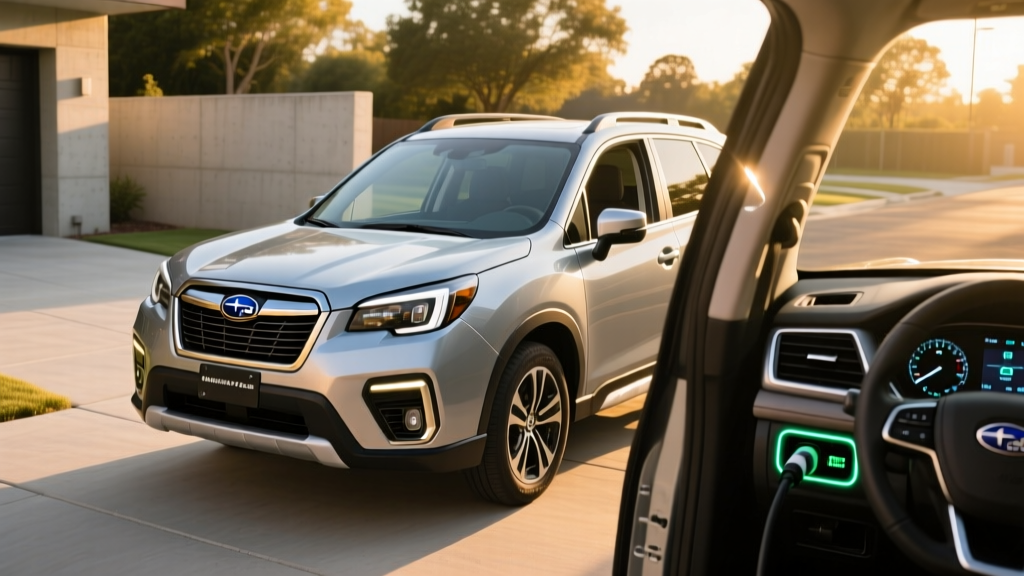
Subaru reintroduced the Forester Hybrid for the 2025 model year after a multi-year hiatus, and the 2026 version carries forward with meaningful updates to its series-parallel hybrid system. For buyers who want Subaru's signature symmetrical all-wheel drive, 8.7 inches of ground clearance, and genuine off-road capability without the fuel-economy penalty of a traditional compact SUV, the Forester Hybrid makes a compelling case. This is a conventional hybrid (HEV) — not a plug-in — so there's no charging cable, no electric-only range to manage, and no range anxiety. You simply fill up with gas and drive.
But how does the real-world fuel economy stack up against the EPA sticker? Is the hybrid premium worth it over the standard gas Forester? And does it qualify for any federal tax credits? We break down every number that matters.
2026 Subaru Forester Hybrid: Fuel Economy and EPA Ratings
The headline number for the 2026 Forester Hybrid is an EPA-estimated 39 MPG combined. Subaru achieves this through a series-parallel hybrid architecture that pairs a 2.5-liter horizontally opposed (Boxer) four-cylinder engine with an electric motor integrated into the Lineartronic CVT transmission. Here's the full EPA breakdown:
| Metric | EPA Estimate |
|---|---|
| City MPG | 40 MPG |
| Highway MPG | 37 MPG |
| Combined MPG | 39 MPG |
| Fuel Tank Capacity | 13.2 gallons |
| Total Estimated Range | ~515 miles |
Source: fueleconomy.gov
Notice that the city MPG actually exceeds the highway number — this is typical of series-parallel hybrids. The electric motor handles low-speed propulsion and stop-and-go traffic where the regenerative braking system recovers the most energy. On the highway, the gas engine does more of the work at sustained speeds, which is why the highway figure dips slightly.
Real-World MPG: What to Actually Expect
EPA estimates are measured on a dynamometer under controlled conditions. In real-world driving, your mileage will vary based on terrain, temperature, and driving style. Based on owner reports and independent testing for the Forester Hybrid platform:
- City and suburban driving: 38–42 MPG. Hybrids often exceed their EPA city estimate in stop-and-go traffic because regenerative braking recovers energy that a gas-only vehicle wastes as heat.
- Highway cruising (70–75 mph): 33–36 MPG. Aerodynamic drag increases exponentially at higher speeds, and the 2.5L Boxer engine works harder to maintain velocity. Expect this if most of your driving is interstate.
- Cold weather (below 32°F): 32–35 MPG combined. The engine runs more frequently to generate cabin heat and keep the catalytic converter warm, reducing the electric motor's contribution.
- Mixed daily driving (commute + errands): 36–39 MPG. This is where most owners land and aligns closely with the EPA combined figure.
Compared to the standard 2026 gas-only Forester (EPA 26 city / 33 highway / 29 combined), the hybrid delivers roughly a 34% improvement in combined fuel economy. Over 15,000 miles per year at $3.50/gallon, that's approximately $700–$800 in annual fuel savings.
Hybrid Powertrain: Specs and How It Works
The 2026 Forester Hybrid uses a series-parallel hybrid system — fundamentally different from a plug-in hybrid (PHEV) or a fully electric vehicle. Here's how the components break down:
| Component | Specification |
|---|---|
| Engine | 2.5L DOHC Boxer 4-cylinder |
| Engine Power | 163 hp |
| Electric Motor | Integrated in CVT (e-Boxer system) |
| Electric Motor Power | ~26 hp (19.4 kW) |
| Combined System Output | ~194 hp |
| Transmission | Lineartronic CVT |
| Drivetrain | Symmetrical All-Wheel Drive (standard) |
| Hybrid Battery | ~1.1 kWh lithium-ion (self-charging) |
| 0–60 mph | ~7.9 seconds (est.) |
| Towing Capacity | 1,500 lbs |
The e-Boxer system automatically manages the split between engine and electric motor. At low speeds and light loads, the electric motor can propel the vehicle short distances (typically under 1 mile at speeds below 25 mph). During acceleration, both the engine and motor work together. During deceleration and braking, the motor acts as a generator to recharge the small hybrid battery.
The Forester Hybrid is a conventional hybrid (HEV). It has a small battery (~1.1 kWh) that charges itself through regenerative braking and the gas engine. You never plug it in. A plug-in hybrid (PHEV) has a much larger battery (typically 10–20+ kWh) that you charge from a wall outlet or public charger, enabling 20–40 miles of pure electric driving before the gas engine kicks in. Subaru does not currently offer a Forester PHEV in the US market. If you want plug-in capability from Subaru, you'd need to look at the outgoing Crosstrek PHEV (discontinued) or consider competitors like the Toyota RAV4 Prime.
Pricing, Trims, and Tax Credit Eligibility
The 2026 Subaru Forester Hybrid is available across multiple trim levels, with the hybrid powertrain adding a premium over the equivalent gas-only model. Here's the pricing landscape:
| Trim | MSRP (est.) | Hybrid Premium vs. Gas |
|---|---|---|
| Hybrid Premium | ~$34,500 | +$2,500 |
| Hybrid Sport | ~$37,000 | +$2,500 |
| Hybrid Limited | ~$39,500 | +$2,500 |
| Hybrid Touring | ~$42,000 | +$2,500 |
Prices include destination charge. Actual dealer pricing may vary.
Federal Tax Credit: Does the Forester Hybrid Qualify?
No. Under current IRS §30D rules, the federal Clean Vehicle Credit (up to $7,500) applies only to plug-in electric vehicles — battery-electric vehicles (BEVs) and plug-in hybrids (PHEVs) with a minimum battery capacity of 7 kWh. Because the Forester Hybrid is a conventional HEV with a ~1.1 kWh battery, it does not qualify for the federal EV tax credit.
However, hybrid buyers should check:
- State-level incentives: Some states offer rebates or HOV lane access for hybrid vehicles. California, Colorado, and a few others have had hybrid incentive programs, though most have shifted focus to BEVs and PHEVs.
- Employer or utility programs: Some employers and electric utilities offer purchase incentives for any electrified vehicle, including conventional hybrids.
- Fuel savings payback: At ~$750/year in fuel savings over the gas model, the ~$2,500 hybrid premium pays for itself in roughly 3.3 years — before accounting for potentially higher resale value.
For the latest on federal incentive rules, consult the IRS Clean Vehicle Credits page.
Reliability, Battery Warranty, and Long-Term Ownership
Hybrid battery longevity is the number-one concern for first-time hybrid buyers. Here's what Subaru provides and what real-world data shows:
- Hybrid Battery Warranty: 8 years / 100,000 miles (whichever comes first)
- Hybrid System Components: 8 years / 100,000 miles
- Powertrain Warranty: 5 years / 60,000 miles
- Basic Vehicle Warranty: 3 years / 36,000 miles
In California-emissions states (CA, CT, MA, ME, NJ, NY, OR, RI, VT, WA), hybrid battery coverage extends to 10 years / 150,000 miles under PZEV provisions.
Real-World Hybrid Battery Durability
Subaru's hybrid battery pack is small (~1.1 kWh) and operates within a narrow state-of-charge window — typically between 40% and 80%. This shallow cycling dramatically reduces degradation compared to a full EV battery that regularly cycles from 10% to 90%. Toyota and Subaru hybrid systems have demonstrated strong long-term reliability, with many hybrid batteries lasting 150,000–200,000+ miles before significant capacity loss.
If replacement is eventually needed, a Forester Hybrid battery pack is estimated at $2,000–$3,500 (parts and labor) based on current hybrid battery pricing across the Subaru/Toyota platform. This is significantly less than a full EV battery replacement ($8,000–$20,000+) because the pack is small and the chemistry is less exotic.
General Reliability Outlook
The 2026 Forester Hybrid benefits from Subaru's mature e-Boxer hybrid technology, which shares engineering DNA with Toyota's hybrid systems through the companies' partnership. The 2.5L FB25 Boxer engine is well-proven across the Subaru lineup. The CVT transmission has been refined over multiple generations. Safety ratings remain a strong point — the Forester platform has historically earned IIHS Top Safety Pick awards and 5-star NHTSA ratings.
Forester Hybrid vs. Competitors: How It Stacks Up
The compact hybrid SUV segment is competitive. Here's how the Forester Hybrid compares to key rivals:
| Model | Combined MPG | AWD Standard? | Combined HP | Starting MSRP |
|---|---|---|---|---|
| Subaru Forester Hybrid | 39 MPG | Yes | ~194 hp | ~$34,500 |
| Toyota RAV4 Hybrid | 39 MPG | Yes | 219 hp | ~$33,500 |
| Honda CR-V Hybrid | 37 MPG | Yes (Sport trims) | 204 hp | ~$35,000 |
| Hyundai Tucson Hybrid | 37 MPG | Yes | 226 hp | ~$34,000 |
| Ford Escape Hybrid | 39 MPG | Optional | 210 hp | ~$34,500 |
The Forester Hybrid ties the RAV4 Hybrid at the top of the segment for fuel economy while offering more ground clearance (8.7 inches vs. 8.1 on the RAV4) and superior outward visibility thanks to its taller greenhouse. Where it falls short is acceleration — the RAV4 Hybrid's 219 hp gives it a meaningful edge in passing power and 0–60 times.
Who Should Buy the Forester Hybrid — and Who Shouldn't
Choose the Forester Hybrid If:
- You want AWD and off-road capability without sacrificing fuel economy
- You don't have access to home or workplace charging (no plug needed)
- You drive 12,000–20,000 miles per year and want to reduce fuel costs
- You value outward visibility, cargo space (28.9 cu ft behind rear seats), and a commanding ride height
- You live in a snowy or rugged-climate region where ground clearance and AWD matter daily
- You want hybrid efficiency but aren't ready to commit to a full EV or PHEV
Consider Something Else If:
- You want electric-only driving for short commutes — look at a PHEV like the Toyota RAV4 Prime (42 mi electric range)
- You want maximum acceleration — the RAV4 Hybrid (219 hp) or Tucson Hybrid (226 hp) are quicker
- You want to qualify for the $7,500 federal tax credit — you need a BEV or PHEV
- You primarily drive long highway miles — the hybrid advantage shrinks on sustained interstate driving
- You need more than 1,500 lbs of towing capacity — consider a larger SUV or truck
Hybrid vs. PHEV vs. EV: Which Is Right for You?
Choosing between a conventional hybrid, plug-in hybrid, and full electric vehicle comes down to your charging access, driving patterns, and budget. Here's a practical framework:
| Factor | HEV (Forester Hybrid) | PHEV (e.g., RAV4 Prime) | BEV (e.g., Ioniq 5) |
|---|---|---|---|
| Plug-in Required? | No | Yes (for max benefit) | Yes |
| Electric-Only Range | None (assist only) | 25–42 miles | 250–350+ miles |
| Home Charging Needed? | No | Recommended | Essential |
| Federal Tax Credit | None | Up to $7,500* | Up to $7,500* |
| Best For | No charging access, long trips | Home charging + short commute | Home charging, daily driving |
| Fuel Cost (per mile) | ~$0.09 | ~$0.04 (electric) / ~$0.09 (gas) | ~$0.04 |
| Maintenance | Standard (oil changes) | Standard (oil changes) | Minimal (no oil changes) |
* Federal tax credit eligibility depends on MSRP caps, buyer income limits, battery sourcing requirements, and point-of-sale transfer rules under IRS §30D. Verify current eligibility at irs.gov.
Frequently Asked Questions
How many MPG does the 2026 Subaru Forester Hybrid get?
The EPA rates the Forester Hybrid at 40 MPG city, 37 MPG highway, and 39 MPG combined. In real-world driving, expect 36–42 MPG depending on your mix of city and highway driving. Cold weather and sustained high-speed highway driving will reduce these numbers.
Does the Subaru Forester Hybrid need to be plugged in?
No. The Forester Hybrid is a conventional hybrid (HEV). Its small battery charges through regenerative braking and the gas engine. You never plug it in — just fill up at the gas station like any other car.
Is the Forester Hybrid reliable? What about battery replacement cost?
Subaru's e-Boxer hybrid system is proven technology shared with Toyota's hybrid platform. The hybrid battery is covered by an 8-year/100,000-mile warranty (10 years/150,000 miles in CARB states). Based on industry data, hybrid batteries of this size commonly last 150,000–200,000+ miles. If replacement is needed, expect $2,000–$3,500.
Does the Forester Hybrid qualify for any federal tax credit?
No. The federal §30D Clean Vehicle Credit requires a plug-in vehicle with a minimum 7 kWh battery. The Forester Hybrid's ~1.1 kWh battery does not qualify. Check your state's incentive programs for possible hybrid rebates.
How does the Forester Hybrid compare to the RAV4 Hybrid?
Both achieve 39 MPG combined with standard AWD. The Forester Hybrid offers more ground clearance (8.7 vs. 8.1 inches), better outward visibility, and Subaru's X-Mode for off-road traction. The RAV4 Hybrid offers more horsepower (219 vs. ~194), a slightly lower starting price, and a PHEV variant (RAV4 Prime) if you want plug-in capability.
Can I tow with the Forester Hybrid?
Yes, but capacity is limited to 1,500 pounds — enough for a small utility trailer, bike rack, or lightweight pop-up camper. If you need more towing capacity, you'll need to look at larger SUVs.