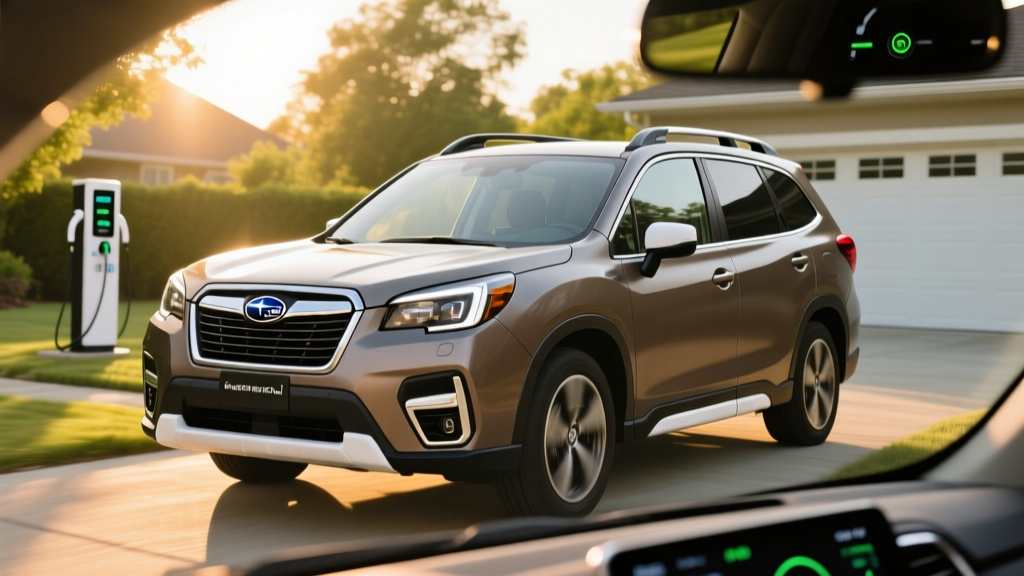
The 2026 Subaru Forester Hybrid Limited pairs Subaru's standard all-wheel-drive capability with a gasoline-electric hybrid powertrain, targeting buyers who want better fuel economy without plugging in. Unlike Subaru's earlier Crosstrek Plug-In Hybrid, this Forester is a conventional hybrid (HEV) — it charges its small battery through regenerative braking and the gasoline engine, so there is no charging port, no electric-only driving mode, and no range anxiety. If you've been searching for the Subaru Forester Hybrid Limited to see whether it delivers meaningful efficiency gains over the gas-only Forester, the answer is a measured yes — with caveats worth understanding.
Quick Verdict: Who the Forester Hybrid Limited Is For
The Forester Hybrid Limited is the right fit if you drive a Subaru today, want all-weather AWD traction, and want to cut fuel costs by roughly 20-25% compared to the non-hybrid Forester — without changing your fueling habits. It is not a stepping stone to electric driving. You will never plug it in. You will never drive on battery alone. What you get instead is a seamlessly integrated hybrid system that improves city MPG substantially, adds a modest power bump, and retains the Forester's practical cargo space and EyeSight safety suite.
- You want AWD and better MPG without changing how you refuel
- You live in a cold or mountainous climate where EV range loss is a concern
- You want a mainstream hybrid with a proven dealer/service network
- You tow light loads (1,500 lb capacity) and need 8.7 inches of ground clearance
- You have home charging access and want some electric-only daily driving
- Your commute is under 30 miles and you want zero tailpipe emissions on most trips
- You want to qualify for the federal §30D tax credit (up to $7,500 for eligible PHEVs/EVs)
HEV vs. PHEV vs. EV: Where the Forester Hybrid Fits
Subaru's electrification strategy has historically been cautious. The brand offered a Crosstrek Plug-In Hybrid (PHEV) through 2023, but for 2026, the Forester Hybrid is a conventional hybrid — an HEV. Here is why that distinction matters for your wallet and daily routine:
| Feature | HEV (Forester Hybrid) | PHEV (e.g., Toyota RAV4 Prime) | BEV (e.g., Hyundai Ioniq 5) |
|---|---|---|---|
| Plug in to charge? | No | Yes | Yes |
| Electric-only range | 0 miles | ~42 miles | ~300 miles (full) |
| Battery size | ~1.1 kWh (small buffer) | ~18.1 kWh usable | ~77 kWh usable |
| Home charger needed? | No | Recommended (Level 2) | Essential (Level 2) |
| Federal tax credit (§30D) | Not eligible | Up to $7,500 if eligible | Up to $7,500 if eligible |
| Best for | No-plug convenience + MPG gains | Short electric commute + gas road trips | Full electric with home charging |
The Forester Hybrid's small battery is never meant to propel the car on electricity alone for meaningful distances. Instead, the electric motor assists the 2.5-liter boxer engine during acceleration, allows brief engine-off coasting at low speeds, and captures energy during braking. This is fundamentally different from a PHEV, which can cover daily commutes entirely on grid-charged electricity before the gas engine engages.
Fuel Economy: EPA Ratings and Real-World MPG
The 2026 Subaru Forester Hybrid carries an EPA-estimated 35 MPG combined, with a city/highway split of 35 city / 34 highway. Compare that to the gas-only 2026 Forester (non-hybrid), which earns roughly 26 city / 33 highway / 29 combined with the same 2.5L engine and CVT.
| Model | City MPG | Highway MPG | Combined MPG |
|---|---|---|---|
| 2026 Forester Hybrid (AWD) | 35 | 34 | 35 |
| 2026 Forester 2.5L (AWD, gas) | 26 | 33 | 29 |
| 2026 Toyota RAV4 Hybrid (AWD) | 41 | 38 | 40 |
| 2026 Honda CR-V Hybrid (AWD) | 40 | 34 | 37 |
The hybrid system delivers its biggest advantage in stop-and-go city driving, where regenerative braking and electric-motor assist work hardest. Expect to see real-world city figures at or slightly above the EPA 35 MPG rating — hybrids routinely exceed their city sticker because the test cycle doesn't fully capture regenerative braking benefits in heavy traffic. Highway driving is a different story: at sustained 70-80 MPH speeds, the hybrid advantage narrows. Expect roughly 31-33 MPG highway in real-world cruising, slightly below the EPA's 34 highway estimate, due to aerodynamic drag and the added weight of the hybrid system (~180 lbs over the gas model).
Powertrain, Performance, and AWD Specs
The 2026 Forester Hybrid Limited uses Subaru's updated hybrid system built around the familiar 2.5-liter FB25 flat-four (boxer) engine. An electric motor is integrated into the drivetrain, providing assist torque during acceleration and enabling engine stop-start and low-speed electric creep.
| Specification | 2026 Forester Hybrid Limited |
|---|---|
| Engine | 2.5L DOHC flat-4 (boxer) |
| Engine output | ~180 hp / 176 lb-ft torque |
| Electric motor assist | ~13 hp / 48 lb-ft |
| Combined system output | ~194 hp |
| Transmission | Lineartronic CVT with manual mode |
| Drivetrain | Symmetrical AWD (standard) |
| 0-60 mph (est.) | ~8.4 seconds |
| Ground clearance | 8.7 inches |
| Towing capacity | 1,500 lbs |
| Battery type | Lithium-ion, ~1.1 kWh |
| Hybrid system warranty | 8 years / 100,000 miles |
The ~194 combined horsepower represents a modest bump over the gas-only Forester's 180 hp, and the electric motor's instant torque fill makes the hybrid feel more responsive from a stoplight than the EPA numbers suggest. The CVT remains smooth but can drone under hard acceleration — a characteristic of all Subaru CVTs. The symmetrical AWD system is full-time, with a center differential distributing torque front-to-rear, giving the Forester Hybrid genuine capability in snow, mud, and gravel. This is a key differentiator against competitors like the RAV4 Hybrid, whose electronic AWD system uses a separate rear motor that engages only when slip is detected.
Pricing, Trims, and Tax Credit Eligibility
The 2026 Subaru Forester Hybrid is available in several trims, with the Limited positioned as the mid-to-upper tier. Pricing reflects the hybrid premium over the equivalent gas-only model:
| Trim | MSRP (est.) | Hybrid Premium vs. Gas |
|---|---|---|
| Forester Hybrid Sport | ~$36,500 | +$1,500 |
| Forester Hybrid Limited | ~$38,900 | +$1,500 |
| Forester Hybrid Touring | ~$42,500 | +$1,500 |
At a roughly $1,500 premium over the equivalent gas-only Forester, the hybrid system pays for itself through fuel savings. Assuming 15,000 miles per year and $3.50/gallon fuel, the 6 MPG combined improvement saves approximately $350-$400 annually. That means the hybrid premium is recovered in roughly 4 years — faster if fuel prices rise or if you drive more than average.
Hybrid Battery Longevity, Warranty, and Replacement Cost
The most common concern among first-time hybrid buyers is battery replacement cost and lifespan. Subaru covers the Forester Hybrid's battery and related components under an 8-year / 100,000-mile hybrid system warranty (10 years / 150,000 miles in California Air Resources Board states). This warranty covers the hybrid battery pack, the electric motor, the inverter, and related control modules.
In practice, hybrid batteries in vehicles like the Forester — which use a small, shallow-cycling lithium-ion pack — experience minimal degradation. Unlike a full EV battery that cycles deeply from 100% to near-empty, the Forester's hybrid battery operates in a narrow state-of-charge window (roughly 40-60%), which dramatically extends cell life. Toyota and Honda hybrid systems have demonstrated 15-20 year lifespans with similar architecture, and Subaru's system follows the same engineering principles.
If a replacement is ever needed outside warranty, expect a cost in the $2,000-$3,500 range for the battery pack itself, plus labor. This is significantly less than EV battery replacement (which can exceed $10,000) because the pack is small (~1.1 kWh). Third-party refurbishers and independent hybrid specialists offer lower-cost options as the hybrid fleet ages.
Interior, Tech, and the Limited Trim Advantage
The Limited trim adds meaningful comfort and technology over the base and Sport trims. Key features on the 2026 Forester Hybrid Limited include:
- 11.6-inch vertical touchscreen with wireless Apple CarPlay and Android Auto
- Leather-trimmed upholstery with heated front seats
- Harman Kardon premium audio (9 speakers)
- Power panoramic moonroof
- Wireless phone charging pad
- Heated steering wheel
- EyeSight Driver Assist (standard across all trims): adaptive cruise control, lane centering, pre-collision braking
- DriverFocus distraction mitigation system
Cargo space is unchanged from the gas Forester at approximately 28.9 cubic feet behind the rear seats and 74.4 cubic feet with the rear seats folded — the hybrid battery is packaged compactly beneath the cargo floor without sacrificing volume. The 60/40 split rear seat folds nearly flat, and the wide cargo opening accommodates bulky items easily. The Forester's boxy greenhouse provides excellent outward visibility, a hallmark of the model that competitors with coupe-like rooflines sacrifice.
Forester Hybrid Limited vs. the Competition
The compact hybrid SUV segment is fiercely competitive. Here is how the Forester Hybrid Limited stacks up against its two main rivals:
| Attribute | Subaru Forester Hybrid Limited | Toyota RAV4 Hybrid XLE | Honda CR-V Hybrid Sport-L |
|---|---|---|---|
| EPA combined MPG | 35 | 40 | 37 |
| Combined HP | ~194 | 219 | 204 |
| AWD type | Full-time symmetrical | Electronic on-demand | Electronic on-demand |
| Ground clearance | 8.7 in | 8.1 in | 8.2 in |
| Cargo (rear up) | 28.9 cu ft | 37.6 cu ft | 36.3 cu ft |
| Towing | 1,500 lbs | 1,750 lbs | 1,000 lbs |
| Starting MSRP (est.) | ~$38,900 | ~$35,400 | ~$38,100 |
| IIHS safety (2025 rating) | Top Safety Pick+ | Top Safety Pick+ | Top Safety Pick+ |
The RAV4 Hybrid leads on fuel economy and cargo volume, and it offers more power. The CR-V Hybrid is a strong all-rounder with competitive MPG and a refined ride. The Forester Hybrid's advantages are its full-time symmetrical AWD (better for consistent low-traction surfaces), best-in-class ground clearance, and Subaru's reputation for durability in harsh climates. If you regularly drive on snow, ice, or unpaved roads, the Forester's mechanical AWD system provides more predictable traction than the electronic systems in its competitors.
- Full-time symmetrical AWD standard — superior in sustained low-traction conditions
- 8.7 inches of ground clearance, best in compact hybrid SUV class
- Modest $1,500 hybrid premium pays back in ~4 years
- Hybrid battery warranty: 8 yr / 100k mi (10/150k in CARB states)
- Excellent visibility and practical cargo shape
- EyeSight safety suite standard on all trims
- 35 combined MPG trails RAV4 Hybrid (40) and CR-V Hybrid (37)
- No plug-in option — cannot drive on electric-only power
- Not eligible for federal §30D tax credit
- CVT drone under hard acceleration
- Towing limited to 1,500 lbs
- Cargo volume smaller than RAV4 Hybrid and CR-V Hybrid
Frequently Asked Questions
How many MPG does the 2026 Subaru Forester Hybrid Limited get?
The EPA rates the 2026 Forester Hybrid at 35 city / 34 highway / 35 combined. In real-world driving, expect 33-36 MPG combined, with city driving often yielding 36-38 MPG and sustained highway cruising at 75+ MPH returning 30-33 MPG. Cold weather reduces efficiency by roughly 5-10%.
Does the Forester Hybrid need to be plugged in?
No. The Forester Hybrid is a conventional hybrid (HEV), not a plug-in hybrid. Its small battery charges through regenerative braking and the gasoline engine. You fuel it exactly like a regular gas car — at the pump. There is no charging port.
Is the Forester Hybrid reliable, and what does battery replacement cost?
Subaru's hybrid system is proven and low-stress, operating the battery in a shallow charge window that extends cell life. The hybrid system warranty covers 8 years / 100,000 miles (10 years / 150,000 miles in CARB states). If replacement is ever needed out of warranty, expect $2,000-$3,500 for the battery pack — far less than an EV battery, due to the small ~1.1 kWh size.
Does the Subaru Forester Hybrid qualify for a tax credit?
No. The federal §30D clean vehicle tax credit applies only to plug-in hybrids (PHEVs) and battery-electric vehicles (BEVs) that meet specific battery sourcing, MSRP, and buyer income requirements. The Forester Hybrid is a conventional HEV and is not eligible. Some states may offer separate hybrid incentives — check your state energy office or the AFDC state incentive database.
Hybrid vs. PHEV vs. EV — which should I choose?
Choose the Forester Hybrid (HEV) if you want better MPG without changing your fueling routine and lack home charging access. Choose a PHEV (like the Toyota RAV4 Prime or Subaru's future plug-in models) if you can charge at home and want 30-40 miles of electric-only commuting with a gas engine for road trips. Choose a full EV (like the Hyundai Ioniq 5 or Tesla Model Y) if you have reliable home charging, want zero tailpipe emissions, and your daily driving is within the vehicle's range.
How does the Forester Hybrid AWD system compare to the RAV4 Hybrid?
The Forester uses full-time symmetrical AWD with a mechanical center differential that constantly distributes torque to all four wheels. The RAV4 Hybrid uses an electronic on-demand system with a separate rear electric motor that activates only when the front wheels slip. For consistent low-traction surfaces (snow, ice, gravel), the Forester's system provides more predictable, immediate traction. The RAV4's system is slightly more efficient on dry pavement since it doesn't drive the rear wheels unless needed.