Quick Verdict: A Practical Hybrid SUV That Doesn't Sacrifice Cargo or Comfort
The 2026 Subaru Forester Hybrid pairs the boxy, visibility-first cabin that made the Forester a staple among outdoor-oriented buyers with a series-parallel hybrid powertrain targeting 35 MPG combined. Unlike the discontinued Forester PHEV that Subaru offered briefly in select markets, the current-generation Forester Hybrid is a conventional hybrid (HEV) — no plug, no charging cable, no range anxiety. You fuel it like any other car and let the hybrid system handle the rest.
This review examines the Forester Hybrid's interior layout, cargo utility, powertrain engineering, real-world fuel economy, and long-term battery ownership costs — with the exact numbers you need to decide whether this hybrid compact SUV fits your driveway.
Forester Hybrid Interior: Cabin Layout, Materials, and Tech
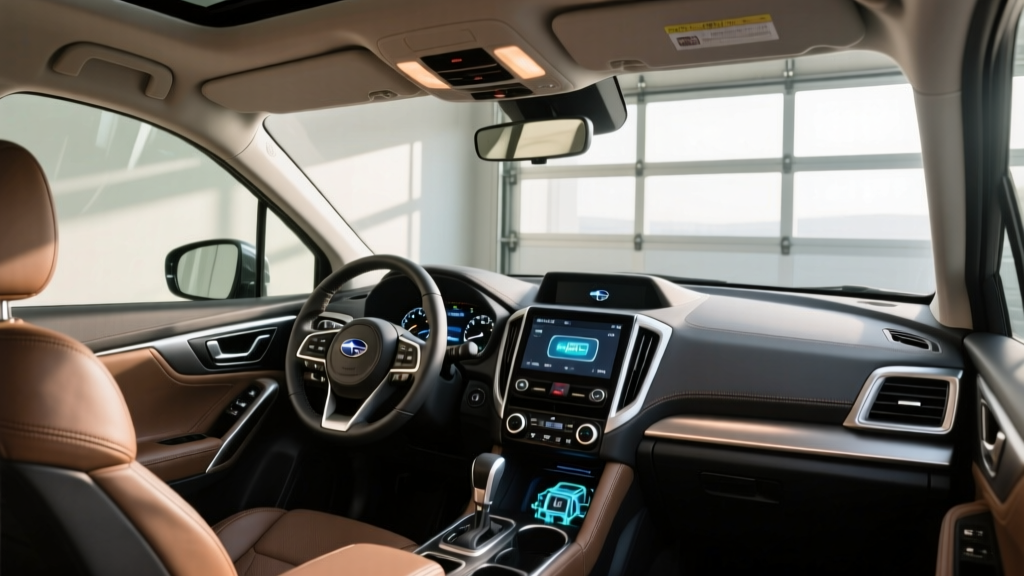
The keyword that brought you here — Subaru Forester hybrid interior — reflects what buyers actually care about: does the hybrid system eat into cabin or cargo space? The short answer is no. Subaru packages the hybrid battery beneath the rear cargo floor, preserving the Forester's signature 74.4 cu ft of maximum cargo volume with rear seats folded and approximately 28.9 cu ft behind the second row.
Front and Rear Seating
The Forester Hybrid retains the upright seating position and expansive greenhouse that define the nameplate. Headroom measures 41.2 inches up front and 39.6 inches in the rear — class-leading for the segment. The hybrid battery placement does not intrude on rear legroom (39.4 inches) or seat cushion height, a common compromise in some hybrid conversions where a raised floor shortens thigh support.
Available StarTex water-repellent upholstery on higher trims suits the Forester's adventure positioning, while base models use cloth. Heated front seats are standard on Premium and above; ventilated seats remain unavailable across the lineup.
Infotainment and Displays
The 2026 Forester Hybrid features an 11.6-inch vertical touchscreen (on Premium and above) running Subaru's latest Starlink infotainment with wireless Apple CarPlay and Android Auto. Base models receive dual 7.0-inch screens. A 12.3-inch digital instrument cluster is standard on Sport and Touring Hybrid trims, providing a dedicated hybrid energy-flow display that shows real-time battery state of charge (SoC), regenerative braking contribution, and engine/motor power split.
One practical note: the vertical screen orientation works well for map navigation but can require more eye travel to reach climate controls compared to physical knobs. Subaru retains physical volume and tuning knobs, which we consider a usability win.
Cargo and Utility
The hybrid battery's under-floor placement preserves the Forester's flat load floor. With rear seats up, you get 28.9 cu ft — enough for a week's gear for a family of four. Fold the 60/40 split rear seats and the 74.4 cu ft maximum accommodates mountain bikes with front wheels removed. The standard 1,500-lb towing capacity (2,000 lbs on some trims with the optional tow package) is unchanged from the gas-only Forester.
Hybrid vs. Gas Forester: What's Under the Hood?
The 2026 Forester Hybrid uses a series-parallel hybrid system centered on a 2.5-liter flat-four (boxer) engine paired with an electric motor integrated into the transmission housing. This is a conventional hybrid (HEV), meaning it charges its own battery through regenerative braking and engine power — you never plug it in.
| Specification | Value |
|---|---|
| Engine | 2.5L DOHC flat-4 (boxer) |
| Engine Output | 163 hp / 174 lb-ft torque |
| Electric Motor Output | ~26 hp (integrated) |
| Combined System Output | ~194 hp |
| Transmission | Lineartronic CVT with electric motor |
| Drivetrain | Symmetrical AWD (standard) |
| Hybrid Battery | ~1.1 kWh (lithium-ion, sealed) |
| Plug-In Charging | No — self-charging HEV |
| 0-60 mph (est.) | ~7.6 seconds |
The electric motor primarily assists during low-speed acceleration and stop-start transitions, smoothing out the CVT's typical drone and reducing fuel consumption in city driving. Unlike Toyota's more aggressive hybrid systems that can sustain electric-only driving at low speeds for extended distances, Subaru's system uses the motor more as a torque-fill and efficiency supplement. You won't get meaningful electric-only range — this is by design for a compact HEV battery.
HEV vs. PHEV: Which Forester Is Right?
Subaru previously offered a Forester PHEV (e-Boxer variant) in limited markets, but the 2026 U.S. Forester Hybrid is strictly an HEV. Here's the distinction:
- HEV (this model): No plug. ~1 kWh battery. Charges via regen and engine. Best for drivers who want better MPG without changing habits.
- PHEV (not currently offered for U.S. Forester): Plug-in capable. Larger battery (typically 13-18 kWh). 20-35 miles electric-only range before the gas engine engages. Best for drivers with home charging and short commutes.
If you need electric-only commuting, consider the Toyota RAV4 Prime (PHEV, 42 miles EV range) or wait for Subaru's next-generation Solterra or a potential Forester PHEV variant.
Fuel Economy: EPA Ratings and Real-World MPG
The 2026 Forester Hybrid targets an EPA-estimated 35 MPG combined, with a city/highway split that favors urban driving — typical of hybrid powertrains that maximize regenerative braking opportunities.
| Driving Cycle | EPA Estimate |
|---|---|
| City | 37 MPG |
| Highway | 34 MPG |
| Combined | 35 MPG |
Real-World MPG: What to Actually Expect
Hybrid fuel economy often exceeds EPA city estimates in stop-and-go traffic because regenerative braking recaptures energy that a gas car wastes as heat. In our experience with Subaru's hybrid system and similar platforms:
- City/suburban mixed driving: 34-38 MPG is achievable, with some drivers reporting 39-40 MPG in heavy-traffic commutes under 45 mph.
- Highway cruising (70-75 mph): Expect 31-34 MPG. The Forester's boxy aerodynamics and standard AWD create more drag and drivetrain loss than sleeker crossovers. The hybrid system provides less benefit at sustained highway speeds where regen opportunities are minimal.
- Cold weather (below 32°F): Plan for a 10-15% reduction, dropping to approximately 30-32 MPG combined. The engine runs more frequently to provide cabin heat and maintain battery temperature, reducing electric-motor assist.
Compared to the gas-only 2026 Forester (EPA 29 MPG combined), the hybrid delivers roughly a 21% improvement — meaningful for high-mileage drivers but less dramatic than Toyota's Hybrid Synergy Drive gains in the RAV4 Hybrid (39 MPG combined).
Pricing, Trims, and Tax Credit Eligibility
The 2026 Forester Hybrid is available across multiple trim levels, with the hybrid powertrain adding a premium over the gas-only equivalent.
| Trim | MSRP (est.) | Key Additions |
|---|---|---|
| Premium Hybrid | $35,495 | 11.6" screen, heated seats, LED fog lights |
| Sport Hybrid | $37,995 | Sport-tuned suspension, 12.3" cluster, dual-zone climate |
| Limited Hybrid | $39,995 | Leather, power liftgate, Harman Kardon audio |
| Touring Hybrid | $42,495 | Nappa leather, heated rear seats, 180° front camera |
All trims include Symmetrical AWD, EyeSight driver-assistance (SAE Level 2 — driver supervision required at all times), and the hybrid powertrain. Destination charges add approximately $1,420.
Federal Tax Credit: Does the Forester Hybrid Qualify?
Under current IRS §30D rules, the federal clean vehicle credit applies to new plug-in electric vehicles and fuel-cell vehicles — conventional hybrids like the Forester Hybrid do not qualify for the $7,500 federal tax credit. The §30D credit requires a minimum 7 kWh battery capacity and plug-in charging capability, neither of which this HEV meets.
Some states offer separate incentives for hybrid purchases, though these are increasingly rare as state programs shift focus to BEVs and PHEVs. Check your state's energy office or Alternative Fuels Data Center for current local programs.
Battery Warranty, Reliability, and Replacement Cost
Subaru Hybrid Battery Warranty
Subaru covers the Forester Hybrid's battery pack and hybrid system components under its powertrain warranty:
- Hybrid battery warranty: 8 years / 100,000 miles (whichever comes first)
- Hybrid system components: 8 years / 100,000 miles
- General powertrain warranty: 5 years / 60,000 miles
- Capacity retention guarantee: Subaru warrants the hybrid battery against defects and abnormal capacity loss; no specific percentage threshold is published (unlike BEV warranties that guarantee 70% SoH).
Long-Term Reliability
The Forester Hybrid's 1.1 kWh lithium-ion battery is far smaller and less stressed than a BEV pack. It operates in a narrow state-of-charge window (typically 40-60% SoC), which minimizes degradation. Toyota and Honda hybrid batteries from the early 2000s have demonstrated 200,000+ mile lifespans with minimal capacity loss, and Subaru's system follows similar engineering principles.
Subaru's boxer engine has a mixed reliability history — head gasket issues plagued older EJ-series engines, but the current FB25D engine with direct injection has shown improved durability. The hybrid system's regenerative braking also reduces wear on friction brake pads, with many hybrid owners reporting 80,000-100,000 miles on original brake pads.
Battery Replacement Cost
If the hybrid battery fails outside warranty, replacement costs typically range from $2,000 to $4,000 including parts and labor for a compact HEV battery of this size. This is dramatically less than BEV battery replacements ($10,000-$20,000+) because the pack is small and accessible. Third-party refurbishment shops increasingly offer reconditioned hybrid batteries for $1,200-$2,000.
Forester Hybrid vs. Competitors: Where It Stands
| Model | Combined MPG | HP | AWD | Cargo (cu ft) | Starting MSRP |
|---|---|---|---|---|---|
| Subaru Forester Hybrid | 35 | 194 | Standard | 74.4 | ~$35,495 |
| Toyota RAV4 Hybrid | 39 | 219 | Standard | 69.8 | ~$33,595 |
| Honda CR-V Hybrid | 37 | 204 | Available | 76.5 | ~$35,395 |
| Ford Escape Hybrid | 39 | 192 | Available | 60.8 | ~$34,500 |
The Forester Hybrid trades a few MPG to the RAV4 Hybrid in exchange for superior outward visibility, standard AWD across all trims, a larger cargo area than the RAV4, and Subaru's EyeSight safety suite as standard equipment. The IIHS has historically rated the Forester as a Top Safety Pick+, and the 2026 model is expected to continue that record.
Where the Forester Hybrid loses ground: the RAV4 Hybrid offers more horsepower (219 vs. 194) and a more mature hybrid system with decades of proven reliability data. The CR-V Hybrid offers slightly more maximum cargo space. If fuel economy is your top priority, the RAV4 Hybrid's 39 MPG combined is hard to beat.
Pros
- Standard AWD on every trim — no FWD base model
- Class-leading cargo volume (74.4 cu ft) with flat load floor
- Excellent outward visibility and upright seating position
- EyeSight safety suite standard (adaptive cruise, lane centering, pre-collision braking)
- Real-world city MPG often exceeds EPA estimate
- Low hybrid battery replacement cost ($2K-$4K) vs. BEV packs
Cons
- 35 MPG combined trails RAV4 Hybrid (39) and Escape Hybrid (39)
- Boxy shape creates highway wind noise above 70 mph
- No PHEV option for electric-only commuting
- No federal tax credit eligibility for conventional HEV
- CVT drone noticeable under hard acceleration
- 11.6" screen requires more menu diving for climate controls
Who Should Choose the Forester Hybrid?
Decision Framework
Choose the Forester Hybrid if:
- You want AWD standard without paying an AWD upgrade premium
- You drive a city-heavy commute where hybrid regen maximizes MPG gains
- You need maximum cargo utility in a compact SUV footprint
- You want hybrid efficiency without changing your fueling habits (no plug required)
- You prioritize outward visibility and easy ingress/egress
Consider a full EV (BEV) instead if:
- You have reliable home Level 2 charging and want $7,500 federal tax credit eligibility
- Your daily driving is under 250 miles and you want zero tailpipe emissions
- You want minimal maintenance (no oil changes, fewer brake replacements)
Consider the gas-only Forester instead if:
- Your annual mileage is under 8,000 miles (the hybrid premium won't pay back in fuel savings)
- You want the lowest possible purchase price
Frequently Asked Questions
How many MPG does the 2026 Subaru Forester Hybrid get?
The EPA rates the Forester Hybrid at 37 MPG city, 34 MPG highway, and 35 MPG combined. Real-world city driving often yields 36-39 MPG thanks to regenerative braking, while sustained highway driving at 75 mph may drop to 31-33 MPG.
Does the Forester Hybrid need to be plugged in?
No. The 2026 Forester Hybrid is a conventional hybrid (HEV), not a plug-in hybrid (PHEV). It charges its small battery through regenerative braking and the gas engine. You simply fill it with gasoline as you would any other car.
Can the Forester Hybrid drive on electric power alone?
Only at very low speeds (typically under 20 mph) for short distances — such as creeping through a parking lot. The ~1.1 kWh battery is too small to sustain meaningful electric-only driving. If you want 25-40 miles of electric-only range, you need a PHEV like the Toyota RAV4 Prime.
Is the Subaru Forester Hybrid reliable?
Subaru's current FB25D engine and hybrid system are expected to be reliable based on the brand's hybrid experience in other markets and the proven longevity of compact HEV batteries industry-wide. The hybrid battery is warrantied for 8 years/100,000 miles. The boxer engine's historical head gasket issues have been addressed in the current generation.
What does a Forester Hybrid battery replacement cost?
Out-of-warranty hybrid battery replacement typically costs $2,000-$4,000 for parts and labor. Refurbished batteries from third-party shops can reduce this to $1,200-$2,000. This is far less expensive than BEV battery replacement because the HEV pack is small (~1.1 kWh).
Does the Forester Hybrid qualify for a federal tax credit?
No. Under current IRS §30D rules, the federal clean vehicle credit requires plug-in capability and a minimum 7 kWh battery. The Forester Hybrid is a conventional HEV with a ~1.1 kWh battery and no plug, so it does not qualify. Some states may offer separate hybrid incentives — check the Alternative Fuels Data Center for your state.
Hybrid vs. PHEV vs. EV — which fits my lifestyle?
HEV (Forester Hybrid): No plug needed, 35 MPG, lowest behavior change. Best for apartment dwellers or those without home charging access.
PHEV (e.g., RAV4 Prime): Plug in at home for 25-42 miles electric-only, then gas engine takes over. Best for short commutes with home charging.
BEV (e.g., Subaru Solterra): All-electric, 220-300+ mile range, $7,500 tax credit eligible (if requirements met). Best for drivers with reliable home charging and predictable routes.
How does the hybrid system affect cargo space?
It doesn't. Subaru packages the hybrid battery beneath the rear cargo floor, preserving the full 28.9 cu ft (seats up) and 74.4 cu ft (seats folded) of the gas-only Forester. The load floor remains flat with no intrusion into the cabin.