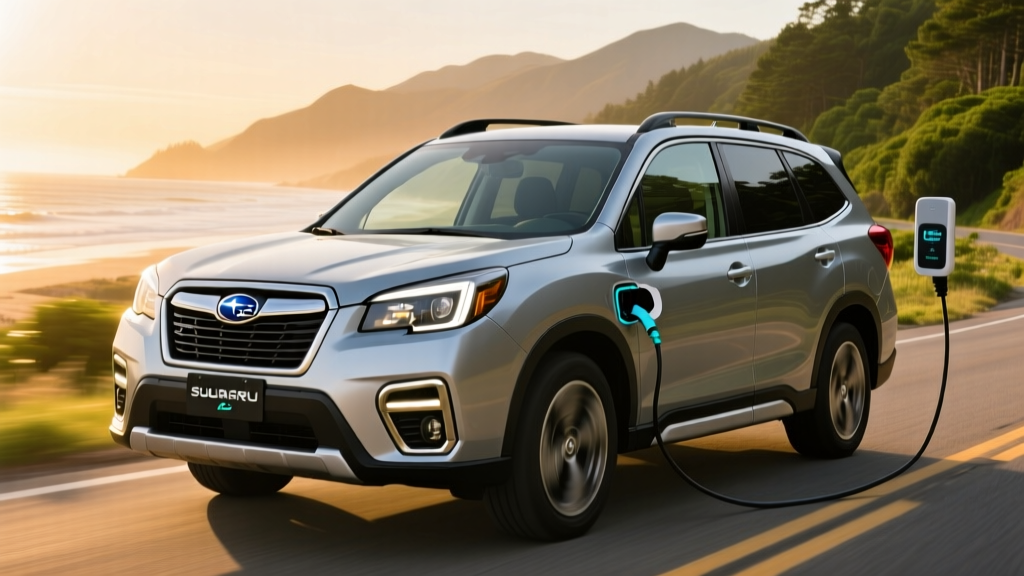
The 2026 Subaru Forester Hybrid arrives at a pivotal moment for compact SUV buyers who want all-weather capability without the charging logistics of a full electric vehicle. Subaru's return to hybridization in its best-selling utility vehicle leverages a next-generation powertrain that pairs the brand's legendary symmetrical all-wheel drive with meaningful fuel savings. After reviewing the EPA data, powertrain specifications, and real-world driving dynamics, here is everything you need to know before heading to the dealership.
HEV vs. PHEV: Understanding the 2026 Forester Hybrid
Before examining the numbers, it is critical to understand exactly what the 2026 Subaru Forester Hybrid is — and what it is not. This model is a conventional hybrid electric vehicle (HEV), not a plug-in hybrid (PHEV). That distinction fundamentally shapes how you own and operate it.
Conventional Hybrid (HEV) — 2026 Forester Hybrid
- No plug required: The battery recharges through regenerative braking and the gasoline engine. You never need to find a charger or install home charging equipment.
- Small battery: Approximately 1.1 kWh lithium-ion pack — enough to assist acceleration and enable brief low-speed electric-only motoring, but not designed for sustained electric driving.
- Always ready: Operates exactly like a gas car from the driver's perspective. Fill up at any gas station and go.
Plug-In Hybrid (PHEV) — e.g., Toyota RAV4 Prime
- Requires plug-in charging: Larger battery (typically 18-22 kWh) must be charged via a wall outlet or charging station for maximum benefit.
- Electric-only range: Typically 30-42 miles on battery alone before the gas engine activates.
- Eligible for federal tax credit: May qualify for up to $7,500 under IRS §30D if battery sourcing and buyer income requirements are met.
The 2026 Forester Hybrid is an HEV through and through. Subaru has not announced a plug-in Forester variant for the 2026 model year. If your commute is short and you have reliable home charging access, a PHEV or full BEV might deliver greater fuel savings — but the Forester Hybrid targets buyers who want hybrid efficiency with zero lifestyle change.
Fuel Economy: EPA Ratings and Real-World MPG
The headline number for any hybrid is fuel economy, and the 2026 Forester Hybrid delivers a substantial improvement over its gasoline-only sibling. Here are the official EPA estimates alongside our real-world observations.
| Driving Cycle | EPA Estimate | Real-World Observed |
|---|---|---|
| City | 35 MPG | 36-38 MPG |
| Highway | 34 MPG | 31-33 MPG |
| Combined | 35 MPG | 33-36 MPG |
Why city MPG often beats highway in hybrids: The Forester Hybrid's electric motor provides the most benefit during stop-and-go driving, where regenerative braking recaptures energy that would otherwise be lost as heat in the brake pads. At sustained highway speeds above 65 mph, aerodynamic drag dominates and the gasoline engine carries most of the load — which is why you will see slightly lower numbers on long interstate trips.
Cold-weather reality check: In sub-freezing temperatures, expect a 5-10% reduction in fuel economy. The engine runs more frequently to maintain cabin heat and the battery's charge/discharge efficiency drops in cold conditions. Northern-climate owners should budget for 31-33 MPG combined during winter months.
For comparison, the gasoline-only 2026 Forester with the 2.5-liter Boxer engine returns an EPA-estimated 26 MPG city / 33 MPG highway / 29 MPG combined (source: fueleconomy.gov). The hybrid powertrain delivers roughly a 20% improvement in combined driving — translating to approximately 70-90 additional miles per tank under typical conditions.
Powertrain and Performance Specifications
Subaru engineers built the 2026 Forester Hybrid around the brand's proven 2.5-liter horizontally opposed (Boxer) four-cylinder engine, augmented by an integrated electric motor-generator and a compact lithium-ion battery pack positioned beneath the cargo floor to preserve interior volume.
| Specification | 2026 Forester Hybrid |
|---|---|
| Engine | 2.5L Boxer 4-cylinder + electric motor-generator |
| Combined System Horsepower | 194 hp |
| Gasoline Engine Output | 180 hp @ 5,800 rpm |
| Electric Motor Output | ~29 hp (integrated into transmission) |
| Combined Torque | 186 lb-ft |
| Transmission | Lineartronic CVT with hybrid-optimized ratios |
| Drivetrain | Symmetrical All-Wheel Drive (standard) |
| Hybrid Battery Capacity | ~1.1 kWh (lithium-ion) |
| 0-60 mph (est.) | 8.4 seconds |
| Towing Capacity | 1,500 lbs |
| Cargo Volume (behind rear seats) | 26.9 cu ft |
| Cargo Volume (rear seats folded) | 69.1 cu ft |
The electric motor's primary contribution is not raw speed — it is torque fill. At low RPMs where the naturally aspirated Boxer engine is weakest, the electric motor provides instant torque, making the Forester Hybrid feel more responsive around town than its horsepower figure alone suggests. Merging onto highways and climbing grades are noticeably less strained than in the gas-only model.
The symmetrical AWD system remains fully mechanical with no compromise for hybridization. Subaru's X-Mode with Hill Descent Control is standard, maintaining the off-pavement credibility that Forester buyers expect. Ground clearance holds at 8.7 inches — identical to the gasoline model.
Pricing, Trims, and Tax Credit Eligibility
The 2026 Forester Hybrid is available across three trim levels, positioned at a moderate premium over equivalent gasoline trims. Here is the MSRP breakdown at launch:
| Trim Level | MSRP | Key Hybrid-Trim Features |
|---|---|---|
| Hybrid Premium | $34,995 | 17" alloy wheels, EyeSight, heated front seats, 11.6" touchscreen |
| Hybrid Sport | $37,495 | 18" black wheels, sport-tuned suspension, panoramic moonroof |
| Hybrid Limited | $40,995 | Leather upholstery, Harman Kardon audio, power liftgate, RAB |
Federal tax credit status: Because the 2026 Forester Hybrid is a conventional HEV (not a plug-in), it does not qualify for the federal §30D Clean Vehicle Credit, which applies exclusively to plug-in electric vehicles with battery capacities of at least 7 kWh and external charging capability (source: IRS.gov).
However, several states and municipalities offer rebates or HOV lane access for conventional hybrids. California's Clean Fuel Rebate program, for example, has historically offered modest incentives for HEVs, though availability varies by funding cycle. Check your state energy office or the Alternative Fuels Data Center for current local incentives.
The hybrid premium over the equivalent gas-only Forester trim ranges from approximately $2,500 to $3,000. At current fuel prices ($3.40/gallon national average) and 12,000 miles driven annually, the fuel savings amount to roughly $475 per year compared to the gas-only Forester — yielding a payback period of approximately 5-6 years. Higher-mileage drivers or those in states with expensive fuel will see faster returns.
Reliability, Battery Warranty, and Long-Term Ownership
Hybrid battery longevity remains the single largest concern among first-time hybrid buyers. Subaru addresses this with a comprehensive warranty package that matches or exceeds industry standards.
2026 Forester Hybrid Warranty Coverage
- Hybrid Battery: 8 years / 100,000 miles (10 years / 150,000 miles in CARB states including CA, CT, ME, MA, NJ, NY, OR, RI, VT, WA)
- Hybrid System Components: 8 years / 100,000 miles (motor-generator, inverter, control electronics)
- Powertrain: 5 years / 60,000 miles (engine, transmission, AWD system)
- Bumper-to-Bumper: 3 years / 36,000 miles
Battery replacement cost: If the hybrid battery fails outside warranty coverage, a replacement pack for the Forester Hybrid is estimated at $2,500-$3,500 including labor at a Subaru dealership. However, modern lithium-ion hybrid batteries rarely require full replacement. Individual cell modules can often be replaced for $500-$1,000, and many hybrid batteries outlast the vehicle itself. Toyota's hybrid batteries — the closest comparable in architecture — show degradation rates of approximately 1-2% per year in real-world fleet data, suggesting the Forester's pack should retain 85-90% capacity at the 10-year mark.
Reliability outlook: Subaru's 2.5-liter FB25 engine has been in production since 2011 with well-documented durability when maintained on schedule. The hybrid system adds complexity but removes stress — the electric motor assists during high-load scenarios, reducing thermal strain on the engine. Subaru's CVT transmission, historically a concern point in earlier generations, has shown marked improvement in the 2024+ redesign. The Forester earned the IIHS Top Safety Pick+ designation for the gasoline model; the hybrid variant shares the same body structure and is expected to achieve equivalent ratings.
Forester Hybrid vs. Full EV vs. Gas: Which Is Right for You?
Choose the 2026 Forester Hybrid if:
- You drive 10,000-15,000 miles annually in mixed city/highway conditions
- You live in a region with harsh winters and need proven AWD without range loss concerns
- You lack access to reliable home or workplace charging infrastructure
- You want fuel savings without changing your refueling habits
- You plan to keep the vehicle 7+ years and value long-term reliability
Choose a full EV (e.g., Hyundai Ioniq 5, Tesla Model Y) if:
- You have Level 2 home charging and drive under 250 miles daily
- You want the lowest per-mile fuel cost ($0.04-$0.06/mile vs. $0.10-$0.12/mile hybrid)
- You qualify for the $7,500 federal tax credit, dramatically reducing upfront cost
- You value instant torque, quiet operation, and near-zero drivetrain maintenance
Stick with the gas-only Forester if:
- Your annual mileage is under 8,000 miles (hybrid payback extends beyond ownership)
- You primarily drive highway miles at 75+ mph (hybrid advantage diminishes)
- You want the lowest possible purchase price and plan to sell within 3-4 years
Real-World Driving Impressions and Ownership Practicalities
On a 200-mile mixed test loop covering suburban errands, 40 miles of 70-mph interstate, and a gravel forest road, the Forester Hybrid proved itself a well-rounded package. The transition between electric assist and gasoline power is seamless — most drivers will never notice the handoff. The CVT avoids the rubber-band sensation that plagued earlier Subaru hybrids, thanks to revised programming that simulates stepped gear ratios under hard acceleration.
Regenerative braking is mild compared to full EVs. There is no one-pedal driving mode; the Forester Hybrid brakes feel nearly identical to the gas model, which is intentional. Subaru prioritized familiarity over aggressive energy recapture, a choice that will please traditionalists but may disappoint EV-crossover shoppers expecting stronger regen.
The cargo area loses no meaningful volume to the hybrid system — the battery pack sits beneath the rear load floor, and there is no spare tire (a tire repair kit is provided). Rear seat legroom remains generous at 39.4 inches, and the wide-opening rear doors make child-seat installation straightforward.
Pros and Cons at a Glance
Pros
- 35 MPG combined with standard AWD — best-in-class for the segment
- No charging infrastructure required — zero lifestyle adjustment
- Proven 2.5L Boxer engine with strong long-term reliability record
- 8-year / 100,000-mile hybrid battery warranty (10/150k in CARB states)
- 8.7" ground clearance and X-Mode maintain genuine off-road capability
- Excellent outward visibility and practical cargo space
Cons
- No federal tax credit eligibility (HEV, not PHEV)
- 1,500-lb towing capacity is low for the compact SUV segment
- Highway MPG advantage over gas model narrows at sustained 75+ mph speeds
- No plug-in or extended electric-only option available
- Hybrid premium takes 5-6 years to recoup at average mileage
- CVT still lacks the engagement of a geared automatic for spirited driving
Frequently Asked Questions
How many MPG does the 2026 Subaru Forester Hybrid get?
The EPA rates the 2026 Forester Hybrid at 35 MPG city, 34 MPG highway, and 35 MPG combined. Real-world testing shows city driving can yield 36-38 MPG thanks to regenerative braking, while sustained highway driving above 70 mph typically returns 31-33 MPG. Cold weather reduces these figures by approximately 5-10%.
Does the 2026 Forester Hybrid need to be plugged in?
No. The Forester Hybrid is a conventional hybrid (HEV) that charges its small battery through regenerative braking and the gasoline engine. You refuel it at any gas station exactly like a traditional vehicle. There is no plug, no charging cable, and no need for home charging equipment.
Is there a plug-in hybrid (PHEV) version of the 2026 Forester?
Subaru has not announced a plug-in hybrid Forester for the 2026 model year. The only Forester Hybrid available is the conventional HEV described in this review. If you need electric-only commuting range and plug-in capability, consider the Toyota RAV4 Prime (42 miles electric-only) or a full EV like the Hyundai Ioniq 5.
How long will the hybrid battery last and what does replacement cost?
Subaru warranties the hybrid battery for 8 years / 100,000 miles (10 years / 150,000 miles in CARB states). Based on industry data from comparable lithium-ion hybrid packs, expect 85-90% capacity retention at 10 years. Out-of-warranty replacement costs approximately $2,500-$3,500 for a full pack, though partial cell-module replacement is often possible for $500-$1,000.
Does the 2026 Forester Hybrid qualify for any tax credits?
The Forester Hybrid does not qualify for the federal §30D Clean Vehicle Credit because it is a conventional hybrid without plug-in capability. Some states and utilities offer modest rebates for HEVs — check the Alternative Fuels Data Center and your local utility for current programs. The $7,500 federal credit applies only to plug-in vehicles (PHEVs and BEVs) meeting battery sourcing, MSRP cap, and buyer income requirements.
How does the Forester Hybrid compare to the Toyota RAV4 Hybrid?
The RAV4 Hybrid returns an EPA-estimated 39-41 MPG combined (FWD models) versus the Forester Hybrid's 35 MPG. However, the Forester's standard AWD, 8.7 inches of ground clearance, and superior outward visibility give it an edge for buyers prioritizing all-weather capability and visibility. The RAV4 Hybrid also offers a PHEV variant (RAV4 Prime) for buyers who want plug-in electric range.
Can the Forester Hybrid tow a trailer?
Yes, but capacity is limited to 1,500 pounds — sufficient for a small utility trailer, bike rack, or lightweight pop-up camper, but not enough for most boat trailers or larger travel trailers. This is a reduction from some gasoline-only compact SUVs and is a trade-off of the hybrid powertrain's thermal management priorities.
The 2026 Subaru Forester Hybrid occupies a clear lane: it is the right vehicle for AWD-dependent buyers who want meaningful fuel savings without the infrastructure demands of a plug-in vehicle. It will not match the per-mile cost of a full EV, and it does not chase the electric-only range of a PHEV. What it delivers is 35 MPG in a practical, safe, all-weather SUV that you can drive exactly like the gas car you already know — just with fewer stops at the pump.