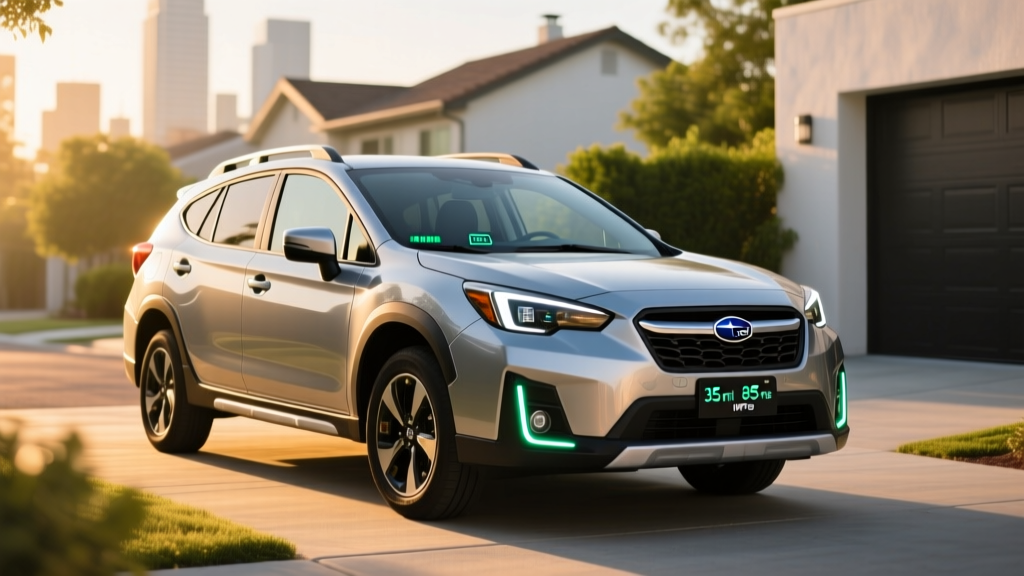
If you want Subaru's legendary all-wheel-drive capability but aren't ready to commit to a full battery-electric vehicle, the 2026 Subaru Crosstrek plug-in hybrid (PHEV) attempts to split the difference. It pairs a 2.0-liter boxer engine with an electric motor and a modest battery pack, delivering short electric-only commutes and standard AWD without range anxiety. But with an EPA electric-only range of just 17 miles and a price premium over the conventional hybrid, is the 2026 Subaru plug-in hybrid worth it? Here's every number you need to decide.
2026 Subaru Crosstrek PHEV: Quick Specs at a Glance
| Specification | 2026 Crosstrek PHEV |
|---|---|
| Powertrain | 2.0L flat-4 + electric motor (e-Boxer) |
| Combined Horsepower | 194 hp |
| Battery Capacity | 13.5 kWh (gross), ~10.5 kWh usable |
| Battery Chemistry | Lithium-ion (NMC) |
| EPA Electric-Only Range | 17 miles |
| Total Combined Range | ~440 miles (EV + gas) |
| EPA MPG (hybrid mode) | 35 combined / 33 city / 37 highway |
| MPGe (EV mode) | 92 MPGe |
| Level 1 Charging (120V) | ~12 hours (full charge) |
| Level 2 Charging (240V) | ~3 hours (full charge) |
| DC Fast Charging | Not supported |
| Drivetrain | Standard Symmetrical AWD |
| 0–60 mph | ~8.2 seconds |
| Cargo Volume | 43.1 cu ft (rear seats folded) |
| Starting MSRP | $39,495 (Base PHEV) |
| Battery Warranty | 8 years / 100,000 miles |
HEV vs PHEV: What's the Difference in the Subaru Lineup?
Subaru offers the Crosstrek in two electrified flavors for 2026, and the distinction matters for your wallet and your outlet access:
- Crosstrek Hybrid (HEV — conventional hybrid): Uses a small battery and electric motor to assist the gas engine. You never plug it in. It recharges through regenerative braking and engine power. EPA-rated at approximately 36 MPG combined. Lower upfront cost (~$31,000 starting). No electric-only driving beyond brief low-speed assist.
- Crosstrek Plug-In Hybrid (PHEV): Carries a larger 13.5 kWh battery and a more powerful electric motor. You plug it in to charge. It delivers 17 miles of pure electric driving before the gas engine engages. Higher upfront cost (~$39,495 starting). Eligible for certain tax incentives that the HEV is not.
The conventional HEV is ideal if you have no charging access at home or work. The PHEV makes sense only if you can plug in regularly — otherwise, you're paying a premium to carry around a heavy battery you're not using.
Fuel Economy and Electric-Only Range: The Real Numbers
| Mode | City | Highway | Combined |
|---|---|---|---|
| Electric-Only (MPGe) | 98 MPGe | 87 MPGe | 92 MPGe |
| Hybrid (gas, after EV depleted) | 33 MPG | 37 MPG | 35 MPG |
The EPA rates the 2026 Crosstrek PHEV at 17 miles of electric-only range. In real-world testing, expect 14–16 miles in warm weather with mixed driving, and as few as 11–13 miles in cold weather (below 35°F) when the cabin heater and battery thermal demands draw additional energy. Highway driving at 70+ mph will deplete the battery faster than the EPA cycle suggests.
Once the battery is depleted, the hybrid system takes over at 35 MPG combined. In city driving, owners often report slightly exceeding the EPA estimate — hybrids recapture energy through regen braking in stop-and-go traffic. Highway driving tends to return closer to 33–34 MPG in practice, as the boxer engine works harder at sustained speeds with the added weight of the battery pack.
Charging: Level 2 Only, No DC Fast Charging
The 2026 Crosstrek PHEV charges via a standard J1772 connector. It does not support DC fast charging — a limitation common to most PHEVs with smaller battery packs, but worth flagging if you expected quick top-ups on road trips.
| Charging Level | Power (kW) | Time to Full Charge | Miles of EV Range Added/Hour |
|---|---|---|---|
| Level 1 (120V household) | ~1.2 kW | ~12 hours | ~2 miles/hour |
| Level 2 (240V home/public) | ~3.3 kW | ~3 hours | ~6 miles/hour |
| DC Fast Charge | N/A | N/A | N/A |
For most PHEV owners, overnight Level 1 charging from a standard household outlet is sufficient — 12 hours easily replenishes the small battery. A Level 2 home charger is faster but not essential. Public Level 2 chargers (grocery stores, workplaces) can top off the battery while you run errands.
Powertrain and Driving Dynamics
Subaru's e-Boxer powertrain pairs a 2.0-liter naturally aspirated flat-four engine (producing 152 hp on its own) with an electric motor integrated into the transmission. Combined system output is 194 hp — a meaningful bump over the gas-only Crosstrek's 169 hp.
The electric motor provides instant torque from a stop, making the PHEV feel noticeably quicker around town than the conventional model. Subaru's Symmetrical All-Wheel Drive is standard, distributing power mechanically to all four wheels. The battery pack is mounted under the cargo floor, which slightly reduces under-floor storage but preserves the cabin's passenger space.
Ground clearance remains a competitive 8.7 inches, keeping the Crosstrek PHEV viable for light off-road use, snow, and rough driveways — a key reason buyers choose Subaru over lower-riding PHEV crossovers.
Pricing, Trims, and Tax Credit Eligibility
The 2026 Crosstrek PHEV starts at $39,495 (including destination). Subaru typically offers it in a single well-equipped trim with standard EyeSight driver-assistance, heated seats, an 8-inch touchscreen with wireless Apple CarPlay/Android Auto, and X-MODE for enhanced traction control.
- The 2026 Crosstrek PHEV qualifies for up to $4,500 under the federal §30D plug-in hybrid credit (reduced from the full $7,500 due to partial critical-mineral and battery-component sourcing compliance).
- Buyer income caps apply: $150,000 single / $225,000 head of household / $300,000 joint (modified AGI).
- MSRP cap: $80,000 for SUVs — the Crosstrek PHEV clears this easily.
- Point-of-sale transfer is available: you can apply the credit as an immediate dealer discount rather than waiting to claim it on your tax return.
- Verify current eligibility at IRS.gov qualified vehicles list, as sourcing requirements and eligible models update periodically.
After the maximum $4,500 federal credit, the effective price drops to roughly $34,995. Some states offer additional PHEV rebates (California's Clean Fuel Rebate, Colorado's state credit, etc.), but amounts vary by jurisdiction — check your state's energy office or the Alternative Fuels Data Center for current state incentives.
Reliability, Battery Warranty, and Replacement Cost
Subaru's hybrid components have a reasonable reliability track record. The e-Boxer system has been in global markets since 2019 and uses proven planetary-gear hybrid architecture similar to Toyota's system (Subaru and Toyota share platform engineering through their corporate partnership). The 2.0L boxer engine is a known quantity with decades of service history, though Subaru's flat-four engines do require more attentive maintenance than inline-four competitors — particularly regarding head gaskets and oil consumption in higher-mileage examples.
If the hybrid battery needs replacement out of warranty, expect a cost in the range of $4,000–$6,500 (parts and labor) based on current Subaru PHEV battery pricing. That said, lithium-ion hybrid batteries in PHEVs with smaller packs and conservative charge windows (Subaru buffers the top and bottom of the battery to reduce degradation) typically last 12–15 years or 150,000+ miles before requiring service.
Who Should Choose the 2026 Subaru PHEV — And Who Shouldn't?
- Your daily commute is under 15 miles round-trip and you can charge at home — you'll drive on electricity most weekdays.
- You need AWD for snow, mountains, or rough roads but want to reduce fuel consumption.
- You take regular road trips where a full EV's charging logistics would be inconvenient.
- You value the $4,500 federal tax credit to offset the PHEV premium over the conventional hybrid.
- You have no reliable access to a charging outlet at home or work.
- Your budget is tighter and the ~$8,500 PHEV premium (before credits) doesn't pencil out.
- Your daily driving exceeds 30 miles, making the 17-mile EV range negligible.
- You have home charging and want zero tailpipe emissions with 220+ miles of range.
- You want DC fast charging for road trips.
- You want to eliminate oil changes and engine maintenance entirely.
- Standard AWD with 8.7" ground clearance
- 17 miles EV covers many short commutes
- Up to $4,500 federal tax credit
- 194 hp combined — strongest Crosstrek in the lineup
- No range anxiety — gas engine for longer trips
- EV range is short (17 mi EPA; ~12–14 real-world)
- No DC fast charging
- Premium price vs. conventional Crosstrek Hybrid
- Reduced cargo under-floor storage due to battery
- 3.3 kW onboard charger is slow for public Level 2
Frequently Asked Questions
How many MPG does the 2026 Subaru Crosstrek plug-in hybrid get?
The EPA rates it at 35 MPG combined (33 city / 37 highway) when operating in hybrid mode after the battery is depleted. In electric mode, it achieves 92 MPGe combined. Real-world city driving often returns 36–38 MPG thanks to regenerative braking, while sustained highway driving may dip to 33–34 MPG.
How far can the 2026 Crosstrek PHEV go on electric only?
The EPA rates it at 17 miles of electric-only range. Real-world expectations are 14–16 miles in warm weather and 11–13 miles in cold weather. Highway speeds above 65 mph reduce range further. The gas engine seamlessly takes over once the battery depletes.
Does the 2026 Subaru PHEV qualify for a federal tax credit?
Yes, the 2026 Crosstrek PHEV qualifies for up to $4,500 under the federal §30D clean vehicle credit, subject to buyer income caps ($150K single / $300K joint) and battery-sourcing requirements. The credit can be applied at the point of sale as an immediate price reduction. Always verify current eligibility on the IRS qualified vehicles page.
Is the Subaru plug-in hybrid reliable?
Subaru's e-Boxer hybrid system has been in production since 2019 and leverages Toyota-partnered hybrid engineering. The hybrid battery carries an 8-year/100,000-mile warranty. Out-of-warranty battery replacement is estimated at $4,000–$6,500, though PHEV batteries with conservative charge buffers typically last 12–15 years. The 2.0L boxer engine is proven but requires consistent maintenance.
Can the Crosstrek PHEV use DC fast chargers?
No. The 2026 Crosstrek PHEV supports Level 1 (120V) and Level 2 (240V) charging only, via a J1772 connector. DC fast charging is not available. For the 13.5 kWh battery, this is rarely a limitation — overnight Level 1 charging fully replenishes the pack.
Hybrid vs PHEV vs EV — which is right for me?
Choose the conventional hybrid (HEV) if you can't plug in at home and want maximum simplicity. Choose the PHEV if you have home charging, a short commute, and want to drive on electricity most days without range anxiety on longer trips. Choose a full EV if you want zero engine maintenance, DC fast charging, 200+ miles of range, and the lowest per-mile fuel cost. For a deeper breakdown, see our side-by-side comparison tool on FuelEconomy.gov.