The Subaru Crosstrek has long been the default compact crossover for outdoor-minded buyers who need standard all-wheel drive without paying a luxury premium. The 2026 Subaru Crosstrek PHEV (Plug-In Hybrid Electric Vehicle) adds a battery and electric motor to that formula, letting you handle short commutes on electricity alone before the gasoline boxer engine takes over. But with a relatively modest electric-only range and a price premium over the conventional hybrid, the Crosstrek PHEV occupies a narrow lane. Here's exactly what you get — and whether it makes sense for your driveway.
Quick Verdict: Who the Crosstrek PHEV Is For
Choose the Crosstrek PHEV if: You have home charging, a commute under 15 miles each way, and you want AWD capability for weekend trails without range anxiety on longer trips.
Choose the conventional Crosstrek Hybrid (HEV) if: You can't charge at home or work, want a lower purchase price, and don't need electric-only driving.
Choose a full EV (like the Solterra or Ioniq 5) if: Your daily driving is predictable, you have reliable home charging, and you want zero tailpipe emissions with lower running costs.
HEV vs. PHEV: What's the Difference on the Crosstrek?
Before diving into specs, it's critical to understand the two electrified Crosstrek variants Subaru offers, because they serve very different use cases.
| Feature | Crosstrek Hybrid (HEV) | Crosstrek PHEV |
|---|---|---|
| Plugs in to charge? | No — charges via regenerative braking and engine | Yes — Level 1 (120V) and Level 2 (240V) |
| Electric-only driving | Very limited, low-speed assist only | Up to 17 miles at full highway speeds |
| Battery capacity | ~1.1 kWh (small buffer) | 8.8 kWh usable (lithium-ion) |
| Combined MPG (gas) | ~36 MPG combined | 35 MPG combined (after battery depleted) |
| MPGe (electric + gas) | N/A | 90 MPGe combined |
| Federal tax credit | Not eligible | Up to $4,502 (see details below) |
| Starting MSRP (est.) | ~$30,000 | ~$37,500 |
The conventional HEV is a traditional hybrid — the gasoline engine and a small electric motor work together, and you never plug it in. The PHEV has a much larger battery that you charge from an outlet, enabling genuine electric-only driving for short trips. Once that battery is depleted, the PHEV operates as a conventional hybrid.
Range, MPG, and Efficiency: The Numbers That Matter
The Crosstrek PHEV's headline efficiency figure is its 90 MPGe (miles per gallon equivalent) when operating in combined electric-and-gas mode, per the EPA's fueleconomy.gov database. MPGe converts electricity consumption into a gasoline-equivalent metric so you can compare across powertrains. Here's the full breakdown:
| Mode | City | Highway | Combined |
|---|---|---|---|
| Electric + Gas (MPGe) | — | — | 90 MPGe |
| Gas Only (MPG) | 34 | 36 | 35 |
Electric-Only Range: EPA-rated 17 miles. In real-world conditions — especially with AWD engagement, cold temperatures, or aggressive acceleration — expect 12–15 miles from a full charge. Highway-speed driving in winter can drop this to 10–11 miles.
Total Combined Range: Approximately 440 miles (17 mi electric + ~420 mi on the 13.2-gallon tank once the battery is depleted).
Real-world MPG note: Once the battery is depleted, the Crosstrek PHEV's 35 MPG combined is slightly lower than the conventional HEV's ~36 MPG. That's because the PHEV carries roughly 400 extra pounds of battery and powertrain hardware. If you rarely plug in, the PHEV is actually marginally less efficient than the HEV — a crucial point many buyers overlook.
However, if you charge nightly and your round-trip commute is under 30 miles, you may burn almost no gasoline on weekdays. Over a year, that's a meaningful fuel savings — and far fewer trips to the gas station.
Powertrain and Performance Specs
| Engine | 2.0L 4-cylinder Boxer (naturally aspirated) |
| Electric Motor | AC synchronous, integrated into transmission |
| Combined Horsepower | 148 hp |
| Combined Torque | ~149 lb-ft |
| Transmission | CVT (Lineartronic) |
| Drivetrain | Symmetrical AWD (standard) |
| Battery Capacity | 8.8 kWh usable (lithium-ion, NMC chemistry) |
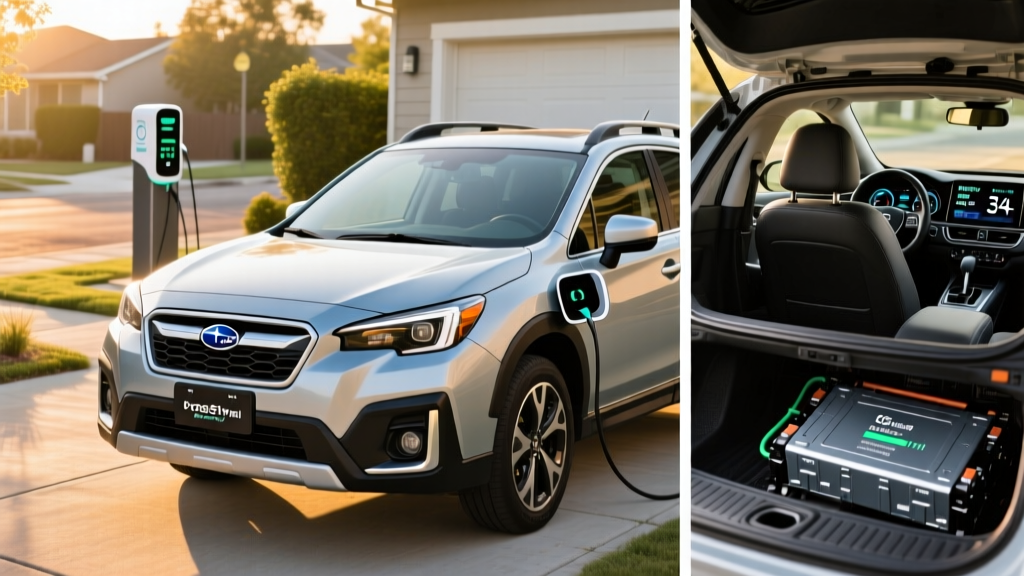
| Battery Location | Under rear cargo floor (reduces cargo space slightly) |
| 0–60 mph | ~9.0 seconds |
| Cargo Volume | ~20.1 cu ft (rear seats up) — reduced from non-PHEV |
| Ground Clearance | 8.7 inches |
| Towing Capacity | 1,000 lbs |
The 2.0-liter boxer four isn't a powerhouse, and 148 combined horsepower means the Crosstrek PHEV is adequate for commuting and trail access but not quick. Highway merging requires planning. The CVT keeps the engine in its efficient range but drones under hard acceleration — a familiar Subaru trait.
The electric motor provides strong initial torque from a stop, making the PHEV feel peppier than its 0–60 time suggests in city driving. In EV mode, the cabin is noticeably quieter, and the transition from electric to gasoline power is generally smooth.
Charging: Level 1, Level 2, and No DC Fast Charging
This is where the Crosstrek PHEV reveals its biggest limitation compared to newer PHEVs like the Toyota RAV4 Prime or Jeep Wrangler 4xe:
| Charging Level | Power | Time (0–100%) | Connector |
|---|---|---|---|
| Level 1 (120V household outlet) | ~1.2 kW | ~8 hours | J1772 |
| Level 2 (240V home/public) | ~3.3 kW | ~2.5–3 hours | J1772 |
| DC Fast Charging | Not supported | ||
No DC fast charging. The Crosstrek PHEV uses a J1772 connector for Level 1 and Level 2 AC charging only. You cannot use CCS, NACS, or CHAdeMO DC fast chargers. For an 8.8 kWh battery, this isn't a dealbreaker — Level 2 fully replenishes the pack in under three hours. But it means you can't top up quickly on a road trip.
Home charging setup: Most PHEV owners charge overnight on a standard 120V outlet (Level 1), which is sufficient for the small battery. A Level 2 home charger ($500–$1,200 installed) will give you a full battery in about 2.5 hours, useful if you want to charge between an afternoon errand and an evening commute.
Pricing, Trims, and Tax Credit Eligibility
The 2026 Crosstrek PHEV starts at an estimated $37,495 (including destination), available in a single well-equipped trim. That's roughly a $7,500 premium over the conventional Crosstrek Hybrid and about $10,000 above the base gasoline Crosstrek.
Federal tax credit (§30D): The Crosstrek PHEV may qualify for a partial federal tax credit. Under current IRS §30D rules, PHEVs must meet the same battery-sourcing and critical-minerals requirements as full EVs, plus:
- MSRP cap: Must be under $80,000 for SUVs/trucks (Crosstrek PHEV qualifies)
- Buyer income cap: Modified AGI ≤ $150,000 (single) / $300,000 (joint)
- Battery sourcing: Critical minerals and battery components must meet phased-in thresholds — Subaru's supply chain has historically limited credit eligibility
- Point-of-sale transfer: Eligible buyers can transfer the credit to the dealer for an upfront price reduction
- Estimated credit amount: Up to $4,502 depending on current-year sourcing compliance (not the full $7,500)
Critical caveat: Tax credit eligibility changes frequently based on battery-component and critical-mineral sourcing rules. Consult a tax professional and check the latest fueleconomy.gov tax credit page before purchasing. Never assume the full $7,500 applies.
Battery Warranty, Reliability, and Replacement Cost
Hybrid/PHEV Battery Warranty: 8 years / 100,000 miles (whichever comes first), covering defects and capacity loss below a specified threshold (typically 60–70% of original capacity).
Powertrain Warranty: 5 years / 60,000 miles
Battery Replacement Cost (out of warranty): Estimated $4,000–$6,500 for the PHEV traction battery pack, plus labor. Subaru's PHEV battery has proven durable in real-world use — widespread degradation reports are rare.
Subaru's hybrid system is derived from the Toyota partnership (the Crosstrek PHEV shares powertrain architecture with the Toyota Prius Prime lineage). This is a mature, well-tested system. IIHS has historically rated the Crosstrek well in crashworthiness, though check for the latest 2026 model-year results.
Will you need a battery replacement? Statistically, most PHEV batteries outlast the 8-year warranty period without significant issues. Subaru's relatively small 8.8 kWh pack experiences shallower charge-discharge cycles than a full EV battery, which reduces stress. Owners who regularly deplete and recharge the battery should expect gradual capacity loss — perhaps 10–15% over 8 years — meaning your 17-mile electric range might become 14–15 miles. That's noticeable but not catastrophic.
Driving Impressions: On-Road and Off
The Crosstrek PHEV drives like a slightly heavier Crosstrek — which is to say, comfortable, composed, and unhurried. The 8.7 inches of ground clearance and standard X-MODE AWD system make it genuinely capable on gravel roads, snow, and mild trails. No other PHEV in this price range matches its off-road competence.
Regenerative braking is moderate. Unlike a full EV, the Crosstrek PHEV doesn't offer strong one-pedal driving. You can select increased regen via steering-wheel paddles, but the car will still creep forward when you lift off the brake — traditional hybrid behavior.
In cold weather (below 30°F), expect the gasoline engine to start sooner and run more frequently, even with a full battery charge. The engine provides cabin heat, and Subaru's thermal management prioritizes battery longevity over electric-only range in extreme cold. Plan on 10–12 miles of electric range in January, not 17.
Crosstrek PHEV vs. Alternatives: Where It Fits
| Spec | Subaru Crosstrek PHEV | Toyota RAV4 Prime | Mitsubishi Outlander PHEV |
|---|---|---|---|
| EV Range | 17 mi | 42 mi | 38 mi |
| Combined HP | 148 hp | 302 hp | 248 hp |
| Gas MPG (depleted) | 35 MPG | 38 MPG | 26 MPG |
| AWD | Standard (mechanical) | Standard (e-AWD) | Standard (S-AWC) |
| DC Fast Charge | No | No | Yes (CHAdeMO) |
| Starting MSRP | ~$37,500 | ~$44,500 | ~$41,000 |
| Ground Clearance | 8.7 in | 8.1 in | 7.4 in |
The RAV4 Prime dominates on electric range (42 miles) and power (302 hp) but commands a much higher price and is frequently in limited supply. The Outlander PHEV offers three rows and DC fast charging but sacrifices fuel economy. The Crosstrek PHEV wins on price, ground clearance, and off-road capability — but its 17-mile electric range is the shortest in the segment.
Pros
- Lowest PHEV crossover entry price
- Standard AWD with genuine off-road capability (8.7 in ground clearance, X-MODE)
- Mature Toyota-derived hybrid system — proven reliability
- Level 1 overnight charging is sufficient for the small battery
- Quiet, comfortable ride quality
Cons
- Only 17 miles of electric-only range — shortest in class
- No DC fast charging
- 148 hp is underpowered for highway merging
- Premium over gas Crosstrek is steep (~$10,000)
- Cargo space reduced by battery placement
- Partial (not full) federal tax credit eligibility
Frequently Asked Questions
How many MPG does the Crosstrek PHEV get?
The EPA rates the 2026 Crosstrek PHEV at 35 MPG combined (34 city / 36 highway) when running on gasoline after the battery is depleted. When factoring in electric-only driving, it achieves 90 MPGe combined. In real-world driving, expect 33–37 MPG depending on terrain, temperature, and driving style — hybrids tend to match or slightly exceed EPA city figures in stop-and-go traffic but may fall short on sustained highway driving.
How far can the Crosstrek PHEV go on electric only?
The EPA rates it at 17 miles of electric-only range. Real-world testing typically yields 12–15 miles in moderate weather and 10–12 miles in cold conditions or at sustained highway speeds. This covers short commutes and errands but is insufficient for most round-trip commutes without mid-day charging.
Hybrid vs. PHEV vs. EV — which should I choose?
If you have home charging and a short commute, the PHEV lets you drive electrically most weekdays while keeping a gas engine for road trips. If you can't charge at home, the conventional Crosstrek Hybrid (HEV) gives you better fuel economy with zero behavior change. If your daily mileage is predictable and under 250 miles, a full EV like the Subaru Solterra or Hyundai Ioniq 5 eliminates gas entirely and has lower per-mile fuel costs — but requires commitment to charging infrastructure.
Is the Crosstrek PHEV reliable, and what does a battery replacement cost?
Yes. Subaru's PHEV system is based on proven Toyota hybrid architecture with a strong reliability track record. The battery is warrantied for 8 years/100,000 miles. Out-of-warranty replacement is estimated at $4,000–$6,500, though most PHEV batteries last well beyond the warranty period without significant issues.
Does the Crosstrek PHEV qualify for a tax credit?
It may qualify for a partial federal tax credit under IRS §30D rules — estimated at up to $4,502 depending on current battery-sourcing compliance. Eligibility also depends on your income (≤$300,000 joint / ≤$150,000 single) and the vehicle's MSRP (under $80,000). The credit can be transferred to the dealer at point of sale for an upfront discount. Always verify current eligibility on fueleconomy.gov and consult a tax professional before purchasing.
Can I charge the Crosstrek PHEV at a Tesla Supercharger?
No. The Crosstrek PHEV does not support DC fast charging of any kind — not Tesla NACS, not CCS, not CHAdeMO. It charges exclusively via AC Level 1 (120V) or Level 2 (240V) using a J1772 connector. For a small 8.8 kWh battery, this is adequate for home and destination charging.
Does the PHEV battery eat into cargo space?
Yes, slightly. The battery pack sits under the rear cargo floor, reducing volume to approximately 20.1 cubic feet (rear seats up) compared to the gasoline Crosstrek's 22.2 cubic feet. The cargo floor is also slightly higher, which matters if you load heavy gear.