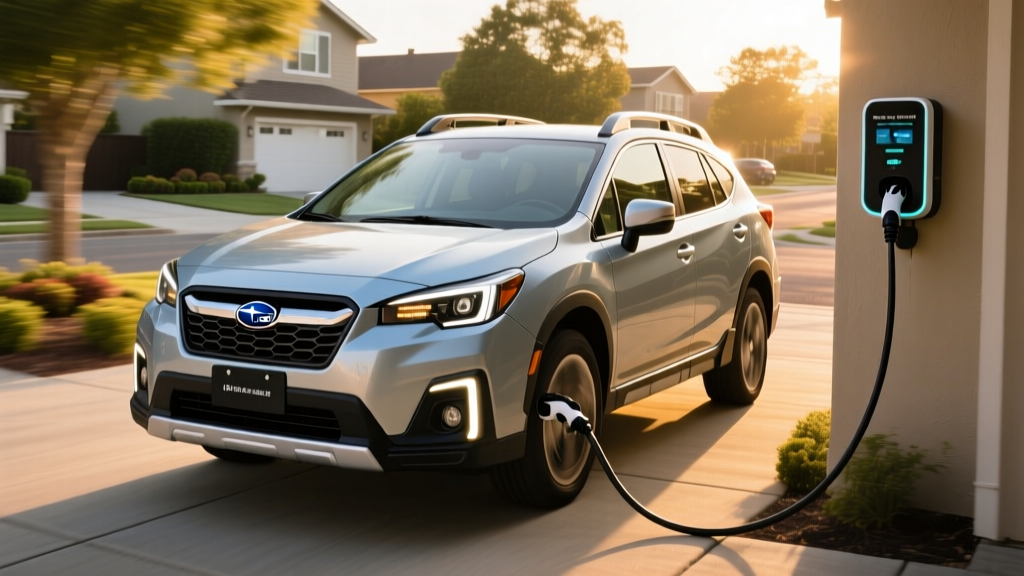
Subaru's compact crossover has long been the default choice for outdoorsy drivers who need standard all-wheel drive without the fuel penalty of a traditional SUV. The plug-in hybrid variant takes that formula and layers in meaningful electric-only range for daily commuting, while preserving the boxer-engine AWD system that defines the brand. This Subaru Crosstrek Hybrid review examines the 2026 model year — its plug-in hybrid powertrain, real-world efficiency, charging practicality, and where it fits among the growing field of electrified crossovers.
HEV vs PHEV: What the Crosstrek Hybrid Actually Is
Before diving into specs, it's essential to clarify what Subaru sells under the "Hybrid" badge, because the terminology can mislead buyers cross-shopping the segment.
Conventional Hybrid (HEV): A small battery (typically 1–2 kWh) recharges through regenerative braking and the gas engine. You never plug it in. The electric motor assists the engine to improve MPG, but there is no meaningful electric-only driving range. Think Toyota RAV4 Hybrid.
Plug-in Hybrid (PHEV): A larger battery (8–20+ kWh) that you can plug in to charge. It provides a usable electric-only range (typically 17–42 miles) before the gas engine takes over. After the battery depletes, it operates like a conventional hybrid. The Crosstrek Hybrid is a PHEV.
The 2026 Subaru Crosstrek Hybrid is exclusively a plug-in hybrid. If you're looking for a self-charging hybrid Crosstrek that requires no plug, Subaru does not currently offer one in the US market. Every Crosstrek Hybrid requires access to a 120V or 240V outlet to realize its full efficiency potential.
Powertrain and Performance Specs
The 2026 Crosstrek Hybrid pairs Subaru's 2.0-liter horizontally opposed (boxer) four-cylinder engine with two electric motors integrated into a continuously variable transmission (CVT). The result is Subaru's StarDrive all-wheel-drive system, which uses the electric motors to power the rear axle independently of the front — eliminating the mechanical driveshaft found in the gas-only Crosstrek and improving efficiency.
| Specification | Value |
|---|---|
| Engine | 2.0L boxer 4-cylinder + 2 electric motors |
| Combined System Horsepower | 148 hp |
| Combined System Torque | 152 lb-ft |
| Battery Capacity (Total / Usable) | 13.1 kWh / ~10.5 kWh usable |
| Battery Chemistry | Lithium-ion (NMC) |
| Electric-Only Range (EPA) | 17 miles |
| Total Combined Range (EPA) | ~440 miles |
| Drivetrain | StarDrive AWD (standard) |
| Transmission | Lineartronic CVT |
| 0–60 mph | ~10.5 seconds |
| Cargo Volume (behind rear seats) | 19.9 cu ft |
| Ground Clearance | 8.7 inches |
| Base MSRP | $36,995 (including destination) |
The 148 combined horsepower won't win any stoplight drag races, and the ~10.5-second 0–60 time reflects that. But for a compact AWD crossover prioritizing efficiency and capability, the powertrain delivers smooth, adequate acceleration with the instant torque fill that electric motors provide off the line.
Fuel Economy: EPA Ratings vs Real-World MPG
| Mode | City | Highway | Combined |
|---|---|---|---|
| Charge-Depleting (EV + Hybrid blended) | 90 MPGe | ||
| Charge-Sustaining (hybrid only, battery depleted) | 35 mpg | 33 mpg | 34 mpg |
According to EPA data at fueleconomy.gov, the Crosstrek Hybrid achieves 90 MPGe when operating in its blended electric-plus-gas mode with a charged battery, and 34 mpg combined once the battery is depleted and the car operates as a conventional hybrid.
Real-world MPG expectations: In mixed suburban and city driving with regular home charging, owners typically report 40–60 mpg effective fuel economy because most daily miles are covered on electricity. On long highway road trips with a depleted battery, expect 31–34 mpg — roughly 2–3 mpg less than the EPA city figure due to the AWD system's weight penalty and the boxer engine's highway-rpm characteristics. In cold weather (below 30°F), electric-only range drops 20–30%, making the gas engine kick in sooner.
This is where PHEV ownership gets nuanced. If your daily commute is under 17 miles round-trip and you charge nightly, you may go months between fill-ups. If you regularly drive 50+ miles without charging, you're essentially driving a heavy conventional hybrid at 33–35 mpg — which is still respectable for a standard-AWD crossover but not class-leading among hybrids.
Electric-Only Range and Charging
The Crosstrek Hybrid's EPA-rated electric-only range is 17 miles. That figure has remained relatively static across recent model years, and it's one area where the Crosstrek Hybrid falls behind competitors. The Toyota RAV4 Prime delivers 42 miles of electric range; the Hyundai Tucson PHEV manages 33 miles; even the smaller Kia Niro PHEV achieves 33 miles.
Seventeen miles covers a short commute or a grocery run, but it won't cover most Americans' daily driving without the gas engine engaging. FHWA data indicates the average American drives roughly 37 miles per day — meaning the Crosstrek Hybrid will rely on its gas engine for a significant portion of most owners' mileage.
| Charging Level | Power (kW) | 0–100% Time | Notes |
|---|---|---|---|
| Level 1 (120V household outlet) | ~1.2 kW | ~9 hours | Included portable cord |
| Level 2 (240V home/public charger) | ~3.3 kW (onboard charger max) | ~3 hours | Requires J1772 connector |
| DC Fast Charging | N/A | N/A | Not supported |
The onboard charger is limited to 3.3 kW, which means even on a Level 2 home charger, a full charge takes roughly 3 hours. This is typical for PHEVs in this class — most do not support DC fast charging, and the Crosstrek Hybrid is no exception. For daily use, plugging in overnight on Level 1 or Level 2 is sufficient to start each morning with a full battery.
Charging connector: The Crosstrek Hybrid uses the J1772 connector standard for AC charging. It does not have a NACS or CCS port since it cannot accept DC fast charging.
Pricing, Tax Credits, and Ownership Costs
The 2026 Subaru Crosstrek Hybrid starts at approximately $36,995 (destination included). That positions it roughly $8,000–$10,000 above a well-equipped gas-only Crosstrek Premium, which starts around $28,000. The premium buys you the PHEV powertrain, standard AWD, and lower operating costs — but the payback period depends heavily on your driving habits and electricity costs.
Federal Tax Credit Eligibility
Under IRS §30D Clean Vehicle Credit rules, the Crosstrek Hybrid may qualify for a partial federal tax credit of up to $7,500, but eligibility depends on multiple factors that change periodically:
- MSRP Cap: SUVs/crossovers must have an MSRP at or below $80,000 — the Crosstrek Hybrid clears this easily.
- Buyer Income Cap: Adjusted gross income must not exceed $150,000 (single), $225,000 (head of household), or $300,000 (joint filers).
- Battery Sourcing: Critical minerals and battery components must meet phased-in domestic-sourcing percentages that tighten each year. PHEVs must also meet a minimum battery capacity threshold (at least 7 kWh — the Crosstrek's 13.1 kWh pack qualifies).
- Point-of-Sale Transfer: As of 2024, eligible buyers can transfer the credit to the dealer at purchase, applying it as a down payment reduction rather than waiting for a tax refund.
Important caveat: Battery-sourcing requirements have disqualified many PHEVs from the full credit in recent years. Check the latest fueleconomy.gov tax credit listings for the Crosstrek Hybrid's current eligibility status before purchasing. Consult a tax professional for your specific situation.
Battery Warranty, Reliability, and Replacement Cost
Hybrid/PHEV Battery Warranty: Subaru covers the Crosstrek Hybrid's high-voltage battery for 8 years / 100,000 miles (whichever comes first), with a capacity retention threshold of approximately 70%. The hybrid system components (inverter, electric motors, wiring) carry the same 8-year/100,000-mile coverage.
PHEV battery degradation is generally slower than full BEV degradation because the battery is smaller, the usable window is narrower (the system buffers the top and bottom of the charge to protect longevity), and the battery isn't subjected to repeated DC fast charging, which accelerates wear.
Subaru's hybrid reliability track record has been solid but not without caveats. The previous-generation Crosstrek Hybrid (sold through 2023) had relatively few widespread battery failure reports. IIHS crash-test ratings and Subaru's EyeSight driver-assist system contribute to strong safety credentials, though EyeSight remains a Level 2 system requiring constant driver attention.
Battery replacement cost: If the high-voltage battery requires replacement out of warranty, expect a cost in the range of $4,000–$7,000 for the battery pack plus labor. This is a worst-case scenario — many PHEV batteries outlast the vehicle itself, and individual module replacement (rather than the full pack) can reduce costs significantly. Some states with California Air Resources Board (CARB) emissions rules mandate extended hybrid battery warranties of 10 years/150,000 miles.
Who Should Choose the Crosstrek Hybrid?
Choose the Crosstrek Hybrid if:
- You need standard AWD for snow, rain, or light off-road use
- Your daily commute is under 20 miles and you can charge at home
- You want to reduce fuel consumption without range anxiety on road trips
- You value Subaru's safety reputation and EyeSight driver-assist system
- You live in a state with CARB extended hybrid warranty protections
Choose a full BEV (like the Hyundai Ioniq 5 or Tesla Model Y) if:
- You have reliable home charging and your daily drive is under 250 miles
- You want to eliminate gasoline entirely and minimize maintenance
- You want access to DC fast charging for road trips
- You want 200+ miles of range without the gas engine ever starting
Choose the gas-only Crosstrek if:
- You cannot charge at home or at work
- You want a lower purchase price (saves $8,000+)
- Your daily mileage is high and predominantly highway (the PHEV advantage diminishes)
- You plan to keep the vehicle 10+ years and want mechanical simplicity
Pros
- Standard AWD with no fuel-economy penalty vs. gas AWD competitors
- 8.7 inches of ground clearance — best in PHEV crossover class
- Can operate as a conventional hybrid if you forget to charge
- Subaru EyeSight safety suite standard
- 8-year/100,000-mile hybrid battery warranty
Cons
- Only 17 miles of electric-only range — trails RAV4 Prime (42 mi) and Tucson PHEV (33 mi)
- No DC fast charging capability
- 3.3 kW onboard charger means slow Level 2 top-ups
- ~$8,000+ premium over the gas Crosstrek
- Modest 148 hp — noticeably slower than RAV4 Prime's 302 hp
- Cargo space slightly reduced vs. gas Crosstrek due to battery placement
How It Compares to Key PHEV Rivals
| Spec | Subaru Crosstrek Hybrid | Toyota RAV4 Prime | Hyundai Tucson PHEV |
|---|---|---|---|
| Electric-Only Range | 17 mi | 42 mi | 33 mi |
| Combined MPG (hybrid mode) | 34 mpg | 38 mpg | 35 mpg |
| Combined Horsepower | 148 hp | 302 hp | 261 hp |
| AWD Standard? | Yes | Yes | Yes |
| Ground Clearance | 8.7 in | 8.1 in | 7.3 in |
| DC Fast Charge? | No | No | No |
| Base MSRP (approx.) | $36,995 | $44,500 | $39,900 |
| Battery Warranty | 8 yr / 100k mi | 10 yr / 150k mi | 10 yr / 100k mi |
The Crosstrek Hybrid's strongest differentiator is ground clearance and off-road capability — it genuinely outperforms these rivals on rough terrain. The RAV4 Prime dominates on electric range and power. The Tucson PHEV sits in the middle with more range than the Subaru at a lower price than the Toyota.
Frequently Asked Questions
How many MPG does the Subaru Crosstrek Hybrid get?
The EPA rates the 2026 Crosstrek Hybrid at 34 mpg combined (35 city / 33 highway) when operating in hybrid mode with a depleted battery. When factoring in electric-only driving with regular charging, the effective MPGe rating is 90 MPGe. Real-world highway fuel economy with a depleted battery typically falls to 31–34 mpg.
How far can the Crosstrek Hybrid go on electric only?
The EPA-rated electric-only range is 17 miles. In mild weather with gentle acceleration, some drivers report 19–20 miles. In cold weather or at highway speeds, expect 12–14 miles before the gas engine activates.
Does the Subaru Crosstrek Hybrid qualify for a federal tax credit?
It may qualify for up to $7,500 under IRS §30D, but eligibility depends on your income, the vehicle's battery-sourcing compliance in the current year, and MSRP caps. Check fueleconomy.gov for the latest status and consult a tax professional. The credit can be transferred to the dealer at point of sale as a price reduction.
Is the Crosstrek Hybrid reliable? What about battery replacement cost?
Subaru's hybrid components have shown solid reliability, and the battery is covered for 8 years/100,000 miles. Out-of-warranty battery replacement runs approximately $4,000–$7,000, though full-pack replacement is rare — individual module service is often possible. Many PHEV batteries last 15+ years with normal use.
Do I have to plug in the Crosstrek Hybrid?
Yes — it's a plug-in hybrid (PHEV), not a conventional self-charging hybrid. If you never plug it in, it operates as a conventional hybrid at 34 mpg combined, but you lose the efficiency benefit and fuel savings that justify the price premium. Without regular charging, a gas-only Crosstrek is a better financial choice.
Is EyeSight self-driving?
No. Subaru EyeSight is an SAE Level 2 driver-assistance system. It provides adaptive cruise control, lane-centering, and pre-collision braking, but the driver must remain fully attentive, keep hands on the wheel, and be prepared to take over at any moment. It is not autonomous driving.