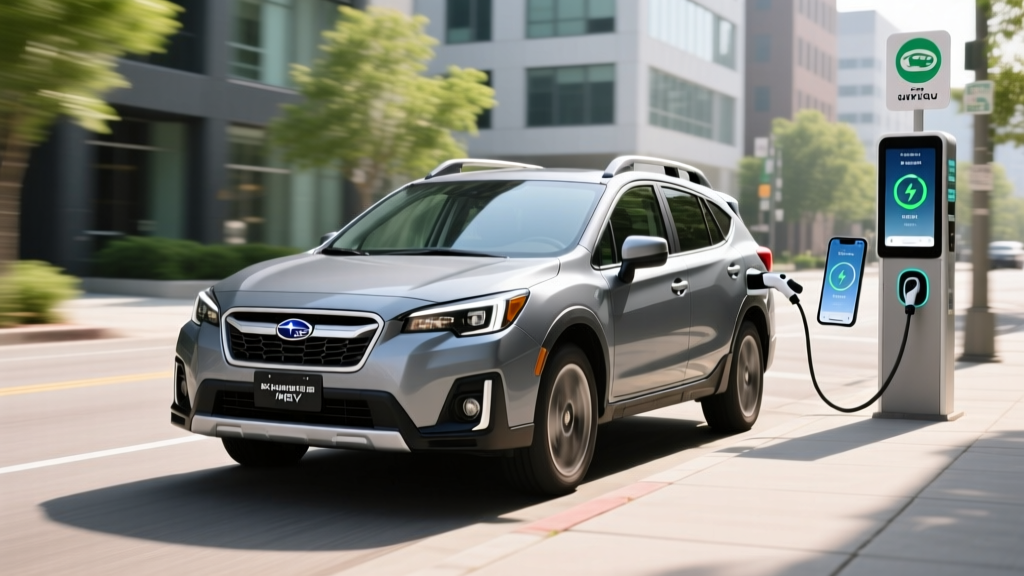
Subaru has never been a brand to chase the EV hype cycle. Instead, the automaker leans into what its loyal buyers actually want: standard all-wheel drive, rugged ground clearance, and practical efficiency. The 2026 Subaru Crosstrek Hybrid — a plug-in hybrid electric vehicle (PHEV) — is the clearest expression of that philosophy. It pairs Subaru's 2.0-liter boxer engine with a plug-in hybrid system derived from Toyota's proven PHEV architecture, delivering short-range electric-only commuting and all-wheel-drive capability without range anxiety.
If you've been searching for a Subaru PHEV, the Crosstrek Hybrid is currently the only plug-in option in Subaru's U.S. lineup (the larger Outback and Forester remain conventional hybrids or gas-only for 2026). Here's everything you need to know about range, efficiency, charging, pricing, and whether this PHEV fits your garage.
Subaru PHEV vs. Conventional Hybrid: What's the Difference?
Before diving into specs, it's critical to understand what separates the Crosstrek PHEV from a conventional hybrid (HEV). Many shoppers conflate the two, and the distinction determines whether you'll actually benefit from plug-in capability.
| Feature | Conventional Hybrid (HEV) | Plug-In Hybrid (PHEV) |
|---|---|---|
| Plugs in to charge? | No — charges via regenerative braking and engine | Yes — Level 1 (120V) or Level 2 (240V) |
| Electric-only range | 0–1 miles at low speed | ~17 miles (EPA est.) |
| Battery size | ~1.1 kWh (small buffer) | 8.8 kWh usable |
| Federal tax credit (§30D) | Not eligible | Up to $4,502 (see eligibility below) |
| Best for | Drivers who can't charge at home | Drivers with home/workplace charging + short commutes |
The Crosstrek Hybrid is a PHEV. You plug it in to unlock its electric-only range. If you never plug it in, it still functions as a conventional hybrid — just with less efficiency than a dedicated HEV due to the added battery weight.
2026 Subaru Crosstrek Hybrid: Full Spec Sheet
| Powertrain | 2.0L boxer 4-cyl + 2 electric motors (e-CVT) |
| Combined Horsepower | 148 hp (net system) |
| Battery (usable) | 8.8 kWh lithium-ion |
| EV-Only Range (EPA est.) | 17 miles |
| Total Combined Range | ~440 miles (EV + gas) |
| EPA MPGe (EV mode) | 92 MPGe combined |
| EPA MPG (hybrid mode, battery depleted) | 35 combined (33 city / 38 highway) |
| Drivetrain | Symmetrical AWD (standard) |
| 0–60 mph | ~8.6 seconds |
| Ground Clearance | 8.7 inches |
| DC Fast Charging | Not available (AC only) |
| Level 2 Charge Time (0–100%) | ~2.5 hours at 3.3 kW |
| Level 1 Charge Time (120V) | ~5 hours |
| Cargo Volume (rear seats up) | 19.9 cu ft |
| Base MSRP | $38,445 (includes destination) |
How Many MPG Does the Subaru PHEV Get?
The EPA rates the 2026 Crosstrek Hybrid at 35 MPG combined once the battery is depleted and the car operates as a conventional hybrid. The breakdown is 33 city / 38 highway, according to fueleconomy.gov. In EV mode, it achieves 92 MPGe combined.
| Mode | City | Highway | Combined |
|---|---|---|---|
| Hybrid (charge-depleted) | 33 MPG | 38 MPG | 35 MPG |
| Electric-only (MPGe) | — | — | 92 MPGe |
Real-World MPG vs. EPA Estimates
Hybrids, including PHEVs in charge-depleted mode, tend to exceed EPA city estimates in real-world stop-and-go driving because regenerative braking recaptures energy that gas-only vehicles waste as heat. Owners report seeing 36–40 MPG in city commuting when the battery is depleted.
Highway driving tells a different story. At sustained 70–80 mph speeds, the Crosstrek's boxy crossover profile and standard AWD create drag and mechanical losses. Expect 33–35 MPG on the highway in hybrid mode — slightly below the EPA sticker. In cold weather (below 35°F), engine warm-up cycles and cabin heating demands can push hybrid-mode consumption higher, yielding 30–32 MPG on winter road trips.
- EV-only (EPA): 17 miles — expect 13–15 miles at highway speeds or in cold weather
- Hybrid mode (gas tank): ~370 miles on the 10.6-gallon tank at 35 MPG combined
- Total real-world range: ~385–410 miles (EV + gas), depending on conditions
Electric-Only Range: How Far Can the Subaru PHEV Go Without Gas?
The EPA rates the Crosstrek Hybrid at 17 miles of electric-only range. That figure is modest compared to PHEVs like the Toyota RAV4 Prime (42 miles) or the Hyundai Tucson PHEV (33 miles). However, 17 miles covers a meaningful share of daily driving: the U.S. average one-way commute is roughly 16 miles, according to Census Bureau data.
The 8.8 kWh battery pack is smaller than many PHEV competitors, which is a deliberate engineering trade-off. Subaru prioritized maintaining the Crosstrek's 8.7 inches of ground clearance and cargo floor height — packaging a larger battery would compromise the vehicle's off-road capability and interior volume.
What degrades EV range in a PHEV?
- Cold weather: Below freezing, expect 20–30% EV range loss (11–14 miles) due to battery chemistry limitations and cabin heating demands.
- Highway speeds: Above 55 mph, EV efficiency drops sharply. At 75 mph, you may see only 10–12 electric miles.
- Hills and towing: The Crosstrek Hybrid is not rated for heavy towing, but steep grades will consume battery faster.
Charging the Crosstrek Hybrid: No DC Fast Charging
One of the most important things to understand about the Crosstrek Hybrid's charging is what it cannot do: it does not support DC fast charging. This is common among smaller-battery PHEVs. The 8.8 kWh pack is designed for overnight or workplace top-ups, not highway fast-charging stops.
| Charging Level | Voltage / Power | Time (0–100%) | Practical Notes |
|---|---|---|---|
| Level 1 (included cord) | 120V / ~1.4 kW | ~5 hours | Standard household outlet; sufficient for overnight |
| Level 2 (home/public) | 240V / 3.3 kW | ~2.5 hours | Requires J1772 connector; max onboard charger is 3.3 kW |
| DC Fast Charge | N/A | N/A | Not supported — AC charging only |
With a 3.3 kW onboard charger, the Crosstrek Hybrid won't take full advantage of a 48-amp Level 2 home charger (which can deliver up to 11.5 kW). It will only pull 3.3 kW regardless of the station's capability. This is perfectly adequate for a battery this size — a full charge in 2.5 hours on Level 2 means you can easily top up during the workday or between errands.
Powertrain and Performance
The Crosstrek Hybrid uses Subaru's 2.0-liter naturally aspirated boxer engine paired with two electric motors integrated into a continuously variable transmission (e-CVT). The system produces a combined 148 horsepower — adequate for commuting and light trail driving, but not quick by modern standards. The 0–60 mph time of roughly 8.6 seconds trails turbocharged PHEV competitors.
The AWD system is Subaru's proven Symmetrical All-Wheel Drive, with the rear axle driven electrically in EV mode and mechanically via the e-CVT in hybrid mode. This means AWD is always available regardless of battery state — a key advantage over some FWD-only PHEVs.
Pricing and Tax Credit Eligibility
The 2026 Subaru Crosstrek Hybrid starts at $38,445 (including destination charge). That's a significant premium over the gas-only Crosstrek (starting around $27,445) and the conventional Crosstrek Hybrid HEV variant available in some markets.
Federal Tax Credit (§30D)
Under current IRS rules for the §30D Clean Vehicle Credit, the Crosstrek Hybrid qualifies for a partial credit based on its battery capacity. The credit formula under §30D(e) provides $417 plus $417 per kWh of battery capacity exceeding 5 kWh. With an 8.8 kWh battery:
- Base: $417
- Excess kWh: 3.8 kWh × $417 = $1,585
- Estimated credit: ~$2,002
However, the full credit amount also depends on critical mineral and battery component sourcing requirements that phase in annually. For 2026, vehicles must meet escalating domestic-content thresholds. Subaru's PHEV battery sourcing may qualify for the additional critical-minerals bonus, potentially bringing the total closer to $3,750–$4,502. Buyers must verify eligibility via the IRS's official vehicle eligibility list at the time of purchase.
- Vehicle MSRP must be ≤ $80,000 for SUVs/CUVs (Crosstrek qualifies at ~$38,445)
- Buyer AGI must be ≤ $150,000 (single) / $300,000 (joint) / $225,000 (head of household)
- Vehicle must be assembled in North America (Subaru's Lafayette, IN plant qualifies)
- Battery critical mineral and component sourcing thresholds must be met (check irs.gov for current-year list)
- Credit can be applied at point of sale as a down payment reduction (transfer to dealer)
- Must be purchased new; used PHEV credits fall under §25E with different rules
Battery Warranty and Long-Term Reliability
- Hybrid battery: 8 years / 100,000 miles (whichever comes first)
- Capacity retention guarantee: Battery warranted against defects and abnormal capacity loss
- Powertrain warranty: 5 years / 60,000 miles
- Bumper-to-bumper: 3 years / 36,000 miles
Is the Subaru PHEV Reliable?
Subaru's PHEV system is derived from Toyota's plug-in hybrid architecture — one of the most extensively validated hybrid systems in production. Toyota has manufactured tens of millions of hybrid vehicles since the Prius launched in 1997, and the e-CVT design used in the Crosstrek Hybrid has no traditional transmission bands, clutches, or torque converters to fail.
Hybrid battery replacement cost is a common concern. For the Crosstrek Hybrid's 8.8 kWh pack, expect a dealer replacement to cost between $3,500 and $5,500 if needed outside warranty. However, real-world data from Toyota's mechanically similar PHEV systems shows battery degradation of 10–15% over 10 years and 150,000+ miles is typical — far below the threshold for warranty claims.
Subaru's standard AWD system and boxer engine have well-documented maintenance requirements (head gasket history on older models is largely resolved in the current-generation FB20 engine). The hybrid variant adds complexity with the battery pack and electric motors but eliminates the conventional starter motor and alternator — components that regularly fail on gas-only vehicles.
Who Should Buy the Subaru Crosstrek PHEV?
- Standard AWD with 8.7" ground clearance — genuine light off-road capability
- Electric-only commuting for short trips (17 mi EPA)
- No range anxiety — 440+ mile total range with gas engine
- Toyota-derived hybrid system with proven reliability
- Qualifies for partial federal tax credit
- Good visibility, practical cargo space, EyeSight safety suite standard
- Short EV range (17 mi) vs. RAV4 Prime (42 mi) or Tucson PHEV (33 mi)
- No DC fast charging
- Only 148 hp — noticeably slower than turbocharged PHEV competitors
- ~$11,000 premium over base gas Crosstrek
- 3.3 kW onboard charger limits Level 2 speed
- Cargo space slightly reduced vs. gas model due to battery placement
Subaru PHEV vs. Full EV vs. Gas: Which Fits You?
- You have home or workplace Level 2 charging access
- Your daily commute is under 20 miles round-trip (you'll rarely burn gas on weekdays)
- You need AWD and ground clearance for snow, gravel, or light trails
- You take road trips where charging infrastructure is sparse
- You want EV-like commuting without committing to a full BEV
- You have reliable home charging and your daily driving is under 200 miles
- You want zero tailpipe emissions and minimal drivetrain maintenance
- You're eligible for the full $7,500 §30D credit on a qualifying BEV
- Consider: Tesla Model Y, Hyundai Ioniq 5, Subaru Solterra (Subaru's all-electric option)
- You cannot charge at home or work (apartment, street parking)
- You want hybrid efficiency without the PHEV price premium
- Your commute is long (40+ miles daily) where EV-only range provides minimal benefit
- Consider: Toyota RAV4 Hybrid, Honda CR-V Hybrid
- You drive fewer than 8,000 miles per year (the fuel savings won't offset the PHEV premium)
- You need maximum towing capacity or heavy-duty off-road use
Frequently Asked Questions
Does the 2026 Subaru Crosstrek Hybrid need to be plugged in?
No — it will operate as a conventional hybrid if you never plug it in. However, you'll miss the 17-mile EV-only range and the associated fuel savings. To get the full benefit of a PHEV, plug it in nightly on Level 1 or Level 2.
Can the Subaru PHEV DC fast charge?
No. The Crosstrek Hybrid only supports AC charging (Level 1 at 120V or Level 2 at 240V). The onboard charger is limited to 3.3 kW. DC fast charging is not available, which is typical for smaller-battery PHEVs.
How long will the hybrid battery last?
Subaru warranties the hybrid battery for 8 years / 100,000 miles. Based on data from Toyota's similar PHEV systems, expect 10–15% capacity loss over 10 years and 150,000+ miles under normal use. Full battery replacement, if needed out of warranty, costs approximately $3,500–$5,500.
Does the Subaru PHEV qualify for the federal tax credit?
Yes, partially. Under §30D, the estimated credit is approximately $2,002–$4,502 depending on battery sourcing compliance. Eligibility also depends on buyer income limits ($150K single / $300K joint) and the vehicle's MSRP (must be ≤ $80,000 for SUVs). Check the IRS Clean Vehicle Credit page for the current eligibility list.
Is the Subaru Crosstrek Hybrid good in snow?
Yes. With standard Symmetrical AWD, 8.7 inches of ground clearance, and Subaru's X-MODE traction management, the Crosstrek Hybrid is one of the most capable PHEVs in winter conditions. The hybrid system adds low-speed electric torque that enhances traction on icy surfaces.
What is the difference between the Subaru Crosstrek Hybrid and the Subaru Solterra?
The Crosstrek Hybrid is a plug-in hybrid (PHEV) with a gas engine and 17 miles of EV range. The Subaru Solterra is a fully electric SUV (BEV) with ~227 miles of EPA range and no gas engine. The Solterra is better for drivers who can charge at home and don't need 400+ mile road-trip range; the Crosstrek Hybrid suits those who need flexibility for remote travel.
How much does it cost to charge the Crosstrek PHEV at home?
A full charge of the 8.8 kWh battery at the U.S. average residential electricity rate of ~$0.17/kWh costs approximately $1.50. That's roughly $0.09 per electric mile — compared to $0.14–$0.16 per mile on gasoline at 35 MPG and $3.50/gallon.