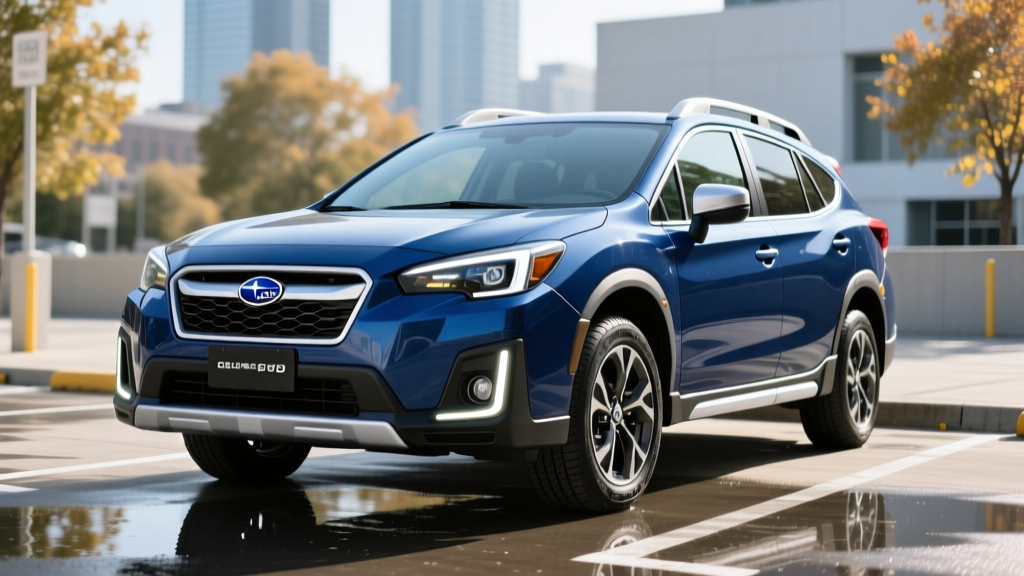
The Subaru Crosstrek Hybrid occupies a narrow but compelling lane in the electrified compact crossover segment. Unlike a pure battery-electric vehicle, it pairs a gasoline engine with a plug-in hybrid powertrain, giving drivers a short electric-only commute followed by seamless gas-engine operation when the battery depletes. For the 2026 model year, Subaru continues the Crosstrek Hybrid as a plug-in hybrid (PHEV) — not a conventional self-charging hybrid — which is a critical distinction for buyers comparing it to rivals like the Toyota RAV4 Prime or Hyundai Tucson Plug-in Hybrid.
This guide breaks down the 2026 Subaru Crosstrek Hybrid's real-world fuel economy, electric-only range, powertrain specs, pricing, tax credit eligibility, and long-term battery reliability. If you're weighing this PHEV against a full EV or a gas-only Crosstrek, you'll find the data you need below.
2026 Subaru Crosstrek Hybrid: Key Specs at a Glance
| Specification | Value |
|---|---|
| Powertrain Type | Plug-in Hybrid (PHEV) |
| Engine | 2.0L 4-cylinder boxer + electric motor |
| Combined Horsepower | 148 hp |
| Battery Capacity | 8.8 kWh (lithium-ion) |
| Electric-Only Range (EPA) | 17 miles |
| Total Combined Range | ~430 miles |
| EPA MPG (Combined) | 35 MPG (hybrid mode) / 90 MPGe (with charge) |
| Drivetrain | Symmetrical AWD (standard) |
| Level 2 Charge Time (0–100%) | ~2.5 hours (240V, 3.3 kW onboard charger) |
| DC Fast Charging | Not supported |
| Base MSRP | $36,995 |
| Federal Tax Credit (§30D) | Up to $7,500 (subject to eligibility — see below) |
Fuel Economy: How Many MPG Does the Subaru Crosstrek Hybrid Get?
The EPA rates the 2026 Subaru Crosstrek Hybrid at 35 MPG combined when operating in hybrid mode (after the battery is depleted). When factoring in electric-only driving, the combined rating is 90 MPGe. Here is the full breakdown according to fueleconomy.gov:
| Driving Mode | City | Highway | Combined |
|---|---|---|---|
| Hybrid Mode (gas only) | 34 MPG | 36 MPG | 35 MPG |
| Electric + Hybrid (MPGe) | — | — | 90 MPGe |
Electric-Only Range: How Far Can It Go Without Gas?
The EPA rates the 2026 Crosstrek Hybrid at 17 miles of electric-only range. That figure comes from the 8.8 kWh lithium-ion battery pack, of which roughly 6.5 kWh is usable to protect long-term battery health (the system maintains a buffer at both the top and bottom of the charge).
Seventeen miles is modest compared to competitors. The Toyota RAV4 Prime delivers 42 miles of electric range, and the Hyundai Tucson PHEV offers 33 miles. The Crosstrek Hybrid's shorter range is a direct consequence of its smaller battery, which was chosen to keep weight down and preserve cargo space.
Real-world electric range expectations:
- Mild weather, city driving (under 45 mph): 18–20 miles
- Highway driving (65–70 mph): 13–15 miles
- Cold weather (below freezing, with cabin heat): 10–13 miles
If your one-way commute is under 15 miles and you can charge at home overnight, you'll run almost entirely on electricity during the week — only using gas for longer weekend trips. That's the PHEV sweet spot.
Powertrain and Performance
The 2026 Crosstrek Hybrid uses Subaru's e-Boxer plug-in hybrid system, pairing a 2.0-liter horizontally opposed (boxer) four-cylinder engine with an electric motor integrated into the CVT transmission. Combined output is 148 horsepower.
The electric motor provides immediate torque at low speeds, making the Crosstrek Hybrid feel more responsive around town than the gas-only 2.0L Crosstrek (which produces 152 hp but lacks the electric assist). Subaru's Symmetrical All-Wheel Drive is standard, using the electric motor to power the rear axle in certain conditions — a setup that provides genuine traction benefits in snow and rain without a mechanical driveshaft to the rear wheels.
Acceleration is adequate rather than quick. Expect a 0–60 mph time in the 8.5–9.0 second range. The CVT keeps the engine in its efficient power band, but it drones noticeably under hard acceleration — a common CVT trait. For buyers prioritizing performance, the RAV4 Prime's 302 hp is in a completely different league, but it also starts over $44,000.
Charging: What You Need to Know
The Crosstrek Hybrid comes with a J1772 charge port and a dual-voltage charging cable (Level 1 / Level 2 capable). Here's what charging looks like in practice:
| Charge Level | Power (kW) | 0–100% Time | Notes |
|---|---|---|---|
| Level 1 (120V outlet) | 1.2 kW | ~7 hours | Standard household outlet; overnight is sufficient |
| Level 2 (240V) | 3.3 kW | ~2.5 hours | Home wall charger or public Level 2 station |
| DC Fast Charge | N/A | N/A | Not supported — battery too small to justify |
The 3.3 kW onboard charger is the limiting factor. Even if you plug into a 7.2 kW or 11.5 kW public Level 2 station, the car will only accept 3.3 kW. That's perfectly fine for overnight home charging — 2.5 hours is fast enough to top off while you run errands or between commute segments — but it means the Crosstrek Hybrid can't take advantage of faster public chargers.
The absence of DC fast charging is standard for PHEVs with small batteries. The 8.8 kWh pack simply doesn't benefit from 50+ kW charge rates. You'll rely on Level 1 or Level 2 charging exclusively.
Pricing, Tax Credits, and Incentives
The 2026 Subaru Crosstrek Hybrid starts at $36,995 MSRP (including destination). That's approximately $7,000–$9,000 more than a comparably equipped gas-only Crosstrek Premium. The price gap narrows considerably if you qualify for federal and state incentives.
- Vehicle MSRP cap: SUVs/crossovers must be under $80,000 — the Crosstrek Hybrid qualifies ✓
- Buyer income cap: AGI must not exceed $150,000 (single), $225,000 (head of household), or $300,000 (joint) ✓
- Battery sourcing & critical minerals: Must meet IRS requirements for North American assembly and battery component sourcing — verify current-year eligibility on irs.gov before purchase
- Point-of-sale transfer: Eligible buyers can transfer the credit to the dealer for an immediate price reduction at purchase
- Maximum credit: Up to $7,500, but actual amount depends on battery sourcing compliance — some PHEVs qualify for only $3,750
Always confirm eligibility with a tax professional and the IRS §30D guidance before purchasing. Rules change frequently.
Many states also offer additional rebates or HOV lane access for PHEVs. California's Clean Vehicle Rebate, Colorado's state tax credit, and New York's Drive Clean Rebate are examples — but amounts and eligibility vary by jurisdiction. Check your state's energy or DMV website for current programs.
Battery Warranty, Reliability, and Replacement Cost
Hybrid battery reliability has proven strong across the industry. Toyota's decades of hybrid production (the Crosstrek Hybrid shares its powertrain architecture with Toyota's plug-in hybrid system under the Subaru-Toyota partnership) show that lithium-ion hybrid batteries routinely last 150,000–200,000+ miles with minimal degradation. The smaller battery in a PHEV cycles more frequently than an HEV's, but the system's thermal management and charge buffers are designed to mitigate wear.
Battery replacement cost: If the high-voltage battery fails outside of warranty, replacement runs $4,000–$7,000 including parts and labor at a Subaru dealer. Independent hybrid specialists may offer refurbished packs for $2,500–$4,000. This cost is declining as the hybrid parts aftermarket matures.
The Crosstrek Hybrid's overall reliability benefits from Subaru's proven AWD system and the Toyota-derived hybrid components. The main maintenance items remain standard: tire rotations, brake fluid, cabin air filter, and engine oil changes (yes, the gas engine still needs oil — typically every 6,000–10,000 miles with synthetic).
Subaru Crosstrek Hybrid vs Full EV vs Gas: Which Is Right for You?
| Factor | Crosstrek Hybrid (PHEV) | Full EV (e.g., Subaru Solterra) | Gas Crosstrek |
|---|---|---|---|
| Home charging needed? | Recommended (not required) | Essential | No |
| Road trip range anxiety | None (gas backup) | Requires route planning | None |
| Daily commute (under 15 mi) | Mostly electric | 100% electric | 100% gas |
| Fuel cost per mile | $0.06–$0.12 | $0.04–$0.08 | $0.14–$0.18 |
| Maintenance cost | Moderate | Low | Moderate |
| Upfront price | $36,995 | $38,495+ | $27,995+ |
- Your daily commute is under 20 miles round-trip and you can charge at home
- You regularly take longer road trips and don't want to plan around DC fast chargers
- You need AWD for snow, mud, or light off-road use
- You want to reduce gas consumption without committing to a full EV
Choose a full EV if:
- You have reliable home Level 2 charging and rarely drive over 200 miles in a day
- You want the lowest per-mile fuel and maintenance costs
- You don't want to maintain a gas engine (oil changes, spark plugs, emissions)
Stick with the gas Crosstrek if:
- You can't charge at home (apartment, no garage, street parking only)
- Your budget is under $30,000 and the tax credit doesn't bridge the gap
- You drive very few miles annually — the fuel savings won't offset the price premium
Pros and Cons
- Standard AWD with genuine snow/mud capability
- 17-mile electric range covers most short commutes
- No range anxiety — gas engine provides 430+ total miles
- Federal tax credit up to $7,500 (if eligible)
- Toyota-derived hybrid system with strong reliability history
- 8.8-foot ground clearance for light off-road use
- 17-mile electric range trails RAV4 Prime (42 mi) and Tucson PHEV (33 mi)
- 3.3 kW onboard charger limits Level 2 speed
- No DC fast charging
- 148 hp is modest — highway passing requires planning
- ~$9,000 premium over gas Crosstrek before incentives
- Cargo space reduced by battery placement (~20 cu ft vs 21 cu ft gas model)
Frequently Asked Questions
How many MPG does the Subaru Crosstrek Hybrid get?
The EPA rates the 2026 Crosstrek Hybrid at 34 city / 36 highway / 35 combined MPG in hybrid mode. In real-world city driving, many owners report 36–40 MPG thanks to regenerative braking. Highway driving at 75+ MPH typically returns 31–33 MPG.
How far can the Crosstrek Hybrid go on electric only?
The EPA rates it at 17 miles of electric-only range. In mild weather city driving, you may see 18–20 miles. Highway or cold-weather driving reduces this to 10–15 miles. After the battery depletes, the gas engine takes over seamlessly.
Do I have to plug in the Subaru Crosstrek Hybrid?
No — but you should. Unlike a conventional hybrid (HEV), the Crosstrek Hybrid is a PHEV, meaning it can be plugged in to charge the battery for electric-only driving. If you never plug it in, it operates as a regular hybrid at 35 MPG, but you're paying a premium for electric capability you're not using.
Is the Crosstrek Hybrid reliable?
The hybrid powertrain is derived from Toyota's proven plug-in hybrid system, which has demonstrated excellent long-term reliability across millions of vehicles. Subaru covers the hybrid battery for 8 years/100,000 miles (10 years/150,000 miles in CARB states). Battery replacement, if needed out of warranty, costs $4,000–$7,000.
Does the Subaru Crosstrek Hybrid qualify for a tax credit?
It may qualify for the federal §30D clean vehicle credit of up to $7,500, depending on battery sourcing requirements, your income, and the vehicle's MSRP (which is under the $80,000 SUV cap). Eligibility rules change frequently — verify on irs.gov and consult a tax professional before purchasing. Many states offer additional rebates.
Can the Crosstrek Hybrid use DC fast chargers?
No. The Crosstrek Hybrid does not support DC fast charging. Its 8.8 kWh battery charges via Level 1 (120V, ~7 hours) or Level 2 (240V, ~2.5 hours) using a J1772 connector. This is standard for PHEVs with small battery packs.
How does the Crosstrek Hybrid compare to the RAV4 Prime?
The Toyota RAV4 Prime offers significantly more electric range (42 vs 17 miles), more power (302 vs 148 hp), and a faster onboard charger. However, the RAV4 Prime starts around $44,000 and is often subject to dealer markups. The Crosstrek Hybrid is more affordable, more compact, and offers Subaru's renowned AWD system with higher ground clearance for off-pavement use.