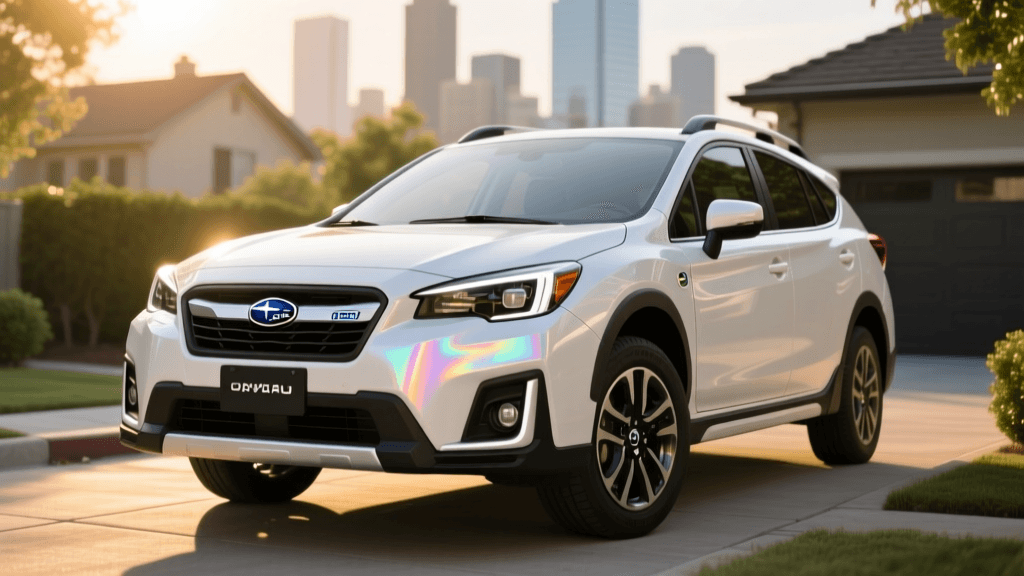
The Subaru Crosstrek Hybrid: A Unique PHEV Proposition
When evaluating the plug-in hybrid electric vehicle (PHEV) market, the Subaru Crosstrek Hybrid occupies a fascinating, albeit complicated, space. Leveraging Toyota’s highly regarded Hybrid Synergy Drive technology, Subaru paired a 2.0-liter Boxer engine with dual electric motors and an 8.8 kWh lithium-ion battery pack. The result is a compact crossover that delivers standard Symmetrical All-Wheel Drive (AWD) alongside the promise of electric-only commuting. However, with Subaru discontinuing the Crosstrek Hybrid after the 2023 model year to pivot toward new dedicated EV and hybrid platforms, prospective buyers are now navigating the certified pre-owned and leftover inventory markets.
This shift makes a rigorous cost and value breakdown more critical than ever. Is the Crosstrek Hybrid a financial hack for daily commuters, or does its premium price tag and compromised cargo space outweigh the fuel savings? In this comprehensive ownership review, we dissect the real-world EV range, charging economics, and total cost of ownership (TCO) to determine the true value of Subaru’s only PHEV.
Real-World EV Range: The 17-Mile Reality
The EPA rates the Crosstrek Hybrid at 17 miles of pure electric range. On paper, this is on the lower end of the modern PHEV spectrum, especially when compared to rivals like the Toyota RAV4 Prime (42 miles) or the Ford Escape PHEV (37 miles). But how does this translate to real-world ownership?
For urban dwellers or those with short suburban commutes, 17 miles is often sufficient to cover daily round-trip errands without burning a drop of gasoline. According to the U.S. Environmental Protection Agency (EPA), PHEV fuel economy heavily depends on how frequently the driver recharges and the distance of their typical trips. If you can charge at home overnight and your commute is under 15 miles, you will operate almost exclusively in EV mode, yielding an impressive 90 MPGe.
However, Subaru owners are no strangers to harsh climates. In freezing winter conditions—where the Crosstrek’s legendary AWD system truly shines—the battery's chemical efficiency drops. Real-world winter testing shows the EV range can dip to between 12 and 14 miles. While the regenerative braking system helps recapture some energy, cold weather cabin heating relies heavily on the gas engine, further reducing electric-only miles.
Charging Costs and Infrastructure Limitations
One of the most significant value deductions for the Crosstrek Hybrid is its charging architecture. The vehicle is limited to a 3.3 kW onboard charger and lacks DC Fast Charging capabilities. According to the U.S. Department of Energy's Alternative Fuels Data Center, while Level 3 fast charging isn't strictly necessary for small PHEV batteries, the inability to rapidly charge on a road trip means the Crosstrek Hybrid operates purely as a standard hybrid once the battery depletes away from home.
- Level 1 (120V Standard Outlet): Takes approximately 5 hours to fully charge the 8.8 kWh battery. This is viable for overnight charging if you drive less than 20 miles a day.
- Level 2 (240V Home Charger): Takes roughly 2 hours to reach a full charge. Installing a Level 2 home station costs between $500 and $1,200, which must be factored into your initial ownership costs.
Financially, charging at home is where the PHEV shines. Assuming a national average electricity rate of $0.16 per kWh, a full charge costs roughly $1.40. Compare this to the $4.00+ required to buy a gallon of premium gasoline, and the per-mile energy cost drops dramatically for those who charge religiously.
Fuel Economy and Highway Efficiency
Once the 17 miles of EV range are exhausted, the Crosstrek Hybrid transitions into standard hybrid mode. Here, the 2.0-liter Boxer engine and e-CVT transmission deliver an EPA-estimated 35 MPG combined. While this is highly respectable, it falls slightly short of the Toyota Corolla Cross Hybrid or the RAV4 Hybrid.
Furthermore, the added weight of the battery pack and electric motors (nearly 500 lbs heavier than the gas-only Crosstrek) means that aggressive highway driving or steep mountain ascents will see fuel economy drop into the high 20s. The value proposition here relies on the driver's discipline to plug in daily; if you treat the Crosstrek Hybrid like a standard gas car and never charge it, you are paying a premium for a heavy, slightly less efficient vehicle.
The Cargo Tax: Utility vs. Battery Placement
A hidden cost of PHEV ownership is the compromise in utility. To house the 8.8 kWh battery pack, Subaru had to raise the cargo floor. As a result, cargo volume drops from 20.8 cubic feet in the gas model to just 15.9 cubic feet in the Hybrid. For outdoor enthusiasts who buy Subarus specifically for hauling camping gear, mountain bikes, or ski equipment, this loss of space is a tangible value reduction that cannot be ignored.
Total Cost of Ownership (TCO) Breakdown
To understand the true financial value, we must compare the Crosstrek Hybrid against its conventional sibling. The following table outlines an estimated 5-year TCO, assuming 15,000 miles driven annually (7,500 miles in EV mode for the PHEV, assuming daily home charging).
| Cost Category | Gas Crosstrek Premium (Used/CPO) | Crosstrek Hybrid (Used/CPO) |
|---|---|---|
| Purchase Price (Avg CPO) | $24,500 | $29,500 |
| 5-Year Fuel/Energy Costs | $10,200 (Gas only) | $5,800 (Mix of Gas & Electricity) |
| Maintenance (5 Years) | $4,800 | $4,600 (Less brake/engine wear) |
| Insurance (5 Years) | $7,500 | $8,100 |
| Estimated Depreciation | $11,000 | $14,500 |
| Total 5-Year Cost | $58,000 | $62,500 |
As the data illustrates, the fuel savings generated by the PHEV powertrain do not entirely offset the higher initial purchase price and steeper depreciation curve over a five-year period. The Hybrid costs roughly $4,500 more to own over five years. Therefore, the value of the Crosstrek Hybrid is not rooted in pure financial arbitrage, but rather in environmental impact, the smooth, torque-heavy EV driving experience, and the ability to utilize HOV lanes in certain states.
Depreciation, Resale Value, and the Used Market
The discontinuation of the Crosstrek Hybrid creates a unique depreciation scenario. As highlighted by Car and Driver's Crosstrek Hybrid hub, the vehicle's exit from the lineup means it will not receive direct generational updates, which can soften resale demand compared to evergreen models. Early adopters of PHEVs often face steeper depreciation as battery technology rapidly advances and EV ranges push past 30+ miles on rival models.
However, Subaru owners are notoriously loyal, and the brand's reputation for longevity provides a safety net. Crucially, Subaru includes an 8-year/100,000-mile warranty on the hybrid battery and associated components. When purchasing a 2021 or 2022 CPO model, buyers will still have significant factory-backed battery coverage remaining, mitigating the risk of a catastrophic out-of-warranty repair bill.
Maintenance and Long-Term Reliability
From a maintenance perspective, the Crosstrek Hybrid offers subtle savings. The regenerative braking system significantly extends the life of brake pads, often pushing replacements past 70,000 miles. Additionally, because the gas engine is used less frequently for stop-and-go city driving, oil degradation is slightly reduced, though Subaru still mandates strict 6-month/6,000-mile oil change intervals to maintain the warranty.
Because the hybrid system is co-developed with Toyota, the underlying electronics and motor-generators are proven and highly reliable. The primary concern for long-term ownership is the e-CVT transmission and the eventual replacement of the battery pack outside of the warranty window, a repair that can exceed $4,000.
Final Verdict: Is the Crosstrek Hybrid a Good Value?
The Subaru Crosstrek Hybrid is not a vehicle you buy to save money on your ledger; it is a vehicle you buy to align your lifestyle with your environmental values without sacrificing all-weather capability. If your goal is purely financial, a standard gas-powered Crosstrek or a used Toyota RAV4 Hybrid will yield a better return on investment.
However, if you have a short commute, access to cheap home charging, and require standard AWD for snowy mountain passes, the Crosstrek Hybrid offers an incredibly refined, quiet, and capable driving experience. Its value lies in its uniqueness: a compact, trail-ready PHEV that bridges the gap between electric commuting and rugged weekend exploration. Just be prepared to accept the cargo space compromise and the reality of its 17-mile electric tether.