The Verdict: Subaru's First Hybrid Family Hauler
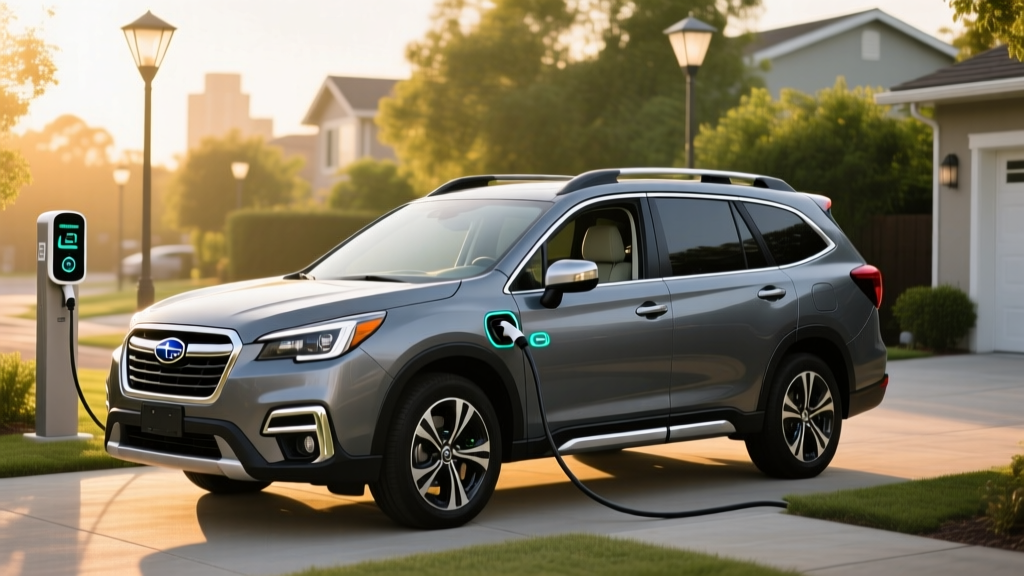
After years of resisting electrification in its three-row lineup, Subaru finally introduced the Ascent Hybrid for the 2026 model year. This is a conventional hybrid (HEV) — not a plug-in — meaning you never need to plug it in. The gasoline engine and regenerative braking handle all battery charging internally. For families who need three rows, standard all-wheel drive, and better fuel economy without changing their fueling habits, the Ascent Hybrid occupies a practical middle ground between the gas-only Ascent and full-electric competitors like the Kia EV9 or Hyundai Ioniq 9.
The headline number is 27 MPG combined (EPA), a meaningful bump over the standard Ascent's 22 MPG combined. But as with any hybrid, the real-world story is more nuanced — and whether this is the right three-row for you depends on how you drive, where you live, and whether you have access to home charging.
HEV vs PHEV vs EV: Where the Ascent Hybrid Fits
Before diving into specs, it's worth clarifying the three electrified powertrain types, because the Ascent Hybrid is specifically an HEV:
| Feature | HEV (Ascent Hybrid) | PHEV (e.g., Toyota Grand Highlander Hybrid) | BEV (e.g., Kia EV9) |
|---|---|---|---|
| Plug-in required? | No | Yes (optional for max benefit) | Yes (mandatory) |
| Electric-only range | ~1 mi at low speed | 30–40 mi typical | 250–310 mi |
| Fuel/energy | Gasoline only | Gasoline + electricity | Electricity only |
| Federal tax credit (§30D) | Not eligible | Up to $7,500 (if eligible) | Up to $7,500 (if eligible) |
| Home charger needed? | No | Recommended | Essential |
| Best for | No charging access, long trips | Home charging + short commutes | Home charging, lower running cost |
The Ascent Hybrid targets buyers who want improved fuel economy but lack a garage or driveway for a Level 2 charger. It also suits road-trip-heavy families who don't want to plan around DC fast-charging stops. If you do have home charging and a short commute, a PHEV like the Toyota Grand Highlander PHEV or a full EV will deliver far greater daily electric miles and lower fuel costs.
Fuel Economy: EPA Numbers vs Real-World MPG
The EPA rates the 2026 Subaru Ascent Hybrid at 27 MPG combined, broken down as follows:
| Driving Cycle | EPA Estimate | Real-World Expectation |
|---|---|---|
| City | 28 MPG | 28–31 MPG (hybrids excel in stop-and-go) |
| Highway | 26 MPG | 23–25 MPG (less regen benefit at steady speed) |
| Combined | 27 MPG | 25–28 MPG (varies by terrain, weather, load) |
Why real-world MPG varies: Hybrids recapture energy during braking and low-speed driving, so city MPG often exceeds the EPA sticker in moderate climates. Highway driving, however, relies more on the gasoline engine, and the Ascent's boxy aerodynamics and 4,500+ lb curb weight work against it at 70+ mph. In cold weather (below 30°F), expect a 5–10% drop due to engine warm-up cycles, winter fuel blends, and increased rolling resistance. Owners in mountainous terrain will see lower numbers on ascents but can recapture some energy on descents via regenerative braking.
For context, the gas-only 2026 Ascent returns 22 MPG combined — so the hybrid delivers roughly a 23% improvement in combined driving. Over 15,000 annual miles at $3.40/gallon, that's approximately $390/year in fuel savings.
Powertrain & Performance Specs
| Specification | 2026 Subaru Ascent Hybrid |
|---|---|
| Engine | 2.4L turbocharged flat-4 (Boxer) |
| Electric motor | Integrated electric motor (transmission-mounted) |
| Combined horsepower | ~290 hp (est.) |
| Combined torque | ~310 lb-ft (est.) |
| Transmission | CVT (Lineartronic) |
| Drivetrain | Symmetrical AWD (standard) |
| 0–60 mph | ~6.8 sec (est.) |
| Towing capacity | 5,000 lbs |
| Battery type | Lithium-ion (small, ~1.5 kWh, self-charging) |
| Plug-in capable? | No — HEV only |
| Seating | 7 or 8 passengers |
Subaru pairs its familiar 2.4-liter turbocharged Boxer engine with an electric motor sandwiched into the CVT housing. This setup provides torque fill at low RPMs — the electric motor delivers instant thrust while the turbo spools up — resulting in noticeably quicker off-the-line acceleration than the gas-only Ascent. The standard Symmetrical AWD system is fully retained, with no compromise to Subaru's trademark traction in snow and mud.
Towing capacity holds at 5,000 lbs when properly equipped, matching the gas Ascent. This matters for families hauling a small boat or camper trailer, and it's an area where the Ascent Hybrid outguns most three-row EVs (the Kia EV9 is rated for 5,000 lbs on AWD trims, but at a significantly higher starting price).
Pricing, Trims & Tax Credit Eligibility
The 2026 Ascent Hybrid is offered across multiple trims. Pricing starts at approximately $44,995 for the Premium Hybrid trim, with higher trims (Limited Hybrid, Touring Hybrid) climbing to roughly $54,000. Subaru has not published final MSRP for all trims as of early 2026; these figures reflect announced pricing and may shift slightly at dealer delivery.
Federal Tax Credit: Not Eligible
Because the Ascent Hybrid is a conventional HEV (not a plug-in), it does not qualify for the IRS §30D Clean Vehicle Credit. That credit — up to $7,500 — is reserved for plug-in vehicles (PHEVs and BEVs) that meet battery-sourcing, MSRP cap ($80,000 for SUVs), and buyer income limits. See the IRS §30D page for current eligibility rules.
Some states offer separate rebates for conventional hybrids, though these are increasingly rare as incentives shift toward plug-in vehicles. Check your state energy office for current programs.
Without the federal credit, the Ascent Hybrid's value proposition rests entirely on fuel savings, standard AWD, and Subaru's resale-value reputation. Over a 5-year/75,000-mile ownership period, the hybrid's fuel savings total roughly $1,950 compared to the gas Ascent — not enough to offset a significant trim-level price premium if one exists.
Battery Warranty, Reliability & Replacement Cost
Subaru covers the Ascent Hybrid's battery pack under its hybrid-system warranty: 8 years / 100,000 miles (10 years / 150,000 miles in California and states adopting CARB emissions standards). This warranty covers defects and capacity loss below a defined threshold, typically 60–70% of original capacity.
Hybrid Battery Longevity: What the Data Shows
Modern lithium-ion hybrid batteries are vastly more durable than early NiMH packs from the 2000s Prius era. Toyota's hybrid fleet — the largest real-world sample — shows battery replacement rates below 5% at 150,000 miles. Subaru's hybrid system, while newer to the Ascent, uses proven components shared with the Crosstrek Hybrid lineage.
Replacement cost (out of warranty): Estimated $3,000–$5,000 for the battery pack, plus labor. However, most owners will never face this expense — the battery is designed to outlast the vehicle's typical ownership cycle.
Subaru's overall reliability reputation is mixed. The brand has faced head-gasket and CVT concerns in prior generations, though the current Ascent (introduced for 2019) has shown improved durability in Consumer Reports testing. The hybrid powertrain adds an electric motor but actually reduces stress on the engine and CVT by providing low-speed torque assist, which may improve long-term drivetrain longevity.
Ascent Hybrid vs the Competition
The three-row hybrid SUV segment is competitive. Here's how the Ascent Hybrid stacks up on paper:
| Vehicle | Type | EPA Combined MPG | AWD | Starting MSRP | §30D Credit |
|---|---|---|---|---|---|
| 2026 Subaru Ascent Hybrid | HEV | 27 MPG | Standard | ~$44,995 | No |
| 2026 Toyota Grand Highlander Hybrid | HEV | 36 MPG | Available | ~$46,000 | No |
| 2026 Toyota Grand Highlander PHEV | PHEV | 35 MPG + 33 mi EV | Standard | ~$54,000 | Up to $7,500 |
| 2026 Kia Sorento Hybrid | HEV | 34 MPG | Available | ~$40,000 | No |
| 2026 Hyundai Santa Fe Hybrid | HEV | 33 MPG | Available | ~$41,500 | No |
The Toyota Grand Highlander Hybrid's 36 MPG combined is the efficiency benchmark here, beating the Ascent Hybrid by 9 MPG. That gap matters — over 15,000 miles/year, it's roughly $400 more in annual fuel savings. However, the Grand Highlander Hybrid doesn't include standard AWD (it's an option on most trims), and its third row, while spacious, doesn't match the Ascent's adult-friendly rearmost seats for long trips.
If you have home charging, the Grand Highlander PHEV's 33 miles of electric-only range covers most daily commutes without burning gas — and the potential $7,500 federal credit brings its effective price close to the Ascent Hybrid's. That's a compelling argument for plug-in buyers.
Who Should Buy the Ascent Hybrid?
Choose the Ascent Hybrid if:
- You need standard AWD for snow, mud, or mountain driving
- You lack access to home or workplace charging (apartment, street parking)
- You regularly use all three rows and need adult-capable rear seats
- You tow up to 5,000 lbs and want hybrid fuel savings
- You plan to keep the vehicle 8+ years (Subaru resale value)
- You want better MPG than the gas Ascent without changing your fueling routine
Look elsewhere if:
- You have home charging and a short commute (a PHEV or EV saves more)
- Maximum fuel economy is the priority (Grand Highlander Hybrid gets 36 MPG)
- You want federal tax credit eligibility (requires a plug-in vehicle)
- You prioritize third-row cargo space over passenger comfort (check the Grand Highlander)
- You want EV-mode silent driving in neighborhoods (HEVs run the engine frequently)
Frequently Asked Questions
How many MPG does the Subaru Ascent Hybrid get?
The EPA rates the 2026 Ascent Hybrid at 28 city / 26 highway / 27 combined MPG. Real-world city driving often yields 28–31 MPG thanks to regenerative braking, while sustained highway driving at 70+ mph may drop to 23–25 MPG. Cold weather and heavy cargo loads reduce these figures by 5–10%.
Does the Ascent Hybrid need to be plugged in?
No. The Ascent Hybrid is a conventional HEV. Its small lithium-ion battery charges exclusively through regenerative braking and the gasoline engine. You fuel it exactly like a standard car — with gasoline at any station.
Can the Ascent Hybrid drive on electric power only?
Only at very low speeds (under ~15 mph) for brief distances, such as creeping through a parking lot or in stop-and-go traffic. It cannot sustain electric-only driving for meaningful distances. If you want 30+ miles of electric range, you need a PHEV or BEV.
Does the Subaru Ascent Hybrid qualify for a federal tax credit?
No. The IRS §30D Clean Vehicle Credit applies only to plug-in electric vehicles (PHEVs and BEVs) with qualifying battery components and critical minerals. The Ascent Hybrid, as an HEV, is not eligible. Some states may offer small hybrid rebates — check your state energy office.
Is the Ascent Hybrid battery reliable? What does replacement cost?
Subaru covers the hybrid battery for 8 years/100,000 miles (10 years/150,000 miles in CARB states). Based on industry data from Toyota's hybrid fleet, failure rates are low — under 5% at 150,000 miles. Out-of-warranty replacement is estimated at $3,000–$5,000, but most owners will trade or sell the vehicle before reaching that point.
Hybrid vs PHEV vs EV — which three-row SUV is right for me?
If you have no charging access: choose an HEV like the Ascent Hybrid. If you have home charging and a commute under 35 miles: a PHEV (Grand Highlander PHEV) lets you drive electric daily and use gas for road trips. If you have home charging and want the lowest running cost: a BEV (Kia EV9, Ioniq 9) eliminates gasoline entirely but requires planning for road-trip charging.
How does the Ascent Hybrid handle in snow?
Subaru's Symmetrical AWD is standard and fully retained in the hybrid. The electric motor's instant low-speed torque actually improves traction control response in slippery conditions. Combined with 8.7 inches of ground clearance and Subaru's X-Mode traction software, the Ascent Hybrid is one of the most capable three-row SUVs in winter weather — a key advantage over FWD-biased hybrid competitors.
Sources: fueleconomy.gov (EPA ratings), IRS §30D Clean Vehicle Credit, Subaru of America press materials.