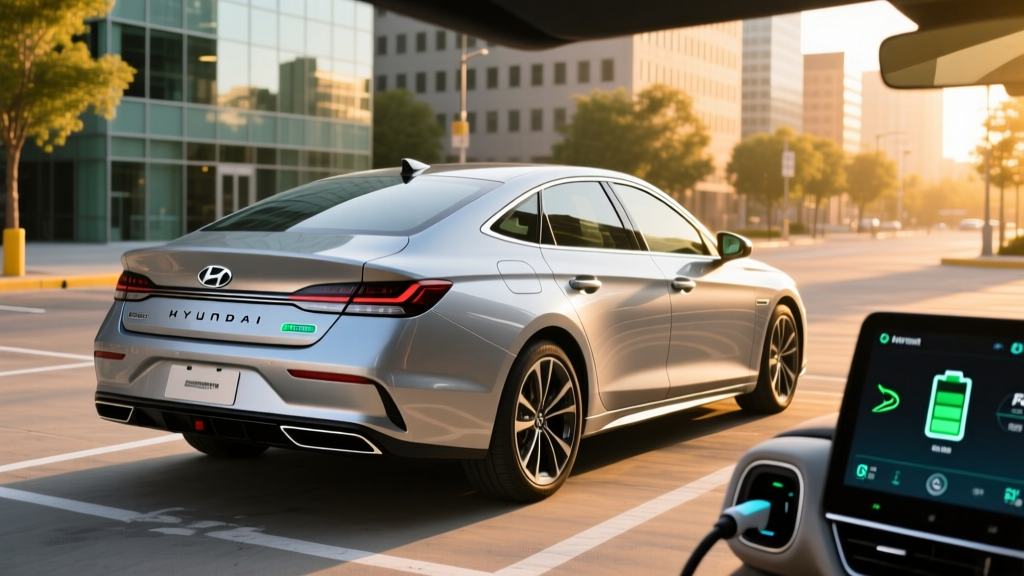
The midsize sedan segment has thinned considerably, but the Hyundai Sonata Hybrid remains one of the most compelling arguments for electrified efficiency without plugging in. For 2026, Hyundai continues the sixth-generation Sonata Hybrid with the same proven 2.0-liter hybrid powertrain that has earned a reputation for delivering exceptional real-world fuel economy — often beating its EPA estimates in city driving. If you are researching Sonata Hybrid fuel economy to decide whether this sedan fits your commute, this guide covers every number that matters: EPA MPG, real-world results, powertrain output, battery longevity, and how it stacks up against plug-in hybrids and full EVs.
2026 Sonata Hybrid EPA Fuel Economy: The Official Numbers
The 2026 Hyundai Sonata Hybrid is available in three trims — Blue, SEL, and Limited — and fuel economy varies slightly depending on wheel size and equipment weight. Here is the full EPA breakdown as published on fueleconomy.gov:
| Trim | City MPG | Highway MPG | Combined MPG | Annual Fuel Cost* |
|---|---|---|---|---|
| Blue | 50 | 43 | 47 | ~$1,050 |
| SEL | 45 | 41 | 44 | ~$1,150 |
| Limited | 44 | 38 | 41 | ~$1,250 |
*Based on 15,000 miles/year at $3.50/gallon regular unleaded. Actual costs vary by region and driving habits.
The Blue trim stands out with a remarkable 50 MPG city rating, achieved through lighter 16-inch wheels, lower rolling-resistance tires, and slightly more aggressive regenerative braking calibration. The SEL and Limited trims trade a few MPG for larger alloy wheels (17- and 18-inch respectively), additional sound insulation, and more feature content.
How the Sonata Hybrid Powertrain Delivers 47 MPG Combined
The 2026 Sonata Hybrid pairs a 2.0-liter Smartstream GDI four-cylinder engine with a permanent-magnet synchronous electric motor integrated into a 6-speed automatic transmission — Hyundai calls this the TMED (Transmission-Mounted Electric Device) system. Unlike Toyota's planetary-gear e-CVT approach, Hyundai's setup uses a conventional gearset, which gives the Sonata Hybrid a more natural acceleration feel with distinct shift points.
| Component | Specification |
|---|---|
| Engine | 2.0L Smartstream GDI I-4 |
| Engine Output | 150 hp / 139 lb-ft torque |
| Electric Motor | 39 kW (52 hp) / 151 lb-ft torque |
| Combined System Output | 192 hp / 271 lb-ft torque |
| Transmission | 6-speed automatic with TMED |
| Drivetrain | Front-wheel drive |
| Hybrid Battery | 1.62 kWh lithium-ion polymer (HEV, self-charging) |
| 0-60 mph | ~7.5 seconds |
| Top Speed | 130 mph (electronically limited) |
| Fuel Tank | 13.2 gallons |
| Total Range (Blue) | ~620 miles |
The 192 combined horsepower figure is competitive in the midsize hybrid segment. The electric motor fills in torque at low RPMs where the naturally aspirated 2.0L would otherwise feel sluggish, giving confident merge-and-pass performance. The 1.62 kWh traction battery is small by EV standards — it is not designed for electric-only driving beyond brief low-speed crawls — but it is sufficient for the frequent engine-off coasting and regenerative energy buffering that drives the Sonata Hybrid's excellent fuel economy.
Sonata Hybrid (HEV) vs. Plug-In Hybrid vs. Full EV: Which Fits You?
A common question from buyers cross-shopping the Sonata Hybrid is whether they should consider a plug-in hybrid (PHEV) or a full battery electric vehicle (BEV) instead. The answer depends entirely on your charging access, commute pattern, and budget.
HEV (Sonata Hybrid)
- No plug-in required
- 44-47 MPG combined
- 620+ mile total range
- Lower purchase price
- No federal tax credit
- Best for: no home charging, long highway commutes
PHEV (e.g., Tucson PHEV)
- Plugs in for 30-33 mi electric range
- ~35 MPG after battery depletes
- ~430 mile total range
- Mid-range purchase price
- May qualify for partial §30D credit
- Best for: short commutes + occasional road trips
BEV (e.g., Ioniq 6)
- 100% electric, 305-361 mi EPA range
- 140 MPGe combined
- No gas engine
- Higher purchase price, lower fuel cost
- Up to $7,500 federal credit (if eligible)
- Best for: home charging access, mostly <200 mi/day
The Sonata Hybrid is the right choice if: you do not have access to home or workplace Level 2 charging, you regularly drive more than 300 miles between fill-ups, or you want electrified efficiency with zero change to your refueling habits. It is also the most affordable electrified option — no premium for a larger battery pack, and no dependency on charging infrastructure.
Consider a PHEV if: you can install a Level 2 charger at home and your daily round-trip commute is under 30 miles. A PHEV lets you drive most days on electricity alone while keeping a gas engine for road trips. Note that Hyundai does not currently offer a Sonata PHEV in the U.S. market for 2026; buyers wanting a Hyundai PHEV sedan would need to look at the Tucson PHEV crossover or wait for future model announcements.
Consider a full BEV if: you have reliable home charging, your daily driving stays within 200 miles, and you want to eliminate fuel costs entirely while qualifying for the full IRS §30D federal tax credit (up to $7,500, subject to MSRP caps, income limits, and battery-sourcing requirements).
2026 Sonata Hybrid Pricing and Tax Credit Eligibility
| Trim | Base MSRP | Federal Tax Credit | Effective Price |
|---|---|---|---|
| Blue | ~$30,250 | None | ~$30,250 |
| SEL | ~$34,650 | None | ~$34,650 |
| Limited | ~$38,900 | None | ~$38,900 |
Tax credit reality check: The Sonata Hybrid is a conventional HEV — it does not plug in and its battery capacity is far below the minimum threshold required for the IRS §30D New Clean Vehicle Credit. That credit applies only to plug-in electric vehicles (BEVs and PHEVs) with a battery capacity of at least 7 kWh. The Sonata Hybrid's 1.62 kWh battery does not qualify.
However, some states and local utilities offer rebates for conventional hybrids. Check your state energy office or utility provider for any regional incentive programs. Additionally, the fuel savings themselves are substantial: at 47 MPG combined versus a comparable gas-only midsize sedan at 30 MPG combined, the Sonata Hybrid saves roughly $580-$750 per year in fuel costs for a driver covering 15,000 miles annually.
Battery Longevity, Warranty, and Replacement Cost
Hybrid battery degradation is a top concern for buyers, but real-world data is reassuring. The Sonata Hybrid's 1.62 kWh battery operates within a narrow state-of-charge window (typically 40-80% SoC), managed by the vehicle's battery management system to minimize stress. Unlike a full EV battery that cycles deeply every day, the HEV battery experiences shallow, frequent cycles that are far less degrading.
What to expect over time: Most Hyundai hybrid owners report negligible fuel economy loss over 100,000+ miles. The battery does not need to hold enough energy to power the car for long distances — it only needs to buffer regenerative braking energy and assist during acceleration. Even with 15-20% capacity loss after a decade, the impact on fuel economy is typically less than 1-2 MPG.
Replacement cost if out of warranty: A replacement hybrid battery pack for the Sonata Hybrid currently costs between $2,500 and $4,000 including labor at a dealership. Independent hybrid specialists may offer refurbished packs for $1,800-$2,500. Given the 10-year/100,000-mile warranty coverage, most original owners will never face this expense. For context, this is substantially less than a full EV battery replacement ($8,000-$20,000+) because the HEV battery is much smaller.
Reliability, Safety, and Ownership Costs
The Sonata Hybrid benefits from Hyundai's mature hybrid system, now in its second generation on this platform. The 2.0L Smartstream engine has no turbocharger, reducing complexity and potential failure points compared to forced-induction competitors. The 6-speed automatic with TMED is a proven design shared across Hyundai-Kia's hybrid lineup.
For safety, the 2026 Sonata Hybrid comes standard with Hyundai SmartSense, including forward collision-avoidance assist, lane-keeping assist, blind-spot monitoring, and rear cross-traffic alert. The IIHS has historically rated the Sonata as a Top Safety Pick when equipped with specific headlights — verify the current-year rating before purchase.
| Cost Category | Sonata Hybrid (Blue) | Gas Midsize Sedan (~30 MPG) |
|---|---|---|
| Purchase Price | ~$30,250 | ~$28,000 |
| Fuel (5 yrs, 75K mi) | ~$5,250 | ~$8,750 |
| Maintenance (5 yrs) | ~$2,800 | ~$3,200 |
| Insurance (5 yrs avg) | ~$7,500 | ~$7,000 |
| Depreciation (est.) | ~$12,000 | ~$11,500 |
| Total 5-Year | ~$57,800 | ~$58,450 |
The Sonata Hybrid's higher sticker price is largely offset by fuel savings within the first 3-4 years of ownership. Maintenance costs are slightly lower than gas-only counterparts thanks to regenerative braking reducing brake pad wear — many hybrid owners report original brake pads lasting 80,000+ miles. Insurance premiums are marginally higher due to the hybrid system's replacement cost, but the difference is typically $50-$100 per year.
Pros, Cons, and Final Verdict
Pros
- 47 MPG combined (Blue) — among the best in any non-plug-in vehicle
- Real-world city MPG often exceeds EPA estimate
- 620+ mile range between fill-ups
- 192 hp provides confident highway merging
- 10-year/100,000-mile hybrid battery warranty
- No charging infrastructure needed
- Comprehensive SmartSense safety suite standard
- Spacious trunk (15.1 cu ft) — no battery intrusion
Cons
- No federal tax credit eligibility (HEV, not PHEV/BEV)
- Limited trim loses 6 MPG vs. Blue (41 vs. 47 combined)
- No all-wheel-drive option
- Not a PHEV — no electric-only commuting capability
- CVT-like drone under hard acceleration (despite 6-speed)
- Rear visibility slightly compromised by sloping roofline
- Sedan body style limits cargo versatility vs. crossovers
Verdict: The 2026 Sonata Hybrid is the fuel-economy champion for drivers who want maximum MPG without changing their refueling habits. The Blue trim's 47 MPG combined and 620-mile range make it one of the most efficient non-plug-in vehicles you can buy, and real-world city driving often pushes that number even higher. If you lack home charging access or frequently take long road trips, the Sonata Hybrid offers a compelling, low-risk path to electrified efficiency.
Frequently Asked Questions
How many MPG does the 2026 Sonata Hybrid actually get in real driving?
In real-world mixed driving, the Blue trim consistently delivers 46-52 MPG in city and suburban conditions, often beating its 50 MPG city EPA estimate. Highway driving at 75+ mph typically yields 39-43 MPG. Combined real-world results of 45-48 MPG are common for the Blue trim. The SEL and Limited trims average 41-44 MPG combined in real-world use.
Does the Sonata Hybrid need to be plugged in?
No. The Sonata Hybrid is a conventional HEV (hybrid electric vehicle). It charges its own 1.62 kWh battery through regenerative braking and engine-driven generation. You simply fill it with regular unleaded gasoline like any other car. There is no plug, no charging cable, and no electric-only driving range to manage.
Is there a Sonata Plug-In Hybrid (PHEV) available?
As of 2026, Hyundai does not sell a Sonata PHEV in the United States. Previous model years (2016-2020) offered a Sonata PHEV with approximately 28 miles of electric-only range, but it was discontinued. If you want a Hyundai PHEV, the Tucson PHEV crossover is the current option with 33 miles of electric range.
How long will the Sonata Hybrid battery last?
Hyundai warrants the hybrid battery for 10 years or 100,000 miles (10 years/150,000 miles in CARB states). Real-world data from Hyundai-Kia hybrid owners suggests these batteries routinely last 150,000-200,000+ miles before any significant capacity loss. The shallow charge-discharge cycles in an HEV are far less stressful on battery chemistry than the deep cycles in a full EV.
What does it cost to replace the Sonata Hybrid battery?
Out-of-warranty replacement costs range from $2,500 to $4,000 at a Hyundai dealership, including parts and labor. Refurbished or aftermarket packs may be available for $1,800-$2,500. However, given the generous 10-year warranty and the proven longevity of Hyundai's hybrid batteries, most owners will never need a replacement.
Does the Sonata Hybrid qualify for any tax credits?
The Sonata Hybrid does not qualify for the federal IRS §30D New Clean Vehicle Credit, which requires a plug-in vehicle with at least 7 kWh of battery capacity. Some state or local utility programs may offer small rebates for hybrid purchases — check your state energy office. The primary financial benefit is fuel savings: roughly $580-$750 per year compared to a 30 MPG gas sedan.
Sonata Hybrid vs. Toyota Camry Hybrid: which gets better MPG?
The Toyota Camry Hybrid (51 city / 53 hwy / 52 combined for the LE trim) edges out the Sonata Hybrid Blue on EPA paper. However, the Sonata Hybrid offers more combined horsepower (192 hp vs. 225 hp for the Camry, which is actually more powerful), a traditional 6-speed automatic feel, and Hyundai's longer 10-year powertrain warranty vs. Toyota's 8-year/100,000-mile hybrid battery warranty. Both are excellent choices — the decision often comes down to styling preference and dealer experience.