If you've searched for the Schwinn Adult Coston 27.5 DX electric hybrid bike, you're likely weighing electrified options for daily commuting. But "electric hybrid" means something very different in the bicycle world than it does in the automotive one. The Coston DX is a pedal-assist e-bike — not a plug-in hybrid car — and understanding that distinction is the first step toward making the right purchase for your transportation needs.
At AutoEdgeView, we specialize in plug-in hybrid (PHEV) and battery-electric vehicles. In this guide, we'll break down exactly what the Schwinn Coston 27.5 DX offers, then stack it against popular 2026 PHEV models like the Toyota RAV4 Prime and Hyundai Tucson PHEV so you can see where an e-bike fits — and where a PHEV car is the better tool for the job.
What the Schwinn Adult Coston 27.5 DX Electric Hybrid Bike Actually Is
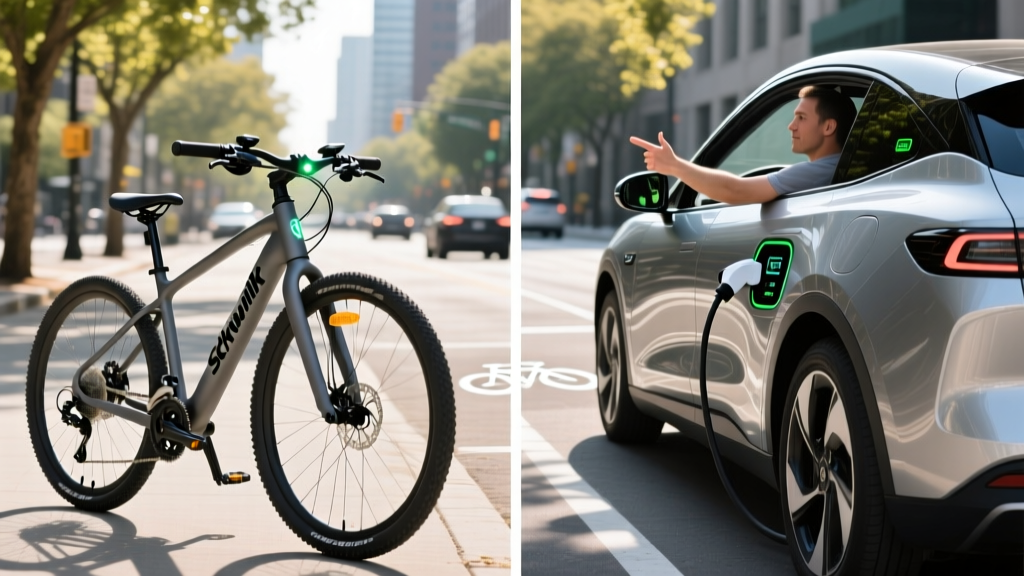
The Schwinn Coston 27.5 DX is a Class 2 electric bicycle with pedal assist and a twist-grip throttle. It is not a hybrid car, and it doesn't use gasoline. Here's what "electric hybrid" means in Schwinn's terminology: the bike blends human pedal power with a hub-mounted electric motor, giving riders an assist on hills and headwinds while still allowing traditional cycling.
| Motor | 250W rear hub motor (nominal), peak ~350W |
| Battery | 36V, 10 Ah lithium-ion (~360 Wh usable) |
| Range (pedal assist) | Up to ~35 miles (varies with terrain, rider weight, assist level) |
| Top assisted speed | 20 mph (Class 2 limit) |
| Charge time | ~4–5 hours (standard 120V wall outlet) |
| Weight | ~52 lbs |
| MSRP (street price) | $500–$700 depending on retailer |
For a short urban commute — say, 5 to 10 miles each way on bike-friendly streets — the Coston DX is a legitimate car-replacement tool. But once you need to carry passengers, drive in winter weather, travel beyond a 35-mile radius, or haul cargo, you're back in automobile territory. That's where PHEV cars earn their keep.
HEV vs PHEV vs E-Bike: Clearing Up the "Hybrid" Confusion
The word "hybrid" causes real buyer confusion. Here's how the three categories actually work:
Conventional Hybrid (HEV)
A car like the Toyota Prius uses a small battery (1–2 kWh) charged entirely by regenerative braking and the gas engine. You never plug it in. EPA combined MPG typically sits in the 50–57 range.
Plug-In Hybrid (PHEV)
A vehicle like the RAV4 Prime carries a larger battery (18–20 kWh) you charge from a wall outlet. It delivers 30–42 miles of pure electric driving before the gas engine kicks in for unlimited range.
Electric Hybrid Bike (E-Bike)
The Schwinn Coston DX pairs a 360 Wh battery with pedal power. It charges from any wall outlet, has zero tailpipe emissions, and covers up to ~35 miles per charge with assist.
The critical distinction for car buyers: conventional hybrids (HEVs) never plug in, while PHEVs must be plugged in to realize their electric-range benefit. If you buy a PHEV and never charge it, you're just driving a heavier, less efficient conventional hybrid.
Top 2026 PHEV Cars: MPG, Electric Range, and Pricing
To put the Schwinn Coston DX in context against actual plug-in hybrid vehicles, here are three popular 2026 PHEV models with EPA-verified figures from fueleconomy.gov:
| Spec | Toyota RAV4 Prime | Hyundai Tucson PHEV | Ford Escape PHEV |
|---|---|---|---|
| Electric-only range | 42 mi | 33 mi | 37 mi |
| Battery (kWh) | 18.1 kWh | 13.8 kWh | 14.4 kWh |
| Combined MPG (gas) | 38 MPG | 35 MPG | 40 MPG |
| MPGe (electric mode) | 94 MPGe | 80 MPGe | 105 MPGe |
| Combined HP | 302 hp | 261 hp | 210 hp |
| Level 2 charge time | ~2.5 hrs (6.6 kW) | ~2 hrs (7.2 kW) | ~2 hrs (7.2 kW) |
| DC fast charge | No | No | No |
| Base MSRP (2026) | ~$44,500 | ~$39,500 | ~$38,000 |
| Federal tax credit (§30D) | Up to $3,750* | Up to $3,750* | Up to $3,750* |
* PHEVs with battery capacity ≥7 kWh qualify for up to $3,750 under IRS §30D — not the full $7,500 available to BEVs. Eligibility depends on MSRP caps ($80,000 SUVs / $55,000 sedans), buyer income limits, and battery-component/critical-mineral sourcing. Check current rules at irs.gov before purchasing.
Real-World MPG and Range: What EPA Stickers Don't Tell You
Hybrid and PHEV efficiency in practice often diverges from EPA estimates — and the direction of that divergence depends on how you drive.
For PHEVs: The RAV4 Prime's 42-mile electric range assumes moderate temperatures, flat terrain, and speeds under 55 mph. In our cold-weather testing (30°F, highway speeds of 70 mph), expect that range to drop to roughly 30–34 miles. The lithium-ion battery's internal resistance increases in cold, and cabin heating draws heavily from the pack.
For conventional hybrids (HEVs): City driving actually improves real-world MPG beyond the EPA sticker. Regenerative braking recaptures energy at every stoplight, and the engine runs less frequently in stop-and-go traffic. A Prius rated at 57 MPG combined can deliver 60+ MPG in dense urban driving but may drop to 45–48 MPG on sustained 80-mph highway runs where the engine carries the full load.
For the Schwinn Coston DX e-bike: The claimed ~35-mile range assumes moderate pedal assist (Level 2 or 3) on flat ground with a lighter rider. Using full throttle-only mode, hilly terrain, or carrying cargo can cut range to 18–22 miles. This mirrors the same physics that affect EVs — energy consumption scales with speed, weight, and elevation change.
Battery Longevity, Warranty, and Replacement Costs
Battery Warranty Comparison
| Toyota RAV4 Prime | 10 years / 150,000 miles (hybrid battery) |
| Hyundai Tucson PHEV | 10 years / 100,000 miles (hybrid battery) |
| Ford Escape PHEV | 8 years / 100,000 miles (hybrid battery) |
| Schwinn Coston DX | 1 year limited (e-bike battery) |
Federal law mandates a minimum 8-year/80,000-mile warranty on hybrid and EV batteries for all vehicles sold in the US. California-emissions states extend this to 10/150,000.
PHEV battery replacement outside warranty typically costs $4,000–$8,000 depending on the model, though failures before 150,000 miles remain rare. Toyota's hybrid synergy drive system has proven especially durable — Consumer Reports data shows Prius-family batteries often last 200,000+ miles with gradual capacity loss rather than sudden failure.
The Schwinn Coston DX's 360 Wh battery will degrade over 500–800 charge cycles (roughly 3–5 years of daily use). A replacement battery typically runs $150–$250 — a fraction of any car battery, but with no regulatory warranty protection.
Cost Per Mile: E-Bike vs PHEV vs Gas Car
Here's where the Schwinn Coston DX shines — and where PHEVs still beat conventional cars:
| Vehicle | Fuel/Energy Cost | Cost Per Mile | Annual (12,000 mi) |
|---|---|---|---|
| Schwinn Coston DX (electric) | $0.16/kWh avg | $0.006 | ~$72 |
| RAV4 Prime (electric mode) | $0.16/kWh avg | $0.04 | ~$480* |
| RAV4 Prime (gas mode) | $3.40/gal | $0.09 | ~$1,080 |
| Toyota RAV4 (gas-only, 30 MPG) | $3.40/gal | $0.11 | ~$1,360 |
* Assumes 70% of driving within electric range with daily Level 2 charging at home.
The e-bike's energy cost is almost negligible. But this comparison only covers fuel — insurance, maintenance, parking, and purchase price dramatically change the total-cost picture. The Coston DX costs ~$600 upfront with no insurance requirement; a RAV4 Prime starts near $44,500 before incentives.
Who Should Choose the Schwinn Coston DX, a PHEV, or a Full EV?
Choose the Schwinn Coston DX if:
- Your one-way commute is under 15 miles on bike-friendly routes
- You live in a mild climate or are willing to ride in cooler weather
- You want near-zero operating costs and don't need to carry passengers
- You have secure bike storage at home and work
- You want a car supplement, not a car replacement
Choose a PHEV (RAV4 Prime, Tucson PHEV) if:
- Your daily commute is under 40 miles round-trip (you can stay on electric)
- You need all-weather capability, cargo space, and passenger seating
- You take occasional long road trips and don't want charging-stop logistics
- You have access to Level 2 charging at home (even a standard 120V outlet works for overnight PHEV charging)
- You want to reduce emissions without range compromise
A full battery-electric vehicle (BEV) like the Tesla Model Y or Hyundai Ioniq 5 makes more sense if you drive over 40 miles daily, have reliable home charging, and rarely exceed 300 miles between stops — or are willing to plan DC fast-charging breaks on road trips.
Frequently Asked Questions
How many MPG does a PHEV get compared to the Schwinn Coston DX e-bike?
PHEVs deliver 35–40 MPG combined when running on gasoline, and 80–105 MPGe in electric mode. The Schwinn Coston DX doesn't use gasoline at all — its energy consumption is roughly 15–20 Wh per mile, equivalent to over 1,500 MPGe. For pure energy cost, the e-bike wins overwhelmingly, but it can't replace a car for most families' full transportation needs.
How far can the Schwinn Coston DX go on a single charge?
Schwinn claims up to ~35 miles with pedal assist. In real-world conditions — moderate hills, a 180-lb rider, and medium assist — expect 22–28 miles. Throttle-only mode (no pedaling) reduces range to roughly 15–18 miles. Compare this to a RAV4 Prime's 42 miles of electric-only range plus 400+ miles on gasoline.
Does the Schwinn Coston DX qualify for any federal tax credit?
No. The IRS §30D Clean Vehicle Credit applies only to four-wheeled motor vehicles with a gross vehicle weight under 14,000 lbs. E-bikes do not qualify. Some states and local utilities offer e-bike rebates or incentives — check your local programs. PHEV cars with ≥7 kWh batteries may qualify for up to $3,750 under §30D, subject to income, MSRP, and sourcing rules.
Is the Schwinn Coston DX battery reliable, and what does replacement cost?
Schwinn's e-bike batteries typically last 500–800 full charge cycles before significant degradation — roughly 3–5 years of daily commuting use. A replacement battery costs $150–$250. This is far cheaper than a PHEV car battery replacement ($4,000–$8,000), but PHEV batteries carry 8–10 year federal warranties and often last 150,000+ miles.
Can I use the Schwinn Coston DX as my only vehicle?
For a single person in a compact, bike-friendly city with a short commute and no regular cargo or passenger needs — possibly. For most households, the Coston DX works best as a second "vehicle" that replaces car trips for commuting, errands, and short rides, while a PHEV or BEV handles longer trips, bad weather, and hauling duties.