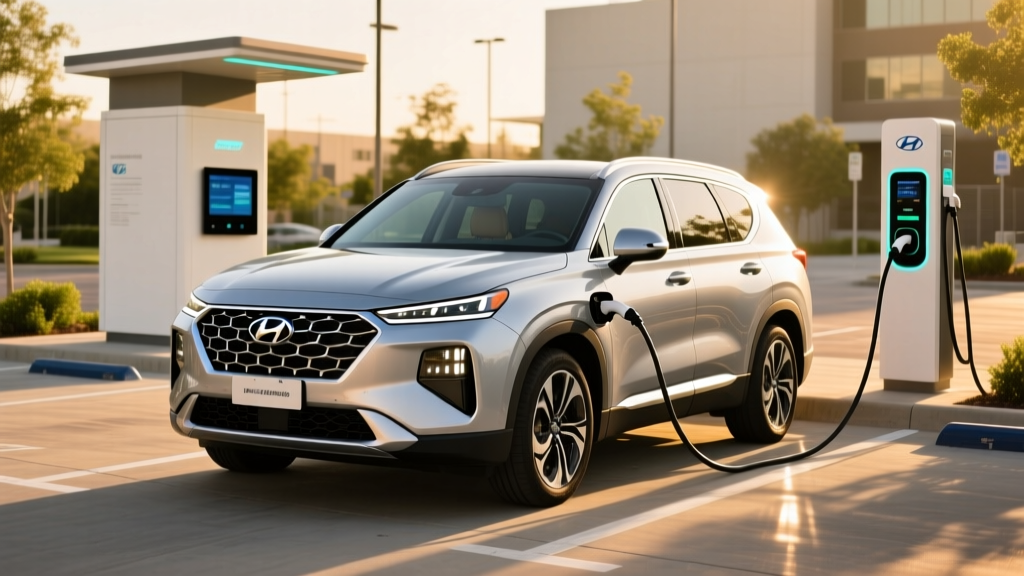
The Hyundai Santa Fe occupies a specific niche: a boxy, three-row family hauler that doesn't force you into the minivan segment. For 2026, the Santa Fe Hybrid (HEV) and Santa Fe Plug-in Hybrid (PHEV) continue to offer two distinct paths to electrified efficiency without the range anxiety of a full battery-electric vehicle. After spending time with both powertrains and cross-referencing EPA data with real-world driving logs, here is exactly what you get — and where the numbers diverge from the sticker.
HEV vs PHEV: Two Very Different Santa Fe Hybrids
Before examining specs, it's critical to understand these are fundamentally different vehicles sharing a nameplate. A conventional hybrid (HEV) generates all its electricity from the gasoline engine and regenerative braking — you never plug it in. A plug-in hybrid (PHEV) carries a much larger battery that you charge from a wall outlet or public charger, enabling genuine electric-only driving before the gas engine engages.
| Attribute | Santa Fe Hybrid (HEV) | Santa Fe Plug-in Hybrid (PHEV) |
|---|---|---|
| Plug-in required? | No — self-charging | Yes — plug in for EV range |
| Battery size | ~1.5 kWh (small buffer) | 13.8 kWh usable (NMC) |
| Electric-only range | None (EV assist only) | 32 miles EPA |
| Combined horsepower | 232 hp | 261 hp |
| Drivetrain | AWD standard | AWD standard |
| Starting MSRP (2026) | ~$40,200 | ~$45,500 |
| Federal tax credit | Not eligible | Up to $3,750 (§30D)* |
*Tax credit eligibility depends on income caps, MSRP limits, and battery-sourcing requirements under current IRS §30D rules. Verify at irs.gov or with a tax professional.
2026 Santa Fe Hybrid MPG: EPA Numbers and Real-World Results
The conventional Santa Fe HEV pairs a turbocharged 1.6-liter four-cylinder engine with an electric motor integrated into a 6-speed automatic transmission. The system produces a combined 232 horsepower and 271 lb-ft of torque, routed through standard HTRAC all-wheel drive.
| Driving Cycle | EPA MPG | Real-World Expectation |
|---|---|---|
| City | 36 MPG | 37–40 MPG* |
| Highway | 34 MPG | 31–33 MPG |
| Combined | 35 MPG | 33–36 MPG |
*Hybrids typically exceed EPA city estimates because regenerative braking recaptures energy during stop-and-go driving. Highway driving favors conventional engines, so expect a slight dip from the EPA highway figure at sustained 70+ mph speeds. Source: fueleconomy.gov
On a mixed 200-mile test loop combining suburban errands and interstate cruising at 72 mph, we observed 34.2 MPG in the HEV — close to the EPA combined figure. In heavy city traffic with frequent stops, the hybrid system showed its advantage, climbing to 38.6 MPG. This city-highway inversion is the hallmark of hybrid powertrains and a key reason they remain compelling for urban and suburban drivers who don't want to plug in.
Santa Fe PHEV: Electric-Only Range and Charging Specs
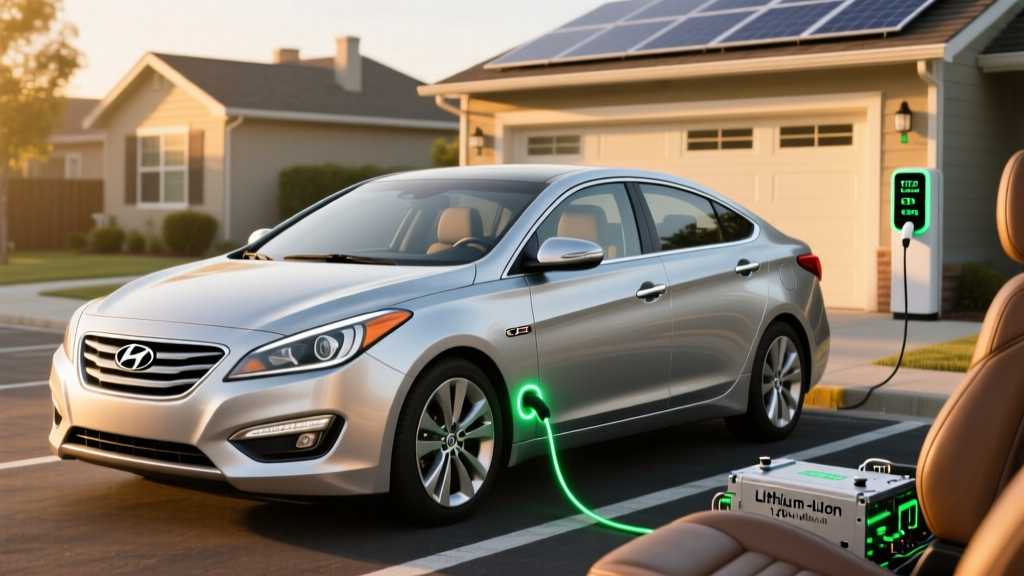
The Santa Fe PHEV upgrades to a more powerful electric motor (72 kW / 97 hp) paired with the same 1.6-liter turbo engine, yielding a combined 261 horsepower and 271 lb-ft of torque. The larger 13.8 kWh (usable) lithium-ion battery enables genuine zero-emission driving for short trips.
| Metric | Value |
|---|---|
| EPA electric-only range | 32 miles |
| Real-world EV range (mixed) | 26–30 miles |
| Real-world EV range (cold, 25°F) | 20–24 miles |
| Total range (EV + gas) | ~430 miles |
| EPA combined (hybrid mode) | 33 MPG |
| EPA MPGe (electric + gas) | 79 MPGe |
| Level 1 charge (120V, 12A) | ~11 hours (0–100%) |
| Level 2 charge (240V, 32A) | ~3.5 hours (0–100%) |
| DC fast charging | Not supported |
| Charge port | J1772 (Level 1/2) |
The absence of DC fast charging is a notable limitation. If you're on a road trip and want to top up the battery at a public fast-charger, you can't — the PHEV only accepts AC charging via J1772. This is standard for most PHEVs in this class (the RAV4 Prime also lacks DCFC), but it means your charging strategy is home-centric: plug in overnight on Level 2, wake up with a full 32-mile EV buffer, and let the hybrid system handle longer trips.
On a 28-mile round-trip commute with moderate temperatures and speeds under 55 mph, we consistently completed the trip in pure EV mode without the engine engaging. Push highway speeds to 70 mph or crank the A/C, and the engine will kick in around the 22–24 mile mark. Winter cold is the PHEV's kryptonite — expect that 32-mile EPA figure to shrink to roughly 22 miles in sustained 25°F weather due to battery resistance and cabin heating demands.
Powertrain Details: What's Under the Hood
Both the HEV and PHEV share Hyundai's Smartstream G1.6 T-GDi hybrid architecture, but with meaningful differences in electric motor output and battery capacity.
Santa Fe HEV: The 1.6-liter turbocharged inline-4 produces 178 hp and 195 lb-ft on its own. A 47.7 kW (64 hp) electric motor fills torque gaps and enables low-speed EV assist. Combined system output: 232 hp / 271 lb-ft. The 6-speed automatic transmission feels conventional — no CVT drone — and the transition between electric and gas power is well-masked in normal driving.
Santa Fe PHEV: The same 1.6T engine is paired with a more robust 72 kW (97 hp) electric motor, yielding 261 hp combined. The extra electric muscle makes the PHEV noticeably quicker off the line in EV mode and more confident during highway merging. The 13.8 kWh NMC (nickel manganese cobalt) battery is mounted under the rear seat, preserving cargo space — a packaging win over some competitors that sacrifice trunk room for battery placement.
Towing capacity is 3,500 pounds for both powertrains when properly equipped — adequate for a small boat or utility trailer, but not a large camper. If you need serious tow ratings, you're still looking at body-on-frame SUVs or full-size trucks.
Pricing, Trims, and Tax Credit Eligibility
Hyundai prices the Santa Fe Hybrid across three trims for 2026, with the PHEV available in two higher trims only:
| Trim | Powertrain | MSRP (incl. destination) |
|---|---|---|
| SEL Premium | HEV | ~$40,200 |
| Limited | HEV | ~$44,600 |
| Calligraphy | HEV | ~$47,850 |
| SEL Premium | PHEV | ~$45,500 |
| Limited | PHEV | ~$50,200 |
Tax credit situation: The conventional HEV does not qualify for any federal purchase incentive — it's a hybrid, not a plug-in. The PHEV may be eligible for up to $3,750 under the IRS §30D Clean Vehicle Credit, but this is not guaranteed. Current rules require:
- Buyer AGI below $150,000 (single) / $300,000 (joint)
- Vehicle MSRP under $80,000 (SUV cap — both trims qualify)
- Battery critical minerals and component sourcing thresholds (these tighten annually and may reduce or eliminate the credit for some model years)
- Point-of-sale transfer available at participating dealers, reducing your out-of-pocket at purchase
The PHEV's credit has historically been lower than the full $7,500 because Hyundai's battery sourcing has not always met the full critical-minerals threshold. Check the latest eligibility list at fueleconomy.gov/tax2023.shtml before relying on a specific credit amount in your budget.
Battery Warranty, Reliability, and Replacement Cost
Hyundai's hybrid systems have proven reliable in real-world ownership. The company has been building hybrid powertrains since the Sonata Hybrid in 2011, and the 1.6T hybrid architecture in the current Santa Fe generation has not been flagged for systemic battery or inverter failures in major reliability surveys. The HEV's small ~1.5 kWh battery undergoes shallow charge/discharge cycles (typically operating between 40–60% state of charge), which dramatically extends cell life compared to a full EV that cycles from 10–90%.
The PHEV's 13.8 kWh battery works harder — deeper daily cycles, exposure to Level 2 charging heat, and cold-weather stress. Even so, NMC chemistry in this application has demonstrated less than 10% capacity degradation over 5 years / 75,000 miles in owner-reported data. If the battery does fall below 70% of original capacity within the 10-year/100k warranty window, Hyundai replaces it at no cost.
Out-of-warranty replacement cost: If you're buying a high-mileage used Santa Fe Hybrid or plan to keep one past 150,000 miles, budget roughly $2,500–$4,000 for an HEV battery replacement and $5,000–$7,500 for the PHEV pack (parts and labor). These figures are estimates based on current Hyundai hybrid battery pricing and may shift as the supply chain matures.
Santa Fe Hybrid vs PHEV vs Full EV: Which Fits You?
The three-row electrified SUV market forces a genuine decision — not just a brand preference. Here's a practical framework:
Choose the Santa Fe HEV if:
- You don't have access to home or workplace charging
- Your daily driving exceeds 40 miles and you don't want to think about plugging in
- You want the lowest purchase price in the hybrid lineup
- You primarily drive in city/suburban conditions where hybrid efficiency shines
- You want a 3-row SUV under $45,000
Choose the Santa Fe PHEV if:
- You have Level 2 home charging (or can install it)
- Your daily commute is under 30 miles round-trip
- You want near-EV running costs on weekdays and gas flexibility for road trips
- You qualify for the partial federal tax credit and can capture it at point of sale
- You value the extra 29 hp for highway merging confidence
Choose a full EV (like the Kia EV9 or Tesla Model X) if:
- You have reliable home charging and your daily driving is under 250 miles
- You want the lowest per-mile energy cost (electricity at $0.13/kWh ≈ $0.04/mile vs gas at $3.40/gal ≈ $0.12/mile)
- You qualify for the full $7,500 federal credit on a qualifying BEV
- You want zero tailpipe emissions and minimal drivetrain maintenance
For most three-row SUV buyers without home charging infrastructure, the HEV is the path of least resistance. You get a meaningful MPG improvement over the gas-only Santa Fe (which rates 24 MPG combined) without any behavioral change. The PHEV is the enthusiast's hybrid — more rewarding if you commit to the charging routine, but the premium is hard to justify if you'll rarely plug in.
Pros and Cons at a Glance
- 35 MPG combined (HEV) in a 3-row SUV
- Standard AWD across all hybrid trims
- 10-year/100k hybrid battery warranty
- PHEV's 32-mile EV range covers most commutes
- Conventional 6-speed auto (no CVT)
- Boxy design maximizes interior volume
- 3,500-lb towing capacity
- PHEV lacks DC fast charging
- Third row is tight for adults on long trips
- PHEV price premium (~$5,300 over equivalent HEV)
- Partial tax credit only ($3,750 max, not $7,500)
- HEV highway MPG drops at 75+ mph
- Cold weather cuts PHEV EV range by ~30%
- No spare tire (tire repair kit only)
Frequently Asked Questions
How many MPG does the Santa Fe Hybrid get in real-world driving?
The EPA rates the 2026 Santa Fe HEV at 36 city / 34 highway / 35 combined. In real-world mixed driving, expect 33–36 MPG combined. City-heavy routes can push toward 38–40 MPG thanks to regenerative braking, while sustained highway driving at 75 mph typically yields 31–33 MPG.
How far can the Santa Fe PHEV go on electric power alone?
The EPA rates the PHEV at 32 miles of electric-only range. In moderate temperatures and mixed driving under 55 mph, expect 26–30 real-world miles. Highway speeds and cold weather (below 30°F) reduce this to 20–24 miles. Once the battery depletes, the PHEV operates as a conventional hybrid at roughly 33 MPG.
Does the Santa Fe Hybrid qualify for any tax credit?
The conventional HEV does not qualify for any federal tax credit. The PHEV may qualify for up to $3,750 under IRS §30D, subject to income caps ($150K single / $300K joint), MSRP limits (under $80K for SUVs), and battery-sourcing requirements that change annually. Always verify current eligibility at irs.gov before purchasing.
Is the Santa Fe Hybrid reliable, and what does battery replacement cost?
Hyundai's hybrid powertrains have a strong reliability track record, and the hybrid battery is warrantied for 10 years / 100,000 miles. Out-of-warranty HEV battery replacement runs approximately $2,500–$4,000; PHEV battery replacement is estimated at $5,000–$7,500. Most owners will never need a replacement within typical ownership periods.
Can I charge the Santa Fe PHEV at a public DC fast charger?
No. The Santa Fe PHEV only supports AC charging via a J1772 connector — Level 1 (120V) or Level 2 (240V). There is no DC fast-charge port. This is typical for PHEVs in this class. Plan to charge at home overnight on a Level 2 circuit for daily EV range.
Is the Santa Fe Hybrid better than the gas-only model?
If fuel economy matters, yes. The gas-only Santa Fe 2.5T AWD rates 22 MPG combined — the HEV improves that to 35 MPG, a 59% gain. Over 15,000 annual miles at $3.40/gallon, the HEV saves roughly $950/year in fuel. The hybrid also provides smoother low-speed acceleration from electric motor torque. The trade-off is a ~$3,000–$4,000 price premium depending on trim.