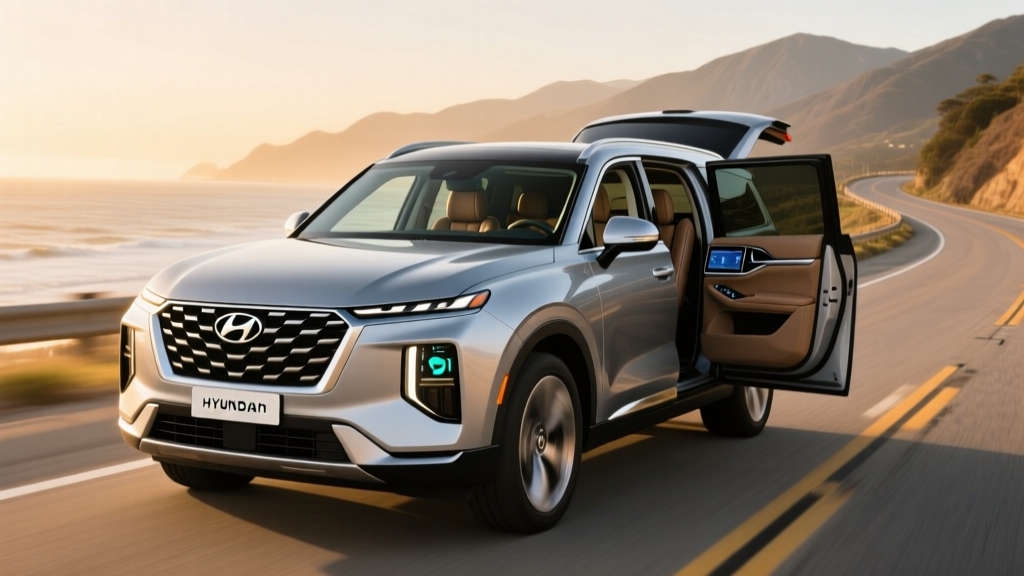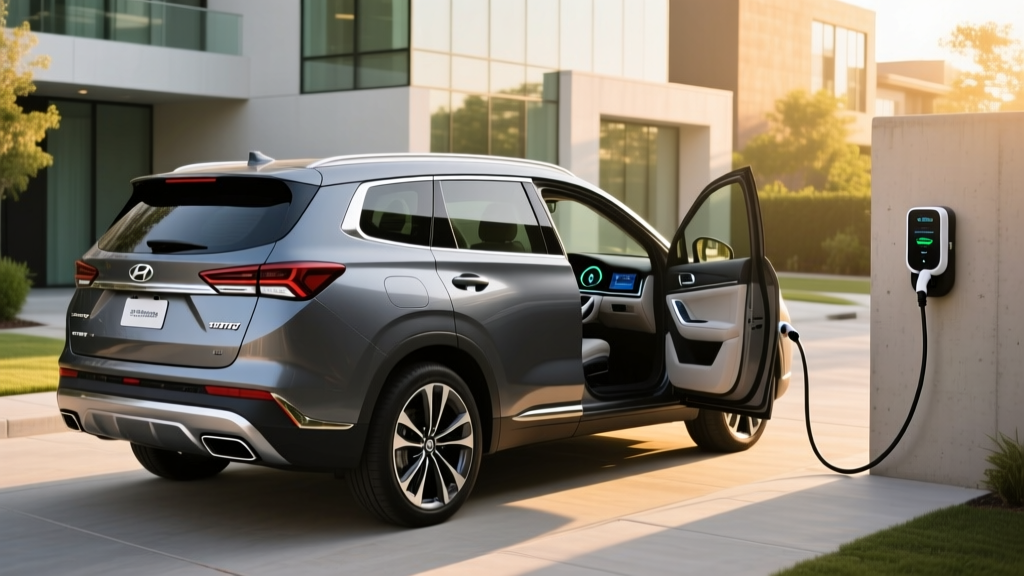
The 2026 Hyundai Santa Fe Hybrid Limited sits at the top of Hyundai's midsize three-row hybrid lineup, pairing a turbocharged gasoline engine with an electric motor for an EPA-estimated 36 MPG combined. Unlike a plug-in hybrid or full electric vehicle, this conventional hybrid (HEV) never needs to be plugged in — it recovers energy through regenerative braking and the engine to charge its small battery. For buyers who want the fuel savings of electrification without altering their driving or charging habits, the Santa Fe Hybrid Limited makes a compelling case at $46,200 MSRP.
In this guide, we break down the powertrain specs, real-world fuel economy, battery longevity, and how this HEV compares to the Santa Fe Plug-in Hybrid and full EVs. If you're cross-shopping the three-row hybrid SUV segment, this is the data-driven look you need before visiting a dealer.
HEV vs PHEV: Which Santa Fe Hybrid Is Which?
Hyundai sells the Santa Fe in two electrified flavors for 2026, and confusing them is the most common mistake shoppers make. Here's the critical difference:
| Feature | Santa Fe Hybrid (HEV) | Santa Fe Plug-in Hybrid (PHEV) |
|---|---|---|
| Needs to be plugged in? | No — self-charging | Yes — for electric-only range |
| Electric-only driving | Very short low-speed assists | ~30 miles EPA (estimated) |
| Battery size | ~1.49 kWh (small) | ~13.8 kWh (larger) |
| Combined power | 232 HP | 261 HP (estimated) |
| Best for | No home charging access; simplicity | Home charger + short daily commutes |
| Federal tax credit (§30D) | Not eligible | Eligibility varies by sourcing/income |
The Santa Fe Hybrid Limited (this review) is the HEV. It requires zero behavior change from a gas car. You fill it with regular unleaded, and the hybrid system handles the rest. The PHEV is a separate model we cover in its own profile.
Powertrain & Performance Specs
The 2026 Santa Fe Hybrid uses Hyundai's Smartstream 1.6-liter turbocharged four-cylinder engine paired with an electric motor integrated into the six-speed automatic transmission. The system drives all four wheels through Hyundai's HTRAC all-wheel-drive system as standard on the Limited trim.
| Specification | 2026 Santa Fe Hybrid Limited |
|---|---|
| Engine | 1.6L Turbocharged I-4 |
| Electric Motor | 47.7 kW (64 HP) |
| Combined System Output | 232 HP / 271 lb-ft torque |
| Transmission | 6-speed automatic |
| Drivetrain | HTRAC AWD (standard on Limited) |
| Battery Capacity | ~1.49 kWh (lithium-ion polymer) |
| 0-60 mph (estimated) | ~7.8 seconds |
| Towing Capacity | 2,000 lbs (with tow package) |
| Seating | 7 passengers (3 rows) |
The 232 combined horsepower is competitive for the segment — it matches up favorably against the Toyota Highlander Hybrid's 243 HP while delivering similar fuel economy. The turbocharged engine gives the Santa Fe Hybrid stronger mid-range passing power than most naturally aspirated hybrid competitors, which matters when merging onto highways with three rows of passengers and cargo.
Fuel Economy: EPA Ratings vs Real-World MPG
Fuel economy is the headline reason buyers choose this SUV. Here's what the EPA reports for the 2026 Santa Fe Hybrid AWD:
| Driving Cycle | EPA MPG | Real-World Expectation |
|---|---|---|
| City | 35 MPG | 36–38 MPG (hybrids excel in stop-and-go) |
| Highway | 36 MPG | 32–34 MPG (sustained 75+ mph reduces regen benefit) |
| Combined | 36 MPG | 33–36 MPG depending on driving mix |
How many MPG does the Santa Fe Hybrid actually get? In mixed driving with a combination of suburban errands and highway commuting, expect to average 33–35 MPG. City-heavy drivers may see 37+ MPG because conventional hybrids recover more energy through regenerative braking at lower speeds — the electric motor handles more of the workload while the engine shuts off at stops.
Highway fuel economy drops slightly versus the EPA sticker because sustained high-speed driving reduces the regenerative braking benefit and increases aerodynamic drag on this boxy three-row SUV. In cold weather (below 30°F), expect a 5–8% reduction in MPG as the engine runs more frequently to provide cabin heat and warm the catalytic converter.
Total Range: With a 17.7-gallon fuel tank and 36 MPG combined, the Santa Fe Hybrid Limited delivers approximately 637 miles of total range before refueling — eliminating the range anxiety some EV buyers feel on road trips.
Pricing, Trims, and Tax Credit Eligibility
The 2026 Hyundai Santa Fe Hybrid is available in three trims. The Limited is the top-tier model with the most complete feature set:
| Trim | MSRP | Key Additions |
|---|---|---|
| SEL Premium | $40,200 | Heated front seats, power liftgate, 12.3" dual screens |
| Limited | $46,200 | Nappa leather, ventilated front seats, head-up display, Highway Driving Assist 2, surround-view camera |
| Calligraphy | $49,200 | Quilted leather, premium headliner, exclusive wheels, Digital Key 2 |
Does the Santa Fe Hybrid Limited qualify for a federal tax credit? No. The conventional Santa Fe Hybrid (HEV) does not qualify for the federal §30D Clean Vehicle Credit. That credit is reserved for plug-in electric vehicles (PHEVs and BEVs) that meet battery sourcing, MSRP, and buyer income requirements as outlined on IRS.gov. The Santa Fe Plug-in Hybrid may be eligible depending on current-year sourcing rules — consult a tax professional for your specific situation.
Some states offer separate incentives for conventional hybrids, though these are less common than EV rebates. Check your state's energy office or department of environmental quality for current programs.
Battery Warranty, Reliability, and Replacement Costs
Hybrid battery longevity is the number-one concern for first-time hybrid buyers. Here's what Hyundai provides:
| Warranty Coverage | Terms |
|---|---|
| Hybrid Battery | 10 years / 100,000 miles (original owner) |
| Hybrid System Components | 10 years / 100,000 miles |
| Powertrain (engine/transmission) | 10 years / 100,000 miles |
| New Vehicle Limited | 5 years / 60,000 miles |
Is the Santa Fe Hybrid reliable? Hyundai's hybrid systems have proven durable across the Tucson Hybrid, Sonata Hybrid, and Ioniq lineups over multiple model years. The 1.49 kWh battery in the HEV is small and operates within a narrow state-of-charge window (roughly 40–60%), which significantly reduces degradation stress compared to full EVs that cycle through wider charge ranges. This is a key reason hybrid batteries routinely outlast their warranty periods.
What does hybrid battery replacement cost? If the hybrid battery fails outside of warranty, replacement for a midsize Hyundai hybrid typically ranges from $2,000 to $4,000 including parts and labor at a dealership. Independent hybrid specialists may offer refurbished battery packs for $1,500–$2,500. However, given the 10-year/100,000-mile warranty and the conservative charge management of HEV systems, most owners will never face this expense.
Interior, Technology, and Safety
The Limited trim earns its name with a well-appointed cabin. Standard features on the 2026 Santa Fe Hybrid Limited include:
- 12.3-inch digital instrument cluster and 12.3-inch infotainment touchscreen with wireless Apple CarPlay and Android Auto
- Nappa leather-trimmed seats with ventilated front and heated rear outboard seats
- Head-up display (HUD) with hybrid energy flow information
- Highway Driving Assist 2 (HDA-2): SAE Level 2 driver assistance with lane-centering, adaptive cruise, and lane-change assist
- Surround-view monitor with blind-spot view display
- Bose 12-speaker premium audio system
- Dual wireless phone charging pads
- Power-folding third row and hands-free smart power liftgate
The squared-off exterior design maximizes interior volume. Cargo space measures approximately 14.5 cubic feet behind the third row, 40.5 cubic feet with the third row folded, and 79.6 cubic feet with both rear rows folded — competitive with the Kia Sorento Hybrid and exceeding the Toyota Highlander Hybrid's cargo figures.
NHTSA and IIHS safety ratings should be consulted at purchase time as crash-test results are updated throughout the model year. The previous-generation Santa Fe earned strong marks, and Hyundai has expanded standard active safety features for 2026.
Santa Fe Hybrid vs PHEV vs Full EV: Which Fits You?
The three-row electrified SUV market offers three distinct paths. Here's a decision framework:
Choose the Santa Fe Hybrid (HEV) if:
- You don't have access to home or workplace charging
- You want fuel savings with zero lifestyle changes
- You regularly take road trips where charging infrastructure is sparse
- You want a lower purchase price than a PHEV or EV equivalent
- Your daily driving is varied — some city, some highway
Choose the Santa Fe Plug-in Hybrid (PHEV) if:
- You can install a Level 2 home charger (240V)
- Your daily commute is under 30 miles round-trip (drive electric most days)
- You still want gas-engine flexibility for longer trips
- You want to reduce daily fuel costs dramatically while keeping road-trip range
Choose a full EV (like the Hyundai Ioniq 5 or Kia EV9) if:
- You have reliable home charging and your daily driving is under 250 miles
- You want zero tailpipe emissions and the lowest per-mile fuel cost
- You're eligible for the federal §30D tax credit (up to $7,500 point-of-sale)
- You want minimal maintenance (no oil changes, fewer moving parts)
The Santa Fe Hybrid's advantage is simplicity. You drive it exactly like a gas car, and it rewards you with 36 MPG combined — a 40–50% improvement over a non-hybrid three-row SUV. There's no charging cable, no range estimation, no trip planning. For many three-row SUV buyers hauling families, that simplicity is worth more than the theoretical savings of a plug-in.
Pros and Cons: Santa Fe Hybrid Limited
Pros
- 36 MPG combined is excellent for a 3-row AWD SUV
- No plug-in required — zero behavior change from a gas car
- 232 HP with turbo provides confident highway merging
- Limited trim is fully loaded with premium features at $46,200
- 10-year/100,000-mile hybrid battery warranty
- ~637 miles of total range eliminates refueling stops on long trips
- HTRAC AWD standard on Limited for all-weather confidence
Cons
- No federal tax credit eligibility (HEVs excluded from §30D)
- Highway MPG drops to ~32–34 at sustained 75+ mph speeds
- Third row is tight for adults on long trips
- Heavier than non-hybrid Santa Fe (hybrid system adds ~200 lbs)
- 2,000-lb towing capacity is modest for the segment
- No DC fast charging (not applicable to HEVs, but a PHEV limitation to note)
- Cold weather reduces MPG by 5–8% as engine runs more for cabin heat
Frequently Asked Questions
How many MPG does the 2026 Santa Fe Hybrid Limited get in real-world driving?
The EPA rates it at 35 city / 36 highway / 36 combined. In real-world mixed driving, owners typically see 33–35 MPG. City-heavy drivers may exceed the EPA city rating — conventional hybrids are most efficient in stop-and-go traffic where regenerative braking and electric-motor assists do the most work. Sustained highway driving at 75+ mph reduces the hybrid advantage.
Does the Santa Fe Hybrid need to be plugged in?
No. The Santa Fe Hybrid is a conventional hybrid (HEV). It charges its 1.49 kWh battery through regenerative braking and the gasoline engine. You simply fill it with regular unleaded gasoline. If you want a Santa Fe that plugs in for electric-only driving, look at the Santa Fe Plug-in Hybrid (PHEV), which is a separate model.
How far can the Santa Fe Plug-in Hybrid go on electric only?
The Santa Fe PHEV (a different model from this HEV review) offers an estimated 30 miles of electric-only range on a full charge, enough for most daily commutes. Once the battery is depleted, it operates as a conventional hybrid. The PHEV's larger 13.8 kWh battery can be charged via a Level 2 (240V) home charger in approximately 3.5 hours. DC fast charging is not available on the Santa Fe PHEV.
Does the Santa Fe Hybrid qualify for any tax credit?
The conventional Santa Fe Hybrid (HEV) does not qualify for the federal §30D Clean Vehicle Credit, which applies only to plug-in vehicles. Some states may offer hybrid-specific incentives — check your state energy office. The Santa Fe Plug-in Hybrid may be eligible for partial or full federal credits depending on battery sourcing requirements and buyer income caps. Always verify current rules at IRS.gov before purchasing.
How long will the hybrid battery last, and what does replacement cost?
Hyundai covers the hybrid battery for 10 years or 100,000 miles for the original owner. Because the HEV battery is small (1.49 kWh) and operates within a narrow charge window, degradation is minimal. Most Toyota and Hyundai hybrid batteries last well beyond 150,000 miles. If replacement is needed out of warranty, expect $2,000–$4,000 at a dealer or $1,500–$2,500 from an independent hybrid specialist using a refurbished pack.
Is the Santa Fe Hybrid better than the Toyota Highlander Hybrid?
They're closely matched. The Highlander Hybrid offers 36 MPG combined (same as the Santa Fe Hybrid) and has a longer track record in the segment. The Santa Fe Hybrid counters with a more modern interior design, turbocharged engine for stronger passing power, and Hyundai's 10-year/100,000-mile warranty versus Toyota's 10-year/150,000-mile hybrid battery coverage. Test-drive both — the decision often comes down to styling preference and dealer experience in your area.