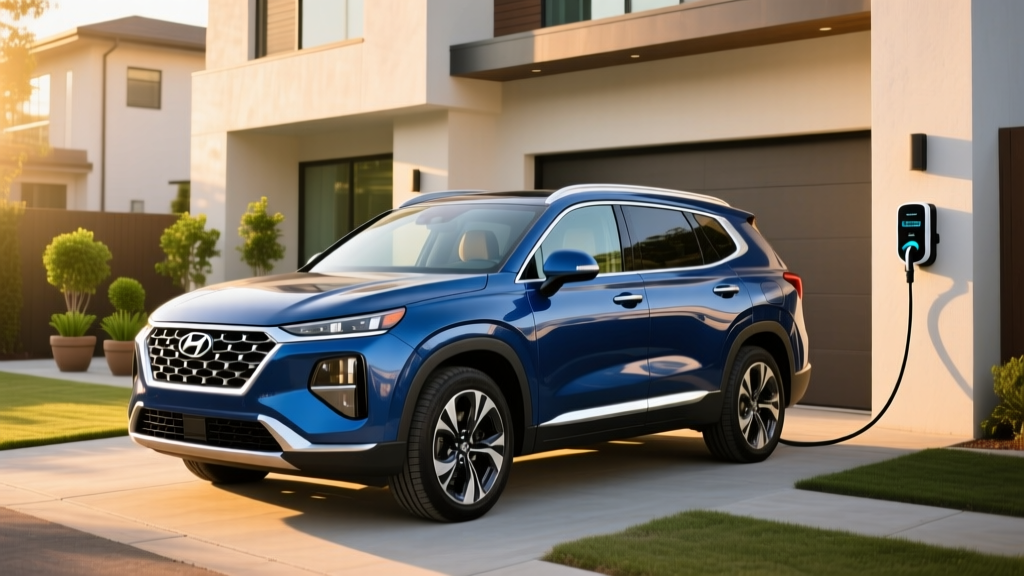
The redesigned 2024 Hyundai Santa Fe arrives with a boxy, rugged aesthetic and two electrified powertrains: a conventional hybrid (HEV) and a plug-in hybrid (PHEV). Both pair a 1.6-liter turbocharged four-cylinder with electric motors, but they serve fundamentally different buyers. The HEV delivers strong fuel economy with zero lifestyle change, while the PHEV offers a meaningful electric-only commute for those with home charging access. Here's every number that matters.
HEV vs PHEV: Which Santa Fe Is Right for You?
Santa Fe Hybrid (HEV)
- No plug required — the battery charges via regenerative braking and the engine
- 36 MPG combined EPA estimate across all driving
- Lower starting price — begins around $37,000 MSRP
- Best for: apartment dwellers, those without garage charging, drivers who want simplicity
Santa Fe Plug-In Hybrid (PHEV)
- 30 miles electric-only EPA range before the engine engages
- 33 MPG combined once the battery depletes (hybrid mode)
- 1.38 kWh usable battery (13.8 kWh total pack), Level 2 chargeable
- Best for: homeowners with Level 2 access and commutes under 30 miles
The distinction matters because the PHEV commands a premium (roughly $3,000-$4,000 over the HEV at equivalent trims) and only delivers its fuel-cost advantage if you plug in regularly. Drive a PHEV without charging and you're carrying dead battery weight at slightly worse MPG than the HEV.
Fuel Economy: EPA Ratings and Real-World MPG
| Model | City MPG | Highway MPG | Combined MPG | Electric-Only Range | Total Range |
|---|---|---|---|---|---|
| Santa Fe Hybrid (HEV) AWD | 35 | 34 | 36 | N/A | ~640 mi |
| Santa Fe PHEV AWD | 33 (hybrid mode) | 31 (hybrid mode) | 33 (hybrid mode) | 30 mi | ~430 mi total |
Source: EPA Fuel Economy Guide
Hyundai's hybrid system excels in stop-and-go traffic where regenerative braking recaptures energy frequently. In city-heavy driving, owners consistently report matching or slightly exceeding the 35 MPG city EPA figure. Highway cruising at 75+ mph drops efficiency to the low 30s due to the boxy new body design's aerodynamic penalty. In cold weather (below 30°F), expect a 10-15% fuel economy reduction — the engine runs more frequently to provide cabin heat and maintain battery temperature. For the PHEV, the 30-mile electric range shrinks to roughly 22-25 miles in freezing temperatures due to battery chemistry limitations and cabin heating demands.
Powertrain Specs: Horsepower, Torque, and Drivetrain
| Specification | Santa Fe Hybrid (HEV) | Santa Fe PHEV |
|---|---|---|
| Engine | 1.6L Turbo I4 | 1.6L Turbo I4 |
| Combined System Horsepower | 232 hp | 258 hp |
| Combined System Torque | 271 lb-ft | 271 lb-ft |
| Electric Motor Output | 47.7 kW (64 hp) | 74 kW (99 hp) |
| Transmission | 6-speed automatic | 6-speed automatic |
| Drivetrain | AWD (standard) | AWD (standard) |
| 0-60 mph (estimated) | ~7.5 sec | ~7.0 sec |
| Towing Capacity | 2,000 lbs | 2,000 lbs |
The PHEV's larger electric motor provides noticeably stronger off-the-line acceleration and more confident highway merging. Both models use Hyundai's TMED-II (Transmission-Mounted Electric Device) architecture, which places the motor between the engine and transmission for seamless power blending. Standard HTRAC all-wheel drive uses a rear-mounted electric motor on the HEV to provide torque to the rear axle without a mechanical driveshaft — a clever efficiency choice.
PHEV Charging: Battery Size, Charge Times, and Infrastructure
| Charging Level | Power (kW) | Time (0-100%) | Equipment Needed |
|---|---|---|---|
| Level 1 (120V household) | ~1.4 kW | ~11 hours | Included portable cord |
| Level 2 (240V home/public) | ~7.2 kW | ~3.5 hours | Home wallbox or public station |
| DC Fast Charging | N/A | N/A | Not supported |
The PHEV's 13.8 kWh battery pack (1.38 kWh usable for electric-only driving, with the remainder reserved as a buffer for hybrid operation) uses a J1772 connector for Level 2 charging. There is no DC fast charging capability — this is standard for PHEVs in this class, as the small battery doesn't justify the hardware cost and thermal complexity.
Home charging cost reality: A full Level 1 charge from a standard 120V outlet takes roughly 11 hours, sufficient for overnight top-ups if your daily electric driving stays under 25 miles. For full daily replenishment of the 30-mile range, a Level 2 home charger ($500-$700 for equipment, $800-$2,000 for professional installation depending on panel capacity and run distance) delivers a full charge in about 3.5 hours. At the national average electricity rate of $0.16/kWh, a full PHEV charge costs approximately $2.20 — versus roughly $4.50 in gasoline for the same 30 miles at 33 MPG.
Pricing, Trims, and Tax Credit Eligibility
| Trim | HEV MSRP | PHEV MSRP |
|---|---|---|
| SEL Premium | $37,000 | $40,500 |
| Limited | $40,350 | $43,850 |
| Calligraphy | $43,400 | $47,050 |
Prices include destination. Source: Hyundai USA
- HEV (conventional hybrid): Does NOT qualify for the federal EV tax credit. The §30D credit applies only to plug-in vehicles with battery capacity ≥7 kWh. Some states offer hybrid rebates — check your state energy office.
- PHEV: The 2024 Santa Fe PHEV does NOT currently qualify for the $7,500 federal tax credit under updated IRS critical mineral and battery component sourcing requirements effective January 2024. Hyundai has not confirmed compliance for this model year. Always verify current eligibility at fueleconomy.gov before purchasing.
- Income caps (§30D): $150,000 single / $300,000 joint MAGI
- MSRP caps: $80,000 for SUVs/vans/pickups (Santa Fe qualifies)
- Point-of-sale transfer: If eligible, the credit can be transferred to the dealer at purchase for an immediate price reduction
While the PHEV doesn't currently receive the federal credit, several states offer their own incentives. California's CVRP program, Colorado's state credit, and various utility company rebates can offset $1,000-$4,000 of the PHEV premium. Check AFDC's state incentive database for your jurisdiction.
Battery Warranty, Longevity, and Replacement Cost
- Coverage: 10 years / 100,000 miles (whichever comes first)
- What's covered: Battery capacity loss below a defined threshold, cell failures, BMS defects
- Transferable: Yes, to subsequent owners (reduced to 5yr/60k in some states for second owners)
- Out-of-warranty replacement cost: $2,500-$4,500 for the HEV pack; $4,000-$6,500 for the larger PHEV pack (parts + labor, dealer pricing)
Hyundai's lithium-ion hybrid battery packs have demonstrated strong longevity in real-world use. The HEV's smaller ~1.5 kWh pack and the PHEV's 13.8 kWh pack both employ conservative buffer management — Hyundai locks away a significant portion of total capacity to prevent deep discharge and overcharge cycles that accelerate degradation. Based on data from earlier Hyundai/Kia hybrid models (Ioniq, Niro, Sonata Hybrid), most packs retain 85-90% of original capacity after 100,000 miles. Complete failures within the warranty period are uncommon but not unheard of, and Hyundai's 10-year coverage is among the industry's strongest.
The hybrid system's other high-voltage components — the inverter, electric motor, and TMED-II transmission — are similarly covered under the 10-year powertrain warranty. The 12V auxiliary battery (which powers electronics and starts the hybrid system) is covered for 3 years/36,000 miles and costs $200-$350 to replace.
Santa Fe Hybrid vs PHEV vs Full EV: The Decision Framework
- You rent or live in an apartment without charging access
- Your daily driving is unpredictable — some days 10 miles, others 300
- You want maximum simplicity with no charging habits to develop
- Budget is a primary concern and the $3,000+ PHEV premium doesn't pencil out
- You own your home and can install a Level 2 charger ($1,300-$2,700 total)
- Your daily commute is under 30 miles round-trip (you'll rarely use gas)
- You want EV-like quiet, instant-torque driving for daily errands but road-trip flexibility on weekends
- Your state offers a PHEV rebate that narrows the price gap
- Your daily driving exceeds 30 miles regularly (PHEV electric range won't cover you)
- You have reliable home AND workplace charging
- You want to eliminate oil changes, spark plugs, and transmission fluid entirely
- You qualify for the $7,500 federal credit on an eligible EV, making total cost of ownership competitive
Real-World Ownership: What Hybrid Buyers Should Know
The 2024 Santa Fe's redesign trades the previous generation's sleek crossover look for a boxy, Land Rover-esque profile. This creates excellent interior volume (40.5 cu ft cargo behind the second row in hybrid models, with a usable under-floor compartment where the spare tire would be) but introduces a measurable aerodynamic penalty. Highway fuel economy suffers relative to more slippery competitors like the Toyota RAV4 Hybrid (39 MPG combined) and Honda CR-V Hybrid (40 MPG combined).
However, the Santa Fe Hybrid's 36 MPG combined still represents a 40-50% improvement over the gas-only Santa Fe (24 MPG combined with the 2.5T engine). For a driver covering 15,000 miles annually at $3.50/gallon, that's roughly $2,187 in annual fuel costs for the hybrid versus $3,645 for the gas model — a savings of $1,458 per year that recovers the hybrid's price premium in approximately 2.5 years.
The PHEV's economics depend entirely on charging discipline. A PHEV owner who charges nightly and drives 25 miles daily might use only 100-150 gallons of gasoline annually (for weekend trips and occasional long drives), cutting fuel costs to roughly $500-$700 per year. But that same PHEV, never plugged in, would burn roughly 455 gallons annually at 33 MPG — only marginally better than the HEV's 417 gallons at 36 MPG.
Pros
- Class-leading cargo volume and third-row seat (rare in hybrid midsize SUVs)
- Standard AWD with no fuel economy penalty vs FWD
- 10-year/100k-mile hybrid battery warranty
- Quiet, refined hybrid system with seamless engine/motor transitions
- PHEV offers genuine 30-mile electric commute capability
Cons
- Boxy design hurts highway MPG vs RAV4 Hybrid and CR-V Hybrid
- PHEV lacks DC fast charging (expected for the class)
- No federal tax credit eligibility on PHEV (as of 2024)
- Third row is tight for adults — best for children
- 2,000-lb towing capacity trails body-on-frame competitors
Frequently Asked Questions
How many MPG does the 2024 Santa Fe Hybrid get?
The EPA rates the Santa Fe Hybrid AWD at 35 city / 34 highway / 36 combined MPG. Real-world testing shows city MPG can exceed the EPA estimate in heavy stop-and-go traffic, while sustained highway driving at 75+ mph typically yields 30-32 MPG due to aerodynamic drag from the boxy body design.
How far can the Santa Fe PHEV go on electric only?
The EPA rates the 2024 Santa Fe PHEV at 30 miles of electric-only range. In mild weather with moderate speeds (under 50 mph), some drivers report 32-34 miles. In cold weather (below freezing) or at highway speeds, expect 22-26 miles before the engine engages.
Is the Santa Fe Hybrid reliable?
Hyundai's hybrid powertrain has demonstrated strong reliability in earlier models. The 10-year/100,000-mile hybrid battery warranty provides long-term protection. Out-of-warranty battery replacement costs $2,500-$4,500 for the HEV and $4,000-$6,500 for the PHEV, though most packs last well beyond 150,000 miles with gradual capacity loss rather than sudden failure.
Does the Santa Fe Hybrid qualify for a tax credit?
The conventional hybrid (HEV) does not qualify for any federal tax credit. The PHEV does not currently qualify for the $7,500 federal §30D credit due to battery sourcing requirements, though state incentives may apply. Verify current eligibility at fueleconomy.gov before purchasing.
Can I charge the Santa Fe Hybrid at home?
The conventional hybrid (HEV) cannot be plugged in — it charges its small battery through regenerative braking and the gasoline engine. Only the PHEV variant can be plugged in, using a standard 120V outlet (Level 1, ~11 hours for full charge) or a 240V Level 2 home charger (~3.5 hours).
How does the Santa Fe Hybrid compare to the Toyota RAV4 Hybrid?
The RAV4 Hybrid achieves 39 MPG combined versus the Santa Fe Hybrid's 36 MPG, and offers a slightly lower starting price. However, the Santa Fe provides more cargo volume, an available third row, and a more premium interior. The RAV4 also offers a PHEV variant (RAV4 Prime) with 42 miles of electric range — significantly more than the Santa Fe PHEV's 30 miles.