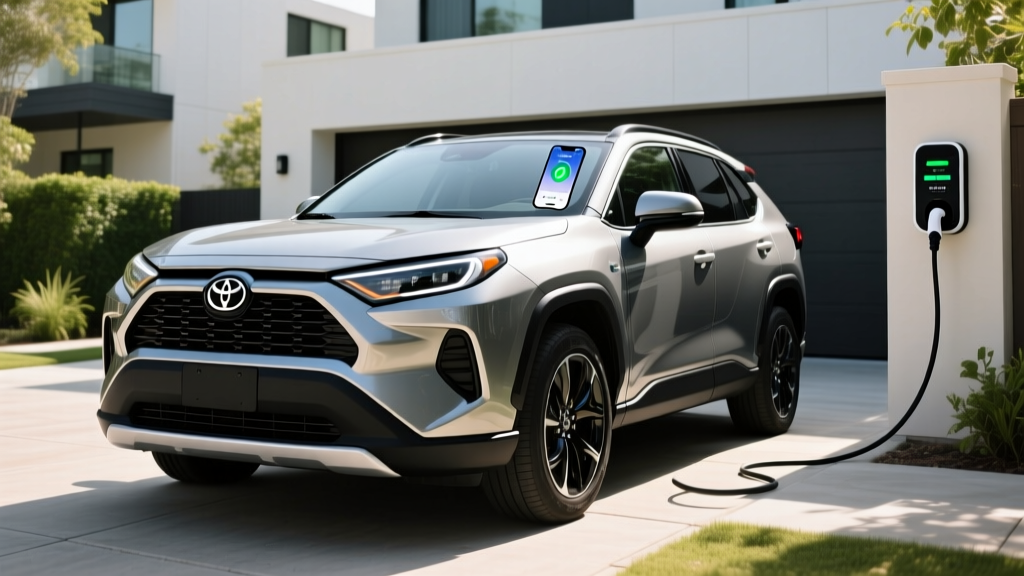
The Toyota RAV4 Hybrid has been the best-selling electrified SUV in America for years, and the XSE trim sits in a sweet spot: sport-tuned suspension, a blacked-out roof, and all the efficiency of Toyota's fifth-generation hybrid system without the price premium of the Plug-in variant. For 2026, the RAV4 XSE Hybrid continues to offer standard all-wheel drive, a 219-horsepower powertrain, and an EPA-estimated 39 MPG combined — numbers that make it one of the most practical crossovers on the market for buyers who want to cut fuel costs without plugging in.
This guide breaks down everything you need to know about the 2026 RAV4 XSE Hybrid: real-world fuel economy, how the HEV system works, battery longevity, tax credit eligibility, and whether the XSE Hybrid or the RAV4 Prime PHEV is the better buy for your driving pattern.
RAV4 XSE Hybrid Powertrain: How Toyota's HEV System Works
The 2026 RAV4 XSE Hybrid pairs a 2.5-liter four-cylinder Atkinson-cycle engine with three electric motor-generators — one up front integrated into the transaxle, and a dedicated rear-axle motor that provides electronic on-demand all-wheel drive. The combined system output is 219 horsepower, with the gasoline engine contributing 176 hp and 163 lb-ft of torque on its own.
This is a conventional hybrid (HEV), meaning it never needs to be plugged in. The 1.6 kWh nickel-metal hydride (NiMH) traction battery charges through regenerative braking and the gasoline engine. The electric motors assist during acceleration, enable low-speed EV-mode driving for short distances (typically under 1 mile at low speeds), and recapture energy during deceleration. The driver never manages charging — the powertrain control module handles it all automatically.
| Specification | 2026 RAV4 XSE Hybrid |
|---|---|
| Powertrain | 2.5L I4 + 3 electric motor-generators |
| Combined Horsepower | 219 hp |
| Drivetrain | Electronic AWD (eAWD) |
| Traction Battery | 1.6 kWh NiMH |
| Transmission | eCVT (planetary gearset) |
| 0–60 mph | ~7.4 seconds |
| Towing Capacity | 1,750 lbs |
| Cargo Volume | 37.6 cu ft (rear seats up) |
Fuel Economy: EPA Ratings and Real-World MPG
The EPA rates the 2026 RAV4 Hybrid AWD (including the XSE trim) at 41 MPG city / 38 MPG highway / 39 MPG combined, according to fueleconomy.gov. These are strong numbers for a compact SUV with standard AWD.
| Driving Condition | EPA Estimate | Real-World Expectation |
|---|---|---|
| City | 41 MPG | 38–44 MPG (hybrids excel in stop-and-go) |
| Highway | 38 MPG | 34–38 MPG (aerodynamic drag reduces regen benefit) |
| Combined | 39 MPG | 36–41 MPG depending on driving mix |
| Cold Weather (below 32°F) | — | 32–36 MPG (engine runs more for cabin heat) |
Real-world note: Toyota hybrids consistently match or exceed their EPA city ratings in actual driving because regenerative braking is most effective in urban stop-and-go traffic. Highway driving is where the RAV4 Hybrid's efficiency dips relative to its city number — the electric motors contribute less at sustained high speeds, and the boxy SUV shape creates aerodynamic drag. In cold weather, expect a 5–10% drop as the gasoline engine runs more frequently to provide cabin heat and maintain battery temperature.
For comparison, the non-hybrid gas-only RAV4 AWD returns roughly 27 MPG combined — meaning the XSE Hybrid saves approximately 4.5 gallons per 100 miles, or about $600–$800 per year in fuel at 15,000 miles driven annually and $3.50/gallon.
HEV vs PHEV vs EV: Is the RAV4 XSE Hybrid Right for You?
Toyota offers the RAV4 in three powertrains: conventional gas, hybrid (HEV), and the RAV4 Prime plug-in hybrid (PHEV). Here's how the XSE Hybrid stacks up against the PHEV and a full battery-electric vehicle (BEV) like the Toyota bZ4X or Hyundai Ioniq 5.
| Factor | RAV4 XSE Hybrid (HEV) | RAV4 Prime (PHEV) | Full EV (e.g., Ioniq 5) |
|---|---|---|---|
| Plug-in Required? | No — self-charging | Yes — 2.5 hrs Level 2 | Yes — 7+ hrs Level 2 |
| Electric-Only Range | ~0.5 mi (low speed only) | 42 miles EPA | 250–310 miles EPA |
| Total Range | ~570 miles | ~600 miles (gas + electric) | 250–310 miles |
| Combined Efficiency | 39 MPG | 94 MPGe (electric) / 38 MPG (gas) | 110+ MPGe |
| Starting MSRP | ~$37,000 | ~$44,500 | ~$42,000–$48,000 |
| Federal Tax Credit (§30D) | Not eligible | Up to $7,500 (if eligible) | Up to $7,500 (if eligible) |
| Home Charging Needed? | No | Recommended for PHEV benefit | Essential |
Choose the RAV4 XSE Hybrid (HEV) if: You don't have access to home or workplace charging, you want maximum simplicity with no plug-in routine, your budget is under $40K, or you drive a mix of city and highway where the hybrid system shines without needing electric-only commuting.
Choose the RAV4 Prime (PHEV) if: You can install a Level 2 home charger, your daily commute is under 42 miles round-trip (so you rarely burn gas), and you qualify for the §30D federal tax credit — which can narrow the ~$7,500 price gap between the HEV and PHEV to nearly zero.
Choose a full EV if: You have reliable home charging, your daily driving is under 250 miles, you want zero tailpipe emissions and minimal maintenance, and you're ready to plan around DC fast charging on road trips.
RAV4 Prime PHEV: Electric Range, Battery, and Charging
Since many RAV4 Hybrid shoppers cross-shop the RAV4 Prime, here are the key PHEV specs for context. The 2026 RAV4 Prime uses a larger 18.1 kWh lithium-ion battery and a more powerful electric motor system producing a combined 302 horsepower — making it the quickest RAV4 Toyota sells (0–60 in 5.7 seconds).
On a full charge, the Prime delivers 42 miles of EPA-rated electric-only range, enough for most daily commutes without the gasoline engine starting. Total combined range (electric + 14-gallon gas tank) exceeds 600 miles.
Charging the RAV4 Prime:
- Level 1 (120V household outlet): ~12 hours for a full charge — feasible but slow
- Level 2 (240V, 32A): ~2.5 hours for a full charge using the onboard 6.6 kW charger
- DC fast charging: Not supported. The RAV4 Prime has no DC fast-charge capability, which is typical for PHEVs with smaller batteries
If you're considering the Prime specifically for electric commuting, a Level 2 home charger is effectively mandatory — relying on a 120V outlet means you'll often start the day without a full battery unless the vehicle sits unused for 12+ hours.
Pricing, Tax Credits, and Ownership Cost
The 2026 RAV4 XSE Hybrid carries a starting MSRP of approximately $37,000 (including destination). Options like the Premium package with panoramic moonroof, heated/ventilated seats, and the 12.3-inch digital cluster can push a well-equipped XSE to around $41,000.
Federal Tax Credit (§30D) Eligibility for the RAV4 Lineup:
- RAV4 Hybrid (HEV, including XSE): NOT eligible for the §30D Clean Vehicle Credit. Federal law restricts this credit to plug-in vehicles (PHEVs and BEVs) with battery capacity of at least 7 kWh. The RAV4 Hybrid's 1.6 kWh battery does not qualify.
- RAV4 Prime (PHEV): Potentially eligible for up to $7,500, but eligibility depends on current-year IRS rules including buyer income caps ($150K single / $300K joint), vehicle MSRP caps ($80K for SUVs), battery critical-mineral sourcing, and North American final assembly. The RAV4 Prime is assembled in Japan, which may affect eligibility under current sourcing rules. Always verify at irs.gov before purchasing.
- Point-of-sale transfer: If the RAV4 Prime qualifies, buyers can transfer the credit to the dealer at purchase for an immediate price reduction rather than waiting to claim it on their tax return.
Five-year cost of ownership comparison (15,000 miles/year, $3.50/gallon):
| Cost Factor | RAV4 XSE Hybrid | Gas RAV4 AWD | RAV4 Prime PHEV |
|---|---|---|---|
| Fuel (5 years) | ~$6,730 | ~$9,720 | ~$3,200 (gas + electricity) |
| Purchase Price (base) | ~$37,000 | ~$33,000 | ~$44,500 |
| Tax Credit | $0 | $0 | Up to $7,500 |
| Net 5-Year Cost (fuel + purchase – credit) | ~$43,730 | ~$42,720 | ~$40,200 |
The RAV4 Prime wins on total cost when the full $7,500 credit applies, but the XSE Hybrid remains competitive without requiring any charging infrastructure or credit-eligibility verification. For buyers who don't qualify for the credit or can't charge at home, the XSE Hybrid is the more predictable financial choice.
Battery Warranty, Reliability, and Replacement Cost
Toyota provides a 10-year / 150,000-mile hybrid battery warranty on the 2026 RAV4 Hybrid (extended from the previous 8-year / 100,000-mile standard for models sold in California-emissions states, now applied nationwide). This covers defects and capacity loss below a defined threshold — typically 70% of original capacity for the hybrid system battery.
2026 RAV4 Hybrid Battery Coverage:
- Hybrid Battery Warranty: 10 years / 150,000 miles
- Hybrid System Components: 8 years / 100,000 miles (inverter, motor, control module)
- Battery Chemistry: Nickel-Metal Hydride (NiMH) — proven, mature technology with extensive real-world longevity data
- Expected Lifespan: Toyota's NiMH hybrid batteries routinely last 150,000–200,000+ miles based on two decades of Prius and RAV4 Hybrid fleet data
- Replacement Cost (out of warranty): Approximately $3,000–$5,000 for a refurbished or new hybrid battery pack, installed
The RAV4 Hybrid's NiMH battery is one of the most proven electrified powertrain components on the road. Unlike lithium-ion batteries in full EVs and PHEVs, NiMH packs experience slower degradation and are less sensitive to deep discharge cycles. Real-world failure rates on Toyota hybrid batteries are low — IIHS and long-term owner surveys consistently show Toyota hybrids reaching 200,000+ miles on the original battery.
Reliability ratings for the RAV4 Hybrid remain strong. Toyota's hybrid synergy drive system has been refined over five generations, and the eCVT transmission (which uses a planetary gearset rather than belts or clutches) has no traditional wear components. There are no timing belts to replace, no conventional starter motor to fail, and brake pad life is extended by regenerative braking.
Driving Impressions: XSE Trim Specifics
The XSE trim distinguishes itself from the more comfort-oriented XLE and SE trims with a sport-tuned suspension, unique 18-inch black alloy wheels, a two-tone paint scheme with a black roof, SofTex-trimmed seats with red contrast stitching, and paddle shifters for selecting among six simulated gear ratios in the eCVT.
On the road, the XSE Hybrid delivers responsive acceleration from a stop — the electric motor's instant torque fills in the low-RPM gap before the gasoline engine reaches its power band. The 219-hp combined output provides confident highway merging, and the eAWD system engages the rear motor within milliseconds when front-wheel slip is detected. The sport-tuned suspension is noticeably firmer than the XLE, reducing body roll in corners at the cost of slightly more impact harshness over rough pavement.
Toyota Safety Sense 3.0 is standard across all RAV4 Hybrid trims, including pre-collision braking with pedestrian detection, full-speed adaptive cruise control, lane-departure alert with steering assist, lane-tracing assist, and automatic high beams. This is a SAE Level 2 driver-assistance system — it supports steering and speed control but requires the driver to remain fully engaged at all times.
Pros
- 39 MPG combined with standard AWD — no plug-in required
- Proven NiMH battery with 10-year/150K-mile warranty
- Sport-tuned suspension adds engagement without sacrificing daily comfort
- Strong cargo space (37.6 cu ft) and 1,750-lb towing capacity
- Toyota Safety Sense 3.0 standard on all trims
- Excellent resale value — RAV4 Hybrids hold value among the best in the segment
Cons
- Not eligible for the $7,500 federal §30D tax credit (HEV, not plug-in)
- Highway MPG drops to ~34–36 in real-world driving at sustained speeds
- Cold-weather fuel economy can dip to low-to-mid 30s
- Engine noise under hard acceleration (eCVT drone) is noticeable
- XSE premium packages push price toward $41K, approaching RAV4 Prime territory
- Infotainment system is functional but lags competitors in responsiveness
Frequently Asked Questions
How many MPG does the RAV4 XSE Hybrid actually get?
The EPA rates it at 41 city / 38 highway / 39 combined. In real-world driving, most owners report 36–42 MPG depending on their city-to-highway ratio. City driving often exceeds the EPA estimate thanks to aggressive regenerative braking, while sustained highway speeds above 70 mph typically return 34–37 MPG.
Does the RAV4 XSE Hybrid need to be plugged in?
No. The RAV4 Hybrid is a conventional HEV — it charges its own battery through regenerative braking and the gasoline engine. You never plug it in. If you want plug-in electric-only driving range, you'd need the RAV4 Prime PHEV, which offers 42 miles of EV range on a full charge.
Does the RAV4 XSE Hybrid qualify for any tax credit?
The RAV4 Hybrid (HEV) does not qualify for the federal §30D Clean Vehicle Credit, which requires plug-in capability and a minimum 7 kWh battery. Some states offer rebates for conventional hybrids, but these vary by jurisdiction — check your state energy office or the Alternative Fuels Data Center for local incentives. The RAV4 Prime PHEV may qualify for up to $7,500 federally, subject to income, MSRP, and battery-sourcing rules.
How long will the RAV4 Hybrid battery last, and what does replacement cost?
Toyota's NiMH hybrid batteries are among the longest-lasting in the industry, routinely reaching 150,000–200,000+ miles. The battery is covered by a 10-year/150,000-mile warranty. Out-of-warranty replacement runs approximately $3,000–$5,000 installed, though many third-party shops offer refurbished packs for less.
Is the RAV4 XSE Hybrid or the RAV4 Prime a better value?
If you qualify for the full $7,500 federal tax credit and can install a Level 2 home charger, the RAV4 Prime becomes the better financial choice — its effective price drops close to the XSE Hybrid's, and you gain 42 miles of electric-only range plus 302 hp. If you can't charge at home, don't qualify for the credit, or want a lower upfront price with zero lifestyle change, the XSE Hybrid at ~$37,000 is the pragmatic pick.
How does the RAV4 Hybrid's eAWD system work?
The electronic AWD uses a dedicated electric motor on the rear axle — there's no mechanical driveshaft connecting the front and rear wheels. The rear motor engages automatically when the system detects front-wheel slip, during hard acceleration, or in low-traction conditions. It can send up to 50% of available torque to the rear wheels, then disengage entirely during steady cruising to maximize fuel economy.