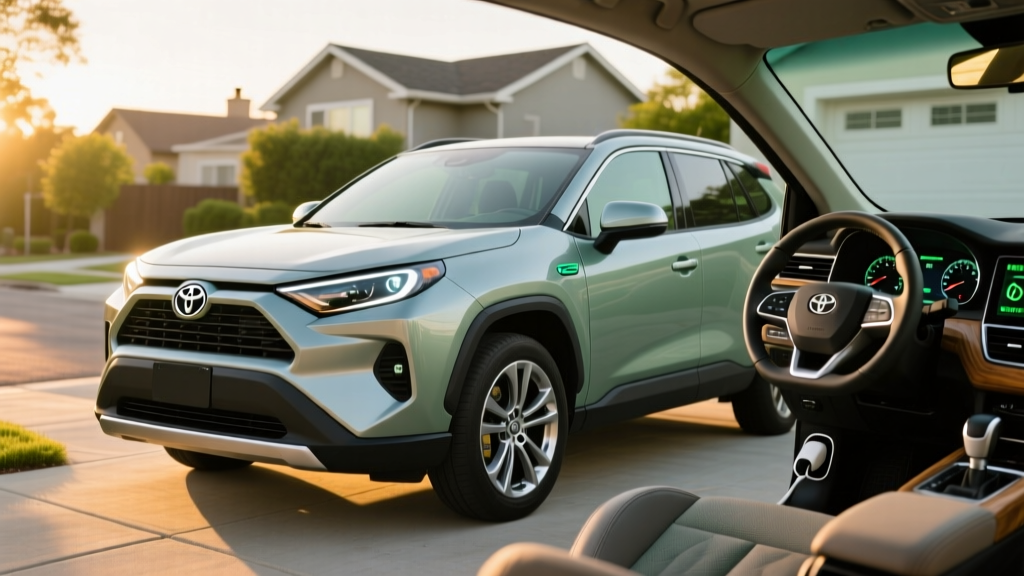
The Toyota RAV4 Hybrid has held the top spot among non-plug-in hybrid SUVs for years, and the XLE trim sits in the sweet spot of the lineup — offering the best balance of features and value. If you've searched for the RAV4 XLE Hybrid, you likely already know it doesn't need a plug, sips fuel in stop-and-go traffic, and avoids the range anxiety of a full EV. But what does ownership actually look like in 2026? Below, we break down the exact EPA numbers, real-world MPG behavior, powertrain hardware, battery longevity data, and how the XLE Hybrid stacks up against its plug-in sibling and full-electric alternatives.
2026 RAV4 XLE Hybrid: Quick Verdict
The 2026 Toyota RAV4 Hybrid XLE delivers an EPA-estimated 39 MPG combined, standard all-wheel drive, and a starting MSRP around $34,025. It remains one of the most practical hybrid SUVs on the market for buyers who want meaningful fuel savings without changing their refueling habits. The XLE trim adds key features over the base LE — including an 8-inch touchscreen, wireless Apple CarPlay/Android Auto, blind-spot monitoring, and dual-zone climate control — without the premium of the Limited or Woodland Edition trims.
EPA Fuel Economy and Real-World MPG
| Metric | EPA Estimate | Real-World Expectation |
|---|---|---|
| City MPG | 41 | 40–44 MPG |
| Highway MPG | 38 | 34–37 MPG |
| Combined MPG | 39 | 37–41 MPG |
| Fuel Tank Capacity | 14.5 gal | ~530–565 mi range |
Source: fueleconomy.gov
Here's what the EPA sticker doesn't tell you: Toyota's hybrid system actually excels in city driving, where regenerative braking and electric-motor assist do the heavy lifting. Many RAV4 Hybrid owners report exceeding the 41 MPG city estimate in moderate-temperature, stop-and-go conditions. Highway driving is a different story — at sustained 70–80 MPH speeds, the gasoline engine runs more frequently, and real-world highway MPG often drops to 34–37.
Cold weather also matters. In sub-freezing temperatures, expect a 5–10% reduction in fuel economy as the engine runs longer to generate cabin heat and maintain battery temperature. Owners in northern climates typically see combined winter MPG in the 35–37 range, recovering to 39–42 in spring and fall.
Powertrain: Engine, Motors, and Horsepower
| Specification | 2026 RAV4 Hybrid XLE |
|---|---|
| Gasoline Engine | 2.5L 4-cylinder (176 hp / 163 lb-ft) |
| Front Electric Motor | Permanent magnet (118 hp) |
| Rear Electric Motor (AWD) | Permanent magnet (54 hp) |
| Net Combined Horsepower | 219 hp |
| Drivetrain | Electronic On-Demand AWD (standard) |
| Transmission | eCVT (electronically controlled) |
| 0–60 MPH | ~7.4 seconds |
| Towing Capacity | 1,750 lbs |
The RAV4 Hybrid uses Toyota's fourth-generation hybrid system. The 2.5-liter Atkinson-cycle engine handles steady-state cruising and high-load situations, while the front and rear electric motors provide instant torque for acceleration and low-speed maneuvering. The rear motor also enables the electronic AWD system — there's no mechanical driveshaft connecting the front and rear axles. Instead, the rear motor engages automatically when slip is detected or during hard acceleration.
The eCVT is not a traditional belt-and-pulley CVT. It uses a planetary gearset to seamlessly blend power from the engine and motors, which eliminates the "rubber band" feeling that older CVTs are known for. Acceleration is linear and predictable, if not particularly thrilling.
HEV vs. PHEV: RAV4 Hybrid vs. RAV4 Prime
Toyota sells two electrified RAV4 variants, and the distinction matters for your wallet and daily routine:
RAV4 Hybrid (HEV)
- Type: Conventional hybrid — no plug
- Battery: ~1.6 kWh (NiMH), self-charging
- Electric-only driving: Brief low-speed assist only
- EPA Combined: 39 MPG
- Starting MSRP: ~$34,025 (XLE)
- Federal tax credit: None
- Refueling: Gas station only, 14.5-gal tank
RAV4 Prime (PHEV)
- Type: Plug-in hybrid — requires charging for full benefit
- Battery: 18.1 kWh (lithium-ion)
- Electric-only range: 42 miles EPA
- EPA Combined: 94 MPGe (electric) / 38 MPG (gas)
- Starting MSRP: ~$44,500 (SE)
- Federal tax credit: Up to $7,500 (subject to §30D rules)
- Refueling: Level 1/2 charging + gas station
The conventional RAV4 Hybrid (HEV) cannot be plugged in. Its small battery charges through regenerative braking and the gasoline engine. The electric motors assist during acceleration and enable brief electric-only movement at low speeds (typically under 25 MPH for short distances), but the gasoline engine is always the primary power source.
The RAV4 Prime (PHEV) has a much larger 18.1 kWh battery that you plug in to charge. It can drive up to 42 miles on electricity alone before the gas engine engages. For commuters with a short round trip and home charging access, the Prime can cover weeks of driving on electricity with the gas engine as a backup for longer trips. Level 2 charging (240V) takes approximately 2.5 hours; the Prime does not support DC fast charging.
Pricing, Trims, and Tax Credit Eligibility
| 2026 RAV4 Hybrid Trim | MSRP (est.) | Key Features |
|---|---|---|
| LE | $32,675 | Base hybrid, TSS 3.0, 8" screen |
| XLE | $34,025 | Blind-spot monitor, dual-zone climate, wireless CarPlay |
| SE | $36,200 | Sport-tuned suspension, 19" wheels |
| XLE Premium | $37,500 | SofTex seats, moonroof, power liftgate |
| Limited | $40,800 | Leather, JBL audio, panoramic roof |
Does the RAV4 XLE Hybrid Qualify for a Federal Tax Credit?
No. The conventional RAV4 Hybrid (HEV) does not qualify for the federal §30D clean vehicle tax credit. That credit applies only to plug-in electric vehicles (BEVs and PHEVs) meeting specific battery-sourcing, critical-mineral, MSRP, and buyer-income requirements as defined by the IRS.
The RAV4 Prime (PHEV) may qualify for up to $7,500 under §30D, but eligibility depends on your taxable income (capped at $150,000 single / $300,000 joint), the vehicle's MSRP (must be under $80,000 for SUVs), and battery component/critical-mineral sourcing requirements that have tightened significantly since 2024. Always verify current-year eligibility with a tax professional before purchasing.
Some states offer their own hybrid incentives — check your state's energy office or DMV for current programs. These vary widely and change frequently.
Battery Warranty, Reliability, and Replacement Cost
Hybrid Battery Warranty
Coverage: 10 years / 150,000 miles (whichever comes first) on the hybrid battery and all hybrid-system components, including the electric motors and inverter.
Capacity retention: Toyota does not publish a specific capacity-retention threshold for HEV batteries (unlike EV warranties that guarantee 70% SoH). However, the hybrid battery is relatively small (~1.6 kWh) and operates within a narrow state-of-charge window (roughly 40–80%), which significantly reduces degradation stress.
Toyota's hybrid system is one of the most proven in the automotive industry, with over 25 years of continuous production since the original Prius. The RAV4 Hybrid's nickel-metal hydride (NiMH) battery pack is designed for longevity rather than energy density — it doesn't need to store much energy, just deliver and absorb short bursts of power.
What Does a Hybrid Battery Replacement Cost?
If your hybrid battery fails outside the warranty window, expect to pay between $2,500 and $4,500 for a replacement, including labor. Refurbished battery packs are available for $1,500–$2,500. Independent hybrid specialists often offer more competitive pricing than dealership service centers. In practice, widespread hybrid battery failures on modern Toyotas before 200,000 miles are uncommon — most degradation is gradual and manifests as a slight MPG decline rather than a sudden failure.
The conventional hybrid system also eliminates several maintenance costs associated with gas-only vehicles: regenerative braking extends brake pad life significantly (many owners report 80,000+ miles on original pads), and there's no traditional starter motor or alternator to replace.
Who Should Choose the RAV4 XLE Hybrid — and Who Shouldn't?
Decision Framework
Choose the RAV4 XLE Hybrid if:
- You don't have access to home or workplace charging (apartment, street parking, no garage outlet)
- Your daily commute is 20–60 miles and you want fuel savings without plug-in hassle
- You want AWD capability for snow/rain without a fuel-economy penalty
- You plan to keep the vehicle 8–12 years and value proven reliability data
- Your budget is $34,000–$38,000 and you don't want to stretch for a PHEV or EV
Choose the RAV4 Prime (PHEV) instead if:
- You have reliable Level 2 charging at home and a commute under 42 miles round trip
- You want to drive mostly on electricity and may qualify for the §30D tax credit
- You're willing to pay ~$10,000 more upfront (before credit) for the PHEV powertrain
Choose a full EV (e.g., Tesla Model Y, Hyundai Ioniq 5) instead if:
- You have home charging and want zero tailpipe emissions with no gas engine maintenance
- Your daily driving is under 250 miles and you road-trip infrequently
- You want the lowest per-mile "fuel" cost (electricity is typically 3–5¢/mile vs. 10–14¢/mile for the hybrid)
Hybrid vs. PHEV vs. EV — Which Fits You?
The decision ultimately comes down to three factors: charging access, daily mileage, and budget. The RAV4 XLE Hybrid is the lowest-friction choice — you buy it, fuel it at any gas station, and immediately save 25–30% on fuel compared to the gas-only RAV4 (which rates 30 MPG combined). No chargers to install, no apps to manage, no range planning. The PHEV is ideal for plug-in commuters who want EV-like daily driving with gas-engine flexibility. The full EV offers the lowest operating cost but requires charging infrastructure and trip planning for longer drives.
Pros and Cons at a Glance
✓ Pros
- 39 MPG combined — 41 city excels in stop-and-go traffic
- Standard AWD at no fuel-economy penalty
- No plug-in charging required — zero behavior change
- 10-year / 150,000-mile hybrid battery warranty
- Strong resale value and proven reliability track record
- XLE trim well-equipped at ~$34,000 MSRP
- Toyota Safety Sense 3.0 standard (adaptive cruise, lane-keep, AEB)
✗ Cons
- No federal tax credit (HEV ineligible for §30D)
- Highway MPG drops to 34–37 in real-world driving
- eCVT drone under hard acceleration
- 1,750-lb towing capacity — lower than some turbo-gas competitors
- Infotainment system functional but not class-leading
- No DC fast charging (not applicable to HEV, but PHEV also lacks it)
- Cold-weather MPG penalty of 5–10%
Cost of Ownership: 5-Year Estimate
| 5-Year Cost Factor | RAV4 Hybrid XLE | RAV4 Gas (AWD LE) |
|---|---|---|
| Purchase Price (MSRP) | $34,025 | $31,325 |
| Fuel Cost (15,000 mi/yr, $3.40/gal) | $6,562 | $8,500 |
| Maintenance (est. 5 yr) | $2,800 | $3,400 |
| Federal Tax Credit | $0 | $0 |
| Estimated 5-Year Total | $43,387 | $43,225 |
At current fuel prices, the RAV4 Hybrid XLE's fuel savings nearly close the $2,700 MSRP gap with the gas-only RAV4 AWD within five years. The hybrid's lower brake wear and fewer engine-on miles may tilt the long-term cost advantage further in its favor beyond year five. If gas prices rise above $4.00/gallon, the hybrid breaks even even sooner.
Frequently Asked Questions
How many MPG does the RAV4 XLE Hybrid get?
The 2026 RAV4 Hybrid XLE is EPA-rated at 41 MPG city, 38 MPG highway, and 39 MPG combined. In real-world driving, many owners exceed the city estimate in warm-weather stop-and-go traffic (40–44 MPG) but see highway MPG drop to 34–37 at sustained freeway speeds. Expect a combined real-world average of 37–41 MPG depending on climate and driving mix.
Does the RAV4 Hybrid need to be plugged in?
No. The RAV4 Hybrid is a conventional hybrid (HEV). Its battery charges automatically through regenerative braking and the gasoline engine. You fuel it exclusively at gas stations. If you want a RAV4 that plugs in, you're looking for the RAV4 Prime (PHEV), which is a separate model with a larger battery and 42 miles of electric-only range.
Is the RAV4 Hybrid reliable, and what does a battery replacement cost?
Toyota's hybrid system has an exceptional reliability record spanning over 25 years. The hybrid battery is covered by a 10-year / 150,000-mile warranty. Out-of-warranty replacement costs range from $2,500–$4,500 for a new pack, or $1,500–$2,500 for a refurbished unit. Catastrophic hybrid battery failures before 200,000 miles are rare; gradual capacity loss may reduce MPG by 1–3 MPG over the vehicle's lifespan.
Does the RAV4 XLE Hybrid qualify for any tax credit?
The conventional RAV4 Hybrid (HEV) does not qualify for the federal §30D clean vehicle credit — that credit is reserved for plug-in vehicles (BEVs and PHEVs). Some states may offer separate hybrid incentives, but these vary by jurisdiction. Check your state's energy office for current programs. The RAV4 Prime PHEV may qualify for up to $7,500 federally, subject to income caps, MSRP limits, and battery-sourcing requirements.
How does the RAV4 Hybrid compare to a full EV like the Tesla Model Y?
The RAV4 Hybrid costs roughly $10,000–$15,000 less upfront than a Model Y, requires no charging infrastructure, and eliminates range-planning for road trips. However, the Model Y's per-mile energy cost is roughly half that of the hybrid's fuel cost (about 4¢/mile vs. 9¢/mile at $3.40/gal), and it qualifies for the $7,500 federal credit (subject to eligibility). If you have home charging and drive under 250 miles daily, the EV offers lower long-term operating costs. If charging access is uncertain or you frequently drive 300+ miles, the hybrid remains the more practical choice.
What's the difference between the RAV4 Hybrid XLE and the XLE Premium?
The XLE Premium adds SofTex synthetic leather seating, a power moonroof, a hands-free power liftgate, and an auto-dimming rearview mirror. The powertrain, fuel economy, and AWD system are identical. The Premium trim typically adds $3,000–$3,500 to the MSRP. If those comfort features aren't priorities, the standard XLE offers the same hybrid efficiency at a lower price.
Specifications based on manufacturer data and EPA estimates. Pricing reflects estimated 2026 MSRP and may vary by dealer. Tax credit rules reference IRS §30D guidelines and are subject to change. Always verify eligibility with a tax professional before purchase. Safety ratings: see IIHS and NHTSA for current scores.