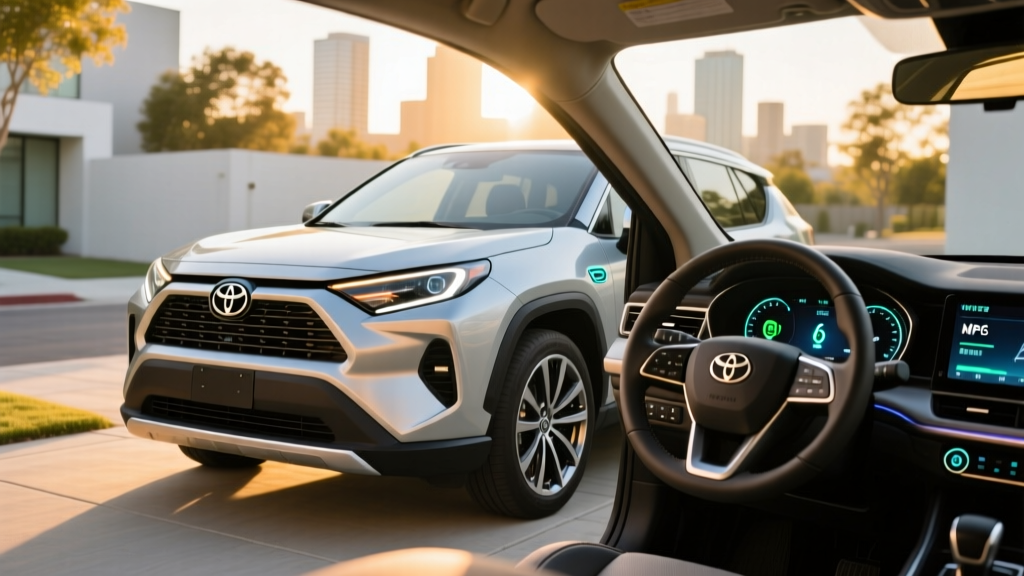
The Toyota RAV4 Hybrid has anchored the compact SUV segment for years, and the SE trim sits in a sweet spot: sport-tuned suspension, blacked-out styling cues, and the same proven hybrid powertrain that sips fuel without demanding a plug. For 2026, the RAV4 SE Hybrid continues with a 2.5-liter four-cylinder paired to Toyota's fourth-generation hybrid system and electronic all-wheel drive. If you want electrified efficiency without charging infrastructure headaches, this is one of the most pragmatic vehicles on the market.
But how does it stack up against the RAV4 Prime plug-in hybrid, a full battery-electric SUV, or a conventional gas model? Below, we break down every number that matters—from EPA MPG to battery warranty—to help you decide.
2026 RAV4 SE Hybrid Powertrain and Performance Specs
The SE Hybrid uses Toyota's well-established Hybrid Synergy Drive architecture. A 2.5-liter Atkinson-cycle inline-four generates 176 hp and 163 lb-ft of torque on its own, while a front-mounted electric motor adds 134 hp. A separate rear-axle electric motor provides 54 hp, enabling electronic AWD without a mechanical driveshaft. Combined system output is rated at 219 horsepower.
| Spec | Value |
|---|---|
| Combined Horsepower | 219 hp |
| Gas Engine | 2.5L 4-cyl Atkinson (176 hp / 163 lb-ft) |
| Front Electric Motor | 134 hp |
| Rear Electric Motor (eAWD) | 54 hp |
| Transmission | eCVT (planetary gearset) |
| Drivetrain | Electronic AWD (standard) |
| 0–60 mph | ~7.4 seconds |
| Hybrid Battery | 1.6 kWh (sealed NiMH, self-charging) |
| Towing Capacity | 1,750 lbs |
| Cargo Volume (rear seats up) | 37.5 cu ft |
| Base MSRP (SE Hybrid) | ~$37,500 |
The SE trim adds a sport-tuned suspension with stiffer damping and unique 18-inch alloy wheels. It doesn't transform the RAV4 into a corner carver, but it tightens body roll noticeably compared to the LE and XLE Hybrid trims. The eCVT operates without the rubber-band feeling of belt-driven CVTs; Toyota's planetary gearset blends engine and motor power smoothly, with minimal drone under hard acceleration.
Fuel Economy: EPA Ratings and Real-World MPG
The EPA rates the 2026 RAV4 Hybrid (all AWD trims, including the SE) at 41 mpg city, 38 mpg highway, and 39 mpg combined, according to fueleconomy.gov. That puts it among the most efficient AWD compact SUVs available.
| Driving Cycle | EPA Rating |
|---|---|
| City | 41 MPG |
| Highway | 38 MPG |
| Combined | 39 MPG |
Real-World MPG vs. EPA Sticker
Toyota hybrids tend to meet or slightly exceed their EPA city estimates because regenerative braking recovers energy in stop-and-go traffic. Owners who commute in urban environments regularly report 42–44 mpg on the dashboard display. Highway efficiency is a different story: at sustained 75–80 mph speeds, expect 34–36 mpg. The boxy SUV profile creates aerodynamic drag that the hybrid system can't fully offset at high speeds.
In cold weather (below 30°F), the engine runs more frequently to maintain cabin heat and battery temperature, typically dropping observed fuel economy by 3–5 mpg. A 10-mile winter commute might yield 33–35 mpg, while a 40-mile summer city drive can push past 43 mpg. These are normal hybrid behaviors, not defects.
RAV4 SE Hybrid vs. RAV4 Prime PHEV: Which One Fits?
Toyota offers two electrified RAV4 variants, and buyers frequently confuse them. Here's the critical difference: the RAV4 Hybrid (HEV) is a conventional self-charging hybrid—you never plug it in. The RAV4 Prime (PHEV) is a plug-in hybrid with a much larger battery, an electric-only driving mode, and a charging port.
| Attribute | RAV4 SE Hybrid (HEV) | RAV4 Prime SE (PHEV) |
|---|---|---|
| Powertrain Type | Conventional Hybrid | Plug-in Hybrid |
| Combined HP | 219 hp | 302 hp |
| Battery Capacity | ~1.6 kWh (NiMH) | 18.1 kWh (Li-ion) |
| Electric-Only Range | None (EV assist only) | 42 miles (EPA) |
| Plugs In? | No | Yes (Level 1/Level 2) |
| DC Fast Charging | N/A | No |
| Level 2 Charge Time (0–100%) | N/A | ~2.5 hours (240V, 32A) |
| Combined MPG (gas) | 39 MPG | 38 MPG (gas) / 94 MPGe (gas+electric) |
| 0–60 mph | ~7.4 sec | ~5.7 sec |
| AWD | Electronic AWD | Electronic AWD |
| Base MSRP | ~$37,500 | ~$45,000 |
| Federal Tax Credit (§30D) | Not eligible | Up to $7,500 (eligibility varies) |
The RAV4 Prime offers 42 miles of electric-only range—enough for most daily commutes without burning gas. It also delivers 302 hp, making it the quickest RAV4 Toyota sells. But it costs roughly $7,500 more upfront, requires access to a charging outlet (a standard 120V outlet works overnight, but a 240V Level 2 charger is far more practical), and does not support DC fast charging.
Tax Credits and Incentives: What You Can Actually Claim
This is where the HEV vs. PHEV distinction has real financial consequences.
RAV4 SE Hybrid (HEV): Conventional hybrids do not qualify for the federal §30D clean vehicle tax credit. That credit applies only to plug-in vehicles (BEVs and PHEVs) meeting battery-sourcing, MSRP, and buyer-income requirements. Some states offer modest hybrid rebates, but there is no federal incentive for the standard RAV4 Hybrid.
RAV4 Prime (PHEV): The Prime may qualify for up to $7,500 under IRS §30D, but eligibility is not guaranteed. According to irs.gov, the vehicle must meet critical-mineral and battery-component sourcing thresholds, the buyer's adjusted gross income must fall below $150,000 (single) or $300,000 (joint), and the MSRP must not exceed $80,000 for SUVs. Starting in 2025, the credit can be transferred to the dealer at the point of sale, reducing your purchase price directly. Verify current eligibility with your dealer and a tax professional before relying on the credit.
- MSRP cap: SUVs must be under $80,000 (both RAV4 variants qualify)
- Income cap: $150K single / $225K head of household / $300K joint filers
- Battery sourcing: Critical minerals and components must meet escalating domestic/free-trade thresholds each year
- Point-of-sale transfer: Available since 2024 — apply the credit as a down payment reduction at the dealer
Battery Longevity, Warranty, and Replacement Costs
Hybrid battery anxiety is the number-one concern we hear from prospective buyers. Here's what the data shows for the RAV4 SE Hybrid.
The RAV4 SE Hybrid's 1.6 kWh nickel-metal hydride (NiMH) battery is small and lightly stressed compared to a full EV pack. It never fully discharges or charges to 100%—Toyota's battery management system keeps the state of charge in a narrow middle band, which dramatically extends cycle life. In practice, Toyota hybrid batteries routinely last 150,000–200,000+ miles without significant degradation.
If replacement is ever needed out of warranty, a remanufactured RAV4 Hybrid battery typically costs $2,000–$3,500 installed at an independent hybrid specialist, or $4,000–$5,500 at a Toyota dealer using a new OEM unit. For context, that's roughly the cost of a single major repair on a conventional vehicle (transmission rebuild, head gasket) and is rarely needed within the vehicle's normal lifespan.
The RAV4 Prime's 18.1 kWh lithium-ion pack is larger and more expensive to replace out of warranty ($6,000–$9,000 estimated), but it carries the same 10-year/150,000-mile warranty and benefits from active thermal management.
Reliability Track Record and Ownership Costs
Toyota's hybrid system is among the most thoroughly proven in the automotive industry. The planetary-gear eCVT has no belts, no clutches, and no friction bands—the components that fail in conventional automatics. The Prius taxi fleet demonstrated million-mile durability, and the RAV4 Hybrid uses a closely related architecture.
The IIHS has historically rated the RAV4 as a Top Safety Pick, and Toyota Safety Sense 3.0 (standard on all 2026 trims) includes forward collision warning, automatic emergency braking, lane departure alert with steering assist, lane tracing assist, and full-speed-range adaptive cruise control.
Maintenance costs are lower than a gas-only RAV4 because regenerative braking extends pad life (often 80,000+ miles on the original set), there's no conventional transmission fluid to change, and the engine sees reduced wear from electric-motor assist during acceleration. Oil changes, cabin air filters, and tire rotations remain the primary recurring expenses.
Who Should Choose the RAV4 SE Hybrid?
Choose the RAV4 SE Hybrid If:
- You lack home charging access (apartment, street parking)
- You want 500+ miles of total range with zero plug-in routine
- Your budget is under $40,000 and you want AWD
- You drive mostly city/suburban miles where hybrid efficiency peaks
- You plan to keep the vehicle 8–10+ years and value proven reliability
Choose the RAV4 Prime PHEV If:
- You can install a Level 2 charger at home
- Your daily commute is under 40 miles round-trip (electric-only covers it)
- You want 302 hp and a 5.7-second 0–60 time
- You qualify for the §30D tax credit, narrowing the price gap
- You want to drive electric daily but keep gas flexibility for road trips
Consider a Full EV (BEV) If:
- You have reliable home and workplace charging
- You want zero tailpipe emissions and minimal maintenance
- Your daily driving is under 250 miles and you road-trip infrequently
- You want to maximize fuel savings ($0.04–$0.06/mile on home electricity vs. $0.12–$0.15/mile on gas)
Pricing and Trim Summary
The 2026 RAV4 SE Hybrid starts at approximately $37,500 including destination. Key standard equipment includes the sport-tuned suspension, 18-inch black alloy wheels, SofTex-trimmed heated front seats, an 8-inch Toyota Audio Multimedia touchscreen with wireless Apple CarPlay and Android Auto, and the full Toyota Safety Sense 3.0 suite.
Adding the Technology Package (panoramic moonroof, 10.5-inch display, JBL audio) pushes the price to around $40,500. Fully loaded, an SE Hybrid remains under $42,000—well below the RAV4 Prime's starting point.
Insurance costs for the RAV4 Hybrid are competitive with the gas-only RAV4, typically $1,400–$1,800 annually for a clean-record driver, depending on state and coverage level.
Frequently Asked Questions
How many MPG does the 2026 RAV4 SE Hybrid get?
The EPA rates it at 41 mpg city, 38 mpg highway, and 39 mpg combined. Real-world city driving often yields 42–44 mpg thanks to regenerative braking. Sustained highway driving at 75+ mph drops to 34–36 mpg.
Does the RAV4 SE Hybrid need to be plugged in?
No. The RAV4 SE Hybrid is a conventional (self-charging) hybrid. The battery recharges through regenerative braking and the gasoline engine. There is no plug and no electric-only driving mode.
How far can the RAV4 Prime go on electric only?
The RAV4 Prime PHEV delivers an EPA-rated 42 miles of electric-only range before the gas engine engages. That covers most daily commutes without using any gasoline.
Is the RAV4 Hybrid battery expensive to replace?
Out of warranty, a replacement hybrid battery runs $2,000–$3,500 (remanufactured) or $4,000–$5,500 (new OEM). Toyota's 10-year/150,000-mile warranty covers the battery, and failures within that period are rare based on long-term fleet data.
Does the RAV4 SE Hybrid qualify for any federal tax credit?
No. The federal §30D clean vehicle credit applies only to plug-in vehicles (BEVs and PHEVs). The conventional RAV4 Hybrid does not qualify. The RAV4 Prime PHEV may qualify for up to $7,500 depending on income, sourcing, and MSRP requirements. Consult irs.gov and a tax professional for current eligibility.
Is the RAV4 SE Hybrid reliable?
Toyota's hybrid system has over 25 years of production history and is among the most reliable powertrains in the industry. The eCVT has fewer wear components than a conventional automatic, and the hybrid battery is warrantied for 10 years/150,000 miles.
Hybrid vs. PHEV vs. EV — which should I buy?
Choose the HEV if you can't charge at home and want maximum simplicity. Choose the PHEV if you can charge at home and want electric commuting with gas flexibility. Choose a full BEV if you have reliable charging access and want the lowest per-mile cost with zero tailpipe emissions.