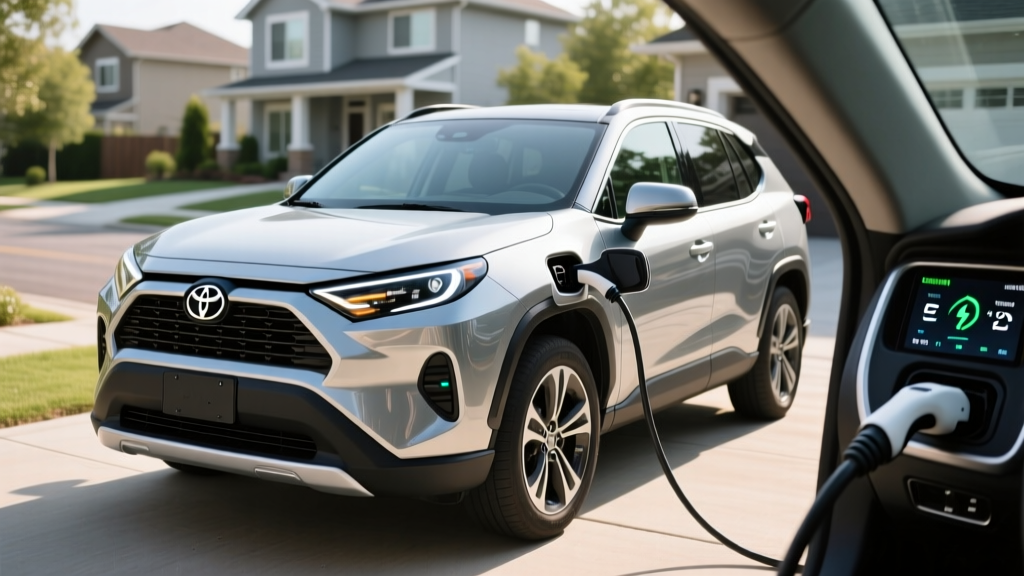
The Toyota RAV4 Prime has held its position as one of the most sought-after plug-in hybrid electric vehicles (PHEVs) on the market for good reason: it delivers genuine electric-only commuting range wrapped in the practicality of a compact SUV. For 2026, the RAV4 Prime continues to bridge the gap between a conventional hybrid and a full battery-electric vehicle, offering buyers who aren't ready to commit to a pure EV a compelling middle ground. This guide covers everything you need to know about the 2026 RAV4 plugin hybrid — from real-world MPG and electric range to tax credit eligibility and long-term battery reliability.
HEV vs. PHEV: What Makes the RAV4 Prime Different?
Before diving into specs, it's critical to understand the distinction between the standard RAV4 Hybrid and the RAV4 Prime. Both are electrified, but they operate very differently.
| Feature | RAV4 Hybrid (HEV) | RAV4 Prime (PHEV) |
|---|---|---|
| Plug-in capable? | No — self-charging only | Yes — plug in to charge the larger battery |
| Electric-only range | ~1 mile at low speed | 42 miles EPA |
| Battery capacity | 1.6 kWh (gross) | 18.1 kWh (gross) |
| Combined horsepower | 219 HP | 302 HP |
| 0–60 mph | 7.4 seconds | 5.7 seconds |
| EPA combined MPG (gas) | 40 MPG | 38 MPG (after battery depletes) |
| Federal tax credit eligible? | No | Yes — up to $7,500 (see eligibility rules) |
| Starting MSRP | ~$33,500 | ~$44,500 |
The conventional RAV4 Hybrid never plugs in — its small battery charges through regenerative braking and the gasoline engine. The RAV4 Prime, however, has a much larger 18.1 kWh lithium-ion battery that you charge by plugging in, enabling 42 miles of pure electric driving before the gas engine takes over. Once the battery is depleted, it operates exactly like a regular hybrid.
Electric-Only Range and Total Driving Range
The headline number for any PHEV buyer is electric-only range. The 2026 RAV4 Prime carries an EPA-estimated 42 miles of all-electric range, which covers the daily commute for the majority of American drivers (the average one-way commute is roughly 16 miles, according to U.S. Census data).
Real-World Electric Range: Expect 36–42 miles in mild weather with mixed driving. In cold weather (below 30°F), electric range can drop to 28–34 miles due to cabin heating demands and reduced battery efficiency. Highway-only driving at 70+ mph will also reduce electric range to approximately 32–36 miles.
Once the battery depletes, the RAV4 Prime switches to hybrid mode, delivering an EPA-estimated 38 MPG combined. With a 14.5-gallon fuel tank, total combined range (electric + gasoline) exceeds 580 miles — eliminating any range anxiety on long road trips.
Fuel Economy: EPA MPG and Real-World Numbers
Understanding PHEV fuel economy requires looking at two figures: MPGe (miles per gallon equivalent, which includes electric driving) and standard MPG (gasoline-only operation after the battery is depleted).
| Metric | City | Highway | Combined |
|---|---|---|---|
| MPGe (with full charge) | — | — | 94 MPGe |
| MPG (gas only, battery depleted) | 40 MPG | 36 MPG | 38 MPG |
MPGe explained: MPGe converts the energy in electricity to a gasoline-equivalent figure. The 94 MPGe combined rating applies when you're driving on a mix of battery charge and gasoline. Once the battery is empty, you're looking at the 38 MPG combined figure — still excellent for a 302-HP, all-wheel-drive compact SUV.
Real-world MPG note: Toyota hybrids consistently perform close to or slightly above EPA estimates in city driving thanks to aggressive regenerative braking. On the highway, expect figures closer to 34–36 MPG at sustained 70–75 mph speeds. According to data from fueleconomy.gov, owner-reported fuel economy for the RAV4 Prime averages around 40 MPG combined in hybrid mode — slightly above the EPA sticker.
Powertrain and Performance Specs
The RAV4 Prime is the most powerful RAV4 Toyota sells, and it's not even close. The plug-in hybrid powertrain pairs a 2.5-liter four-cylinder Atkinson-cycle engine with two electric motors — one on each axle — for standard electronic all-wheel drive (AWD-i).
| Specification | Value |
|---|---|
| Combined system horsepower | 302 HP |
| Gas engine | 2.5L 4-cylinder Atkinson (176 HP / 163 lb-ft) |
| Front electric motor | 134 kW (180 HP) |
| Rear electric motor | 40 kW (54 HP) |
| 0–60 mph | 5.7 seconds |
| Battery capacity | 18.1 kWh (gross) / ~14.5 kWh usable |
| Battery chemistry | Lithium-ion (NMC) |
| Electric-only range | 42 miles (EPA) |
| Top speed (EV mode) | 84 mph |
| Drivetrain | AWD-i (electronic AWD) |
| Towing capacity | 1,500 lbs |
| Cargo volume (rear seats up) | 33.5 cu ft |
That 5.7-second 0–60 time makes the RAV4 Prime quicker than many sport compacts. The instant torque from the electric motors gives it strong off-the-line acceleration, and the transition between electric and gas power is nearly imperceptible — a hallmark of Toyota's hybrid system refinement.
Charging: Times, Levels, and the DC Fast-Charge Limitation
Charging the RAV4 Prime is straightforward, but it comes with one significant limitation that every buyer should understand: the RAV4 Prime does not support DC fast charging. This is common among PHEVs — the battery is small enough that Level 2 charging is usually sufficient — but it's worth knowing if you expected highway fast-charging capability.
| Charging Level | Power (kW) | Time (0–Full) | Notes |
|---|---|---|---|
| Level 1 (120V household outlet) | ~1.4 kW | ~12 hours | Trickle charge; sufficient if parked overnight |
| Level 2 (240V, standard SE trim) | 3.3 kW | ~4.5 hours | SE trim onboard charger |
| Level 2 (240V, XSE trim) | 6.6 kW | ~2.5 hours | XSE trim upgraded onboard charger |
| DC Fast Charge | N/A | N/A | Not supported on any trim |
The trim-level charging difference matters. The SE trim's 3.3 kW onboard charger means a full charge takes about 4.5 hours on a Level 2 home charger. The XSE trim's 6.6 kW charger cuts that to roughly 2.5 hours — meaning you can fully recharge during a workday or between errands. For most owners plugging in overnight, either charger works fine, but the 6.6 kW unit provides more flexibility.
kW vs. kWh reminder: kW (kilowatts) measures charging power — how fast energy flows into the battery. kWh (kilowatt-hours) measures battery capacity — how much energy the battery holds. The RAV4 Prime has an 18.1 kWh battery and charges at up to 6.6 kW.
Pricing, Trims, and Federal Tax Credit Eligibility
The 2026 RAV4 Prime is offered in two trims: SE and XSE. Pricing has crept upward in recent model years but remains competitive for a PHEV with this much capability.
| Trim | MSRP (est.) | Onboard Charger | Key Features |
|---|---|---|---|
| SE | ~$44,500 | 3.3 kW | 18" wheels, SofTex seats, 8" touchscreen, TSS 3.0 |
| XSE | ~$48,000 | 6.6 kW | 19" wheels, panoramic moonroof option, 10.5" display, heated seats |
Does the RAV4 Prime Qualify for the Federal Tax Credit?
The RAV4 Prime is eligible for the IRS §30D Clean Vehicle Credit, but the actual credit amount depends on several factors that change periodically. Under current rules, qualifying PHEVs can receive up to $7,500, split into two halves:
- Battery component requirement ($3,750): A specified percentage of battery components must be manufactured or assembled in North America.
- Critical minerals requirement ($3,750): A specified percentage of critical minerals must be sourced from the U.S. or a free-trade-agreement partner.
- MSRP cap: SUVs must have an MSRP at or below $80,000 — the RAV4 Prime easily qualifies.
- Buyer income cap: Adjusted gross income must not exceed $150,000 (single), $225,000 (head of household), or $300,000 (joint).
- Point-of-sale transfer: As of 2024, you can transfer the credit to the dealer at purchase, reducing your out-of-pocket cost immediately rather than waiting for tax filing.
Critical caveat: Toyota's battery sourcing has been a moving target for §30D eligibility. Some model years of the RAV4 Prime have qualified for the full $7,500, while others have only received $3,750 or none at all depending on when they were placed in service. Always verify current eligibility on the fueleconomy.gov tax credit page or consult a tax professional before relying on a specific credit amount. Rules and sourcing requirements tighten annually.
Battery Warranty, Reliability, and Replacement Costs
Battery longevity is the single biggest concern for hybrid and PHEV buyers, and Toyota's track record here is among the best in the industry. The Prius, now in its third decade, has demonstrated that Toyota's hybrid battery management systems are exceptionally conservative — they keep a large buffer between the battery's actual state of charge and what the vehicle uses, which dramatically reduces degradation.
2026 RAV4 Prime Battery & Hybrid Warranty:
- Hybrid battery: 10 years / 150,000 miles (whichever comes first)
- Hybrid system components: 8 years / 100,000 miles
- Capacity retention: Toyota warrants that the hybrid battery will retain sufficient capacity for normal PHEV operation during the warranty period
- Basic vehicle warranty: 3 years / 36,000 miles
- Powertrain warranty: 5 years / 60,000 miles
Real-world degradation data: Based on owner reports from the 2021–2025 RAV4 Prime model years, most owners see minimal electric-range loss in the first 3–5 years. Toyota's hybrid battery management is notably conservative, keeping a large usable buffer (approximately 3.6 kWh of the 18.1 kWh total is reserved and not accessible to the driver). This buffer management is the primary reason Toyota hybrid batteries rarely need replacement within the warranty period.
Battery replacement cost: If the hybrid battery does need replacement out of warranty, expect to pay between $4,000 and $7,500 including parts and labor at a Toyota dealership. Third-party hybrid battery rebuild services can reduce this to roughly $2,500–$4,000. For context, this is significantly less than a full-EV battery replacement, which can exceed $15,000–$20,000 for larger packs.
According to reliability data from IIHS and long-term owner surveys, the RAV4 Prime's powertrain has proven durable, with the hybrid system requiring less maintenance than a conventional gasoline powertrain (no starter motor, no alternator, reduced brake wear from regen braking).
RAV4 Prime vs. Full EV vs. Gas RAV4: Which Fits You?
Choose the RAV4 Prime (PHEV) if:
- Your daily commute is under 40 miles round-trip and you have access to home or workplace Level 2 charging
- You take regular road trips and don't want to plan around charging infrastructure
- You want EV-like daily driving without committing to a full battery-electric vehicle
- You live in an area with extreme cold that significantly reduces EV range
Choose a full EV (like the Toyota bZ4X or Hyundai Ioniq 5) if:
- You have reliable home Level 2 charging and your daily driving rarely exceeds 200 miles
- You want zero tailpipe emissions and the lowest per-mile fuel cost
- You want to avoid gasoline engine maintenance entirely (oil changes, spark plugs, etc.)
Choose the standard RAV4 Hybrid (HEV) if:
- You don't have access to plug-in charging at home or work
- You want the lowest purchase price and don't need electric-only driving
- Your driving pattern is mostly highway miles where the PHEV advantage diminishes
Choose the gas-only RAV4 if:
- Upfront cost is the primary concern and you drive very low annual miles
- You plan to keep the vehicle for only 2–3 years (the hybrid premium won't pay back)
Pros
- 42 miles of real electric range covers most commutes gas-free
- 302 HP — quickest RAV4 in the lineup by a wide margin
- 580+ miles total range; no road-trip charging anxiety
- Standard AWD with no drivetrain hump compromise
- 10-year / 150,000-mile hybrid battery warranty
- Potential federal tax credit up to $7,500
- Strong resale value — RAV4 Primes have historically held value well
Cons
- No DC fast charging — limits utility of public charging stations
- $10,000+ premium over the standard RAV4 Hybrid
- SE trim's 3.3 kW charger is slow for a PHEV this price
- Cargo space slightly reduced vs. gas RAV4 (battery placement)
- Federal tax credit eligibility fluctuates based on sourcing rules
- High demand can mean dealer markups and limited availability
Frequently Asked Questions
How many MPG does the RAV4 Prime get?
The 2026 RAV4 Prime achieves 94 MPGe combined when using its electric range, and 38 MPG combined (40 city / 36 highway) in gasoline-only hybrid mode after the battery is depleted. Real-world owners frequently report 38–42 MPG in mixed hybrid driving.
How far can the RAV4 Prime go on electric only?
The EPA rates the RAV4 Prime at 42 miles of all-electric range. In real-world conditions, expect 36–42 miles in mild weather and 28–34 miles in cold winter conditions. The electric top speed is 84 mph, so it handles highway speeds in EV mode.
Do I have to plug in the RAV4 Prime?
You don't have to, but you should. If you never plug it in, it operates as a regular hybrid at 38 MPG combined — which is still good, but you're paying a premium for a larger battery you're not utilizing. The RAV4 Prime makes financial and practical sense primarily for drivers who will charge regularly.
Can the RAV4 Prime DC fast charge?
No. The RAV4 Prime only supports Level 1 (120V) and Level 2 (240V) AC charging. There is no DC fast-charge port. This is typical for PHEVs, whose smaller batteries charge adequately on Level 2 overnight.
Is the RAV4 Prime reliable?
Toyota's hybrid systems have an excellent long-term reliability record spanning over two decades. The RAV4 Prime's hybrid battery is covered by a 10-year / 150,000-mile warranty. The hybrid system requires less routine maintenance than a conventional gasoline drivetrain — no starter, alternator, or traditional belt-driven accessories.
What does a RAV4 Prime battery replacement cost?
Out-of-warranty hybrid battery replacement typically costs $4,000–$7,500 at a Toyota dealer. Third-party rebuild services may reduce this to $2,500–$4,000. However, given Toyota's conservative battery management and the 10-year/150,000-mile warranty, most owners will never face this expense.
Does the RAV4 Prime qualify for the $7,500 federal tax credit?
The RAV4 Prime is eligible for the IRS §30D Clean Vehicle Credit, but the exact amount (up to $7,500) depends on current battery-sourcing and critical-minerals requirements, which tighten annually. Buyer income caps also apply ($150K single / $300K joint). Verify current eligibility at fueleconomy.gov or consult a tax professional before purchase.
RAV4 Prime vs. RAV4 Hybrid — is the price premium worth it?
If you can charge at home and your commute is under 40 miles round-trip, the Prime's electric range can eliminate most of your gasoline use, and the potential $7,500 tax credit significantly narrows the price gap. The 302 HP performance advantage is substantial. If you can't plug in regularly, the standard RAV4 Hybrid at 40 MPG combined is the smarter buy.