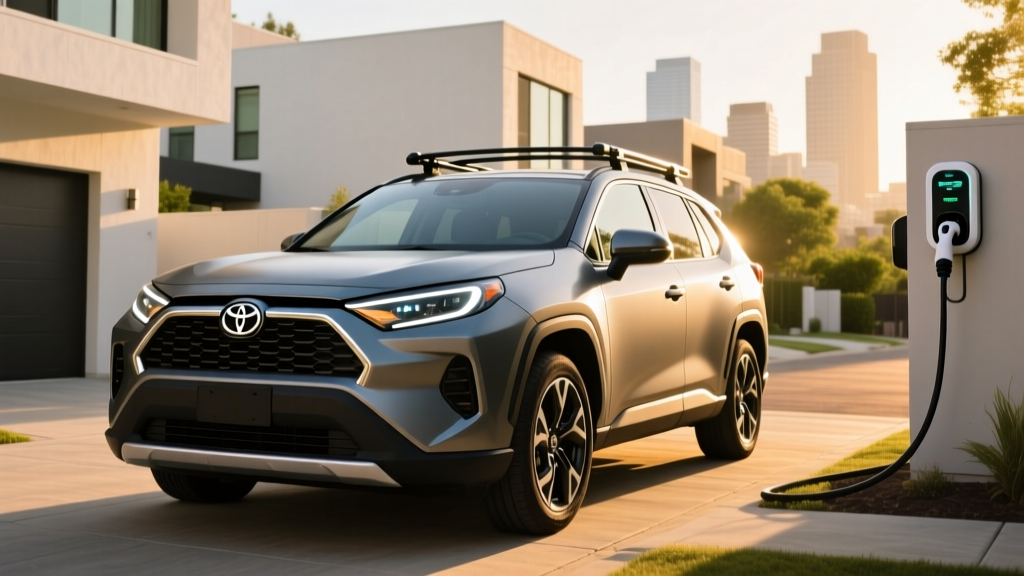
The Toyota RAV4 Prime has been the benchmark plug-in hybrid SUV since its debut, and the 2026 RAV4 Plug-In Hybrid continues that legacy with a proven powertrain, 42 miles of electric-only range, and 302 combined horsepower. For buyers who want electric commuting without range anxiety on road trips, it remains one of the most practical electrified vehicles on the market. But at a premium over the conventional RAV4 Hybrid, does the math work?
This guide breaks down every spec that matters — EPA MPG, real-world efficiency, charging logistics, battery longevity, and federal tax credit eligibility under current IRS §30D rules — so you can decide whether the RAV4 Plug-In Hybrid fits your driving life.
2026 RAV4 Plug-In Hybrid: Key Specs at a Glance
| Specification | Value |
|---|---|
| Electric-Only Range (EPA) | 42 miles |
| Total Combined Range | ~520 miles (EV + gas) |
| MPGe (Electric + Gas Combined) | 94 MPGe |
| Gas-Only MPG (Combined) | 38 MPG (36 city / 40 hwy after battery depletes) |
| Battery Capacity | 18.1 kWh (lithium-ion, NMC chemistry) |
| Combined Horsepower | 302 hp |
| 0–60 mph | 5.7 seconds |
| Drivetrain | AWD (electronic on-demand, rear motor) |
| Level 2 Charge Time (0–100%) | ~2.5 hours at 6.6 kW |
| DC Fast Charging | Not available |
| Base MSRP (SE trim) | $44,615 (est.) |
| Battery Warranty | 10 years / 150,000 miles |
HEV vs. PHEV: What's the Actual Difference?
Toyota sells two electrified RAV4 variants, and buyers frequently confuse them. Here's the distinction:
RAV4 Hybrid (HEV)
- Electric-only range: None — the battery assists the gas engine but cannot drive the car on electricity alone for meaningful distances
- Plug-in charging: No — the battery charges through regenerative braking and the engine
- EPA MPG: 41 combined (41 city / 38 hwy)
- Starting MSRP: ~$33,000
- Best for: Drivers who want better fuel economy with zero change to their fueling routine
RAV4 Plug-In Hybrid / Prime (PHEV)
- Electric-only range: 42 miles (EPA) — enough for most daily commutes
- Plug-in charging: Yes — plug in at home or public Level 2 stations to charge the 18.1 kWh battery
- EPA MPGe: 94 MPGe (when using electric range); 38 MPG combined on gas alone
- Starting MSRP: ~$44,615
- Best for: Drivers with home charging who commute under 40 miles round-trip and want a gas backup for longer trips
The PHEV costs roughly $11,000 more than the HEV at the base trim. Whether that premium pays off depends entirely on your daily mileage, electricity cost, and access to charging.
Fuel Economy: EPA Numbers and Real-World MPG
The EPA rates the 2026 RAV4 Prime at 94 MPGe when operating in electric mode and 38 MPG combined once the battery is depleted and the vehicle runs as a conventional hybrid.
| Mode | City | Highway | Combined |
|---|---|---|---|
| Electric + Gas (MPGe) | — | — | 94 MPGe |
| Gas Only (MPG, charge-depleted) | 36 | 40 | 38 |
Real-world note: Toyota's hybrid synergy system excels in stop-and-go city driving, where regenerative braking recaptures energy constantly. Many owners report exceeding the 38 MPG combined figure in urban commuting — 40–43 MPG is common in warm weather city driving. Highway efficiency at 75+ mph drops closer to 34–36 MPG, especially with the AWD system engaged frequently. In cold weather (below 30°F), expect electric-only range to drop 20–30%, reducing the 42-mile EV range to roughly 30–34 miles as the battery chemistry becomes less efficient and cabin heating draws additional power.
Electric-Only Range and Charging: The Daily Commute Question
The 18.1 kWh lithium-ion battery (NMC chemistry) delivers an EPA-rated 42 miles of electric-only driving. In practice, drivers with moderate acceleration habits and mild temperatures regularly see 38–44 miles. Aggressive highway driving or extreme cold can pull that down to the low 30s.
Charging is straightforward but limited to Level 2:
| Charging Level | Power | Time (0–100%) | Notes |
|---|---|---|---|
| Level 1 (120V household outlet) | ~1.4 kW | ~12 hours | Emergency/overnight only; impractical for daily full charges |
| Level 2 (240V home or public) | 6.6 kW (onboard charger max) | ~2.5 hours | Ideal for daily use; install a 240V/30A circuit at home |
| DC Fast Charging | N/A | N/A | The RAV4 Prime does not support DC fast charging |
The lack of DC fast charging is a deliberate trade-off. Toyota designed the Prime for home and workplace Level 2 charging — the 18.1 kWh battery is small enough that 2.5 hours on a Level 2 charger fills it completely. For road trips, the gas engine takes over seamlessly once the battery depletes, so fast-charging infrastructure is irrelevant. This is a key advantage over full BEVs for drivers in areas with sparse charging networks.
Home charging cost: At the US average electricity rate of ~$0.16/kWh, a full charge costs roughly $2.90 and covers 42 miles — approximately $0.07 per mile. Compare that to gasoline at $3.40/gallon and 38 MPG: roughly $0.09 per mile on gas. The savings are modest per mile but compound over thousands of electric-only commute miles.
Powertrain: 302 Horsepower and AWD Performance
The RAV4 Prime pairs a 2.5-liter four-cylinder Atkinson-cycle engine (177 hp, 165 lb-ft) with two electric motors — a front motor integrated into the transaxle and a dedicated rear motor for all-wheel drive. Combined system output is 302 horsepower.
The result is a 0–60 mph time of 5.7 seconds, making the RAV4 Prime one of the quickest vehicles in Toyota's non-GR lineup. The electric motors provide instant torque from a stop, and the transition between electric-only and hybrid operation is nearly imperceptible.
The electronic AWD system (Toyota calls it AWD-i) uses the rear electric motor to power the rear wheels when slip is detected or during hard acceleration. It's not a mechanical system — there's no driveshaft — which keeps weight down and packaging efficient. For snow and rain, it's effective. For serious off-roading, it's not designed for that duty.
Pricing, Trims, and Federal Tax Credit Eligibility
The 2026 RAV4 Prime is offered in two trims:
- SE: ~$44,615 MSRP (est.) — includes 18-inch wheels, heated front seats, 8-inch touchscreen, Toyota Safety Sense 3.0
- XSE: ~$48,525 MSRP (est.) — adds panoramic glass roof, 9-inch premium audio, SofTex seats, ambient lighting
Destination charges add approximately $1,395. Fully loaded with packages (Premium Package on XSE with head-up display, heated rear seats, 360-degree camera), the RAV4 Prime can approach $55,000.
Does the RAV4 Prime Qualify for the Federal Tax Credit?
Under the IRS §30D Clean Vehicle Credit, the RAV4 Prime's eligibility depends on several factors that shift periodically:
- MSRP cap: SUVs must have an MSRP at or below $80,000 — the RAV4 Prime clears this easily
- Buyer income cap: Modified AGI must not exceed $150,000 (single), $225,000 (head of household), or $300,000 (joint)
- Battery component sourcing: A percentage of battery components must be manufactured or assembled in North America, with thresholds increasing annually. Toyota's supply chain has been adapting, but eligibility for the full $7,500 vs. a partial $3,750 credit varies by model year and production batch
- Critical minerals: A percentage of critical minerals must be sourced from the US or FTA-partner countries
- Point-of-sale transfer: As of 2024, eligible buyers can transfer the credit to the dealer at purchase, reducing the sale price directly rather than waiting for a tax refund
Bottom line: Check the fueleconomy.gov tax credit database for the specific 2026 RAV4 Prime VIN's current eligibility. Do not assume the full $7,500 — partial credit or ineligibility is possible depending on battery sourcing compliance at the time of manufacture. Consult a tax professional for your specific situation.
Battery Longevity, Warranty, and Replacement Cost
Toyota Hybrid Battery Warranty
Coverage: 10 years or 150,000 miles (whichever comes first) for the hybrid battery pack on all 2020+ Toyota hybrids and PHEVs, transferable to subsequent owners.
Capacity threshold: Toyota warrants the battery against defects and abnormal capacity loss. While no specific degradation percentage is published, industry consensus is that replacement is covered if the battery falls below ~70% of original capacity within the warranty period.
Toyota's hybrid batteries have an exceptional longevity track record. The Prius, now in its fifth generation, has demonstrated that Toyota's hybrid battery management systems — which keep the battery in a narrow state-of-charge window (roughly 40–80%) and use active thermal management — significantly extend cell life. Many first-generation Prius packs lasted well over 150,000 miles.
For the RAV4 Prime specifically, the larger 18.1 kWh battery operates under similar management principles. Real-world reports from high-mileage Prime owners (100,000+ miles) show minimal degradation — typically 5–10% range loss over the first four to five years.
Out-of-warranty replacement cost: If the battery needs replacement after the 10-year/150,000-mile window, expect to pay between $6,000 and $9,000 for a new OEM battery pack including labor, based on current Toyota hybrid battery pricing. Refurbished packs are available for $3,000–$5,000. However, given Toyota's track record, most owners will sell or trade the vehicle before this becomes a concern.
Reliability and Ownership Costs
Toyota consistently ranks at or near the top of dependability studies from J.D. Power and Consumer Reports. The RAV4 Prime's powertrain is derived from the same hybrid synergy drive used across Toyota's lineup — a system refined over 25+ years of production. The internal combustion engine is a proven naturally aspirated 2.5L with no turbocharger complexity. The electric motors have essentially no wear components.
Maintenance costs are lower than a conventional gas vehicle: there are no spark plug replacements on the typical schedule (the Atkinson-cycle engine's operating profile extends intervals), regenerative braking significantly extends brake pad life (many owners report original pads at 80,000+ miles), and there's no traditional transmission fluid to change — the e-CVT uses a sealed planetary gearset.
Insurance premiums for the RAV4 Prime tend to run 8–15% higher than the gas-only RAV4 due to the higher replacement cost of the hybrid system and the vehicle's MSRP. Get quotes before purchasing to budget accurately.
Who Should Buy the RAV4 Plug-In Hybrid?
Decision Framework: RAV4 Prime vs. Alternatives
Choose the RAV4 Prime (PHEV) if:
- Your daily round-trip commute is under 40 miles and you have home Level 2 charging
- You take regular road trips (300+ miles) where charging infrastructure is sparse or unreliable
- You want one vehicle that handles weekday commuting on electricity and weekend adventures on gas
- You live in a cold climate where BEV range loss in winter is a concern
- You qualify for at least a partial §30D tax credit to offset the price premium
Choose the RAV4 Hybrid (HEV) if:
- You cannot install a Level 2 charger at home or work
- Your budget is tighter and the $11,000+ premium doesn't pencil out with your mileage
- You want simpler ownership with no plug-in routine
Choose a full EV (e.g., Tesla Model Y, Hyundai Ioniq 5) if:
- You have reliable home charging and your daily driving rarely exceeds 250 miles
- You want zero tailpipe emissions and minimal maintenance
- You can access DC fast charging for road trips and are comfortable planning charge stops
- You want the full $7,500 federal tax credit (more BEVs qualify under current sourcing rules)
Pros and Cons
Pros
- 42 miles electric-only covers most commutes
- 302 hp and 5.7-second 0–60 make it genuinely quick
- 520+ mile total range eliminates road-trip range anxiety
- Standard AWD with no mechanical complexity
- Toyota's proven reliability and 10-year battery warranty
- No dependence on public charging infrastructure
Cons
- $44,600+ starting price — steep premium over the RAV4 Hybrid
- No DC fast charging capability
- Federal tax credit eligibility uncertain due to battery sourcing rules
- Cargo space slightly reduced vs. gas RAV4 (battery packaging)
- High demand means limited dealer inventory and markups in some markets
- Infotainment system lags behind competitors in responsiveness
Frequently Asked Questions
How many MPG does the RAV4 Plug-In Hybrid get?
The 2026 RAV4 Prime achieves 94 MPGe when using its electric range and 38 MPG combined (36 city / 40 highway) once the battery is depleted and it operates as a conventional hybrid. Real-world city driving often yields 40–43 MPG in hybrid mode thanks to Toyota's regenerative braking system.
How far can the RAV4 Prime go on electric only?
The EPA rates it at 42 miles of electric-only range. In real-world conditions with moderate driving, expect 38–44 miles in warm weather and 30–34 miles in freezing temperatures when cabin heating draws additional battery power.
Does the RAV4 Prime qualify for the $7,500 federal tax credit?
Possibly, but it depends on current battery sourcing compliance under IRS §30D rules. The RAV4 Prime meets the MSRP cap (under $80,000 for SUVs) and most buyers meet income caps. However, battery component and critical mineral sourcing requirements determine whether you receive the full $7,500, a partial $3,750, or no credit. Check fueleconomy.gov for the specific VIN's eligibility and consult a tax professional.
Is the RAV4 Prime reliable, and what does battery replacement cost?
Toyota's hybrid system has a 25+ year track record of exceptional reliability. The RAV4 Prime's battery is covered by a 10-year/150,000-mile warranty. Out-of-warranty replacement runs $6,000–$9,000 for a new OEM pack, but historical data suggests most Toyota hybrid batteries last well beyond the warranty period with minimal degradation.
Can I charge the RAV4 Prime at a DC fast charger?
No. The RAV4 Prime only supports Level 1 (120V) and Level 2 (240V) AC charging. Its maximum onboard charger rate is 6.6 kW, filling the 18.1 kWh battery in about 2.5 hours on a Level 2 station. DC fast charging is not available — but for road trips, the gas engine eliminates the need for it.
Hybrid vs. PHEV vs. EV — which should I choose?
If you have home charging and commute under 40 miles daily but take longer road trips, the PHEV (RAV4 Prime) offers the best of both worlds. If you can't charge at home, the conventional HEV (RAV4 Hybrid) gives you excellent MPG with no plug-in routine. If you rarely drive more than 250 miles in a day and have reliable charging access, a full BEV offers lower operating costs and zero tailpipe emissions.
How long does a RAV4 Prime battery last?
Toyota warrants the hybrid battery for 10 years or 150,000 miles. Based on long-term data from Toyota's hybrid lineup, these batteries typically last 15+ years or 200,000+ miles with gradual capacity loss. The battery management system's conservative state-of-charge window (never fully charging or fully depleting the cells) is the primary reason for this longevity.