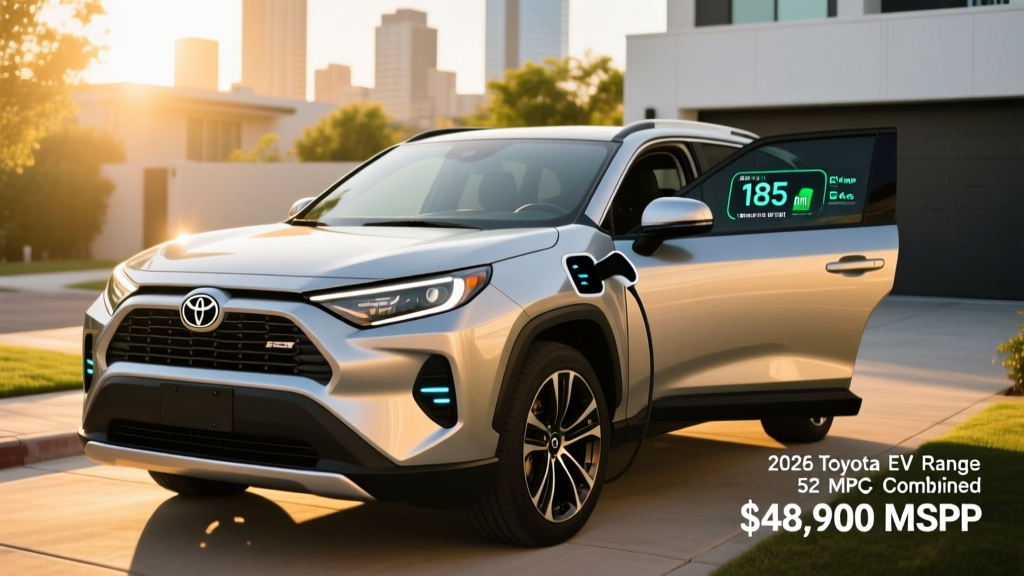
The 2026 Toyota RAV4 Plug-In Hybrid (formerly RAV4 Prime) remains one of the most compelling vehicles in the compact crossover segment for buyers who want meaningful electric-only commuting without sacrificing the freedom to road-trip without planning charging stops. With 42 miles of EPA-rated electric range, 302 combined horsepower, and Toyota's legendary hybrid reliability, it threads a needle that full EVs and conventional hybrids can't quite match.
But at a starting price hovering around $44,500, the 2026 RAV4 Plug-In Hybrid demands a closer look at whether the math works for your specific driving patterns, charging access, and tax situation. This guide breaks down every number that matters.
2026 RAV4 Plug-In Hybrid: Key Specifications at a Glance
| Specification | 2026 RAV4 Plug-In Hybrid |
|---|---|
| Powertrain | 2.5L 4-cyl + 2 electric motors (AWD) |
| Combined Horsepower | 302 hp |
| Battery Capacity | 18.1 kWh (lithium-ion) |
| Electric-Only Range (EPA) | 42 miles |
| Combined Range (Electric + Gas) | ~440 miles |
| MPGe (Electric + Gas Combined) | 94 MPGe |
| MPG (Hybrid Mode, Combined) | 38 MPG |
| 0–60 mph | 5.7 seconds |
| Level 2 Charge Time (0–100%) | ~2.5 hours (240V, 32A) |
| DC Fast Charging | Not available |
| Starting MSRP | $44,500 (SE trim) |
| Hybrid Battery Warranty | 10 years / 150,000 miles |
HEV vs PHEV: Understanding What You're Buying
Toyota sells two electrified versions of the RAV4, and the distinction matters enormously for your wallet and daily routine.
Conventional RAV4 Hybrid (HEV)
- No plug required. The battery recharges via regenerative braking and the gas engine.
- EPA combined MPG: 39–41 MPG depending on trim.
- Electric-only driving: Very limited — brief low-speed EV mode only.
- Starting MSRP: ~$33,000.
- Tax credit: Not eligible for the federal §30D credit.
RAV4 Plug-In Hybrid (PHEV)
- Plugs in at home or public Level 2 chargers. Larger 18.1 kWh battery stores meaningful electric range.
- EPA combined: 94 MPGe (electric mode) / 38 MPG (hybrid mode after battery depletes).
- Electric-only range: 42 miles EPA — enough for most daily commutes.
- Starting MSRP: ~$44,500.
- Tax credit: May qualify for partial federal credit under §30D — details below.
The bottom line: If you can charge at home and your round-trip commute is under ~40 miles, the PHEV lets you drive on electricity most weekdays while keeping a gas tank for longer trips. If you can't charge at home or apartment, the conventional HEV delivers excellent efficiency without lifestyle changes.
Electric-Only Range: EPA vs Real World
EPA Electric Range: 42 miles
Real-World Expectation: 35–40 miles in moderate weather (mixed city/highway); 28–33 miles in cold weather (below 30°F) or sustained highway speeds above 70 mph.
The 42-mile EPA figure is achievable in city and suburban driving at moderate temperatures, where regenerative braking recovers energy and speeds stay lower. On a 75-mph highway run in winter, expect the battery to deplete closer to 30 miles. Running the cabin heater in cold weather draws significantly from the battery pack — a trade-off every PHEV owner learns quickly.
Once the battery depletes, the RAV4 PHEV seamlessly transitions to hybrid mode, delivering 38 MPG combined according to EPA data on fueleconomy.gov. In real-world city driving, many owners report exceeding 40 MPG in hybrid mode because stop-and-go traffic maximizes regenerative braking.
Fuel Economy Breakdown: City, Highway, and Combined
| Mode | City | Highway | Combined |
|---|---|---|---|
| Electric (MPGe) | 105 MPGe | 84 MPGe | 94 MPGe |
| Hybrid Mode (MPG) | 40 MPG | 36 MPG | 38 MPG |
The city-heavy MPG advantage is typical of Toyota's hybrid synergy drive system. The electric motor handles low-speed launches, the gas engine kicks in for highway cruising, and regenerative braking recaptures energy during deceleration. If your driving is predominantly urban, the real-world numbers often beat the EPA sticker.
Powertrain and Performance: 302 HP Is No Joke
The 2026 RAV4 Plug-In Hybrid pairs a 2.5-liter Atkinson-cycle 4-cylinder engine (177 hp on its own) with front and rear electric motors. Combined system output is 302 horsepower, making this the quickest RAV4 in the lineup with a 0–60 mph time of 5.7 seconds — faster than many sport compacts.
Standard electronic on-demand AWD (the rear motor drives the rear axle independently) provides confident traction without the mechanical losses of a traditional driveshaft. In EV mode, the RAV4 PHEV can reach speeds up to 84 mph on electric power alone, meaning you won't be forced into hybrid mode during normal highway merging.
Charging: Level 2 at Home, No DC Fast Charging
The 2026 RAV4 PHEV charges via a J1772 connector (the North American standard for Level 2 AC charging). Here's what to expect:
| Charging Level | Power | Time (0–100%) | Notes |
|---|---|---|---|
| Level 1 (120V outlet) | ~1.4 kW | ~12 hours | Emergency/trickle only |
| Level 2 (240V, 16A) | ~3.3 kW | ~5.5 hours | Standard home charger |
| Level 2 (240V, 32A) | ~6.6 kW | ~2.5 hours | Higher-amperage home charger |
| DC Fast Charging | N/A | N/A | Not supported |
Critical detail: The RAV4 PHEV does not support DC fast charging. This is standard for nearly all PHEVs — the battery is small enough that Level 2 overnight charging is sufficient. If you need DC fast charging for road-trip convenience, you're looking at a full BEV, not a PHEV.
For most owners, a 32-amp Level 2 home charger (roughly $500–$700 for equipment, plus $400–$1,200 for electrician installation depending on panel proximity) replenishes the battery fully overnight. Toyota's onboard charger accepts up to 6.6 kW, so investing in a 48-amp charger won't speed things up beyond what a 32-amp unit delivers.
Pricing, Trims, and Federal Tax Credit Eligibility
The 2026 RAV4 Plug-In Hybrid is offered in two trims:
- SE: Starting at approximately $44,500 (including destination)
- XSE: Starting at approximately $48,000 (adds premium interior, larger wheels, upgraded tech)
Federal Tax Credit (§30D) — Current Rules
The RAV4 Plug-In Hybrid may qualify for a partial federal tax credit under IRS §30D, but eligibility depends on several factors that change periodically:
- Vehicle MSRP cap: SUVs must be under $80,000 MSRP — the RAV4 PHEV qualifies.
- Buyer income cap: Modified AGI must not exceed $150,000 (single), $225,000 (head of household), or $300,000 (joint).
- Battery component sourcing: A percentage of battery components must be manufactured or assembled in North America, and critical minerals must meet sourcing thresholds. These thresholds tighten annually.
- Point-of-sale transfer: As of 2024+, eligible buyers can transfer the credit to the dealer at purchase, reducing the out-of-pocket price directly rather than waiting for a tax refund.
Important: Battery sourcing requirements have disqualified many PHEVs from the full $7,500 credit in recent years. Check the latest eligibility list at IRS.gov's qualified vehicles page before purchasing. Consult a tax professional for your specific situation.
Many states offer additional rebates or HOV lane access for PHEVs — California's CVRP program, for example, has historically offered rebates for qualifying PHEVs, though funding varies. Check your state energy office for current programs.
Reliability and Battery Warranty: What to Expect Long-Term
Hybrid Battery Warranty: 10 years / 150,000 miles (whichever comes first)
Warranty Coverage: Battery capacity must remain above a specified threshold (typically ~70% state of health). If it degrades below that threshold within the warranty period, Toyota replaces or reconditions the pack at no cost.
Toyota's hybrid battery track record is among the best in the industry. Data from long-term Prius and RAV4 Hybrid fleets shows that Toyota's nickel-metal hydride and lithium-ion hybrid batteries routinely exceed 150,000 miles with minimal degradation. The PHEV's larger lithium-ion pack operates with a generous buffer — Toyota never allows full 100% charge or 0% discharge at the cell level, which significantly extends cycle life.
Battery replacement cost (out of warranty): If the hybrid battery eventually needs replacement beyond the warranty window, expect $4,000–$7,000 for a refurbished or new pack including labor at a Toyota dealer. Independent hybrid specialists can sometimes source refurbished packs for $2,500–$4,000. For context, most Toyota hybrid batteries outlast the vehicle's useful economic life.
According to IIHS safety testing, the RAV4 platform earns top marks, and Toyota Safety Sense 2.5+ (pre-collision, lane tracing, adaptive cruise, road sign assist) comes standard on all trims.
Who Should Choose the RAV4 PHEV vs a Full EV or Gas Car?
Choose the RAV4 Plug-In Hybrid if:
- You can install a Level 2 charger at home (garage or driveway with 240V access)
- Your typical daily driving is under 40 miles round-trip (you'll rarely burn gas on weekdays)
- You take road trips of 200+ miles regularly and don't want to plan around charging infrastructure
- You want one vehicle that does everything without compromise
- You live in a cold climate where EV range loss is a concern
Choose a full BEV (like the Tesla Model Y or Hyundai Ioniq 5) if:
- You want zero tailpipe emissions and the lowest per-mile fuel cost
- You have reliable home charging and access to DC fast chargers for road trips
- Your daily driving is predictable and within 250+ miles of range
- You want the full $7,500 federal tax credit (if eligible and the model qualifies)
Choose the conventional RAV4 Hybrid (HEV) if:
- You cannot charge at home (apartment, street parking, no garage)
- You want the lowest purchase price and simplest ownership
- Your daily mileage is high but spread across highway driving where PHEV electric range offers less benefit
Pros and Cons: The Honest Assessment
Pros
- 42 miles of real, usable electric range covers most commutes
- 302 hp makes it the quickest RAV4 — genuinely fast for a family crossover
- Standard AWD with no mechanical penalty
- 38 MPG in hybrid mode even after the battery depletes
- Toyota's 10-year/150,000-mile hybrid battery warranty
- No range anxiety — 440+ total miles of range
- Strong resale value; RAV4 PHEV holds value exceptionally well
Cons
- $44,500+ starting price is a significant premium over the RAV4 Hybrid (~$33K)
- No DC fast charging — not a dealbreaker for PHEVs but limits public charging utility
- Federal tax credit eligibility uncertain due to battery sourcing rules
- Cargo space slightly reduced vs. non-hybrid RAV4 due to battery placement
- Dealer markups remain common due to high demand and limited supply
- Infotainment system functional but not class-leading in UI design
Frequently Asked Questions
How many MPG does the 2026 RAV4 Plug-In Hybrid get?
In hybrid mode (after the battery is depleted), the EPA rates it at 40 city / 36 highway / 38 combined MPG. In electric mode, it achieves 94 MPGe combined. Real-world city driving often exceeds 40 MPG in hybrid mode due to regenerative braking.
How far can the RAV4 Plug-In Hybrid go on electric only?
The EPA rates it at 42 miles of electric-only range. In real-world conditions, expect 35–40 miles in moderate weather and 28–33 miles in cold weather or sustained highway driving above 70 mph.
Does the 2026 RAV4 Plug-In Hybrid qualify for a federal tax credit?
It may qualify for a partial or full credit under IRS §30D, depending on current battery sourcing requirements, your income, and MSRP caps. The MSRP is under the $80,000 SUV cap. However, critical mineral and battery component sourcing thresholds have disqualified some Toyota PHEVs in recent years. Always verify on the IRS qualified vehicle list before purchasing.
Is the RAV4 Plug-In Hybrid reliable? What does a battery replacement cost?
Toyota's hybrid systems have an outstanding long-term reliability record spanning two decades. The hybrid battery is warranted for 10 years/150,000 miles. Out-of-warranty replacement runs approximately $4,000–$7,000 at a dealer, though most packs last well beyond the warranty period.
Should I get the RAV4 PHEV or a full electric vehicle?
If you have home charging, a commute under 40 miles, and regularly take long road trips, the RAV4 PHEV gives you electric commuting with zero range anxiety. If you want the lowest operating cost, have DC fast-charging access, and don't drive beyond ~250 miles without stopping, a full BEV like the Model Y or Ioniq 5 may save more over time and offer a larger tax credit.
Can I charge the RAV4 PHEV at a public DC fast charger?
No. The RAV4 Plug-In Hybrid only accepts AC Level 1 and Level 2 charging via its J1772 port. DC fast charging is not supported, which is typical for PHEVs with smaller battery packs. A full charge on a 32-amp Level 2 home charger takes about 2.5 hours.
The 2026 RAV4 Plug-In Hybrid occupies a specific and valuable niche: it's the vehicle for buyers who are ready to electrify their daily commute but aren't ready to commit fully to a battery-electric vehicle. With 42 miles of electric range, 302 horsepower, standard AWD, and Toyota's reliability backing, it's a pragmatic choice — as long as the $44,500+ price tag and uncertain tax credit fit your budget.