Quick Verdict: The Adventure Hybrid That Doesn't Pretend to Be a PHEV
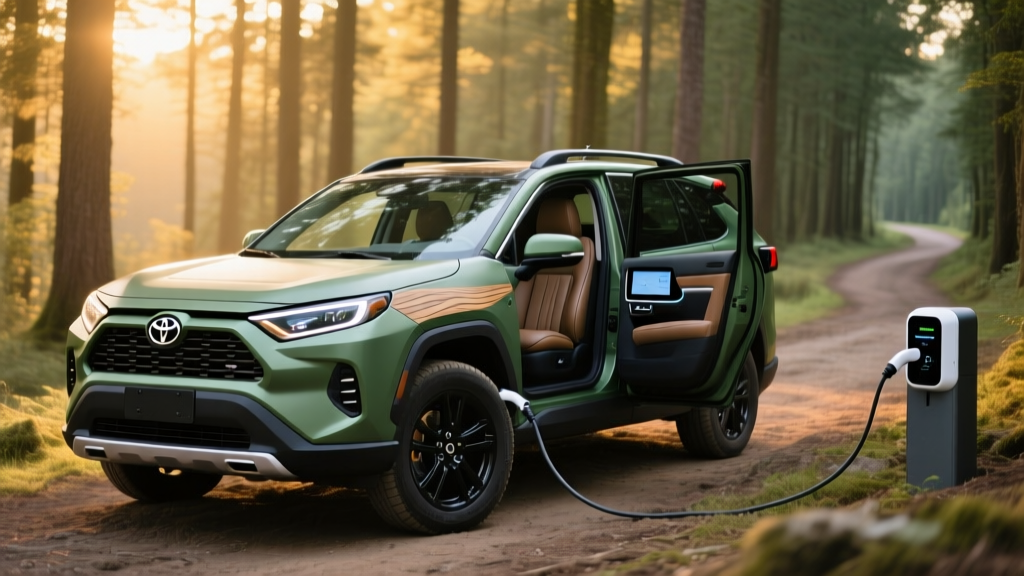
The 2024 Toyota RAV4 Hybrid Woodland Edition occupies a narrow but compelling niche: a conventional hybrid (HEV) compact SUV with genuine all-weather and light off-road hardware, wrapped in rugged styling that isn't just an appearance package. At an EPA-estimated 39 MPG combined, it sips fuel on the daily commute while offering all-wheel drive with a dedicated rear electric motor — no driveshaft, no mechanical link between axles.
Before we break down every spec, let's establish what this vehicle is not: it is not a plug-in hybrid (PHEV). The Woodland Edition cannot be plugged in, carries no electric-only range, and does not qualify for the federal §30D EV tax credit. If you want plug-in capability in a RAV4, that's the RAV4 Prime — a different vehicle entirely, which we'll address later. The Woodland Edition is a self-charging hybrid that runs on gasoline alone, with a nickel-metal hydride (NiMH) traction battery that recharges through regenerative braking and the engine.
The 2024 RAV4 Hybrid (including the Woodland Edition) is a conventional hybrid (HEV). It pairs a 2.5L four-cylinder engine with electric motors and a small battery (1.6 kWh). You never plug it in — the battery charges via regenerative braking and the gas engine. Total range is limited only by the 14.5-gallon fuel tank.
The RAV4 Prime is a plug-in hybrid (PHEV) with an 18.1 kWh lithium-ion battery, 42 miles of electric-only range, and a J1772 charge port (Level 1/Level 2 only, no DC fast charging). The Prime starts at $43,690 and does qualify for certain incentives depending on your tax situation. The Woodland Edition is the HEV variant — simpler, lighter, and roughly $7,500 cheaper than a Prime at base MSRP.
EPA Fuel Economy & Real-World MPG
| Metric | EPA Estimate |
|---|---|
| City MPG | 38 MPG |
| Highway MPG | 35 MPG |
| Combined MPG | 39 MPG |
| Fuel Tank Capacity | 14.5 gallons |
| Total Driving Range | ~565 miles |
Source: fueleconomy.gov — 2024 Toyota RAV4 Hybrid AWD
Real-World MPG: What Owners Actually See
Toyota's hybrid system excels in city driving, where regenerative braking and electric-motor assist do the heaviest work. In real-world testing by owners and automotive publications, the RAV4 Hybrid routinely matches or exceeds its EPA city estimate of 38 MPG in stop-and-go traffic — a trait unique to hybrids, which operate the engine less at low speeds.
Highway driving is a different story. The Woodland Edition's all-terrain tires (225/65R17 Falken Wild Peak A/T) and raised suspension create more rolling resistance and aerodynamic drag than a standard RAV4 Hybrid XLE. Expect highway MPG to land between 33–36 MPG at 70–75 mph, slightly below the 35 MPG EPA highway sticker. In cold weather (below 32°F), the engine runs more frequently to provide cabin heat and maintain battery temperature, dropping combined real-world MPG to roughly 35–37 MPG.
For mixed suburban and highway commuting in temperate conditions, most owners report 38–41 MPG combined — right at or slightly above the EPA figure. The Woodland Edition sacrifices about 1 MPG combined versus a standard RAV4 Hybrid LE AWD (41 MPG combined) due to its off-road hardware, which is a modest trade-off for the added capability.
Powertrain Specs: 219 Horsepower with Electronic AWD
| Specification | Value |
|---|---|
| Engine | 2.5L Dynamic Force 4-cylinder (176 hp / 163 lb-ft) |
| Front Electric Motor | 88 kW (118 hp / 149 lb-ft) |
| Rear Electric Motor (AWD) | 40 kW (54 hp / 89 lb-ft) |
| Net Combined System Horsepower | 219 hp |
| Transmission | eCVT (planetary gearset, not a belt CVT) |
| Traction Battery | 1.6 kWh NiMH (sealed, self-charging) |
| 0–60 mph | ~7.4 seconds |
| Drivetrain | Electronic On-Demand AWD (no mechanical driveshaft) |
| Towing Capacity | 1,750 lbs |
| Ground Clearance | 8.6 inches |
Toyota's eCVT is not a traditional continuously variable transmission with a rubber belt. It uses a planetary gearset to blend engine and motor power with no fixed gear ratios and no shifting shock. The result is smooth, linear acceleration with none of the "rubber-band" drone associated with older CVT designs. Reliability is excellent — this transaxle has no clutch packs, torque converter, or bands to wear out.
The electronic AWD system engages the rear motor automatically when front-wheel slip is detected, in hard acceleration, or during cornering. Unlike mechanical AWD systems, there is no parasitic loss from a spinning driveshaft when AWD isn't needed — which contributes directly to the strong highway fuel economy. The Woodland Edition also adds TRD-tuned suspension, a front skid plate, and Multi-Terrain Select (Mud/Sand, Rock/Dirt modes) that modulate throttle response and brake-based traction control for loose surfaces.
What Makes the Woodland Edition Different from Other RAV4 Hybrids?
The Woodland Edition is not merely an appearance package on a standard RAV4 Hybrid. Toyota equips it with functional hardware that distinguishes it from the XLE, XSE, and Limited trims:
- All-terrain tires: Falken Wild Peak A/T (225/65R17) on unique bronze-finish 17-inch alloy wheels — genuine off-road rubber, not highway all-seasons
- TRD-tuned suspension: revised spring rates and shock damping for improved body control on rough surfaces
- 8.6 inches of ground clearance: 0.2 inches more than standard RAV4 Hybrid trims
- Front skid plate: protects the engine/transaxle subframe on rocky terrain
- Multi-Terrain Select: driver-selectable traction modes for mud, sand, and rock
- Roof rails with cross bars: included standard, rated for 165 lbs dynamic load
- Unique exterior: Army Green or Cavalry Blue paint, blacked-out trim, weatherproof cargo tray
The trade-off is roughly 1 MPG combined versus the standard Hybrid LE, slightly firmer ride quality on pavement, and a modest increase in road noise from the all-terrain tires at highway speeds. For buyers who actually drive on unpaved roads, forest service roads, or snow-covered driveways, these trade-offs are well justified.
Pricing, Trims & Tax Credit Eligibility
The 2024 Toyota RAV4 Hybrid Woodland Edition carries a base MSRP of $36,215 (including $1,395 destination charge). There is only one trim level for the Woodland Edition, but several option packages are available:
| Configuration | MSRP |
|---|---|
| Woodland Edition (base) | $36,215 |
| + Weather Package (heated steering, wiper de-icer) | $36,940 |
| + Technology Package (JBL audio, wireless charging) | $37,555 |
| Fully optioned (both packages + mudguards + cargo) | ~$38,200 |
No. The 2024 RAV4 Hybrid Woodland Edition is a conventional hybrid (HEV), not a plug-in vehicle. It does not qualify for the IRS §30D Clean Vehicle Credit (up to $7,500 for new plug-in vehicles). Only the RAV4 Prime (PHEV) may qualify for federal incentives, though §30D eligibility depends on battery sourcing requirements, MSRP caps ($80,000 for SUVs), and buyer income limits. Consult IRS.gov §30D guidelines or a tax professional for your specific situation.
Some states offer separate hybrid or clean-vehicle rebates that may apply to conventional hybrids — check your state's energy office or DMV for current programs.
Battery Warranty, Reliability & Replacement Cost
- Hybrid Battery Coverage: 10 years / 150,000 miles (whichever comes first) — Toyota's standard hybrid battery warranty since the 2020 model year
- Hybrid System Components: 8 years / 100,000 miles (inverter, transaxle, control module)
- Battery Chemistry: Nickel-Metal Hydride (NiMH) — proven, durable, less energy-dense than lithium-ion but highly tolerant of charge/discharge cycling
- Replacement Cost (out of warranty): $2,000–$4,000 for a new OEM NiMH pack; refurbished packs available for $1,000–$2,000
The RAV4 Hybrid's NiMH battery pack is one of the most proven hybrid batteries on the road. Toyota has used NiMH chemistry across millions of hybrids since the original Prius in 1997. Unlike lithium-ion packs, NiMH degrades very gradually — most Toyota hybrid batteries retain 80%+ capacity well past 150,000 miles. Complete failure before 200,000 miles is uncommon based on long-term owner data.
The hybrid system as a whole — including the eCVT transaxle, power control unit, and electric motors — has an outstanding reliability record. Toyota's hybrid components carry an 8-year/100,000-mile warranty, and the traction battery is covered for 10 years/150,000 miles. Consumer Reports consistently rates the RAV4 Hybrid among the most reliable compact SUVs, and the powertrain shares architecture with the Camry Hybrid and Highlander Hybrid, both of which have demonstrated 250,000+ mile longevity in fleet and owner use.
One important note: the Woodland Edition's 12-volt auxiliary battery (a standard lead-acid unit, separate from the hybrid traction battery) may need replacement every 4–6 years at a cost of $150–$250. This is normal maintenance for any vehicle and unrelated to the hybrid system.
Hybrid vs. PHEV vs. Full EV: Which Powertrain Fits Your Life?
| Factor | RAV4 Hybrid (HEV) | RAV4 Prime (PHEV) | Full EV (e.g., Tesla Model Y, Ioniq 5) |
|---|---|---|---|
| Starting MSRP | $36,215 (Woodland) | $43,690 (SE) | $44,000–$52,000 |
| Plug-in Required? | No — self-charging | Yes — 18.1 kWh battery | Yes — 60–80+ kWh battery |
| Electric-Only Range | None | 42 miles (EPA) | 260–330 miles (EPA) |
| Fuel / Energy Cost per Mile | ~$0.09 (at $3.50/gal) | ~$0.04 (electric) / $0.09 (gas) | ~$0.04 (home charging) |
| Federal Tax Credit (§30D) | Not eligible | May qualify (sourcing rules apply) | Up to $7,500 (if eligible) |
| Home Charging Needed? | No | Recommended (Level 2) | Essential (Level 2) |
| Best For | No home charging access; apartment dwellers; rural drivers; off-road use | Short commutes + long road trips; home charging available | Home charging + mostly under 250-mi trips; lowest operating cost |
Choose the RAV4 Hybrid (HEV) Woodland Edition If:
- You live in an apartment, condo, or street-parking situation with no access to home charging
- Your commute involves mixed city/highway driving and you want 550+ miles of total range per tank
- You drive on unpaved roads, forest service roads, or in deep snow regularly
- You want AWD capability without the fuel-economy penalty of a conventional gas AWD SUV
- You prefer the simplicity of gas-station refueling with no charging infrastructure dependency
Consider the RAV4 Prime (PHEV) Instead If:
- Your daily commute is under 42 miles round-trip and you can install a Level 2 home charger
- You want to drive mostly electric on weekdays and take gas-powered road trips on weekends
- You may qualify for the §30D federal tax credit, which can narrow the $7,500 price gap with the Hybrid
- You want 302 combined horsepower (significantly more than the Hybrid's 219 hp)
Consider a Full EV Instead If:
- You have reliable Level 2 home charging and your typical trips stay under 250 miles
- You want the lowest possible cost per mile (~$0.04/mi on home electricity vs. ~$0.09/mi on gas)
- You want to eliminate oil changes, spark plugs, and transmission fluid entirely
- You qualify for the full $7,500 federal credit and applicable state incentives
Pros, Cons & the Bottom Line
- 39 MPG combined EPA — excellent for an AWD SUV with off-road hardware
- Genuine all-terrain capability: 8.6" ground clearance, skid plate, A/T tires, Multi-Terrain Select
- Proven hybrid powertrain with 10yr/150,000-mi battery warranty
- No plug-in dependency — ideal for apartment dwellers and rural owners
- ~565 miles total range per tank
- Strong reliability ratings (Consumer Reports, J.D. Power)
- Standard Toyota Safety Sense 2.5+ (AEB, lane-keep, adaptive cruise)
- 1 MPG penalty vs. standard RAV4 Hybrid LE due to A/T tires
- No federal tax credit eligibility (HEV, not PHEV)
- All-terrain tires generate more highway road noise than all-seasons
- Only 1,750-lb towing capacity (light-duty only)
- Infotainment is Toyota's older interface (functional but dated vs. competitors)
- Rear-seat space is average for the segment — not class-leading
- NiMH battery (not lithium-ion) — adequate but older chemistry
Frequently Asked Questions
How many MPG does the 2024 RAV4 Hybrid Woodland Edition get?
The EPA rates it at 38 city / 35 highway / 39 combined MPG. In real-world driving, most owners report 38–41 MPG combined in temperate conditions. City driving often exceeds the EPA estimate thanks to the hybrid system's regenerative braking. Highway driving at 75+ mph and cold-weather operation typically yield 33–37 MPG.
Is the RAV4 Hybrid Woodland Edition a plug-in hybrid?
No. It is a conventional hybrid (HEV). You never plug it in. The 1.6 kWh NiMH battery charges itself through regenerative braking and the gasoline engine. If you want a plug-in RAV4, look at the RAV4 Prime, which offers 42 miles of electric-only range and an 18.1 kWh lithium-ion battery.
Does the RAV4 Hybrid qualify for any tax credit?
The conventional RAV4 Hybrid does not qualify for the federal §30D Clean Vehicle Credit, which is reserved for plug-in vehicles (BEVs and PHEVs). Some states may offer hybrid-specific rebates — check your state energy office. The RAV4 Prime (PHEV) may qualify for federal incentives depending on current sourcing and income requirements.
How long will the hybrid battery last and what does replacement cost?
Toyota covers the hybrid battery for 10 years / 150,000 miles. NiMH batteries in Toyota hybrids have demonstrated 200,000+ mile longevity with minimal degradation. If replacement is needed out of warranty, expect $2,000–$4,000 for a new OEM pack or $1,000–$2,000 for a refurbished unit. This is a known, predictable cost — far less than an EV battery replacement.
Can the Woodland Edition handle real off-road trails?
It handles fire roads, forest service roads, snow-covered driveways, and moderate rocky terrain competently thanks to 8.6 inches of ground clearance, all-terrain tires, a front skid plate, and Multi-Terrain Select. It is not a dedicated off-roader like a 4Runner TRD Off-Road or Jeep Wrangler — it lacks a low-range transfer case and locking differentials. Think "adventure-capable," not "rock-crawler."
Is the RAV4 Hybrid reliable?
Yes. Toyota's hybrid powertrain is among the most reliable in the industry. The eCVT transaxle has no belts, clutches, or torque converter to fail. Consumer Reports and J.D. Power consistently rate the RAV4 Hybrid above average for reliability. The hybrid system shares architecture with the Camry Hybrid, Highlander Hybrid, and Prius — all proven over millions of vehicles and 25+ years of production.