Quick Verdict: Which Compact Hybrid SUV Wins?
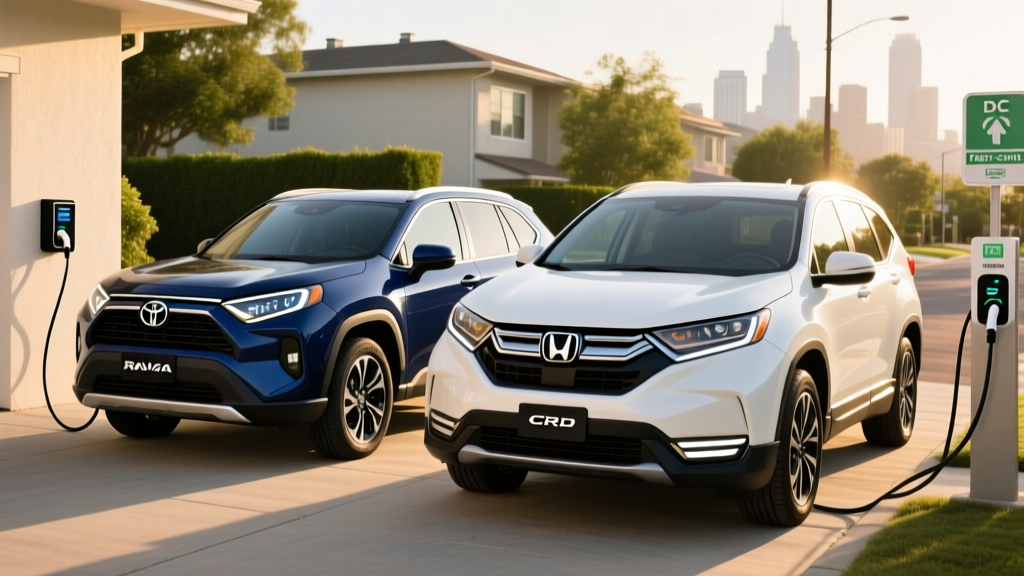
The Toyota RAV4 Hybrid and Honda CR-V Hybrid are the two dominant compact hybrid SUVs in the U.S. market, and for good reason: both deliver 39–41 MPG combined with standard all-wheel drive, spacious cargo areas, and proven hybrid reliability. But the differences matter when you're spending $35,000+.
The 2026 Toyota RAV4 Hybrid edges ahead on raw fuel economy (41 MPG combined) and offers a more aggressive AWD system with a dedicated rear motor. The 2026 Honda CR-V Hybrid counters with a more refined driving experience, a larger cargo area behind the second row, and Honda's excellent Sensing safety suite as standard. Neither is a plug-in hybrid — both are conventional self-charging hybrids (HEVs) that never need to be plugged in.
HEV vs PHEV: What You're Looking At
Both the RAV4 Hybrid and CR-V Hybrid are conventional hybrids (HEVs). They use a small battery (1.6–2.0 kWh) charged by the engine and regenerative braking. You never plug them in. If you want plug-in capability, Toyota offers the RAV4 Prime (PHEV) and Honda previously offered the CR-V Plug-In Hybrid in select markets — but this comparison focuses strictly on the standard HEV models.
EPA Fuel Economy: RAV4 Hybrid vs CR-V Hybrid MPG
| Metric | 2026 Toyota RAV4 Hybrid AWD | 2026 Honda CR-V Hybrid AWD |
|---|---|---|
| EPA City MPG | 41 | 40 |
| EPA Highway MPG | 38 | 34 |
| EPA Combined MPG | 41 | 37 |
| Fuel Tank Capacity | 14.5 gal | 14.0 gal |
| Total Driving Range | ~595 mi | ~518 mi |
The RAV4 Hybrid's highway advantage is significant. Toyota's hybrid system keeps the 2.5-liter engine running at its most efficient RPM range more consistently at sustained speeds, while Honda's system relies more heavily on the electric motor at lower speeds and engages the 1.5-liter turbo engine more frequently on the highway.
Source: EPA Fuel Economy (fueleconomy.gov)
Real-World MPG: What Owners Actually Report
EPA estimates are a starting point, not a guarantee. Here's what real-world driving looks like:
- RAV4 Hybrid real-world: Most owners report 38–43 MPG in mixed driving. City-heavy commutes often exceed the EPA estimate — hybrids thrive in stop-and-go traffic where regenerative braking recovers energy. Highway-only trips at 75+ mph typically drop to 34–36 MPG.
- CR-V Hybrid real-world: Owners commonly see 34–39 MPG mixed. The CR-V Hybrid tends to fall slightly short of its EPA highway estimate on long interstate drives, returning 30–33 MPG at 75 mph. City driving aligns closely with or slightly exceeds the 40 MPG EPA city figure.
Cold-weather impact: Both vehicles lose 5–15% fuel economy in sub-freezing temperatures. The engine runs more often to heat the cabin and maintain battery temperature. Expect 33–36 MPG combined in winter for the RAV4, and 30–34 MPG for the CR-V.
Powertrain and Performance Specs
| Specification | 2026 Toyota RAV4 Hybrid | 2026 Honda CR-V Hybrid |
|---|---|---|
| Engine | 2.5L 4-cyl Atkinson cycle | 2.0L 4-cyl Atkinson cycle |
| Engine HP | 176 hp | 145 hp |
| Electric Motor HP | 118 hp (front) + 54 hp (rear) | 181 hp (combined front motors) |
| Combined System HP | 219 hp | 204 hp |
| 0–60 mph | 7.4 seconds | 7.6 seconds |
| Drivetrain | AWD (electronic rear motor) | AWD (mechanical rear drive) |
| Transmission | eCVT | eCVT |
| Towing Capacity | 1,750 lbs | 1,000 lbs |
The RAV4 Hybrid's AWD system uses a separate rear-mounted electric motor that engages on demand — there's no mechanical driveshaft connecting front and rear axles. This means instant torque to the rear wheels when traction is needed, and zero parasitic drag when it isn't. The CR-V Hybrid uses a more traditional mechanical connection to the rear wheels, which is effective but slightly less responsive in slippery conditions.
Neither hybrid is fast by performance standards, but both merge onto highways and climb grades without strain. The RAV4's extra 15 hp and stronger low-end electric torque give it a slight edge in passing situations.
Pricing and Tax Credit Eligibility
| Trim | 2026 RAV4 Hybrid MSRP | 2026 CR-V Hybrid MSRP |
|---|---|---|
| Base (LE/LX) | $33,575 | $36,395 |
| Mid (XLE/EX) | $35,075 | $38,395 |
| Upper (XLE Premium/EX-L) | $37,575 | $40,895 |
| Top (Limited/Woodland) | $40,075–$42,000 | $42,395 |
Do These Hybrids Qualify for Federal Tax Credits?
No. Under current IRS §30D rules, the federal clean vehicle credit applies only to plug-in electric vehicles (BEVs and PHEVs) with a minimum battery capacity of 7 kWh. Conventional hybrids like the RAV4 Hybrid and CR-V Hybrid have batteries under 2 kWh and do not qualify for the $7,500 federal credit. Some states offer separate hybrid incentives — check your state's energy office or the Alternative Fuels Data Center for local programs.
Hybrid Battery Warranty and Replacement Cost
| Coverage | Toyota RAV4 Hybrid | Honda CR-V Hybrid |
|---|---|---|
| Hybrid Battery Warranty | 10 years / 150,000 miles | 8 years / 100,000 miles |
| Hybrid System Warranty | 10 years / 150,000 miles | 8 years / 100,000 miles |
| Battery Chemistry | Nickel-Metal Hydride (NiMH) | Lithium-Ion (Li-Ion) |
| Estimated Replacement Cost | $3,000–$4,500 | $2,500–$4,000 |
Toyota extended its hybrid battery warranty to 10 years/150,000 miles for all 2020+ models, a significant advantage over Honda's 8-year/100,000-mile coverage. Both warranties cover battery capacity degradation below a specified threshold (typically 60–70% of original capacity).
In practice, hybrid battery failures are rare before 150,000 miles. Toyota's NiMH chemistry has a decades-long track record — the original Prius batteries routinely lasted 200,000+ miles. Honda's lithium-ion pack is lighter and more energy-dense but has a shorter long-term track record. Independent data from sources like Consumer Reports consistently ranks both brands in the top tier for hybrid reliability.
Reliability Ratings and Long-Term Ownership
Both vehicles score well in reliability, but Toyota holds a historical edge:
- RAV4 Hybrid: Predicted reliability scores from Consumer Reports and J.D. Power consistently rate the RAV4 Hybrid as "Above Average" to "Great." The hybrid powertrain is a proven system carried over from the Camry Hybrid and Highlander Hybrid with minimal changes. Common complaints are minor — wind noise at highway speeds, infotainment responsiveness, and occasional brake feel inconsistency from the regen-to-friction handoff.
- CR-V Hybrid: Honda's hybrid system is newer in the CR-V (introduced for the 2023 redesign). Early reliability data is positive, and Honda's two-motor hybrid architecture has performed well in the Accord Hybrid. Some owners report a slight engine drone under hard acceleration as the eCVT holds the engine at high RPM.
Both vehicles earned top safety ratings from the IIHS and NHTSA, with standard automatic emergency braking, lane-keeping assist, and adaptive cruise control.
Who Should Choose Which — Hybrid, PHEV, or Full EV?
Choose the RAV4 Hybrid if:
- You want the highest EPA MPG and longest total range in the segment
- You drive highway-heavy commutes where the RAV4's 38 MPG highway shines
- You need more towing capacity (1,750 lbs vs 1,000 lbs)
- You plan to keep the vehicle past 100,000 miles and want Toyota's 10-year hybrid warranty
Choose the CR-V Hybrid if:
- You prioritize cargo space (36.3 cu ft behind 2nd row vs 37.5 cu ft for RAV4, but CR-V's shape is more usable)
- You prefer Honda's driving dynamics — the CR-V Hybrid feels more car-like and planted in corners
- You value Honda Sensing's lane-centering system, which many reviewers find smoother than Toyota's
- You do mostly city driving where both SUVs perform similarly
Consider a PHEV or Full EV Instead if:
- PHEV (RAV4 Prime): You have home charging access and want 42 miles of electric-only range for daily commuting, plus the federal $7,500 tax credit. The RAV4 Prime starts around $44,500 — roughly $10,000 more than the RAV4 Hybrid — but the credit and fuel savings can close that gap in 4–5 years.
- Full EV (Tesla Model Y, Hyundai Ioniq 5): You can charge at home, drive under 250 miles daily, and want to eliminate gas entirely. A full EV costs more upfront but saves $1,000–$1,500/year in fuel and has near-zero drivetrain maintenance.
- Stick with the HEV if: You lack reliable home charging, frequently drive 400+ miles between fill-ups, live in an apartment without charging access, or want the lowest purchase price with no charging lifestyle changes.
Pros and Cons at a Glance
2026 Toyota RAV4 Hybrid
Pros:
- Best-in-class 41 MPG combined (EPA)
- 10-year/150,000-mile hybrid warranty
- Strong AWD with dedicated rear electric motor
- Proven long-term reliability track record
- 1,750-lb towing capacity
Cons:
- Infotainment system feels dated vs Honda
- More road noise at highway speeds
- Rear seat is tighter than CR-V
- No federal tax credit eligibility
2026 Honda CR-V Hybrid
Pros:
- More refined ride and handling
- Larger, more usable cargo area
- Smoother lane-centering assist (Honda Sensing)
- More comfortable rear seat with better legroom
- Quieter cabin at cruising speeds
Cons:
- Lower highway MPG (34 EPA) than RAV4
- Shorter hybrid battery warranty (8 yr / 100k mi)
- Only 1,000-lb towing capacity
- Higher starting price ($36,395 vs $33,575)
- Engine drone under hard acceleration
Frequently Asked Questions
How many MPG does the RAV4 Hybrid actually get?
The EPA rates the 2026 RAV4 Hybrid AWD at 41 city / 38 highway / 41 combined. In real-world mixed driving, most owners report 38–43 MPG. City-heavy routes often exceed the EPA estimate thanks to regenerative braking, while sustained 75+ mph highway driving typically returns 34–36 MPG.
How many MPG does the CR-V Hybrid actually get?
The EPA rates the 2026 CR-V Hybrid AWD at 40 city / 34 highway / 37 combined. Real-world reports cluster around 34–39 MPG mixed. The highway figure tends to fall slightly short of the EPA estimate on long interstate trips, while city driving matches or slightly beats the 40 MPG rating.
Do the RAV4 Hybrid or CR-V Hybrid need to be plugged in?
No. Both are conventional hybrids (HEVs). The battery charges through the gasoline engine and regenerative braking. You fuel them like any regular car — just with significantly better MPG.
Are these hybrids reliable, and what does battery replacement cost?
Both have strong reliability records. Toyota's hybrid system has 25+ years of proven durability, and Honda's newer two-motor system has performed well since its introduction. Hybrid battery replacement costs $2,500–$4,500 if needed out of warranty, but failures before 150,000 miles are uncommon. Toyota covers the hybrid battery for 10 years/150,000 miles; Honda covers it for 8 years/100,000 miles.
Do either of these hybrids qualify for a federal tax credit?
No. The IRS §30D clean vehicle credit requires a minimum 7 kWh battery and plug-in capability. Both the RAV4 Hybrid and CR-V Hybrid are conventional HEVs with batteries under 2 kWh. Check your state's incentive programs — some states offer rebates for efficient hybrids, though these are less common than EV incentives.
Should I get the RAV4 Prime (PHEV) instead?
The RAV4 Prime offers 42 miles of electric-only range and qualifies for the $7,500 federal tax credit (subject to income and sourcing rules). However, it starts around $44,500 — roughly $10,000 more than the RAV4 Hybrid. If you can charge at home and your daily commute is under 40 miles, the Prime can run almost entirely on electricity for daily driving while still offering 500+ miles of total range. Run the math on your electricity rate vs gas price to see if the premium pays back within your ownership timeline.
Which hybrid is better for snow and ice?
The RAV4 Hybrid has a slight edge in winter conditions. Its electronic AWD system can send torque to the rear wheels instantly via the independent rear motor, with no mechanical lag. The CR-V Hybrid's AWD is effective but uses a mechanical rear connection that engages slightly slower. Both offer traction modes and hill-descent control.