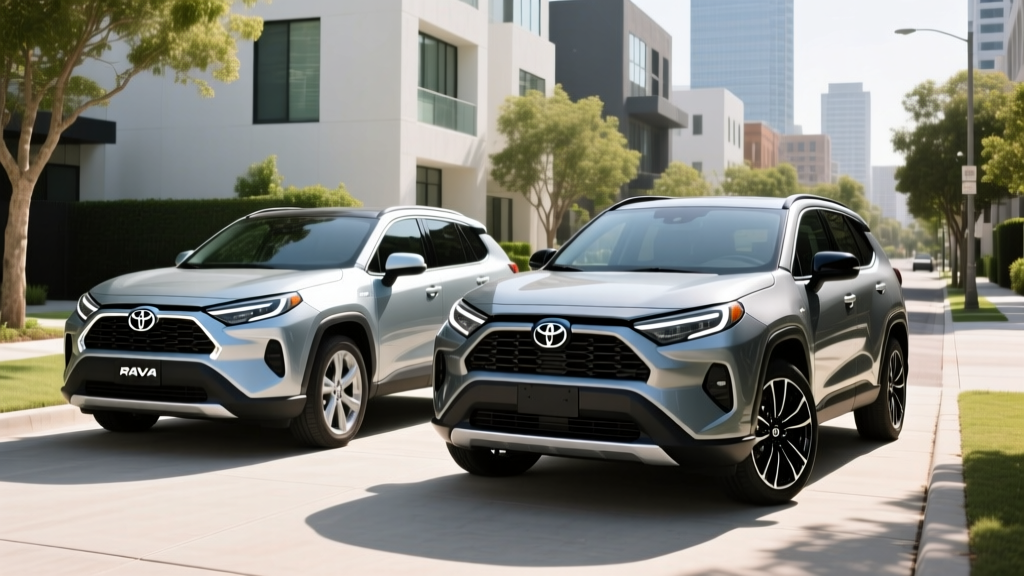
Does the Toyota RAV4 Hybrid Qualify for a Federal Tax Credit?
Here is the short answer that saves you a lot of reading: the conventional Toyota RAV4 Hybrid (HEV) does not qualify for the federal §30D clean vehicle tax credit. Only plug-in hybrids and battery-electric vehicles are eligible, and the standard RAV4 Hybrid is a self-charging hybrid that never plugs in.
However, the RAV4 Prime — Toyota's plug-in hybrid (PHEV) variant — has historically qualified for a partial or full federal credit depending on battery sourcing and buyer income. With the RAV4 being the best-selling non-truck in America, the question of whether you can shave thousands off the purchase price is one of the most searched topics in the hybrid space.
This guide breaks down the 2026 RAV4 Hybrid lineup, the RAV4 Prime PHEV, exact EPA fuel economy figures, real-world MPG expectations, battery warranties, and the current IRS tax credit rules that determine whether you actually pocket any money at the point of sale.
HEV vs PHEV: Understanding the Two RAV4 Hybrid Flavors
Toyota sells two distinct hybrid versions of the RAV4, and confusing them is the single most common mistake buyers make when researching incentives.
| Feature | RAV4 Hybrid (HEV) | RAV4 Prime (PHEV) |
|---|---|---|
| Powertrain Type | Conventional Hybrid | Plug-in Hybrid |
| Plugs In? | No — self-charging via regen & engine | Yes — Level 1 & Level 2 AC |
| Battery Capacity | ~1.6 kWh (small buffer) | 18.1 kWh usable (lithium-ion) |
| Electric-Only Range | ~1 mile at low speed | EPA 42 miles |
| Combined Horsepower | 219 hp | 302 hp |
| 0-60 mph | 7.4 seconds | 5.7 seconds |
| Federal Tax Credit | Not eligible | Potentially up to $7,500* |
| Drivetrain | AWD (standard) | AWD (standard) |
The HEV generates all its electricity onboard through regenerative braking and the gasoline engine. You never plug it in, and it operates like a traditional car at the gas pump. The Prime, by contrast, has a much larger battery that you charge at home or at a public Level 2 station, giving you genuine electric-only commuting range before the gas engine ever starts.
Fuel Economy: EPA MPG and Real-World Expectations
Both RAV4 hybrid variants deliver excellent efficiency, but the way they achieve it differs significantly.
| Model | City MPG | Highway MPG | Combined MPG | MPGe (EV Mode) |
|---|---|---|---|---|
| 2026 RAV4 Hybrid AWD | 41 | 38 | 40 | N/A |
| 2026 RAV4 Prime AWD (charge-sustaining) | 40 | 36 | 38 | 94 MPGe |
Source: EPA Fuel Economy
Real-World MPG: What Owners Actually See
Hybrids have a well-documented trait: they often exceed their EPA city rating in real-world stop-and-go driving because regenerative braking recovers energy that a gas car wastes as heat. Many RAV4 Hybrid owners report 42-44 MPG in city commuting. On the highway, however, expect numbers closer to 35-37 MPG at sustained 75 mph speeds, where the electric motor provides less benefit and aerodynamic drag dominates.
For the RAV4 Prime, the picture changes dramatically based on your charging habits. If you charge nightly and commute under 42 miles, you may use almost zero gasoline for months. Once the battery depletes, the Prime operates as a conventional hybrid at roughly 38 MPG combined — still excellent, but slightly less than the lighter HEV model due to the Prime's 350+ lb weight penalty from the larger battery.
RAV4 Prime PHEV: Electric-Only Range and Charging
The RAV4 Prime's 18.1 kWh battery delivers an EPA-rated 42 miles of electric-only range, which covers the average American's one-way commute with room to spare. In mild weather at city speeds, some drivers squeeze out 45-48 miles. In cold weather (below 35°F) or at highway speeds, expect that range to drop to 32-36 miles as the battery loses efficiency and cabin heating draws additional power.
Charging the RAV4 Prime
The RAV4 Prime uses a standard J1772 connector for AC charging. It does not support DC fast charging — a limitation common to most PHEVs due to their smaller battery packs and onboard charger constraints.
| Charging Method | Power | 0-100% Time | Notes |
|---|---|---|---|
| Level 1 (120V household) | ~1.4 kW | ~12 hours | Trickle charge; adequate for overnight if driven lightly |
| Level 2 (240V, 16A) | 3.3 kW | ~5.5 hours | Standard onboard charger (SE trim) |
| Level 2 (240V, 32A) | 6.6 kW | ~2.5 hours | Available on XSE trim with optional 6.6 kW charger |
Pro tip: If home charging is your plan, the 6.6 kW onboard charger option on the XSE trim is worth the upgrade. A standard 240V Level 2 home charger (like a ChargePoint Home Flex or Emporia Level 2) will fully replenish the Prime in about 2.5 hours, meaning you can top up during the day if you have solar or cheap midday electricity rates.
Powertrain and Performance Specs
| Specification | RAV4 Hybrid | RAV4 Prime |
|---|---|---|
| Engine | 2.5L 4-cyl Atkinson cycle | 2.5L 4-cyl Atkinson cycle |
| Front Motor | 88 kW (118 hp) | 134 kW (180 hp) |
| Rear Motor | 40 kW (54 hp) | 40 kW (54 hp) |
| Combined System HP | 219 hp | 302 hp |
| 0-60 mph | 7.4 sec | 5.7 sec |
| Transmission | eCVT | eCVT |
| Towing Capacity | 1,750 lbs | 2,500 lbs |
The RAV4 Prime's 302 combined horsepower makes it the quickest RAV4 Toyota sells — quicker, in fact, than many V6 midsize SUVs. The electric motors provide instant torque from a standstill, making the Prime genuinely fun to drive in a way that surprises first-time PHEV buyers. The standard RAV4 Hybrid's 219 hp is adequate for daily driving and highway merging, though it lacks the punch of the Prime.
Pricing and Tax Credit Eligibility
2026 RAV4 Hybrid Pricing
The 2026 RAV4 Hybrid starts around $33,500 MSRP (LE trim) and climbs to approximately $41,000 for the fully loaded Limited trim. These prices include destination charges but exclude dealer markups, which remain a frustration in high-demand markets.
2026 RAV4 Prime Pricing
The RAV4 Prime carries a significant premium, starting at approximately $44,500 MSRP (SE trim) and reaching $50,000+ for the XSE Premium trim. Availability remains tight — the Prime has been supply-constrained since its launch, and dealer markups of $3,000-$8,000 above MSRP are still common in many markets.
The Federal Tax Credit: Current §30D Rules
Key point: The conventional RAV4 Hybrid (HEV) does not qualify for any federal tax credit. It is not a plug-in vehicle, and §30D applies exclusively to BEVs and PHEVs with a minimum battery capacity of 7 kWh.
For the RAV4 Prime, federal tax credit eligibility under IRS §30D depends on several conditions that change periodically:
- MSRP cap: The vehicle must have an MSRP at or below $80,000 for SUVs. All RAV4 Prime trims clear this threshold.
- Buyer income cap: Modified adjusted gross income must not exceed $150,000 (single), $225,000 (head of household), or $300,000 (joint filers).
- Battery sourcing requirements: The credit is split into two halves — $3,750 for critical minerals sourcing and $3,750 for battery component manufacturing. Vehicles that meet only one requirement receive a partial $3,750 credit. Sourcing rules tighten annually, and Toyota's supply chain composition determines how much of the credit the Prime qualifies for in any given model year.
- Point-of-sale transfer: As of 2024, buyers can transfer the credit to the dealer at the point of sale, reducing the purchase price directly rather than waiting for a tax refund.
Important: Always verify current eligibility on the fueleconomy.gov tax credit lookup before purchasing, as battery sourcing compliance can change between model years and even production batches.
State and Local Incentives
Several states offer additional rebates or HOV lane access for PHEVs. California's CVRP program, Colorado's state tax credit, and various utility company rebates may stack on top of the federal credit. Check your state energy office and local utility for current programs — these vary by jurisdiction and are subject to funding availability.
Battery Warranty, Reliability, and Replacement Cost
| Coverage | RAV4 Hybrid | RAV4 Prime |
|---|---|---|
| Hybrid Battery Warranty | 10 years / 150,000 miles | 10 years / 150,000 miles |
| Hybrid System Components | 8 years / 100,000 miles | 8 years / 100,000 miles |
| Basic Warranty | 3 years / 36,000 miles | 3 years / 36,000 miles |
| Powertrain Warranty | 5 years / 60,000 miles | 5 years / 60,000 miles |
How Long Do Toyota Hybrid Batteries Actually Last?
Toyota's hybrid battery track record is among the best in the industry. The Prius, which has used a similar hybrid synergy drive system since 2001, routinely sees original batteries lasting 200,000-300,000 miles. The RAV4 Hybrid's nickel-metal hydride (HEV) and lithium-ion (Prime) packs are engineered with conservative charge buffers — Toyota never lets the battery fully charge or fully discharge, which dramatically extends cycle life.
Real-world data from fleet operators and long-term owners suggests that fewer than 5% of Toyota hybrid batteries require replacement within the warranty period. When they do fail, it is typically a single degraded cell module rather than the entire pack.
Battery Replacement Cost
If you do need a replacement out of warranty:
- RAV4 Hybrid (HEV): Approximately $3,000-$4,500 for a new OEM hybrid battery pack, plus labor. Refurbished packs are available for $1,500-$2,500.
- RAV4 Prime (PHEV): Approximately $6,000-$9,000 for the larger lithium-ion traction battery. This is a more significant expense due to the larger capacity and more complex chemistry.
Given the 10-year/150,000-mile warranty and Toyota's reliability history, battery replacement should not be a primary concern for first or even second owners.
Who Should Buy the RAV4 Hybrid vs. the Prime vs. a Full EV?
Choose the RAV4 Hybrid (HEV) If:
- You cannot charge at home or work (apartment, street parking)
- You want maximum simplicity — no plugs, no charging apps
- Your budget is under $38,000
- You drive mostly city miles where the 41 MPG city rating shines
- You want proven reliability with minimal new technology risk
Choose the RAV4 Prime (PHEV) If:
- You can install a Level 2 charger at home
- Your daily commute is under 40 miles round-trip
- You want EV-like daily driving with gas-car road-trip flexibility
- You qualify for the federal tax credit (income + sourcing rules)
- You value the 302 hp performance and 2,500-lb towing capacity
When a Full EV Makes More Sense
If you have reliable home charging, drive under 250 miles daily, and want zero gasoline expenses, a battery-electric SUV like the Hyundai Ioniq 5, Tesla Model Y, or Ford Mustang Mach-E will deliver lower operating costs and a full $7,500 federal credit (if eligible). The tradeoff is that road trips require DC fast-charging planning, and cold-weather range loss of 20-30% is a real consideration for northern-climate drivers. The RAV4 Prime eliminates range anxiety entirely — when the battery depletes, it simply becomes a 38 MPG hybrid.
Frequently Asked Questions
Does the standard RAV4 Hybrid get a tax credit?
No. The conventional RAV4 Hybrid (HEV) does not qualify for the federal §30D clean vehicle credit because it is not a plug-in vehicle. Only battery-electric vehicles and plug-in hybrids with at least 7 kWh of battery capacity are eligible. Some states may offer small rebates for conventional hybrids, but these are increasingly rare as incentive programs shift toward PHEVs and BEVs.
How much is the RAV4 Prime tax credit worth in 2026?
The RAV4 Prime may qualify for up to $7,500 under §30D, but the actual amount depends on current battery sourcing compliance (split into $3,750 for critical minerals and $3,750 for battery components), your income level, and the vehicle's MSRP. Check fueleconomy.gov for the specific model year and trim before purchasing, as these requirements tighten annually.
Can I charge the RAV4 Hybrid at home?
No — the standard RAV4 Hybrid (HEV) does not plug in. It charges its small 1.6 kWh battery through regenerative braking and the gasoline engine. Only the RAV4 Prime (PHEV) has a charging port and can be plugged into a Level 1 or Level 2 AC charger.
How many miles per gallon does the RAV4 Hybrid really get?
The EPA rates the 2026 RAV4 Hybrid AWD at 41 city / 38 highway / 40 combined MPG. In real-world driving, city commuters often see 42-44 MPG thanks to frequent regenerative braking. Highway-heavy drivers at 75+ mph typically see 35-37 MPG. Cold weather reduces efficiency by roughly 5-10% due to increased engine operation for cabin heating.
How far can the RAV4 Prime drive on electric power alone?
The EPA rates the RAV4 Prime at 42 miles of electric-only range. In mild city driving, expect 45-48 miles. In cold weather or at highway speeds, expect 32-36 miles. Once the battery is depleted, the Prime operates as a conventional hybrid at 38 MPG combined — so you are never stranded.
Is the RAV4 Hybrid reliable?
Toyota's hybrid powertrain is one of the most proven in the automotive industry. The hybrid battery carries a 10-year/150,000-mile warranty, and real-world data shows most Toyota hybrid batteries last well beyond 200,000 miles. The RAV4 consistently earns top reliability scores from Consumer Reports and JD Power. The eCVT transmission has no traditional gears or belts to wear out, contributing to long-term durability.
What does it cost to replace a RAV4 hybrid battery?
Out-of-warranty replacement runs approximately $3,000-$4,500 for the RAV4 Hybrid (HEV) and $6,000-$9,000 for the RAV4 Prime (PHEV). However, fewer than 5% of Toyota hybrid batteries require replacement within the warranty period, and the 10-year/150,000-mile coverage means most owners will never face this cost.