Quick Verdict: The RAV4 Hybrid SE at a Glance
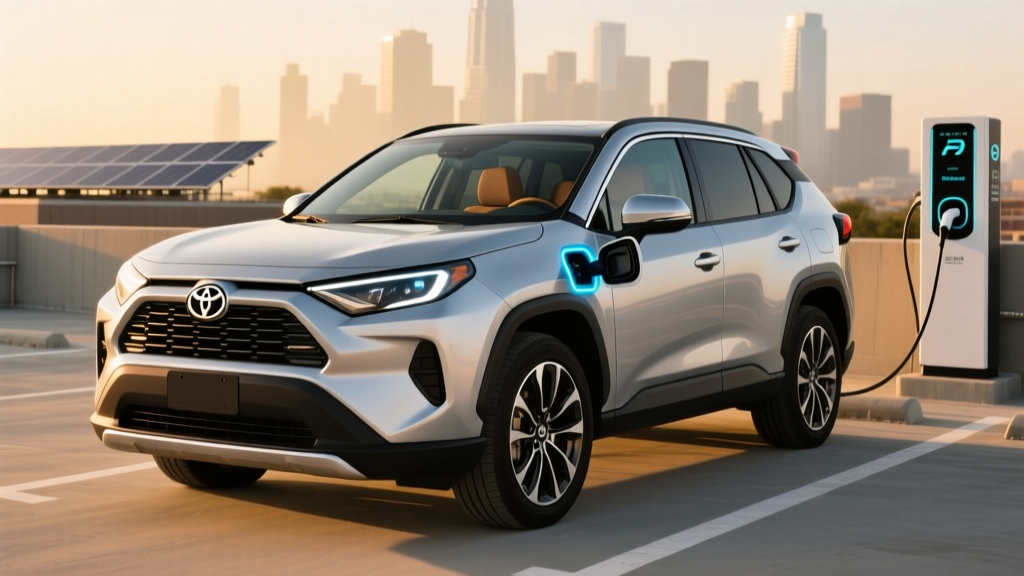
The 2026 Toyota RAV4 Hybrid SE occupies a specific niche: buyers who want the sport-tuned suspension and aggressive styling of the SE trim paired with a proven hybrid powertrain that returns nearly 40 MPG combined. Unlike the RAV4 Prime (the plug-in hybrid variant), the SE is a conventional hybrid — no plug, no electric-only range, but also no charging logistics. It simply sips fuel while you drive normally.
For 2026, Toyota continues the fifth-generation RAV4 Hybrid lineup with the 2.5-liter four-cylinder hybrid system producing 219 combined horsepower and standard electronic all-wheel drive. The SE trim adds a firmer suspension tune, 18-inch black alloy wheels, and sportier exterior accents over the XLE and XSE trims.
| Specification | 2026 RAV4 Hybrid SE |
|---|---|
| Powertrain | 2.5L 4-cyl + 3 electric motors (AWD) |
| Combined Horsepower | 219 hp |
| 0-60 mph | 7.4 seconds |
| EPA MPG (City / Hwy / Combined) | 41 / 38 / 39 |
| Fuel Tank Capacity | 14.5 gallons |
| Total Driving Range | ~565 miles |
| Drivetrain | Electronic AWD (eAWD) |
| Cargo Volume (behind 2nd row) | 37.5 cu ft |
| Towing Capacity | 1,750 lbs |
| Base MSRP | $38,445 (incl. $1,495 destination) |
| Battery Warranty | 10 years / 150,000 miles |
How Many MPG Does the RAV4 Hybrid SE Get?
The EPA rates the 2026 RAV4 Hybrid SE at 41 MPG city, 38 MPG highway, and 39 MPG combined. These figures are consistent across the RAV4 Hybrid AWD lineup (LE, XLE, XSE, SE, Woodland Edition, and Limited), as all share the same powertrain hardware.
| Driving Scenario | EPA Estimate | Real-World Expectation |
|---|---|---|
| City | 41 MPG | 42-45 MPG (hybrids excel in stop-and-go) |
| Highway | 38 MPG | 35-37 MPG (aero drag and sustained speeds) |
| Combined | 39 MPG | 38-41 MPG (mixed driving) |
| Cold Weather (below 35°F) | — | 33-36 MPG (engine runs more for cabin heat) |
Toyota's hybrid system is one of the few powertrains where real-world city driving often exceeds the EPA sticker. The electric motors handle low-speed acceleration, the engine shuts off at stops, and regenerative braking recaptures energy in traffic. On a 200-mile urban loop with moderate traffic, 43-44 MPG is achievable without hypermiling.
Highway efficiency is the hybrid's relative weakness. Above 70 mph, the gasoline engine does most of the work, and the RAV4's boxy crossover aerodynamics limit gains. Expect 35-37 MPG at sustained 75 mph highway speeds. In cold weather, the engine runs more frequently to provide cabin heat (the RAV4 Hybrid lacks a heat pump, which is found only in the RAV4 Prime PHEV), dropping combined figures into the low-to-mid 30s.
According to fueleconomy.gov, the RAV4 Hybrid AWD's 39 MPG combined saves an estimated $2,250 in fuel costs over five years compared to the average new vehicle, assuming 15,000 miles per year and $3.50/gallon regular unleaded.
HEV vs PHEV: RAV4 Hybrid SE vs RAV4 Prime
This is the most common cross-shopping question, so let's be precise about the difference. The RAV4 Hybrid SE is a conventional hybrid (HEV). It has a small 1.6 kWh nickel-metal hydride (NiMH) traction battery that charges itself through regenerative braking and the gasoline engine. You never plug it in. It cannot drive on electric power alone beyond very low-speed, short-distance creep.
The RAV4 Prime is a plug-in hybrid (PHEV). It carries an 18.1 kWh lithium-ion battery, can travel up to 42 miles on electricity alone, and produces a combined 302 hp. It qualifies for federal tax credits. But it starts at over $46,000 and weighs roughly 350 lbs more.
| Attribute | RAV4 Hybrid SE (HEV) | RAV4 Prime SE (PHEV) |
|---|---|---|
| Plug-In Required? | No | Yes (Level 1 or Level 2) |
| Electric-Only Range | None (motor assist only) | 42 miles (EPA) |
| Battery Capacity | 1.6 kWh (NiMH) | 18.1 kWh (Li-ion) |
| Combined Horsepower | 219 hp | 302 hp |
| 0-60 mph | 7.4 sec | 5.7 sec |
| EPA Combined MPG / MPGe | 39 MPG | 94 MPGe / 38 MPG (gas-only) |
| Total Range | ~565 miles | ~600 miles (elec + gas) |
| DC Fast Charging | N/A | No (Level 2 max, ~2.5 hrs) |
| Federal Tax Credit (§30D) | Not eligible | Up to $7,500 (eligibility varies) |
| Starting MSRP | $38,445 | $46,065 |
| Best For | No home charging, simplicity | Home charging, short commutes |
The decision comes down to three factors: budget, charging access, and commute length. If you can charge at home and your daily round-trip is under 40 miles, the Prime effectively becomes an EV for daily use with a gas engine for road trips — and the $7,500 credit (if you qualify) narrows the price gap significantly. If you park on the street, lack a garage, or simply want zero behavior change, the Hybrid SE is the pragmatic choice.
Powertrain and Driving Dynamics
The RAV4 Hybrid uses Toyota's fourth-generation hybrid system. A 2.5-liter Atkinson-cycle four-cylinder engine (176 hp, 163 lb-ft) pairs with a front electric motor (118 hp) and a rear electric motor (54 hp) that provides electronic all-wheel drive. Combined system output is 219 hp. Power flows through an electronically controlled continuously variable transmission (eCVT).
The SE trim specifically adds a sport-tuned suspension with stiffer dampers and revised spring rates compared to the XLE. It's not a performance SUV, but the SE corners flatter and absorbs sharp impacts with slightly more firmness. The 18-inch wheels with 225/60R18 all-season tires provide reasonable grip without harsh ride quality.
Acceleration to 60 mph in 7.4 seconds places the Hybrid SE in the middle of the compact crossover segment — quicker than the Honda CR-V Hybrid (8.0 sec) but well behind the RAV4 Prime (5.7 sec). The eCVT delivers smooth, linear power delivery without the rubber-band sensation of older CVTs, and the transition between electric and gas power is nearly imperceptible during normal driving.
The electronic AWD system engages the rear motor automatically during acceleration, slippery conditions, or when the front wheels lose traction. It's not a serious off-road system — ground clearance is 8.1 inches and there's no low range — but it handles snow, rain, and gravel roads with confidence. The rear motor disengages during steady-state cruising to minimize drag and preserve fuel economy.
Pricing, Trims, and Tax Credit Eligibility
The 2026 RAV4 Hybrid SE starts at $38,445 including destination charge. Key standard equipment includes Toyota Safety Sense 3.0 (pre-collision, lane departure, adaptive cruise, lane tracing), an 8-inch touchscreen with wireless Apple CarPlay and Android Auto, a power-adjustable driver's seat, dual-zone climate control, and the sport-tuned suspension.
Options that push the price higher include the Technology Package (panoramic view monitor, front and rear parking assist with automatic braking) at roughly $1,100, and premium paint colors at $425. A well-equipped SE lands in the $40,000-$41,500 range.
Federal tax credit status: The conventional RAV4 Hybrid (HEV) does not qualify for the IRS §30D Clean Vehicle Credit. That credit applies only to plug-in electric vehicles (BEVs and PHEVs) with sufficient battery capacity and meeting sourcing, MSRP, and buyer income requirements. The RAV4 Prime (PHEV) may qualify for up to $7,500, but eligibility depends on battery component and critical mineral sourcing rules that change annually. Check the latest requirements at IRS.gov and confirm with a tax professional before purchasing.
Some states offer their own hybrid or efficient-vehicle rebates, though these are increasingly targeted toward BEVs and PHEVs. Check your state energy office or DMV for current programs.
Battery Warranty, Reliability, and Replacement Costs
Hybrid battery longevity is the top concern for buyers considering a RAV4 Hybrid, and Toyota's track record here is among the best in the industry. The 2026 RAV4 Hybrid's NiMH traction battery is covered by a 10-year / 150,000-mile warranty (whichever comes first), which applies to the original owner and is transferable to subsequent owners for the same duration.
RAV4 Hybrid Battery Coverage
- Hybrid battery warranty: 10 years / 150,000 miles
- Hybrid system components: 8 years / 100,000 miles (inverter, control module, motors)
- Capacity retention guarantee: Toyota warrants the battery against defects and abnormal degradation; no specific % threshold published for HEVs (unlike BEVs which often cite 70%)
- Replacement cost (out of warranty): $3,000-$5,000 for a new OEM NiMH pack; refurbished units available for $1,500-$2,500
- Expected lifespan: 150,000-200,000+ miles based on historical Prius and RAV4 Hybrid data
The NiMH chemistry used in the RAV4 Hybrid is less energy-dense than the lithium-ion packs in BEVs and PHEVs, but it has a well-documented history of durability. Toyota's hybrid taxis and Priuses routinely exceed 200,000 miles on the original battery. The RAV4 Hybrid has been on sale since the 2016 model year, and widespread battery failures remain rare.
If a replacement is needed outside warranty, independent hybrid shops can often replace individual battery modules (the NiMH pack contains multiple modules) rather than the entire pack, reducing cost to $1,000-$2,000. Toyota dealerships typically replace the full pack at $3,500-$5,000 including labor.
The 12-volt auxiliary battery (a standard AGM unit, not part of the hybrid system) will need replacement every 4-6 years at roughly $200-$300 — same as any conventional vehicle.
For broader reliability, the RAV4 Hybrid earns strong marks from Consumer Reports and carries an IIHS Top Safety Pick rating when equipped with the appropriate headlights. Toyota Safety Sense 3.0 includes forward collision warning with pedestrian detection, lane departure alert with steering assist, automatic high beams, and full-speed-range adaptive cruise control.
Who Should Choose the RAV4 Hybrid SE?
Choose the RAV4 Hybrid SE If:
- You lack access to home or workplace charging (apartment, street parking)
- You want 39 MPG combined with zero behavior change — no plugging in, no range planning
- You live in a region with harsh winters where EV range loss is a concern
- Your budget is $38,000-$42,000 and you want AWD, strong safety ratings, and high resale value
- You tow occasionally (1,750 lb capacity — light trailers, bikes, kayaks)
- You prefer Toyota's proven hybrid reliability and 10-year battery warranty
Consider an Alternative If:
- You have home charging and a short commute — the RAV4 Prime PHEV or a full BEV saves more on fuel
- You want eligibility for the $7,500 federal tax credit (HEVs don't qualify under §30D)
- You need more than 37.5 cu ft of cargo space (consider the Honda CR-V Hybrid at 39.3 cu ft)
- You want a plug-in hybrid at a lower price — the Hyundai Tucson PHEV starts around $40,000 with 33 miles of electric range
- You prioritize acceleration — the 7.4-sec 0-60 is adequate but not quick
Hybrid vs PHEV vs EV: Which RAV4 Fits You?
Choose the RAV4 Hybrid (HEV) if you cannot charge at home, want maximum simplicity, and drive a mix of city and highway. Total cost of ownership is low thanks to 39 MPG, minimal maintenance (no oil changes are more frequent than a gas car — Toyota recommends 10,000-mile intervals), and strong resale value. The trade-off: no electric-only driving and no federal tax credit.
Choose the RAV4 Prime (PHEV) if you have a garage or driveway with a 120V or 240V outlet, your daily commute is under 42 miles, and you qualify for the §30D credit. The Prime covers most daily driving on electricity (at roughly 3-4 miles per kWh, costing $0.04-$0.06 per mile on average residential electricity), then operates as a 38 MPG hybrid on longer trips. The $7,500 credit can bring the effective price close to the Hybrid Limited.
Choose a full EV (like the Toyota bZ4X, Hyundai Ioniq 5, or Tesla Model Y) if you have reliable home Level 2 charging, your daily driving is under 250 miles, and you want the lowest per-mile fuel cost, zero tailpipe emissions, and eligibility for the full $7,500 federal credit (model-dependent). The trade-off is higher upfront cost, longer refueling times on road trips, and cold-weather range reduction of 20-30%.
Frequently Asked Questions
Does the RAV4 Hybrid SE need to be plugged in?
No. The RAV4 Hybrid SE is a conventional hybrid (HEV). Its 1.6 kWh battery charges entirely through regenerative braking and the gasoline engine. There is no plug, no charging cable, and no electric-only driving mode. You fuel it like a regular gas car.
How far can the RAV4 Hybrid SE drive on a full tank?
With a 14.5-gallon fuel tank and 39 MPG combined, expect approximately 565 miles of total range. In predominantly city driving at 41+ MPG, some drivers report exceeding 590 miles between fill-ups.
Is the RAV4 Hybrid SE good in snow?
Yes, for a crossover. The electronic AWD system engages the rear motor automatically when front-wheel slip is detected, and the 8.1 inches of ground clearance handles moderate snow depth. It's not a dedicated off-roader, but it outperforms front-wheel-drive competitors in winter conditions. Pair with all-weather floor mats and winter tires for best results in heavy snow regions.
What is the RAV4 Hybrid battery replacement cost?
A new OEM NiMH hybrid battery pack costs $3,500-$5,000 installed at a Toyota dealer. Refurbished packs or individual module replacements at independent hybrid shops run $1,500-$2,500. However, battery failures before 150,000 miles are uncommon, and the 10-year/150,000-mile warranty provides substantial coverage.
Does the RAV4 Hybrid qualify for any tax credits in 2026?
The conventional RAV4 Hybrid (HEV) does not qualify for the federal §30D Clean Vehicle Credit, which is limited to plug-in vehicles. The RAV4 Prime (PHEV) may qualify for up to $7,500 depending on battery sourcing, buyer income, and MSRP caps. Some states offer separate rebates for hybrids — check your state's energy office. Consult a tax professional for personalized guidance.
How does the SE trim differ from the XSE?
Both the SE and XSE feature sport-tuned suspensions and sportier styling. The XSE adds SofTex-trimmed seats, a 10.5-inch touchscreen upgrade, ambient interior lighting, and chrome/silver exterior accents versus the SE's blacked-out aesthetic. The XSE starts approximately $2,000 higher. Powertrain and MPG are identical.
Is the RAV4 Hybrid more reliable than the gas-only RAV4?
Historically, yes. Toyota's hybrid system eliminates the traditional starter motor, alternator, and accessory belt — components that commonly fail on gas-only vehicles. The eCVT has no clutch packs or bands to wear. Regenerative braking also reduces brake pad wear, with many owners reporting 60,000-80,000 miles on original brake pads. Consumer Reports consistently rates the RAV4 Hybrid above average for predicted reliability.