RAV4 Hybrid Mileage: What the EPA Says vs. What You'll Actually Get
If you've searched for "RAV4 Hybrid mileage" you're likely weighing whether Toyota's best-selling hybrid SUV delivers on its fuel-economy promises. The short answer: it does — and in city driving, it often beats its own EPA sticker. But the full picture depends on which powertrain you choose: the conventional hybrid (HEV) that never needs a plug, or the plug-in RAV4 Prime (PHEV) that adds serious electric-only range.
For the 2026 model year, Toyota continues the RAV4 Hybrid with the proven 2.5-liter four-cylinder hybrid system across LE, XLE, XLE Premium, SE, Woodland Edition, and Limited trims. The RAV4 Prime returns as the plug-in variant with substantially more electric range and combined horsepower. Below, we give you exact numbers — not marketing fluff — so you can decide which version fits your driving pattern and budget.
| Model | City MPG | Highway MPG | Combined MPG | MPGe (PHEV EV Mode) |
|---|---|---|---|---|
| RAV4 Hybrid (LE FWD) | 41 | 38 | 40 | N/A |
| RAV4 Hybrid (AWD trims) | 41 | 38 | 39–40 | N/A |
| RAV4 Prime (PHEV) | 40 (hybrid mode) | 36 (hybrid mode) | 38 | 94 MPGe |
Source: EPA / fueleconomy.gov
HEV vs. PHEV: Understanding the Two RAV4 Hybrids
Toyota sells two distinct electrified RAV4 models, and confusing them is one of the most common buyer mistakes. Here's the critical distinction:
| Attribute | RAV4 Hybrid (HEV) | RAV4 Prime (PHEV) |
|---|---|---|
| Needs to plug in? | No — self-charging via engine + regen | Yes — plug in for EV-only driving |
| Battery capacity | ~1.6 kWh (small buffer) | 18.1 kWh usable |
| Electric-only range | ~0.5–1 mile at low speed | 42 miles (EPA) |
| Total range (full tank + charge) | ~580 miles | ~600 miles |
| Combined horsepower | 219 hp | 302 hp |
| 0–60 mph | 7.5 seconds | 5.7 seconds |
| DC fast charging | N/A | No — Level 2 AC only |
| Level 2 charge time (0–100%) | N/A | ~2.5 hours (240V, 32A) |
| Federal tax credit (§30D) | Not eligible | Up to $7,500 (see rules below) |
| Starting MSRP (2026) | ~$33,500 | ~$44,500 |
The conventional RAV4 Hybrid is a "charge-it-with-gas" system. A small battery captures energy from regenerative braking and the engine, enabling brief electric-only assists at low speeds. You never plug it in, and there's no lifestyle change required — it simply sips less fuel.
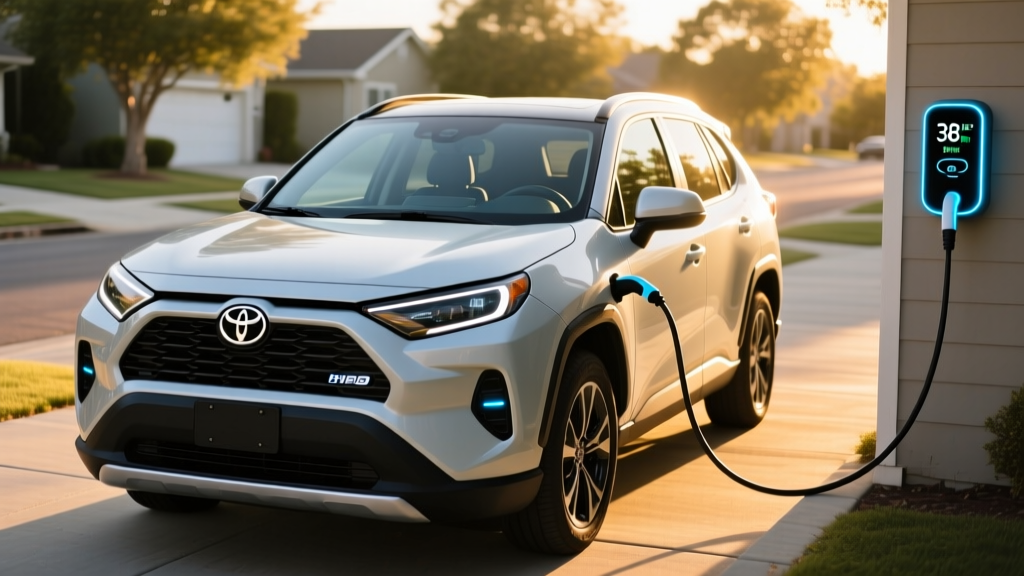
The RAV4 Prime is a full plug-in hybrid. With 18.1 kWh of usable battery capacity, it delivers 42 miles of EPA-rated electric-only range — enough to cover most daily commutes without burning a drop of gas. Once the battery depletes, it seamlessly switches to hybrid mode and still delivers a strong 38 MPG combined. The trade-off is a higher purchase price and the need for home charging access to realize the electric-range benefit.
Powertrain Deep Dive: How Toyota's Hybrid System Delivers These Numbers
Both RAV4 electrified models use Toyota's fourth-generation hybrid synergy drive, but the execution differs significantly.
| Specification | RAV4 Hybrid (HEV) | RAV4 Prime (PHEV) |
|---|---|---|
| Engine | 2.5L inline-4 (176 hp) | 2.5L inline-4 (177 hp) |
| Front electric motor | 118 hp | 180 hp |
| Rear electric motor (AWD) | 54 hp | 54 hp |
| Net combined output | 219 hp | 302 hp |
| Transmission | eCVT (planetary gearset) | eCVT (planetary gearset) |
| Drivetrain | FWD or AWD (e-AWD) | AWD standard |
| Fuel tank | 14.5 gallons | 14.5 gallons |
| Towing capacity | 1,750 lbs | 2,500 lbs |
The reason the RAV4 Hybrid excels in city driving is its eCVT — not a traditional belt-driven CVT but a planetary gearset that blends engine and motor power seamlessly. At low speeds and in stop-and-go traffic, the electric motor handles most propulsion, while the engine either shuts off or acts as a generator. This is why you'll see owners consistently report higher-than-EPA city MPG: the system is optimized for exactly this kind of driving.
The Prime's larger front motor (180 hp vs. 118 hp) and substantially bigger battery enable both its 42-mile EV range and its 5.7-second 0–60 time — making it one of the quickest compact SUVs in its class, electrified or not.
RAV4 Prime Electric Range: 42 Miles Explained
For PHEV shoppers, electric-only range is the headline number. The 2026 RAV4 Prime's EPA rating of 42 miles on a full charge is competitive with rivals like the Hyundai Tucson PHEV (33 miles) and Kia Sportage PHEV (34 miles), giving the Toyota a clear advantage for commute-heavy drivers.
That 42-mile figure assumes moderate temperatures and mixed driving. Here's what to expect in practice:
- Ideal conditions (spring/fall, 50–70°F, suburban roads): 40–45 miles achievable
- Highway cruising at 70+ mph: 32–36 miles before engine engagement
- Cold weather (below 30°F): 28–34 miles, as battery efficiency drops and cabin heating demands engine use
- Hot weather with A/C: 36–40 miles
Charging the Prime's 18.1 kWh battery takes approximately 2.5 hours on a 240-volt Level 2 home charger rated at 32 amps. Toyota does not offer DC fast charging on the RAV4 Prime — a notable limitation if you were hoping for quick top-ups on road trips. However, for the intended use case (overnight home charging before a commute), Level 2 is entirely sufficient and gentler on long-term battery health.
Battery Longevity, Warranty & Replacement Costs
Battery reliability is the top concern for hybrid buyers, and it's where Toyota's track record stands out. The RAV4 Hybrid and Prime both use nickel-metal hydride (HEV) and lithium-ion (PHEV) batteries respectively, managed by Toyota's proven thermal-control systems.
- Hybrid battery warranty: 10 years / 150,000 miles (whichever comes first), transferable to subsequent owners
- Hybrid system components: 8 years / 100,000 miles
- Basic new-vehicle warranty: 3 years / 36,000 miles
- Powertrain warranty: 5 years / 60,000 miles
The warranty guarantees the hybrid battery will retain sufficient capacity to function properly. Toyota's hybrid battery replacement cost for the RAV4 Hybrid (HEV) typically ranges from $3,000–$4,500 including labor at a dealership. The RAV4 Prime's larger lithium-ion pack is more expensive: approximately $6,000–$8,500. However, widespread failures before 150,000+ miles are rare based on two decades of Prius and RAV4 Hybrid field data.
Independent data from sources including Consumer Reports consistently rank Toyota's hybrid systems among the most reliable powertrains in any vehicle category. The eCVT has no belts, no clutches, and no traditional friction components to wear out — contributing to lower long-term maintenance costs compared to turbocharged gas-only alternatives.
Pricing, Trims & Tax Credit Eligibility
The 2026 RAV4 Hybrid lineup starts at approximately $33,500 (LE FWD, including destination) and climbs to around $42,000 for the Limited AWD. The RAV4 Prime begins at approximately $44,500 (SE trim) and reaches roughly $49,000 for the XSE Premium.
Here's where the tax-credit math matters — and where it gets complicated:
- Credit amount: Up to $7,500 for qualifying new PHEVs (HEV RAV4 Hybrid does NOT qualify)
- MSRP cap: Vehicle MSRP must not exceed $80,000 for SUVs (RAV4 Prime qualifies)
- Buyer income cap: AGI must not exceed $150,000 (single) / $300,000 (joint) — per IRS §30D guidelines
- Battery sourcing: Critical minerals and battery component requirements phase in annually — check current-year IRS guidance for the specific percentage thresholds applicable to your purchase date
- Point-of-sale transfer: Eligible buyers can transfer the credit to the dealer at purchase, reducing the out-of-pocket price immediately
Important: The conventional RAV4 Hybrid (HEV) does not qualify for the federal §30D new clean vehicle credit because it is not a plug-in vehicle with at least 7 kWh of battery capacity. Some states offer separate hybrid incentives — check your state's energy office for details.
With the full $7,500 credit applied at point of sale, the RAV4 Prime's effective starting price drops to approximately $37,000 — narrowing the gap with the HEV substantially and making the PHEV a compelling value proposition for qualifying buyers with home charging access.
Who Should Choose the RAV4 Hybrid vs. the Prime vs. a Full EV?
The right choice depends entirely on your driving pattern, charging access, and budget. Here's a practical decision framework:
- You don't have reliable access to home or workplace charging
- Your budget is under $38,000 and you want the lowest entry price
- You want maximum simplicity — no plug, no app, no charging routine
- You drive primarily in the city where the hybrid system shines (40+ MPG)
- You want Toyota's proven hybrid reliability with minimal complexity
- You can install a Level 2 home charger and your daily commute is under 40 miles
- You qualify for the $7,500 federal tax credit (income and sourcing requirements met)
- You want EV-daily driving with zero range anxiety for road trips
- You value the 302-hp performance advantage (5.7-second 0–60)
- You plan to keep the vehicle 8+ years and want the lowest cost per mile
- You have reliable Level 2 home charging and your trips rarely exceed 250 miles
- You want zero gasoline expenses and minimal drivetrain maintenance
- You're comfortable with public DC fast charging for road trips
- You want the lowest per-mile energy cost (electricity is typically $0.04–$0.06/mile vs. $0.12–$0.16/mile for the hybrid)
RAV4 Hybrid Ownership Costs: 5-Year Estimate
Fuel savings are only part of the equation. Here's a realistic 5-year / 75,000-mile cost comparison using national averages:
| Cost Category | RAV4 Hybrid HEV | RAV4 Prime PHEV | Gas-Only RAV4 (203 hp) |
|---|---|---|---|
| Purchase price (after credit) | ~$33,500 | ~$37,000 | ~$30,500 |
| Fuel / electricity (75k mi) | ~$5,400 | ~$2,800 | ~$8,100 |
| Maintenance (est.) | ~$2,200 | ~$2,000 | ~$2,800 |
| Insurance (est.) | ~$7,500 | ~$8,200 | ~$7,000 |
| 5-Year Total (excl. depreciation) | ~$48,600 | ~$50,000 | ~$48,400 |
Assumes $3.40/gal gas, $0.14/kWh electricity, 80% EV-mode driving for Prime, national-average insurance. Your actual costs will vary by region and driving habits. Source: EPA fuel economy data and fueleconomy.gov cost-to-drive tool.
The RAV4 Hybrid HEV and gas-only RAV4 end up remarkably close over five years, with the hybrid's fuel savings largely offsetting its higher purchase price. The Prime pulls ahead in fuel costs dramatically if you charge at home daily, but its higher purchase price and insurance narrow the gap. The Prime's advantage grows substantially if you keep the vehicle 8–10 years and benefit from the full $7,500 credit.
- 40 MPG combined with no plug-in requirement
- Proven reliability with 10yr/150k-mi battery warranty
- Strong resale value
- Lower entry price than Prime
- Excellent city fuel economy (often exceeds EPA)
- No federal tax credit eligibility
- Modest 219 hp — adequate but not quick
- Engine noise under hard acceleration
- AWD system is light-duty (not for off-roading)
- 42 miles EV range covers most commutes gas-free
- 302 hp — genuinely quick for a compact SUV
- Up to $7,500 federal tax credit for qualifying buyers
- Still gets 38 MPG in hybrid mode on road trips
- 2,500-lb towing capacity
- $11,000+ premium over the HEV before credits
- No DC fast charging capability
- Reduced cargo space (battery packaging)
- Limited dealer inventory — often marked up above MSRP
- Requires home charging to realize EV-range benefit
Frequently Asked Questions
How many MPG does the RAV4 Hybrid actually get in real driving?
The EPA rates the 2026 RAV4 Hybrid at 41 city / 38 highway / 40 combined MPG. In real-world use, most owners report 38–42 MPG combined. City-heavy commuters frequently see 42–45 MPG thanks to regenerative braking, while sustained highway driving at 75+ mph typically yields 34–37 MPG. Cold weather reduces these figures by roughly 8–12%.
How far can the RAV4 Prime go on electric power alone?
The EPA rates the RAV4 Prime at 42 miles of electric-only range on a full charge. Real-world results range from about 28 miles in cold weather to 45 miles in mild conditions with moderate speeds. Once the battery depletes, the Prime operates as a conventional hybrid and still achieves 38 MPG combined — so you're never stranded.
Does the RAV4 Hybrid qualify for any tax credit?
The conventional RAV4 Hybrid (HEV) does not qualify for the federal §30D clean vehicle credit because it is not a plug-in vehicle. The RAV4 Prime (PHEV) may qualify for up to $7,500 depending on your income, the vehicle's battery sourcing compliance, and current-year IRS rules. Always verify eligibility at irs.gov before purchasing. Some states offer additional incentives for both hybrids and PHEVs.
Is the RAV4 Hybrid reliable, and what does battery replacement cost?
Toyota's hybrid system is among the most reliable powertrains in the industry, backed by two decades of field data from the Prius and RAV4 Hybrid. The hybrid battery is warranted for 10 years / 150,000 miles. Out-of-warranty replacement costs approximately $3,000–$4,500 for the HEV and $6,000–$8,500 for the Prime's larger lithium-ion pack. Failures before 150,000 miles are uncommon based on fleet and owner data.
Do I need to plug in the RAV4 Hybrid?
No. The conventional RAV4 Hybrid (HEV) charges its small battery entirely through regenerative braking and the gasoline engine. You simply fill it with gas like any other car. Only the RAV4 Prime (PHEV) benefits from plug-in charging — and you'll need a 240V Level 2 home charger to make the most of its 42-mile electric range.
RAV4 Hybrid vs. a full EV like the Tesla Model Y — which is better?
It depends on your situation. The RAV4 Hybrid is better if you lack home charging, take frequent road trips over 300 miles, or want a lower purchase price with no charging infrastructure investment. A full EV like the Model Y is better if you have reliable Level 2 home charging, drive under 250 miles daily, and want the lowest per-mile energy cost with zero tailpipe emissions. The RAV4 Prime splits the difference: EV-like daily driving with gas-engine backup for long trips.