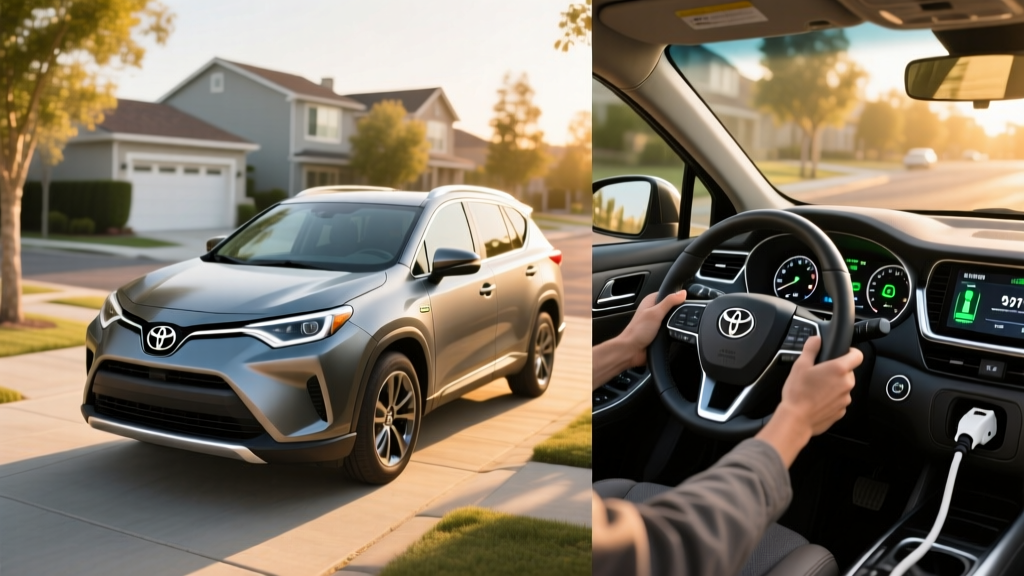
The Toyota RAV4 Hybrid has spent years atop the compact SUV sales charts, and for good reason: it delivers meaningful fuel savings over its gas-only sibling without requiring any change to your driving or fueling habits. But the EPA sticker is only part of the story. In this guide, we dissect the fuel economy of the RAV4 Hybrid — including real-world MPG data, how it compares to the plug-in RAV4 Prime (PHEV), battery longevity, tax-credit eligibility, and who should pick the hybrid over a full EV or conventional gas model.
Quick Primer: HEV vs PHEV
Conventional Hybrid (HEV): The standard RAV4 Hybrid uses a small battery (1.6 kWh) that recharges through regenerative braking and the gasoline engine. You never plug it in. It simply drives like a normal SUV but sips less fuel.
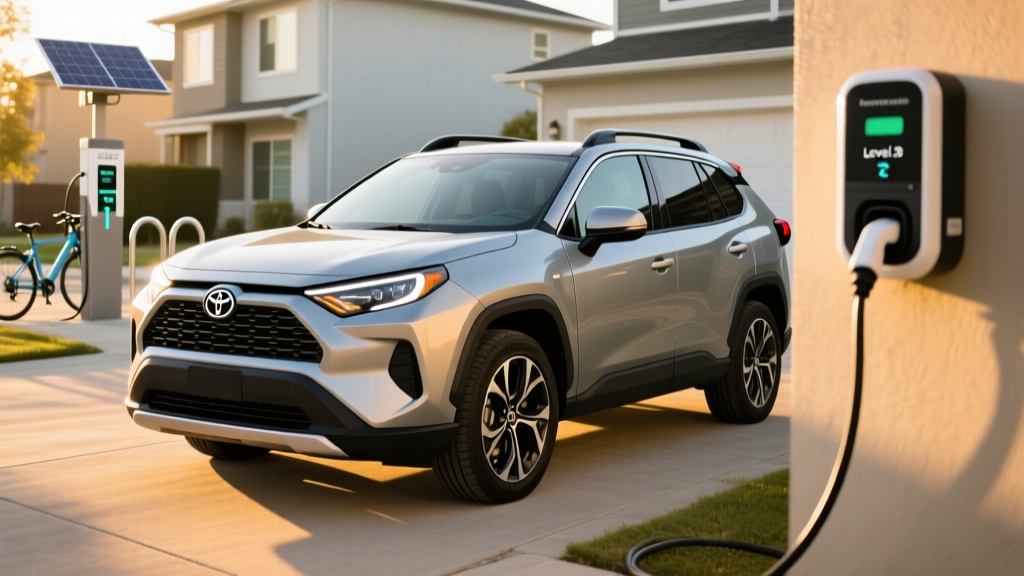
Plug-in Hybrid (PHEV): The RAV4 Prime pairs a larger 18.1 kWh battery with a more powerful electric motor system. You can plug it in to gain up to 42 miles of electric-only driving before the gas engine kicks in. It operates as an EV for short commutes and a hybrid for longer trips.
Fuel Economy of the RAV4 Hybrid: EPA Numbers Breakdown
According to fueleconomy.gov, the 2025/2026 Toyota RAV4 Hybrid AWD carries the following EPA estimates across all trims (LE, XLE, XLE Premium, SE, Woodland Edition, Limited):
| Metric | Value |
|---|---|
| City MPG | 41 |
| Highway MPG | 38 |
| Combined MPG | 39 |
| Fuel Tank Capacity | 14.5 gallons |
| EPA Estimated Total Range | ~566 miles |
| Annual Fuel Cost (15k mi/yr) | ~$1,550* |
*Based on EPA assumptions of $3.50/gal regular unleaded and 15,000 miles/year (55% city / 45% highway). Actual costs vary with local fuel prices.
The hybrid's city MPG exceeds its highway rating — a hallmark of Toyota's Hybrid Synergy Drive. At low speeds and in stop-and-go traffic, the electric motor does the heavy lifting while the 2.5-liter four-cylinder engine shuts off frequently. On the highway, the gasoline engine operates more continuously, reducing the hybrid advantage.
Real-World MPG: How Does the RAV4 Hybrid Actually Perform?
EPA estimates are standardized lab tests, not real-world guarantees. Based on owner-reported data from Fuelly and long-term testing by automotive publications, here is what to expect:
Real-World Fuel Economy Expectations
EPA Combined: 39 MPG
Real-World Average (mixed driving): 37–42 MPG
City-Heavy Commutes: 40–44 MPG (hybrids often beat EPA city estimates in mild weather)
Highway-Dominant (70+ mph): 33–36 MPG
Cold Weather (below 30°F): 32–36 MPG (engine runs more to heat the cabin and warm the battery)
Several factors explain why the RAV4 Hybrid can exceed its EPA rating in city driving: the electric motor handles low-speed acceleration where gas engines are least efficient, and regenerative braking recovers energy at every stop. Conversely, sustained high-speed highway driving diminishes the hybrid advantage because aerodynamic drag dominates and the gas engine carries the full load.
In cold weather, expect a 10–15% MPG drop. The gasoline engine must run longer to generate cabin heat (unlike a full EV with a heat pump, the hybrid relies on engine waste heat), and the battery operates less efficiently at low temperatures. Owners in northern climates typically report winter averages in the low-to-mid 30s.
RAV4 Prime PHEV: Electric-Only Range and Total Efficiency
If you can plug in at home, the RAV4 Prime (the PHEV variant) offers a fundamentally different ownership experience. Here are the key figures:
| Spec | Value |
|---|---|
| EPA Electric-Only Range | 42 miles |
| Total Combined Range (EV + Gas) | ~600 miles |
| MPGe (Electric Mode) | 94 MPGe |
| MPG (Hybrid Mode, Battery Depleted) | 38 combined |
| Battery Capacity (Usable) | 18.1 kWh (lithium-ion, NMC chemistry) |
| Level 2 Charge Time (240V, 6.6 kW) | ~2.5 hours (0–100%) |
| Level 1 Charge Time (120V, 1.4 kW) | ~12 hours (0–100%) |
| DC Fast Charging | Not supported |
| Combined System Horsepower | 302 hp |
| 0–60 mph | 5.7 seconds |
| Drivetrain | AWD (electronic rear motor) |
The RAV4 Prime does not support DC fast charging — a notable limitation. All charging must happen via Level 1 (standard 120V outlet) or Level 2 (240V home or public charger). For most PHEV owners, this is acceptable: the 18.1 kWh battery is small enough that a Level 2 home charger replenishes it in roughly 2.5 hours, and overnight Level 1 charging works if your daily electric-only needs stay under ~30 miles.
When the battery depletes, the Prime seamlessly transitions to conventional hybrid operation at 38 MPG combined — only 1 MPG less than the standard RAV4 Hybrid. You lose nothing by going PHEV on road trips.
Powertrain Comparison: Hybrid vs Prime vs Gas
| Spec | Gas (AWD) | Hybrid (AWD) | Prime PHEV (AWD) |
|---|---|---|---|
| Engine | 2.5L I-4 | 2.5L I-4 + 3 electric motors | 2.5L I-4 + 2 electric motors (higher output) |
| Combined Horsepower | 203 hp | 219 hp | 302 hp |
| 0–60 mph | 8.0 sec | 7.4 sec | 5.7 sec |
| EPA Combined MPG / MPGe | 28 MPG | 39 MPG | 94 MPGe / 38 MPG |
| EPA City MPG | 27 | 41 | N/A (electric mode) |
| EPA Highway MPG | 30 | 38 | N/A (electric mode) |
| Electric-Only Range | — | — | 42 miles |
| Battery Size | — | 1.6 kWh | 18.1 kWh |
| Plug-In Required? | No | No | Yes (for EV mode benefit) |
The RAV4 Hybrid delivers a 39% fuel-economy improvement over the gas model (39 vs 28 combined MPG). The Prime PHEV, when charged regularly, can eliminate gasoline use entirely for commutes under 42 miles round-trip — effectively operating as an EV on weekdays and a hybrid on weekends.
Pricing, Trims, and Tax Credit Eligibility
Here is the current MSRP structure for the 2026 RAV4 Hybrid and Prime lineup (destination charge included):
| Model / Trim | MSRP (approx.) |
|---|---|
| RAV4 Hybrid LE | $33,500 |
| RAV4 Hybrid XLE | $35,000 |
| RAV4 Hybrid XLE Premium | $37,200 |
| RAV4 Hybrid SE | $37,800 |
| RAV4 Hybrid Woodland Edition | $37,500 |
| RAV4 Hybrid Limited | $40,500 |
| RAV4 Prime SE | $45,500 |
| RAV4 Prime XSE | $49,000 |
Federal Tax Credit: Who Qualifies?
IRS §30D Clean Vehicle Credit — Key Requirements (2026)
- Conventional RAV4 Hybrid (HEV): Does NOT qualify for the federal §30D credit. This credit applies only to plug-in electric vehicles (BEVs and PHEVs) meeting battery-sourcing and critical-mineral requirements.
- RAV4 Prime (PHEV): May qualify for up to $7,500, but eligibility depends on multiple factors that change frequently:
- Buyer AGI must not exceed $150,000 (single) / $300,000 (joint)
- Vehicle MSRP must not exceed $80,000 for SUVs (RAV4 Prime clears this easily)
- Battery components and critical minerals must meet phased-in domestic-sourcing thresholds per IRS guidelines
- Credit can be transferred to the dealer at point of sale as a price reduction (effective 2024 onward)
Critical caveat: Toyota's battery supply chain sourcing determines whether the Prime qualifies for the full $7,500, a partial $3,750, or no credit at all in any given model year. Always verify current eligibility on fueleconomy.gov before purchasing, as the IRS updates qualifying vehicle lists regularly. State-level incentives (such as California's CVRP or Colorado's innovative motor vehicle credit) may stack on top — check your state's energy office for current programs.
Battery Longevity, Warranty, and Replacement Costs
Toyota Hybrid Battery Warranty
Hybrid Battery Warranty: 10 years / 150,000 miles (whichever comes first), transferable to subsequent owners
Hybrid System Components Warranty: 8 years / 100,000 miles
Capacity Retention Guarantee: Toyota warrants the hybrid battery against failure and abnormal degradation; if capacity drops below a functional threshold during the warranty period, Toyota replaces it at no cost.
Toyota's hybrid battery track record is among the strongest in the industry. The RAV4 Hybrid's 1.6 kWh nickel-metal hydride (NiMH) battery is deliberately small and conservatively managed — it never fully charges or fully depletes, which dramatically reduces stress on the cells. Real-world data from high-mileage Prius and RAV4 Hybrid owners shows that these batteries routinely last 150,000–200,000+ miles before needing replacement.
The RAV4 Prime's 18.1 kWh lithium-ion (NMC chemistry) battery is also warrantied for 10 years / 150,000 miles. Because it sees deeper daily cycling (full charge to near-empty in EV mode), degradation is slightly more pronounced — expect roughly 85–90% capacity retention after 100,000 miles of regular PHEV use. This still leaves ~35+ miles of EV range, which is adequate for most commutes.
What Does Replacement Cost?
If you own the vehicle well past the warranty period:
- RAV4 Hybrid (HEV) battery replacement: $2,000–$4,000 (refurbished or aftermarket options can reduce this to $1,500–$2,500)
- RAV4 Prime (PHEV) battery replacement: $6,000–$9,000 (larger lithium-ion pack; OEM replacement through Toyota)
For context, a conventional gas vehicle's transmission replacement can run $3,000–$7,000, and timing-chain service on modern engines is similarly expensive. Hybrid battery replacement is a legitimate long-term cost, but it is neither unprecedented nor catastrophic — especially given the fuel savings accumulated over 150,000+ miles.
Hybrid vs PHEV vs Full EV: Which RAV4 Fits Your Life?
Decision Framework
Choose the RAV4 Hybrid (HEV) if:
- You cannot charge at home (apartment, street parking, no garage)
- You want zero change to your fueling routine — just fill up at gas stations
- Your budget starts around $33,000–$35,000
- You drive 12,000–15,000 miles/year and want ~39 MPG without thinking about it
- You frequently take long road trips and don't want to plan around charging stops
Choose the RAV4 Prime (PHEV) if:
- You can install a Level 2 charger at home (240V outlet or hardwired unit)
- Your daily round-trip commute is under 42 miles (most US commutes are under 40 miles)
- You want EV-like silence and instant torque on weekdays but gas flexibility on weekends
- You qualify for the federal tax credit, effectively reducing the price premium over the Hybrid Limited
- You value the 302-hp performance upgrade (5.7-second 0–60)
Choose a full EV (e.g., Tesla Model Y, Hyundai Ioniq 5) if:
- You can charge at home and want to eliminate gasoline entirely
- Your typical trips are under 250 miles, or you're willing to plan DC fast-charging stops
- You want the lowest per-mile fuel cost (electricity at $0.12/kWh ≈ $1.20/gallon equivalent)
- You want minimal maintenance (no oil changes, no spark plugs, fewer moving parts)
5-Year Cost of Ownership: Hybrid vs Gas vs Prime
| Cost Category | Gas RAV4 AWD | RAV4 Hybrid AWD | RAV4 Prime (charged daily) |
|---|---|---|---|
| Fuel / Electricity | $9,375 (gas) | $6,730 (gas) | $2,800 (electricity + some gas) |
| Maintenance (oil, filters, brakes) | $3,500 | $3,000 | $2,500 |
| Purchase Price (base trim, before credit) | $31,000 | $33,500 | $45,500 |
| Federal Tax Credit | $0 | $0 | Up to $7,500* |
| Net 5-Year Operating Cost (fuel + maint.) | $12,875 | $9,730 | $5,300 |
| Estimated Insurance (5-yr total) | $7,500 | $7,800 | $8,500 |
*Tax credit eligibility varies — verify on fueleconomy.gov. Assumes $3.50/gal gas, $0.14/kWh electricity, 55% city driving. Prime owner charges nightly and uses gas for ~20% of miles.
The RAV4 Hybrid saves roughly $3,145 in fuel and maintenance over five years compared to the gas model, which largely offsets its ~$2,500 higher purchase price. The Prime, when the tax credit applies and daily charging is feasible, can save over $7,500 in operating costs — but the higher upfront price means total cost parity depends heavily on your charging habits and credit eligibility.
RAV4 Hybrid (HEV) — Pros
- 39 MPG combined with zero behavior change required
- Proven reliability; 10-year/150k-mile hybrid battery warranty
- Strong resale value (RAV4 Hybrid consistently leads its segment)
- 566-mile total range — fewer fill-ups on road trips
- AWD standard on all hybrid trims
RAV4 Hybrid (HEV) — Cons
- No federal tax credit (HEVs are ineligible for §30D)
- Highway MPG (38) less impressive than city (41)
- Cold-weather MPG drops 10–15%
- CVT drone under hard acceleration
- No electric-only driving capability
Frequently Asked Questions
How many MPG does the RAV4 Hybrid get?
The EPA rates the RAV4 Hybrid AWD at 41 city / 38 highway / 39 combined MPG. In real-world mixed driving, most owners report 37–42 MPG. City-heavy commutes in mild weather can push above 42 MPG, while sustained highway driving at 75+ mph typically yields 33–36 MPG.
How far can the RAV4 Prime go on electric only?
The EPA rates the RAV4 Prime at 42 miles of electric-only range. In real-world conditions, expect 36–42 miles depending on temperature, terrain, and driving style. Cold weather (below freezing) can reduce this to 30–35 miles as the system engages the gas engine for cabin heat.
Does the RAV4 Hybrid qualify for any tax credit?
The conventional RAV4 Hybrid (HEV) does not qualify for the federal §30D Clean Vehicle Credit — this credit is reserved for plug-in vehicles (BEVs and PHEVs). The RAV4 Prime (PHEV) may qualify for up to $7,500 depending on battery-sourcing compliance, buyer income limits, and current IRS guidance. Always check fueleconomy.gov for the latest qualifying vehicle list.
Is the RAV4 Hybrid reliable? What about battery replacement?
Toyota's hybrid system is among the most proven in the industry, with decades of real-world data from millions of Prius, Camry Hybrid, and RAV4 Hybrid vehicles on the road. The hybrid battery is warrantied for 10 years / 150,000 miles. Out-of-warranty replacement costs $2,000–$4,000 for the HEV, but most batteries last well beyond 150,000 miles with Toyota's conservative charge-management strategy.
Should I buy the RAV4 Hybrid or the RAV4 Prime?
If you can charge at home and your daily commute is under 42 miles round-trip, the Prime offers dramatically lower fuel costs and a meaningful performance upgrade (302 hp, 5.7s 0–60). If you cannot charge at home, want a lower purchase price, or prefer the simplest possible ownership experience, the standard Hybrid is the better fit. Both are excellent vehicles — the right choice depends on your charging access and budget.
Does the RAV4 Hybrid need to be plugged in?
No. The conventional RAV4 Hybrid (HEV) never needs to be plugged in. Its small 1.6 kWh battery charges entirely through regenerative braking and the gasoline engine. You fuel it at gas stations exactly like a conventional vehicle. Only the RAV4 Prime (PHEV) benefits from plugging in.