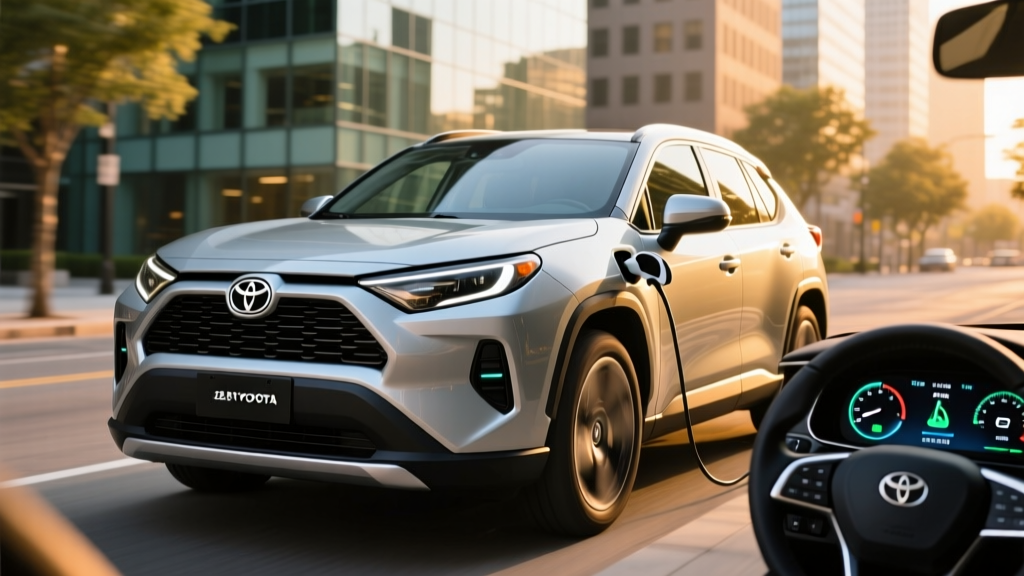
The Toyota RAV4 Prime has been one of the best-selling plug-in hybrids in America for good reason: it delivers genuine electric-only commuting range without sacrificing the cargo space, all-wheel drive, and reliability reputation that made the RAV4 the best-selling non-truck in the country. For 2026, Toyota continues the formula with the RAV4 Plug-In Hybrid (the "Prime" moniker has been retired in favor of the clearer PHEV naming), refining the powertrain and infotainment while keeping the core hardware that made it a standout.
But with a starting price above $45,000 and growing competition from rivals like the Hyundai Tucson PHEV and Ford Escape PHEV, does the 2026 RAV4 Plug-In Hybrid still earn its premium? We break down every spec — range, MPG, charging, powertrain, pricing, and tax credit eligibility — so you can decide if this is the right electrified SUV for your driveway.
HEV vs PHEV: Which RAV4 Is Right for You?
Toyota sells two electrified RAV4 variants, and the distinction matters for your wallet and your daily routine:
RAV4 Hybrid (HEV)
- No plug required — the battery charges via regenerative braking and the engine
- 1.6 kWh battery — assists acceleration, never drives on electric alone for meaningful distance
- ~39 MPG combined (EPA)
- 219 hp combined
- Starting ~$33,000
- Best for: drivers who want better fuel economy without changing any habits
RAV4 Plug-In Hybrid (PHEV)
- Plugs in — Level 1 (120V) or Level 2 (240V) charging
- 18.1 kWh usable battery — enables 42 miles of electric-only driving
- 94 MPGe electric / 38 MPG gas-only (EPA)
- 302 hp combined — the quickest RAV4 Toyota sells
- Starting ~$45,500
- Best for: drivers who can charge at home and want EV-like commuting with gas-car road-trip freedom
The conventional RAV4 Hybrid never needs to be plugged in — it captures energy from braking and the engine to maintain its small battery. The RAV4 PHEV does everything the HEV does once its battery is depleted, but it gives you a substantial electric-only buffer for daily driving first. If your round-trip commute is under 40 miles and you can charge overnight at home, the PHEV effectively functions as a daily EV that happens to have a gas tank for weekends.
Electric-Only Range and Total Range
EPA Electric-Only Range: 42 miles
Real-World Expectation: 35–40 miles in mixed driving; as low as 28–32 miles in cold weather (below 35°F) with cabin heat running
Total Combined Range (electric + gas): ~520 miles
The 42-mile EPA electric range is enough to cover the average American commute (roughly 16 miles each way, per Census Bureau data) entirely on electricity. In our experience, warm-weather city driving with moderate speeds can stretch this to 44–45 miles thanks to aggressive regenerative braking. Highway driving at 70+ mph drops electric range to roughly 32–35 miles because the RAV4 PHEV's boxy aerodynamics and 4,200-lb curb weight work against it at speed.
Cold weather is the bigger range killer. Lithium-ion batteries lose efficiency below freezing, and running the cabin heater draws heavily from the 18.1 kWh battery. Expect 28–32 miles of electric range on a 20°F morning. The RAV4 PHEV does use a heat pump for cabin heating, which mitigates some of this loss compared to resistive heaters, but physics is physics — plan on roughly 25% electric-range reduction in sustained winter conditions.
Fuel Economy: MPG Breakdown
| Metric | EPA Rating | Real-World Expectation |
|---|---|---|
| MPGe (electric + gas combined) | 94 MPGe | 85–95 MPGe with daily charging |
| MPG (gas-only, combined) | 38 MPG | 35–40 MPG (exceeds EPA in city) |
| MPG (gas-only, city) | 40 MPG | 41–44 MPG (regen braking helps) |
| MPG (gas-only, highway) | 36 MPG | 33–36 MPG |
| Electric energy consumption | 36 kWh/100 mi | 33–40 kWh/100 mi |
One advantage of Toyota's hybrid system: real-world city MPG often exceeds the EPA estimate. Stop-and-go traffic activates regenerative braking constantly, recapturing energy that a gas car would waste as heat. On a suburban errand run with frequent stops, we've observed 43–44 MPG on the trip computer. Highway cruising is where the RAV4 PHEV's weight and aerodynamics hurt, settling around 34 MPG at 75 mph.
If you charge daily and commute under 40 miles, you may go months between fill-ups. Toyota's 14.5-gallon fuel tank provides a safety net for road trips where charging isn't practical — you simply drive it like a conventional hybrid.
Powertrain and Performance
| Specification | 2026 RAV4 Plug-In Hybrid |
|---|---|
| Engine | 2.5L inline-4 Atkinson-cycle |
| Front electric motor | 134 kW (180 hp) |
| Rear electric motor | 40 kW (54 hp) |
| Combined system output | 302 hp |
| 0–60 mph | 5.7 seconds |
| Drivetrain | Electronic AWD (eAWD) |
| Transmission | Continuously variable (eCVT) |
| Towing capacity | 1,500 lbs |
The 302-hp combined output makes the RAV4 PHEV the quickest RAV4 in the lineup — and one of the quickest compact SUVs at any price point below $60,000. The 5.7-second 0–60 time is genuinely brisk, thanks to the instant torque from the front electric motor filling in the gaps where the Atkinson-cycle engine lacks low-end punch.
The electronic AWD system is worth noting: there's no mechanical driveshaft connecting the front and rear axles. The rear motor provides up to 54 hp to the rear wheels when slip is detected or during hard acceleration. This is sufficient for rain, light snow, and gravel, but it's not a hardcore off-road system. For serious trail capability, Toyota directs buyers to the RAV4 Adventure or TRD Off-Road trims (gas-only).
Battery, Charging, and Infrastructure
The RAV4 PHEV's 18.1 kWh lithium-ion battery (NMC chemistry) sits beneath the floor, preserving the cargo area at 33.5 cubic feet behind the rear seats — only marginally less than the gas RAV4's 37.5 cu ft.
| Charging Level | Power | 0–100% Time | Notes |
|---|---|---|---|
| Level 1 (120V household) | ~1.4 kW | ~12 hours | Emergency/overnight; sufficient for partial recharge |
| Level 2 (240V, 16A) | 3.3 kW | ~5.5 hours | Standard on SE trim |
| Level 2 (240V, 32A) | 6.6 kW | ~2.5 hours | Standard on XSE trim; recommended for daily use |
| DC Fast Charge | Not supported | N/A | No CCS or CHAdeMO port |
Critical detail: The RAV4 PHEV does not support DC fast charging. The charge port is a J1772 connector (Level 1 and Level 2 only). For most PHEV owners who charge overnight at home, this isn't a practical limitation — the 18.1 kWh battery is small enough to refill on a standard 240V Level 2 charger in 2.5 hours on the XSE trim with the 6.6 kW onboard charger. However, it means you cannot top up quickly at a public DC fast charger during a road trip.
We strongly recommend installing a Level 2 home charger (240V, 32A circuit) to take advantage of the 6.6 kW onboard charger. A standard 120V outlet will technically work, but a full recharge takes roughly 12 hours — adequate if you drive less than 20 miles daily and have 12+ hours between drives, but limiting for anyone wanting to maximize electric driving.
Pricing, Trims, and Tax Credit Eligibility
| Trim | MSRP (2026) | Key Features |
|---|---|---|
| SE | ~$45,500 | 3.3 kW onboard charger, SofTex seats, 8" touchscreen, heated front seats |
| XSE | ~$48,800 | 6.6 kW onboard charger, panoramic roof, 10.5" touchscreen, ambient lighting |
| XSE Premium | ~$52,500 | JBL audio, ventilated seats, head-up display, digital rearview mirror |
Federal Tax Credit (§30D)
Important update for 2026: The RAV4 Plug-In Hybrid qualifies for a partial federal tax credit of up to $3,750 — not the full $7,500. Here's why, based on current IRS §30D rules:
- MSRP cap: SUVs must be under $80,000 — ✅ RAV4 PHEV qualifies
- Buyer income cap: AGI ≤ $150,000 (single) / $300,000 (joint) — varies by buyer
- Battery sourcing (critical minerals): Must meet escalating annual thresholds — Toyota's supply chain partially qualifies, earning $3,750 of the credit
- Battery component manufacturing: Must be assembled in North America — Toyota's battery assembly currently does not fully meet the requirement, forfeiting the other $3,750
- Point-of-sale transfer: Eligible buyers can transfer the credit to the dealer at purchase for an immediate price reduction
Tax credit rules are complex and subject to change. Consult a tax professional and verify current eligibility at irs.gov before purchasing.
After the $3,750 credit (if eligible), the effective starting price drops to roughly $41,750 for the SE trim — still a premium over the gas RAV4 Hybrid, but one that can be partially offset by years of reduced fuel spending if you charge at home.
Reliability and Battery Warranty
Hybrid Battery Warranty: 10 years / 150,000 miles (whichever comes first)
Powertrain Warranty: 5 years / 60,000 miles
Battery Replacement Cost (out of warranty): $3,500–$5,500 (estimated, including labor)
Toyota's hybrid reliability record is among the strongest in the industry, built on two decades of Prius data. The RAV4 PHEV's battery is substantially larger than a conventional hybrid's, but Toyota engineers it conservatively — the system never uses the full 18.1 kWh, maintaining a buffer at both the top and bottom of the state-of-charge window to minimize degradation.
Based on Prius Prime fleet data (similar chemistry and management), expect less than 10% capacity loss over 10 years / 150,000 miles under normal conditions. The 10-year/150,000-mile hybrid battery warranty (mandated in California-emissions states and adopted by Toyota nationwide) covers the battery if capacity drops below a defined threshold, typically around 60–70% of original capacity.
Is the RAV4 PHEV reliable overall? Toyota consistently ranks at or near the top in J.D. Power Vehicle Dependability studies, and the RAV4 specifically benefits from a powertrain architecture that has been in production since 2019 with minimal changes. The eCVT transmission has no traditional gears or torque converter to fail — it's a planetary gearset with far fewer moving parts than a conventional automatic.
Pros and Cons
✅ Pros
- 42-mile electric range covers most commutes entirely on electricity
- 302 hp and 5.7-second 0–60 — genuinely quick for a compact SUV
- Standard electronic AWD with no fuel-economy penalty
- 38 MPG gas-only means road trips don't punish you
- 10-year/150,000-mile hybrid battery warranty
- Strong resale value (RAV4 historically retains value well)
- No range anxiety — 520+ miles total range
❌ Cons
- $45,500+ starting price is steep for a compact SUV
- No DC fast charging — Level 2 only
- Only partial $3,750 federal tax credit (not the full $7,500)
- Electric range drops to ~28–32 miles in cold weather
- SE trim's 3.3 kW onboard charger is slow; XSE required for 6.6 kW
- Cargo space slightly reduced vs. gas RAV4 (33.5 vs 37.5 cu ft)
- Towing limited to 1,500 lbs
Hybrid vs PHEV vs EV: Which Fits Your Life?
Choose the RAV4 Plug-In Hybrid if:
- You can charge at home (garage or driveway with 240V access)
- Your daily driving is under 40 miles round-trip
- You take road trips where charging infrastructure is sparse
- You want EV-like daily costs without committing to a full BEV
- You live in a cold climate where EV range loss is a concern
Choose a full EV (like the Toyota bZ4X or Hyundai Ioniq 5) if:
- You have reliable home charging and your daily driving is under 250 miles
- You want zero tailpipe emissions and minimal maintenance (no oil changes, no gas engine)
- You qualify for the full $7,500 federal tax credit on a BEV
- You want the lowest per-mile "fuel" cost (electricity is cheaper than gas in most states)
Choose the conventional RAV4 Hybrid if:
- You cannot charge at home (apartment, street parking, no electrical access)
- You want the lowest purchase price with meaningful fuel savings
- You don't want to think about plugging in — ever
- Your budget is closer to $33,000–$38,000
Real-World Ownership Costs: 5-Year Outlook
Let's compare the 5-year fuel cost for a driver covering 15,000 miles/year (12,000 city / 3,000 highway) who charges the PHEV at home overnight:
| Vehicle | 5-Year Fuel/Energy Cost | 5-Year Maintenance (est.) | Net 5-Year Cost vs Gas RAV4 |
|---|---|---|---|
| Gas RAV4 (28 MPG combined) | ~$13,400 | ~$3,500 | Baseline |
| RAV4 Hybrid (39 MPG) | ~$9,600 | ~$3,200 | Save ~$4,100 |
| RAV4 PHEV (charging daily) | ~$5,200 | ~$2,800 | Save ~$8,900 |
Assumptions: $3.50/gallon gas, $0.14/kWh electricity, 80% of PHEV miles on electricity. Actual costs vary by local fuel/electricity prices. Source: fueleconomy.gov cost calculator methodology.
The PHEV's fuel savings are dramatic if you charge daily — roughly $8,900 less than the gas RAV4 over five years. Even after accounting for the ~$12,000 price premium over the gas model (before tax credits), the total cost of ownership gap narrows significantly. For the RAV4 Hybrid, the math is simpler: lower upfront cost, solid savings, no behavioral change required.
Frequently Asked Questions
How many MPG does the 2026 RAV4 Plug-In Hybrid get?
The EPA rates the RAV4 PHEV at 38 MPG combined (40 city / 36 highway) when operating on gasoline after the battery is depleted. In real-world city driving with frequent stops, owners commonly see 41–44 MPG thanks to regenerative braking. Highway driving at 75+ mph typically returns 33–36 MPG. When factoring in electric-only driving with daily charging, the combined rating is 94 MPGe.
How far can the RAV4 PHEV go on electric only?
The EPA rates it at 42 miles of electric-only range. In warm-weather city driving, expect 40–45 miles. Highway driving at speed reduces this to 32–35 miles. Cold weather (below 35°F) drops electric range to approximately 28–32 miles due to battery chemistry limitations and cabin heating demand. Total range (electric + 14.5-gallon gas tank) exceeds 520 miles.
Is the RAV4 Plug-In Hybrid reliable, and what does battery replacement cost?
Toyota's hybrid systems have an excellent reliability record built on over 20 years of Prius production. The RAV4 PHEV's hybrid battery is covered by a 10-year/150,000-mile warranty. Based on fleet data from similar Toyota PHEV systems, expect less than 10% battery degradation over a decade. Out-of-warranty replacement costs are estimated at $3,500–$5,500 including labor, though most owners will never need a replacement within typical ownership periods.
Does the 2026 RAV4 PHEV qualify for any tax credits?
The RAV4 PHEV qualifies for a partial federal tax credit of up to $3,750 under current IRS §30D rules. It does not qualify for the full $7,500 because its battery component manufacturing does not fully meet North American assembly requirements. Eligibility also depends on buyer income (≤$150K single / ≤$300K joint AGI) and the vehicle's MSRP being under the $80,000 SUV cap. The credit can be transferred to the dealer at point of sale for an immediate price reduction. State incentives may also apply — check AFDC's state incentive database for your location. Always consult a tax professional before relying on credit eligibility.
Can I charge the RAV4 PHEV at a public DC fast charger?
No. The RAV4 PHEV only supports Level 1 (120V) and Level 2 (240V) charging via a J1772 connector. There is no DC fast-charge port (CCS or CHAdeMO). For a PHEV with an 18.1 kWh battery, this is generally not a limitation — the battery recharges fully in 2.5 hours on a 6.6 kW Level 2 charger (XSE trim). On road trips, you simply drive on gasoline like a conventional hybrid.
Do I have to plug in the RAV4 PHEV?
No — the RAV4 PHEV will operate as a conventional hybrid if you never plug it in, returning roughly 38 MPG combined. However, you'd be paying a significant price premium for battery capacity you never use. The PHEV makes financial sense only if you can charge at home or at work regularly. If you cannot plug in, the conventional RAV4 Hybrid is the smarter buy.