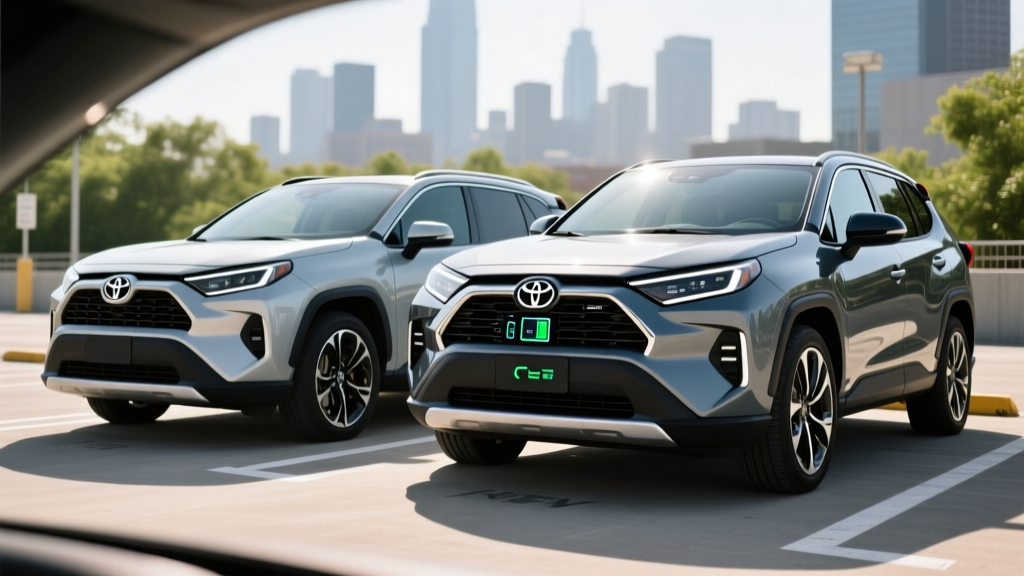
The Toyota RAV4 has been America's best-selling non-truck for years, and its electrified variants are a major reason why. For 2026, Toyota continues to offer the RAV4 in two distinct electrified flavors: the conventional RAV4 Hybrid (HEV), which requires no plug and sips fuel through regenerative braking, and the RAV4 Prime (PHEV), a plug-in hybrid that can drive over 40 miles on electricity alone before the gas engine ever fires up. Both are compelling, but they serve very different drivers. Here's everything you need to know about specs, real-world efficiency, pricing, and whether either qualifies for federal tax incentives.
RAV4 Hybrid vs. RAV4 Prime: What's the Difference?
Before diving into numbers, it's critical to understand the fundamental distinction between these two powertrains, because confusing them is one of the most common buyer mistakes.
RAV4 Hybrid (HEV)
- No plug required — the battery charges via regenerative braking and the gas engine
- Small battery (~1.6 kWh) used for assist, not standalone driving
- Electric motor assists the 2.5L engine at low speeds and under acceleration
- Cannot drive on electric-only power for meaningful distances
- Lower purchase price, simpler ownership
RAV4 Prime (PHEV)
- Plug-in capable — charge from a wall outlet or Level 2 charger
- Larger battery (18.1 kWh usable) enables 42 miles of electric-only driving
- Can operate as a full EV for daily commutes, then switches to hybrid mode
- Significantly more combined horsepower (302 hp vs. 219 hp)
- Higher purchase price, but potential fuel savings and tax credit eligibility
If you don't have access to home or workplace charging, the conventional RAV4 Hybrid is the straightforward pick. If you can plug in nightly and your commute is under 40 miles round-trip, the Prime can operate as an EV for most daily driving while retaining a gas engine for road trips.
Fuel Economy and Electric Range: The Numbers
| Metric | RAV4 Hybrid (HEV) | RAV4 Prime (PHEV) |
|---|---|---|
| EPA City MPG | 41 MPG | 40 MPG (hybrid mode) |
| EPA Highway MPG | 38 MPG | 36 MPG (hybrid mode) |
| EPA Combined MPG | 39 MPG | 38 MPG (hybrid mode) |
| MPGe (electric mode) | N/A | 94 MPGe |
| Electric-Only Range | N/A | 42 miles |
| Total Combined Range | ~580 miles | ~600 miles (EV + gas) |
| Fuel Tank Capacity | 14.5 gallons | 14.5 gallons |
Source: EPA fueleconomy.gov
Real-World MPG vs. EPA Sticker
Toyota's hybrid system excels in stop-and-go city traffic, where the electric motor handles low-speed driving and regenerative braking recaptures energy. In real-world city driving, many RAV4 Hybrid owners report exceeding the 41 MPG city EPA estimate, sometimes reaching 43–45 MPG in warm weather with moderate driving. Highway driving is the opposite: at sustained 70+ mph speeds, expect 34–36 MPG as the gas engine does most of the work. Cold weather (below 35°F) typically drops fuel economy by 3–5 MPG across the board because the engine runs more often to provide cabin heat and because battery chemistry is less efficient at low temperatures.
For the Prime, the 42-mile electric-only EPA estimate holds up well in mild weather with moderate speeds. However, highway-speed electric driving (65+ mph) can reduce that to 30–35 miles, and cold weather with cabin heating engaged can cut electric range to 25–30 miles.
Powertrain and Performance Specs
| Specification | RAV4 Hybrid (HEV) | RAV4 Prime (PHEV) |
|---|---|---|
| Engine | 2.5L 4-cylinder | 2.5L 4-cylinder |
| Combined Horsepower | 219 hp | 302 hp |
| Electric Motors | Front + rear (AWD-e) | Front + rear (AWD-e, more powerful) |
| 0–60 mph | 7.4 seconds | 5.7 seconds |
| Drivetrain | AWD (standard) | AWD (standard) |
| Transmission | eCVT | eCVT |
| Towing Capacity | 1,750 lbs | 2,500 lbs |
| Battery Capacity | ~1.6 kWh (NiMH) | 18.1 kWh (lithium-ion) |
The RAV4 Prime's 302 combined horsepower makes it one of the quickest vehicles in Toyota's lineup — the 5.7-second 0–60 time beats many sport sedans. That extra power comes from larger front and rear electric motors and the ability to draw heavily from the 18.1 kWh battery pack. The conventional Hybrid's 219 hp is adequate for daily driving and merging, but it won't win any stoplight races.
Charging the RAV4 Prime: What PHEV Buyers Need to Know
The RAV4 Prime's 18.1 kWh battery can be charged in several ways, but unlike a full battery-electric vehicle, DC fast charging is not available. This is standard for most PHEVs — the battery is small enough that Level 2 charging is practical overnight.
| Charging Method | Power | 0–100% Time (Prime) | Notes |
|---|---|---|---|
| Level 1 (120V household outlet) | ~1.4 kW | ~12 hours | Works for overnight if you drive < 30 miles/day |
| Level 2 (240V, 16A) | ~3.3 kW | ~5.5 hours | Standard home charger; full charge overnight |
| Level 2 (240V, 32A) | ~6.6 kW | ~2.5 hours | Available on Prime with optional onboard charger upgrade |
| DC Fast Charge | N/A | N/A | Not supported on RAV4 Prime |
Most Prime owners find Level 1 charging (a standard 120V outlet) sufficient if their daily driving is under 30 miles — you'll recover roughly 5–6 miles of electric range per hour of charging. A Level 2 home charger is ideal for ensuring a full 42-mile battery every morning, especially if you use the EV range for round-trip commuting and want to top off during the day.
One important note: the RAV4 Hybrid (HEV) does not plug in at all. Its small battery is charged exclusively through regenerative braking and the gas engine. There is no charging port, no cable, and no home electrical work required.
Pricing, Trims, and Tax Credit Eligibility
For the 2026 model year, Toyota positions the RAV4 Hybrid across multiple trims, while the Prime is offered in fewer, more premium configurations.
| Model / Trim | MSRP (approx.) | Key Features |
|---|---|---|
| RAV4 Hybrid LE | $34,500 | Base hybrid, AWD, Toyota Safety Sense 3.0 |
| RAV4 Hybrid XLE | $36,500 | Upgraded interior, dual-zone climate, blind-spot monitor |
| RAV4 Hybrid Woodland Edition | $38,000 | Off-road-tuned suspension, TRD wheels, roof rails |
| RAV4 Hybrid Limited | $41,500 | Leather, premium audio, panoramic roof |
| RAV4 Prime SE | $46,500 | 302 hp PHEV, 42-mi EV range, SofTex seats |
| RAV4 Prime XSE | $50,000 | Premium PHEV, heads-up display, 6.6 kW charger option |
Note: MSRP figures are approximate for 2026 and exclude destination charges. Verify with your local dealer.
Federal Tax Credit: §30D Eligibility
- RAV4 Hybrid (HEV): Does NOT qualify for the §30D federal clean vehicle credit. Conventional hybrids are not eligible — only plug-in vehicles with sufficient battery capacity qualify.
- RAV4 Prime (PHEV): May qualify for up to $7,500 under §30D, but eligibility depends on several conditions that change frequently:
- Battery components and critical minerals must meet North American sourcing thresholds (these thresholds increase annually through 2030)
- Buyer income must not exceed $150,000 (single), $225,000 (head of household), or $300,000 (joint filing)
- Vehicle MSRP must not exceed $80,000 for SUVs (both Prime trims clear this cap)
- The credit can now be transferred to the dealer as a point-of-sale discount under current IRS rules
- Final assembly must occur in North America (the RAV4 is built in Kentucky and Ontario, Canada)
Critical caveat: Battery sourcing requirements have tightened significantly since the Inflation Reduction Act took effect. Some model years of the Prime have seen their credit eligibility reduced or eliminated depending on the specific battery cell supplier. Always verify current eligibility on the IRS qualified vehicles list before purchasing. State incentives may also apply — check your state's energy office for local rebates.
Battery Longevity, Warranty, and Replacement Costs
Toyota Hybrid Battery Warranty
RAV4 Hybrid (HEV): 10 years / 150,000 miles (whichever comes first) on the hybrid battery and all hybrid system components. This applies in all 50 states.
RAV4 Prime (PHEV): 10 years / 150,000 miles on the high-voltage lithium-ion battery, with a capacity retention guarantee — Toyota warrants that the battery will retain at least 70% of its original capacity during the warranty period.
Source: Toyota Owner's Warranty Guide
Toyota's hybrid battery track record is among the best in the industry. The original Prius fleet, now over 20 years old, demonstrated that nickel-metal hydride hybrid batteries routinely last 150,000–200,000+ miles with minimal degradation. The RAV4 Hybrid's ~1.6 kWh NiMH pack is shallow-cycled (it never fully charges or fully discharges), which dramatically extends cell life. Most hybrid battery failures within the warranty period are isolated cell issues, and Toyota dealers can often replace individual modules rather than the entire pack.
For the Prime's larger 18.1 kWh lithium-ion pack, the chemistry is different but the warranty structure is the same. Lithium-ion degradation in PHEV applications tends to be modest — expect 5–10% capacity loss over the first 100,000 miles based on data from earlier Toyota PHEV models.
Out-of-Warranty Replacement Costs
If a hybrid battery fails outside the warranty window, here's what to expect:
- RAV4 Hybrid (HEV): Full battery pack replacement runs approximately $3,000–$5,000 at a Toyota dealer, including labor. Refurbished packs from third-party suppliers can reduce this to $2,000–$3,000.
- RAV4 Prime (PHEV): The larger lithium-ion pack is more expensive — expect $6,000–$9,000 for a full replacement at current pricing. However, given Toyota's 10-year/150,000-mile warranty and the relatively conservative depth-of-discharge programming, most owners will never face this cost.
Reliability and Real-World Ownership
Toyota's hybrid powertrains are among the most proven in the automotive industry. The eCVT transmission — which is actually a planetary gearset, not a belt-driven CVT — has no friction clutches, torque converter, or traditional gears to wear out. This mechanical simplicity is a key reason Toyota hybrids consistently earn top reliability scores.
The IIHS has historically awarded the RAV4 its Top Safety Pick designation, and Toyota Safety Sense 3.0 (standard on all 2026 trims) includes pre-collision braking, lane departure alert with steering assist, full-speed-range adaptive cruise control, and lane tracing assist.
Common ownership notes from long-term drivers:
- Brake pads last significantly longer than in gas-only vehicles (often 80,000+ miles) due to regenerative braking handling most deceleration
- Engine oil changes remain necessary at Toyota's recommended intervals (typically every 10,000 miles)
- The hybrid battery cooling fan filter (located near the rear seat on some trims) should be inspected and cleaned periodically to prevent overheating
- Tire wear can be slightly higher than gas models due to the added weight of the hybrid system and instant electric torque at low speeds
Who Should Choose the RAV4 Hybrid, the Prime, or a Full EV?
Choose the RAV4 Hybrid (HEV) if:
- You don't have access to home or workplace charging
- You want maximum fuel efficiency without changing any habits
- Your budget is under $40,000
- You frequently take long road trips and don't want to plan around charging
- You want proven reliability with minimal new technology risk
Choose the RAV4 Prime (PHEV) if:
- You can charge at home (even a 120V outlet works for moderate commutes)
- Your daily round-trip commute is under 40 miles
- You want EV-like daily driving with gas-engine flexibility for road trips
- You value the 302 hp performance upgrade
- You may qualify for the §30D tax credit, effectively reducing the price gap with the HEV
Choose a Full EV (like the Toyota bZ4X or Tesla Model Y) if:
- You have reliable Level 2 home charging
- You want zero tailpipe emissions and minimal maintenance (no oil changes, no gas engine)
- Your daily driving is predictable and within the EV's range
- You want access to the full $7,500 federal tax credit without PHEV sourcing complications
- You're ready to plan longer road trips around DC fast-charging stops
RAV4 Hybrid Pros
- 39 MPG combined with no plug-in required
- AWD standard on every trim
- 10-year/150,000-mile hybrid battery warranty
- Strong resale value and proven reliability
- Competitive starting price under $35,000
RAV4 Hybrid Cons
- No federal tax credit eligibility
- 219 hp is adequate but not exciting
- Engine noise is noticeable under hard acceleration (eCVT drone)
- Infotainment system trails competitors in responsiveness
- Cargo space slightly reduced vs. gas RAV4 due to battery placement
RAV4 Prime Pros
- 42 miles electric-only covers most commutes
- 302 hp — quickest RAV4 ever
- 94 MPGe in electric mode
- Potential $7,500 federal tax credit
- 2,500-lb towing capacity
RAV4 Prime Cons
- $46,500+ starting price — a significant premium over the HEV
- No DC fast charging
- Supply remains constrained — dealer markups are common
- Tax credit eligibility depends on evolving battery sourcing rules
- Heavier than HEV, slightly lower MPG in hybrid-only mode
Frequently Asked Questions
How many MPG does the 2026 RAV4 Hybrid get?
The EPA rates the 2026 RAV4 Hybrid at 41 city / 38 highway / 39 combined MPG. In real-world city driving, many owners exceed the EPA city estimate, reaching 43–45 MPG. Highway driving at sustained speeds above 70 mph typically yields 34–36 MPG.
How far can the RAV4 Prime go on electric only?
The EPA rates the RAV4 Prime at 42 miles of electric-only range. In practice, mild-weather city driving at moderate speeds can achieve close to this figure, while highway-speed or cold-weather driving may reduce it to 25–35 miles.
Does the RAV4 Hybrid need to be plugged in?
No. The conventional RAV4 Hybrid (HEV) has no charging port and cannot be plugged in. Its small battery is charged entirely through regenerative braking and the gas engine. Only the RAV4 Prime (PHEV) has a plug-in capability.
Is the RAV4 Hybrid reliable, and what does a battery replacement cost?
Toyota's hybrid system has an exceptional reliability track record spanning over two decades. The hybrid battery is warranted for 10 years / 150,000 miles. Out-of-warranty replacement costs approximately $3,000–$5,000 for the HEV and $6,000–$9,000 for the Prime's larger lithium-ion pack, though most owners never need a replacement.
Does the 2026 RAV4 Hybrid or Prime qualify for a federal tax credit?
The conventional RAV4 Hybrid does not qualify for the §30D federal clean vehicle credit — only plug-in vehicles are eligible. The RAV4 Prime may qualify for up to $7,500, but eligibility depends on current battery sourcing requirements, buyer income limits, and MSRP caps. Always check the IRS qualified vehicles list before purchasing, as sourcing rules change annually.
Can the RAV4 Prime DC fast charge?
No. The RAV4 Prime does not support DC fast charging. It charges via Level 1 (120V, ~12 hours) or Level 2 (240V, ~2.5–5.5 hours depending on onboard charger configuration). This is typical for PHEVs, whose smaller batteries make overnight Level 2 charging practical.
Hybrid vs. PHEV vs. full EV — which should I choose?
Choose the Hybrid (HEV) if you want fuel savings without any charging infrastructure. Choose the Prime (PHEV) if you can plug in at home and want electric-only commuting with gas-engine backup for longer trips. Choose a full EV if you have home charging, want zero tailpipe emissions and minimal maintenance, and are comfortable planning road trips around DC fast chargers.
Always verify the latest pricing, specifications, and tax credit eligibility with Toyota's official site, your local dealer, and the IRS before making a purchase decision. Rules and availability change frequently.