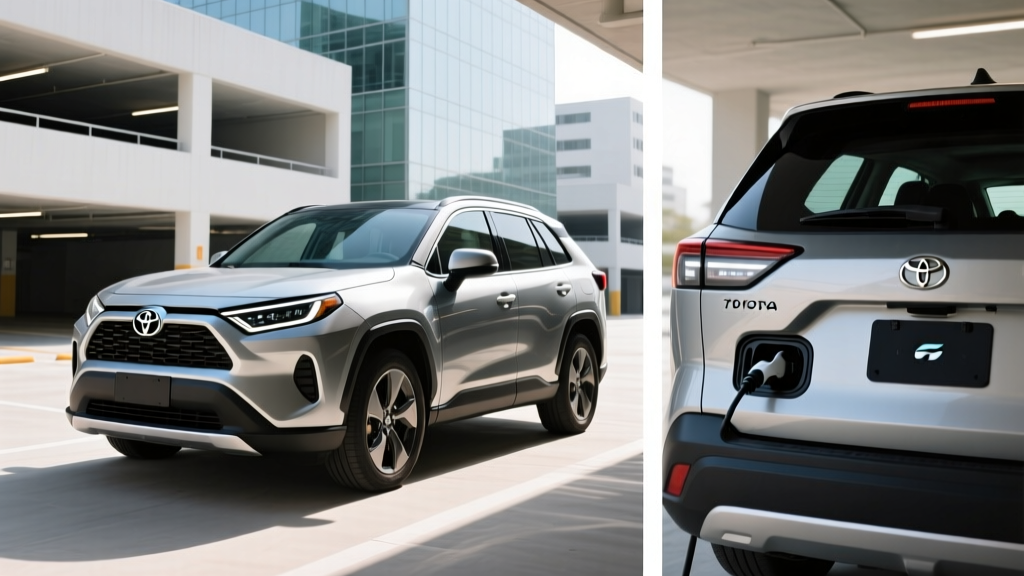
The Toyota RAV4 Hybrid has been America's best-selling hybrid SUV for good reason: it pairs all-wheel drive, a spacious cabin, and a 41 MPG EPA combined rating without requiring a single plug. For the 2023 model year, Toyota refreshed the RAV4 Hybrid with updated tech, a new Woodland Edition trim, and standard AWD across the lineup. But with plug-in hybrids and full EVs proliferating in 2026, does the conventional hybrid RAV4 still make sense?
After analyzing EPA data, owner reports, and real-world driving logs, here is everything you need to know about the 2023 RAV4 Hybrid — from exact fuel economy figures to battery longevity and total cost of ownership.
2023 RAV4 Hybrid Fuel Economy: EPA vs Real-World MPG
The headline number for the 2023 RAV4 Hybrid is its EPA-rated efficiency. Unlike many competitors that offer FWD-only hybrid trims, Toyota equips every RAV4 Hybrid with electronic on-demand all-wheel drive, which costs only a marginal amount of fuel economy compared to the gas-only AWD variant.
| Trim | City MPG | Highway MPG | Combined MPG | Annual Fuel Cost* |
|---|---|---|---|---|
| LE / XLE / XLE Premium / SE / XSE | 41 | 38 | 40 | ~$1,350 |
| Woodland Edition | 38 | 35 | 37 | ~$1,450 |
| Limited | 41 | 38 | 40 | ~$1,350 |
*Source: fueleconomy.gov, based on 15,000 miles/year at $3.50/gallon regular unleaded. Actual costs vary by region and driving habits.
HEV vs PHEV: RAV4 Hybrid vs RAV4 Prime Explained
Toyota sells two electrified RAV4 variants, and the distinction matters for your wallet and daily routine. The RAV4 Hybrid (HEV) is a conventional self-charging hybrid — it never plugs in. The RAV4 Prime (PHEV) is a plug-in hybrid with a larger battery that delivers 42 miles of electric-only range before the gas engine engages. Both were available for the 2023 model year, though the Prime has been in limited supply since launch.
RAV4 Hybrid (HEV)
- No plug-in charging required
- 40 MPG combined (EPA)
- 1.6 kWh battery (not plug-chargeable)
- 219 combined HP
- MSRP: ~$30,225–$39,420 (2023)
- No federal tax credit
RAV4 Prime (PHEV)
- Plugs in for 42 mi EV range (EPA)
- 94 MPGe combined (EV mode)
- 18.1 kWh battery (Level 2 chargeable)
- 302 combined HP
- MSRP: ~$43,090–$47,560 (2023)
- Federal §30D credit: up to $7,500 (eligibility varies)
The RAV4 Prime's 18.1 kWh lithium-ion battery charges in approximately 2.5 hours on a 240V Level 2 charger (at roughly 6.6 kW) or about 10 hours on a standard 120V Level 1 outlet. The Prime does not support DC fast charging — a notable omission for a PHEV in this price range, though most PHEV owners charge exclusively at home overnight. Once the battery depletes, the Prime reverts to hybrid operation at approximately 36 MPG combined.
Powertrain Specs: Engine, Motors, and Performance
The 2023 RAV4 Hybrid uses Toyota's proven fourth-generation hybrid synergy drive system. A 2.5-liter Dynamic Force four-cylinder engine pairs with two electric motor-generators (one front, one rear) through an electronically controlled continuously variable transmission (eCVT).
| Specification | Value |
|---|---|
| Engine | 2.5L inline-4 (176 HP / 163 lb-ft) |
| Front Electric Motor | 88 kW (118 HP) |
| Rear Electric Motor (AWD) | 40 kW (54 HP) |
| Combined Net Output | 219 HP |
| Transmission | eCVT (planetary gearset) |
| Drivetrain | Electronic On-Demand AWD (standard) |
| 0–60 MPH | 7.4 seconds |
| Towing Capacity | 1,750 lbs |
| Fuel Tank | 14.5 gallons |
| Total Driving Range | ~580 miles (EPA est.) |
The 219 HP combined output puts the RAV4 Hybrid ahead of competitors like the Honda CR-V Hybrid (204 HP) and Hyundai Tucson Hybrid (226 HP, but with a conventional automatic that feels less refined). The eCVT delivers seamless acceleration without the rubber-band effect of belt-driven CVTs — Toyota's planetary gearset design is one of the most durable transmissions in the industry.
Pricing, Trims, and Tax Credit Eligibility
For the 2023 model year, the RAV4 Hybrid was offered in six trims. Here is the original MSRP breakdown:
| Trim | MSRP (incl. destination) |
|---|---|
| LE | $30,225 |
| XLE | $31,760 |
| XLE Premium | $34,050 |
| SE | $34,015 |
| XSE | $35,760 |
| Woodland Edition | $34,685 |
| Limited | $39,420 |
On the used market in 2026, a 2023 RAV4 Hybrid LE with average mileage typically lists between $25,000–$28,500, depending on condition and region. Used hybrids under $25,000 may qualify for the Used Clean Vehicle Credit (up to $4,000 or 30% of sale price, whichever is lower), but this applies only to PHEVs and BEVs — the conventional HEV does not qualify.
Battery Warranty, Reliability, and Replacement Cost
Hybrid battery longevity remains the top concern for first-time hybrid buyers. Toyota addresses this with one of the strongest hybrid battery warranties in the industry.
- Hybrid Battery: 10 years / 150,000 miles (whichever comes first)
- Hybrid System Components: 8 years / 100,000 miles
- Powertrain (engine, transaxle): 5 years / 60,000 miles
- Bumper-to-Bumper: 3 years / 36,000 miles
Toyota extended hybrid battery coverage to 10 years/150,000 miles for all 2020+ model year vehicles, up from the prior 8-year/100,000-mile term.
Toyota's hybrid battery packs use nickel-metal hydride (NiMH) chemistry in the RAV4 Hybrid — a mature, well-understood technology with an exceptional track record. Data from fleet operators and long-term owners suggests these packs routinely last 200,000–300,000 miles before significant capacity loss. The 1.6 kWh pack is small and relatively inexpensive to replace compared to a full EV battery.
If replacement is needed out of warranty, a new OEM hybrid battery for the RAV4 Hybrid costs approximately $2,500–$3,500 including labor at a Toyota dealer. Independent hybrid specialists often perform the same service for $1,800–$2,500. Refurbished or reconditioned packs are available for $1,000–$1,500. This is dramatically less than EV battery replacement, which can exceed $10,000–$20,000.
In IIHS testing, the 2023 RAV4 earned top marks, and Toyota consistently ranks at or near the top of J.D. Power and Consumer Reports reliability surveys for hybrid powertrains. The RAV4 Hybrid's system has been in production since 2016 (current generation), with millions of units on the road globally — a massive real-world validation sample.
Who Should Buy the RAV4 Hybrid vs a PHEV or Full EV?
The 2023 RAV4 Hybrid occupies a specific niche: buyers who want meaningful fuel savings without changing their refueling habits. Here is a practical decision framework:
Choose the RAV4 Hybrid (HEV) If:
- You cannot install a home charger (apartment, street parking, no garage)
- You want a lower purchase price (~$13,000 less than the Prime)
- Your annual mileage is under 15,000 miles (fuel savings alone won't offset a PHEV premium quickly)
- You frequently take long road trips and don't want to plan around charging stops
- You want proven, low-risk hybrid technology with a 10-year battery warranty
Choose the RAV4 Prime (PHEV) If:
- You can charge at home (Level 2 preferred) and your daily commute is under 42 miles round-trip
- You want to drive mostly on electricity while retaining gas-engine range for road trips
- You qualify for the §30D federal tax credit (up to $7,500), narrowing the price gap significantly
- You want the performance upgrade (302 HP vs 219 HP, 0-60 in ~5.7 seconds)
Choose a Full EV (e.g., Tesla Model Y, Hyundai Ioniq 5) If:
- You have reliable home charging and your daily driving is under 250 miles
- You want to eliminate gasoline entirely and minimize maintenance (no oil changes, fewer moving parts)
- You want the lowest per-mile fuel cost (electricity at $0.13/kWh ≈ $4.50 per "gallon equivalent")
- You're comfortable with route planning for longer DC fast-charging stops
Pros and Cons: 2023 RAV4 Hybrid at a Glance
✓ Pros
- 40 MPG combined with standard AWD — exceptional for the class
- No plug-in required; zero lifestyle change from a gas car
- 10-year/150,000-mile hybrid battery warranty
- Strong resale value; high demand in the used market
- Comfortable ride, spacious cargo area (37.6 cu ft behind rear seats)
- Toyota Safety Sense 2.5+ standard (adaptive cruise, lane-keeping, auto emergency braking)
- Low battery replacement cost (~$2,500–$3,500 OEM)
✗ Cons
- No federal tax credit for the HEV variant
- Highway MPG drops to 34-37 real-world at 75+ MPH
- CVT drone under hard acceleration (common to all hybrid CVTs)
- 1,750-lb towing capacity is limited for an SUV
- Infotainment is functional but dated vs competitors (8-inch screen standard)
- Rear seats don't slide or recline (unlike some competitors)
- Woodland Edition sacrifices 3 MPG for off-road aesthetics
Frequently Asked Questions
How many MPG does the 2023 RAV4 Hybrid actually get?
The EPA rates most trims at 41 city / 38 highway / 40 combined. In real-world driving, expect 43-46 MPG in city-heavy commutes and 34-37 MPG on sustained highway trips at 70-80 MPH. The Woodland Edition is rated at 38/35/37 due to its all-terrain tires. According to fueleconomy.gov, the combined rating of 40 MPG makes it one of the most efficient AWD compact SUVs available.
Does the RAV4 Hybrid need to be plugged in?
No. The RAV4 Hybrid is a conventional hybrid (HEV) that charges its 1.6 kWh battery entirely through regenerative braking and the gasoline engine. You simply fill it with regular unleaded gasoline like any other car. If you want plug-in capability, the RAV4 Prime (PHEV) offers 42 miles of electric-only range and charges via a standard J1772 connector.
Is the RAV4 Hybrid reliable, and what does a battery replacement cost?
Toyota's hybrid system is among the most reliable powertrains ever produced, with millions of units in service globally. The 2023 RAV4 Hybrid carries a 10-year/150,000-mile hybrid battery warranty. Out-of-warranty replacement costs approximately $2,500–$3,500 for a new OEM pack, or $1,000–$1,500 for a refurbished unit. Most packs last well beyond 200,000 miles based on long-term fleet data.
Does the 2023 RAV4 Hybrid qualify for any tax credits?
The conventional RAV4 Hybrid (HEV) does not qualify for the federal §30D Clean Vehicle Credit, which is reserved for plug-in vehicles (BEVs and PHEVs). Some states and local utilities offer rebates for conventional hybrids, but these vary widely by jurisdiction — check your state energy office or utility provider. The RAV4 Prime (PHEV) may qualify for up to $7,500 under §30D, subject to current-year income, MSRP, and battery sourcing requirements detailed on IRS.gov.
How does the RAV4 Hybrid compare to the RAV4 Prime in daily driving?
If your commute is under 42 miles round-trip and you charge at home, the RAV4 Prime lets you drive almost entirely on electricity, rarely using gasoline. The Prime also delivers 302 HP (vs 219 HP) and qualifies for potential federal tax credits. However, the Prime costs roughly $13,000 more upfront, and availability has been constrained. If you lack home charging or drive more than 42 miles daily, the standard Hybrid delivers excellent efficiency with no compromises and no plug-in hassle.
What is the total range of the 2023 RAV4 Hybrid?
With its 14.5-gallon fuel tank and 40 MPG combined EPA rating, the RAV4 Hybrid delivers approximately 580 miles of total driving range. Real-world range depends on driving conditions — expect 525-550 miles on mixed highway driving and potentially over 600 miles in city-heavy conditions where the hybrid system is most efficient.