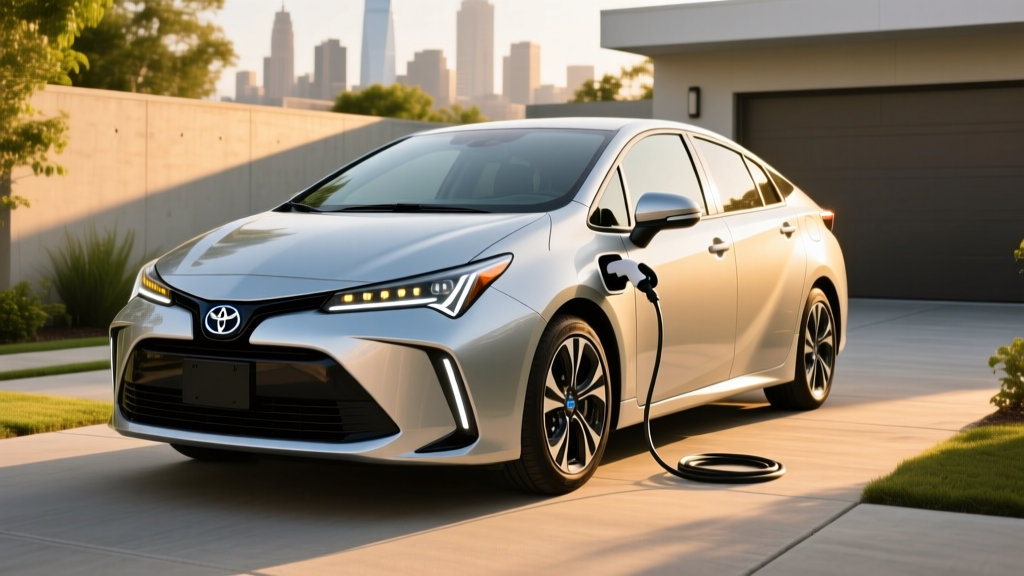
The Toyota Prius plug-in hybrid—officially badged as the Prius Prime since 2017—has long occupied a specific niche: the bridge between conventional hybrid efficiency and full-electric driving. For 2026, Toyota continues to refine the formula with a model that delivers meaningful electric-only range for daily commuting while retaining the gas-engine fallback that eliminates range anxiety entirely. If you've been searching for a "prius plugin" that actually makes sense in 2026's fragmented electrified-vehicle landscape, this is the guide.
This review breaks down the 2026 Prius Prime's real-world efficiency, electric range, charging behavior, powertrain specs, and federal tax credit eligibility. We'll also compare it head-to-head with the conventional Prius HEV and full battery-electric alternatives so you can determine which powertrain actually fits your driving pattern.
HEV vs PHEV: Which Prius Is Actually Right for You?
Before diving into specs, it's critical to distinguish between the two Prius models Toyota sells. The conventional Prius (HEV) never plugs in—it generates all its electricity from the gas engine and regenerative braking. The Prius Prime (PHEV) has a larger battery you can charge from a wall outlet or public charger, enabling electric-only driving before the gas engine kicks in.
| Feature | Prius HEV (Conventional Hybrid) | Prius Prime (Plug-In Hybrid) |
|---|---|---|
| Plugs in to charge? | No | Yes |
| Electric-only range | ~1 mile at low speed | 44 miles (EPA) |
| Battery capacity | ~1.0 kWh (small buffer) | 13.6 kWh (usable ~10.5 kWh) |
| EPA combined (hybrid mode) | 57 MPG | 52 MPG / 127 MPGe |
| Starting MSRP (2026) | ~$29,445 | ~$34,595 |
| Federal tax credit (§30D) | Not eligible | Up to $3,750* |
| Best for | No home charging access | Home charging + short commutes |
*Tax credit eligibility depends on income caps, MSRP limits, battery sourcing, and point-of-sale transfer rules under IRS §30D. See the tax credit section below for full details.
The decision framework is straightforward: if you can charge at home (even a standard 120V outlet works) and your daily round-trip commute is under 40 miles, the Prius Prime lets you drive almost entirely on electricity most days. If you lack charging access or regularly drive 60+ miles daily, the conventional Prius HEV delivers outstanding fuel economy without any plug-in logistics.
Electric Range and Efficiency: EPA vs Real World
The 2026 Prius Prime carries an EPA-rated 44 miles of electric-only range on a full charge, with a combined MPGe rating of 127 MPGe when operating in EV mode. Once the battery depletes, the vehicle switches to hybrid mode and returns an EPA-estimated 52 MPG combined (55 city / 51 highway for the SE trim; XSE and XSE Premium drop slightly to 50 combined due to larger wheels and added weight).
| Trim | EV Range (EPA) | MPGe (EV Mode) | MPG (Hybrid Mode) City/Hwy/Combined | Total Range |
|---|---|---|---|---|
| SE | 44 mi | 127 MPGe | 55 / 51 / 52 | ~610 mi |
| XSE | 40 mi | 119 MPGe | 53 / 48 / 50 | ~580 mi |
| XSE Premium | 40 mi | 119 MPGe | 53 / 48 / 50 | ~580 mi |
Real-world range reality: The EPA's 44-mile EV estimate assumes moderate temperatures and mixed driving. In practice, expect 36–42 miles in warm weather on a mix of city and highway driving. In cold weather (below 35°F), cabin heating and battery chemistry reduce usable EV range to roughly 28–34 miles. Highway-only driving at 70+ mph will also shrink range to approximately 32–36 miles due to aerodynamic drag. On the flip side, gentle city driving in mild weather can push EV range to 46–48 miles thanks to regenerative braking.
Once the battery is depleted, the Prius Prime operates as a conventional hybrid. According to fueleconomy.gov, owners who regularly charge report significantly lower gasoline consumption—some averaging over 100 MPGe equivalent over thousands of miles when most driving is electric. The key insight: your real-world efficiency depends almost entirely on how often you charge.
Powertrain and Performance Specs
Toyota's fifth-generation hybrid system in the 2026 Prius Prime pairs a 2.0-liter four-cylinder Atkinson-cycle engine with two motor-generators and a lithium-ion battery pack. The result is a combined system output of 220 horsepower—a dramatic upgrade from the 121 hp in the pre-2023 generation.
| Specification | 2026 Prius Prime |
|---|---|
| Combined system horsepower | 220 hp |
| Engine | 2.0L 4-cyl Atkinson (150 hp) |
| Electric motor output | 161 hp (front motor) |
| Battery chemistry | Lithium-ion (NMC) |
| Battery capacity (gross / usable) | 13.6 kWh / ~10.5 kWh |
| 0–60 mph | 6.6 seconds |
| Drivetrain | FWD (e-CVT) |
| EV top speed | ~84 mph |
| Cargo volume (rear seats up) | 20.3 cu ft |
| Curb weight | ~3,580 lbs (SE) |
The 6.6-second 0–60 time makes the Prius Prime genuinely quick for an efficiency-focused vehicle. The electric motor provides instant torque off the line, and the transition from EV to hybrid mode is nearly imperceptible under normal acceleration. The e-CVT (electronically controlled continuously variable transmission) eliminates shift shock, though it does produce the characteristic engine drone under hard acceleration that Toyota has partially mitigated with improved sound insulation in this generation.
Charging: Times, Connectors, and the DC Fast-Charging Gap
The Prius Prime charges through a J1772 connector (the standard North American AC charging port). Here's what charging looks like across different levels:
| Charging Level | Power (kW) | Full Charge Time (0–100%) | Where |
|---|---|---|---|
| Level 1 (120V household) | ~1.4 kW | ~11 hours | Standard outlet |
| Level 2 (240V home/public) | ~3.3 kW (vehicle-limited) | ~4 hours | Home wallbox, public L2 |
| DC Fast Charge | Not supported | N/A | N/A |
A critical detail many buyers miss: the Prius Prime's onboard charger is limited to 3.3 kW on Level 2, even if you plug it into a 7.2 kW or 11.5 kW home charger. This means a full charge always takes about 4 hours regardless of your home charger's capacity. For overnight charging this is perfectly adequate—plug in when you get home, wake up to a full battery every morning.
The DC fast-charging limitation is significant. The Prius Prime cannot accept DC fast charging at all. This is standard for most PHEVs (the battery is too small to benefit from DCFC infrastructure), but it means road trips rely entirely on the gas engine. On a 400-mile highway trip, you'll simply drive it as a 52 MPG hybrid—the plug-in advantage disappears until you can park and charge again.
For home charging, a standard 120V outlet technically works but requires 11 hours for a full charge—tight if you have a long commute and short overnight window. A 240V Level 2 outlet (even a simple NEMA 14-50 receptacle without a dedicated EVSE) cuts this to 4 hours and is strongly recommended. Installation of a 240V outlet typically costs $300–$800 depending on panel proximity, based on electrician estimates.
Pricing, Trims, and Federal Tax Credit Eligibility
The 2026 Toyota Prius Prime is offered in three trims:
| Trim | MSRP (incl. destination) | Key Features |
|---|---|---|
| SE | $34,595 | 17" alloy wheels, 8" touchscreen, wireless CarPlay/Android Auto, TSS 3.0 |
| XSE | $37,595 | 19" wheels, SofTex seats, heated front seats, 12.3" touchscreen |
| XSE Premium | $41,195 | Panoramic roof, premium audio, digital key, park assist |
Federal Tax Credit: What You Actually Qualify For
Under current IRS §30D rules, the Prius Prime may qualify for a partial federal tax credit of up to $3,750, contingent on several requirements:
- MSRP cap: The vehicle's MSRP must not exceed $55,000 for sedans (all Prius Prime trims qualify).
- Buyer income cap: Modified adjusted gross income must not exceed $150,000 (single), $225,000 (head of household), or $300,000 (joint).
- Battery component sourcing: A percentage of battery components must be manufactured or assembled in North America. The Prius Prime qualifies for the $3,750 component portion; critical-mineral sourcing requirements may limit the full $7,500 depending on supply-chain changes.
- Point-of-sale transfer: Eligible buyers can transfer the credit to the dealer at purchase, reducing the purchase price directly rather than waiting for a tax refund.
- Final assembly: Vehicle must undergo final assembly in North America (the Prius is assembled in Japan, which has historically complicated eligibility—verify current status with your dealer before purchase).
⚠️ Assembly location matters: Because the Prius Prime is assembled in Japan, its §30D eligibility has been inconsistent across model years. Before committing to a purchase, confirm the current credit status on the IRS clean vehicle credit list or with your Toyota dealer. Do not assume credit eligibility based on prior-year information. Rules and eligible-vehicle lists are updated periodically by the Treasury Department.
Some states offer additional PHEV incentives. California's CVRP program, for example, has historically offered rebates for qualifying PHEVs, though funding availability varies. Check your state energy office or AFDC incentive database for current local programs.
Battery Longevity, Warranty, and Replacement Costs
Hybrid and PHEV battery longevity remains one of the most common buyer concerns. Toyota has the longest track record in the industry—over 25 years of hybrid battery production—and the data is reassuring.
| Coverage | Term |
|---|---|
| Hybrid battery warranty | 10 years / 150,000 miles |
| Hybrid system components | 8 years / 100,000 miles |
| Basic vehicle warranty | 3 years / 36,000 miles |
| Powertrain warranty | 5 years / 60,000 miles |
The 10-year/150,000-mile hybrid battery warranty is among the best in the industry and applies in all 50 states. Toyota warrants the battery to retain at least 60% of its original capacity during the warranty period, though real-world degradation data from Toyota's hybrid fleet suggests most batteries retain 80–90% capacity well past 100,000 miles.
Replacement cost: If a battery replacement is needed out of warranty (rare, but possible at very high mileage), expect to pay between $3,500 and $5,500 including labor at a Toyota dealership. Independent hybrid specialists often perform the same service for $2,500–$4,000 using refurbished or new OEM cells. For context, most Prius batteries last 150,000–200,000+ miles before requiring replacement, and many original batteries are still functioning in vehicles with over 250,000 miles.
To maximize battery life: avoid routinely charging to 100% and leaving the car sitting in extreme heat (the Prius Prime's battery management system already buffers the top and bottom of the charge to protect longevity), and use EV mode for daily driving rather than saving it—the battery benefits from regular cycling.
Reliability and Safety
Toyota consistently ranks at or near the top of long-term reliability studies, and the Prius nameplate is one of the most proven in the industry. The current-generation Prius Prime shares its platform and hybrid system architecture with models that have accumulated billions of real-world miles globally.
On the safety front, the 2026 Prius Prime comes standard with Toyota Safety Sense 3.0, which includes:
- Pre-Collision System with pedestrian detection
- Lane Departure Alert with Steering Assist
- Full-Speed Range Dynamic Radar Cruise Control
- Lane Tracing Assist
- Road Sign Assist
- Proactive Driving Assist (gentle braking/deceleration support)
The IIHS has historically rated the Prius line well, and the current generation earned strong marks in crash testing. For the latest ratings, check the IIHS vehicle ratings page for the current model year.
One note on ADAS: Toyota's Lane Tracing Assist and Dynamic Radar Cruise Control constitute SAE Level 2 driver assistance. This means the system can steer and manage speed under driver supervision, but you must keep your hands on the wheel and eyes on the road at all times. It is not autonomous driving.
Prius Prime vs Full EV vs Conventional Hybrid: Decision Framework
Choose the Prius Prime (PHEV) if:
- You can charge at home (even a 120V outlet)
- Your daily commute is under 40 miles round-trip
- You take occasional road trips and don't want to plan around chargers
- You want EV-like daily driving without full-EV pricing
- You live in an area with limited public charging infrastructure
Choose the conventional Prius (HEV) if:
- You cannot charge at home or work
- Your daily driving exceeds 50+ miles consistently
- You want the lowest purchase price and simplest ownership
- You primarily drive highway miles (where the PHEV's EV range provides minimal benefit)
Choose a full EV (BEV) if:
- You have reliable home Level 2 charging
- You want zero gasoline purchases and minimal maintenance
- Your daily driving is under 250 miles and you can plan road-trip charging
- You qualify for the full $7,500 federal tax credit on a BEV
- You want the lowest per-mile fuel cost (electricity is typically $0.04–$0.06/mile vs $0.10–$0.14/mile for gas in the Prius)
The Prius Prime's ideal owner drives 20–35 miles daily, charges at home overnight, and takes 4–6 road trips per year where the gas engine provides seamless flexibility. In that pattern, annual gasoline consumption can drop to 150–250 gallons—compared to 500+ gallons for a typical gas car or 350+ gallons for the conventional Prius HEV covering the same distance.
Pros and Cons at a Glance
Pros
- 44-mile EV range covers most daily commutes gas-free
- 52 MPG hybrid mode eliminates range anxiety on road trips
- 220 hp makes it genuinely quick (6.6 sec 0–60)
- Charges on a standard 120V outlet (no expensive install required)
- 10-year/150,000-mile hybrid battery warranty
- Strong resale value and proven Toyota reliability
- Standard Toyota Safety Sense 3.0 suite
Cons
- No DC fast charging (road trips are gas-only)
- 3.3 kW onboard charger limits Level 2 speed
- EV range drops significantly in cold weather (~28–34 mi)
- Higher starting price than conventional Prius ($5,000+ premium)
- Federal tax credit eligibility complicated by Japan assembly
- Cargo space reduced vs conventional Prius (battery packaging)
- XSE trims sacrifice EV range for larger wheels
Frequently Asked Questions
How many MPG does the 2026 Prius Prime get?
In hybrid mode (after the battery is depleted), the Prius Prime SE achieves an EPA-estimated 55 city / 51 highway / 52 combined MPG. In EV mode, it's rated at 127 MPGe. Real-world city driving often exceeds the EPA estimate—many owners report 55–60 MPG in stop-and-go traffic where regenerative braking is most effective. Highway cruising at 75+ mph typically yields 46–50 MPG.
How far can the Prius Prime go on electric only?
The EPA rates the 2026 Prius Prime SE at 44 miles of electric-only range. In warm weather mixed driving, expect 36–42 miles. In cold weather or at sustained highway speeds, expect 28–36 miles. The XSE and XSE Premium trims are rated at 40 miles due to larger 19-inch wheels and additional equipment weight.
Does the Prius Prime qualify for a federal tax credit?
Under current IRS §30D rules, the Prius Prime may qualify for up to $3,750 (the battery-component portion of the credit), but eligibility is complicated by the vehicle's Japan assembly. Income caps ($150K single / $300K joint), MSRP limits ($55K for sedans), and battery sourcing rules all apply. Always verify current eligibility on the IRS clean vehicle credit list before purchasing. The credit can be transferred to the dealer at point of sale if eligible.
Is the Prius Prime reliable, and what does a battery replacement cost?
Toyota's hybrid systems have an exceptional reliability record spanning 25+ years. The Prius Prime's hybrid battery is covered by a 10-year/150,000-mile warranty. Out-of-warranty battery replacement typically costs $3,500–$5,500 at a dealership, though most batteries last 150,000–200,000+ miles. The vehicle's overall mechanical simplicity (no traditional transmission, fewer moving parts than a gas car) contributes to lower long-term maintenance costs.
Do I need to install a home charger for the Prius Prime?
No—a standard 120V household outlet will fully charge the Prius Prime in about 11 hours, which works for overnight charging. However, a 240V Level 2 outlet (NEMA 14-50 or hardwired EVSE) reduces charge time to approximately 4 hours and is recommended if your daily driving approaches the 44-mile EV range limit. Installation costs typically range from $300 (simple outlet near panel) to $1,500+ (panel upgrade or long wire run).
Hybrid vs PHEV vs EV—which should I actually buy?
If you can charge at home and commute under 40 miles daily, the Prius Prime PHEV gives you electric daily driving with gas-engine road-trip flexibility. If you can't charge at home, the conventional Prius HEV delivers 57 MPG without any plug-in logistics. If you have home charging, drive under 250 miles daily, and want the lowest operating cost, a full EV like the Hyundai Ioniq 6 or Tesla Model 3 eliminates gasoline entirely but requires road-trip charging planning.