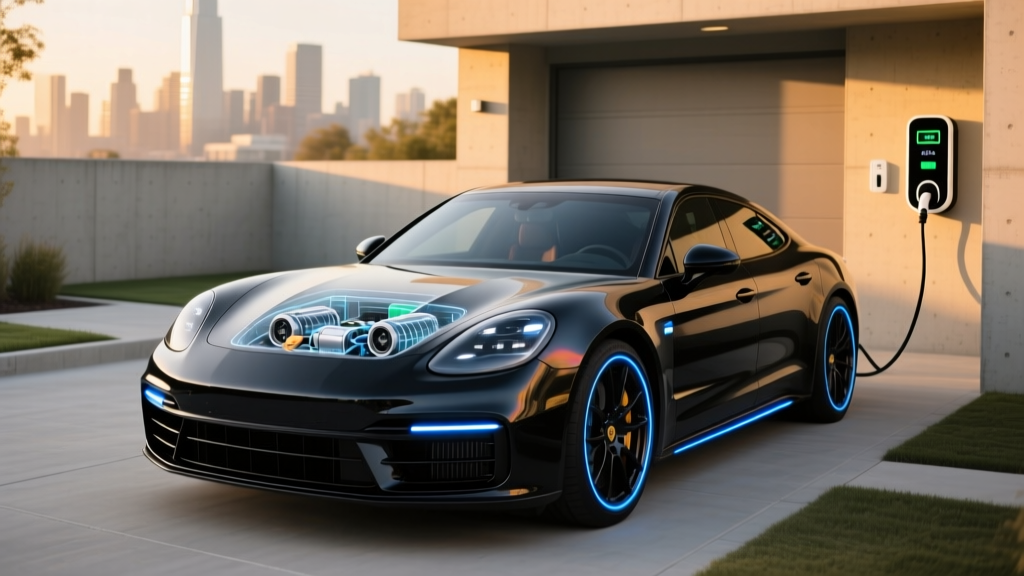
The 2026 Porsche Panamera Turbo S E-Hybrid sits at a rare intersection: a 717-horsepower luxury sedan that can also commute on electricity alone. It is a plug-in hybrid (PHEV), not a conventional hybrid, meaning it pairs a large traction battery and electric motor with a twin-turbo V8—and you can plug it in to recharge. For buyers cross-shopping the Mercedes-AMG S 63 E Performance or the BMW M760e xDrive, the Porsche Turbo S hybrid is the driver's pick. But PHEV ownership comes with real trade-offs in weight, charging logistics, and price. Here is every number that matters.
HEV vs PHEV: What the Panamera Turbo S E-Hybrid Actually Is
Before diving into specs, it is critical to distinguish the two hybrid architectures, because Porsche sells both in the Panamera lineup:
Conventional Hybrid (HEV)
A small battery (typically 1–2 kWh) recharges via regenerative braking and the engine. You never plug it in. Electric-only driving is limited to brief low-speed assist. Examples: Toyota Camry Hybrid, Honda Accord Hybrid.
Plug-In Hybrid (PHEV)
A much larger battery (the Panamera Turbo S E-Hybrid uses a 25.9 kWh pack) recharges from a wall outlet or charger. It delivers meaningful electric-only range—roughly 30 miles in this case—before the gas engine takes over. This is what the Turbo S E-Hybrid is.
The Panamera 4 E-Hybrid and Turbo S E-Hybrid share the PHEV architecture, but the Turbo S layers on a more powerful V8 and a larger electric motor for a combined output that dwarfs most supercars.
Powertrain and Performance Specs
The 2026 Panamera Turbo S E-Hybrid pairs a 4.0-liter twin-turbocharged V8 with an electric motor integrated into the 8-speed PDK dual-clutch transmission. Here is the full output breakdown:
| Specification | Value |
|---|---|
| Engine | 4.0L Twin-Turbo V8 |
| Engine Output | 523 hp / 568 lb-ft |
| Electric Motor Output | 190 hp / 332 lb-ft |
| Combined System Output | 717 hp / 664 lb-ft |
| Battery Capacity (Usable) | 25.9 kWh (NMC chemistry) |
| Transmission | 8-speed PDK dual-clutch |
| Drivetrain | All-wheel drive (AWD) |
| 0–60 mph | 2.9 seconds |
| Top Track Speed | 199 mph |
| Curb Weight | ~5,350 lbs |
| Starting MSRP | $198,400 (Sedan) / $202,100 (Sport Turismo) |
That 717-hp figure is not marketing fluff—it is verified by Porsche and independently tested. The electric motor fills the torque gap at low RPM before the turbos spool up, which is why a 5,350-pound sedan hits 60 mph in under three seconds. The trade-off is mass: the Turbo S E-Hybrid carries roughly 600 lbs more than a gas-only Panamera Turbo, which you will feel in tight corners and braking zones.
Electric-Only Range and Total Driving Range
The EPA rates the 2026 Panamera Turbo S E-Hybrid at approximately 30 miles of electric-only range. In real-world conditions, expect closer to 25–28 miles in mixed city/highway driving, and potentially as low as 20 miles in cold weather (below 40°F), where the battery's usable capacity shrinks and cabin heating draws additional power.
EPA Electric-Only Range: ~30 miles
Real-World Expectation: 25–28 mi (mild weather), 20–23 mi (cold/highway)
Total Combined Range (Electric + Gas): ~440 miles (17.9-gallon tank + battery)
Once the battery is depleted, the car operates as a conventional hybrid, seamlessly blending engine and motor power. You do not need to manage the transition manually—Porsche's hybrid management system handles it. Drivers can also select E-Power mode (electric priority), Hybrid Auto (system decides), or Sport/ Sport Plus (engine always active for maximum performance).
Fuel Economy: EPA MPG and Real-World Efficiency
PHEV fuel economy is expressed two ways: MPGe (miles-per-gallon-equivalent, which includes electric driving) and MPG (gas-only operation after the battery is depleted). Here is the full breakdown:
| Mode | City | Highway | Combined |
|---|---|---|---|
| Charge-Depleting (Electric + Gas, MPGe) | — | — | ~48 MPGe |
| Charge-Sustaining (Gas Only, MPG) | ~20 MPG | ~26 MPG | ~22 MPG |
Real-world note: If you charge nightly and your commute is under 30 miles, you may burn almost no gasoline during the work week. On a long road trip with no charging stops, expect the 22 MPG combined figure—or slightly less if you drive aggressively, which is tempting given the powertrain. For context, the non-hybrid Panamera Turbo returns roughly 18 MPG combined, so the PHEV does offer a measurable efficiency advantage even without plugging in, thanks to regenerative braking and electric assist at low speeds. Data sourced from fueleconomy.gov.
Charging: How Long and What Equipment You Need
The Panamera Turbo S E-Hybrid supports Level 2 AC charging via its onboard charger, rated at up to 11 kW. It does not support DC fast charging—a common limitation among PHEVs due to battery size and cost trade-offs. Here is the charging time breakdown:
| Charging Level | Power | 0–100% Time | Where |
|---|---|---|---|
| Level 1 (120V household) | ~1.4 kW | ~18–20 hours | Standard outlet |
| Level 2 (240V, 48A circuit) | Up to 11 kW | ~2.5 hours | Home wallbox or public L2 |
| DC Fast Charge | Not supported | N/A | N/A |
A 2.5-hour Level 2 charge means you can fully replenish the battery during a workday or overnight with a home wallbox. Porsche recommends a dedicated 240V / 60A circuit (providing ~48A continuous) for optimal charging. Expect a home Level 2 installation to cost between $800 and $2,000 depending on panel proximity and local permitting, according to typical electrician estimates. The charge port uses the standard J1772 connector for Level 2 AC charging in North America—no NACS or CCS adapter is needed for AC, since DC fast charging is not available.
Tax Credits, Pricing, and Ownership Costs
The 2026 Porsche Panamera Turbo S E-Hybrid starts at $198,400 for the sedan and $202,100 for the Sport Turismo (wagon) body style, before destination and options. Well-equipped examples easily clear $220,000.
Federal §30D Tax Credit Eligibility
- MSRP Cap: Sedans must be under $55,000; SUVs/trucks/vans under $80,000. The Panamera at ~$198K does not qualify for the new-vehicle §30D credit.
- Buyer Income Cap: $150K single / $300K joint (AGI). Irrelevant here due to MSRP cap.
- Battery Sourcing: Critical minerals and battery component rules apply. Irrelevant here due to MSRP cap.
- Used EV Credit (§25E): Up to $4,000 for used PHEVs priced under $25,000. Also does not apply to this vehicle's price range.
Bottom line: The Panamera Turbo S E-Hybrid does not qualify for any federal tax credit due to its MSRP. Always verify current rules at IRS.gov, as regulations can shift.
Some states and utilities offer separate PHEV rebates (for example, certain California and New York programs), but these typically have income and price caps that exclude vehicles in this range. Check your state energy office or utility provider for specifics.
Reliability, Battery Warranty, and Long-Term Costs
Porsche provides the following warranty coverage for the 2026 Panamera Turbo S E-Hybrid's hybrid components:
- High-Voltage Battery Warranty: 8 years / 100,000 miles (whichever comes first), covering defects and capacity loss below 70% of original capacity
- Hybrid Component Warranty: 8 years / 100,000 miles (electric motor, power electronics, onboard charger)
- New Vehicle Limited Warranty: 4 years / 50,000 miles
- Maintenance Program: 1 year / 10,000 miles included
Is it reliable? Porsche's PHEV powertrain has been in production since the 2017 Panamera E-Hybrid, and the 2024+ generation uses an updated, more robust battery pack. The V8 is a known quantity from the Cayenne Turbo and 911 Turbo lines. That said, PHEVs add complexity—two powertrains, high-voltage systems, and additional cooling circuits—compared to a pure EV or gas car. If the high-voltage battery requires out-of-warranty replacement, expect a cost between $15,000 and $22,000 based on current Porsche parts pricing. Most owners will not face this within typical ownership periods given the 8-year warranty, but it is a factor for second- and third-generation used buyers.
For additional safety and reliability data, consult NHTSA.gov and IIHS.org once crash-test results are published for the current model year.
Who Should Buy This PHEV vs a Full EV or Gas Car
Choose the Panamera Turbo S E-Hybrid (PHEV) if:
- You want supercar acceleration (2.9s 0–60) with a usable electric commute mode
- You have home Level 2 charging and a commute under 30 miles
- You take regular road trips and want zero range anxiety (440+ mi total range)
- You value Porsche's driving dynamics and do not want the heavier, softer feel of an electric luxury sedan
Choose a Full EV (Taycan, Lucid Air, Model S) if:
- Your commute is under 250 miles and you have reliable home + public charging
- You want zero tailpipe emissions and lower per-mile energy cost (~$0.04/mi vs ~$0.15/mi on gas)
- You prefer minimal maintenance (no oil changes, no engine, fewer fluids)
- You want DC fast charging for road trips (Taycan peaks at 320 kW, 10–80% in ~18 min)
Choose the Gas-Only Panamera Turbo if:
- You lack access to home charging and do not want to manage plug-in logistics
- You want a lower purchase price (~$185,000 base) and less vehicle weight
- Your driving is predominantly highway, where PHEV electric range provides minimal benefit
Pros and Cons at a Glance
Pros
- 717 hp with 2.9-second 0–60 mph—supercar pace in a four-door
- ~30 miles of silent, zero-emission electric commuting
- 440+ mile total range eliminates road-trip charging anxiety
- 11 kW onboard charger replenishes battery in ~2.5 hours
- 8-year / 100,000-mile hybrid battery warranty
- Best-in-class driving dynamics for the luxury PHEV segment
Cons
- $198,400+ MSRP with no federal tax credit eligibility
- No DC fast charging—road trips rely entirely on gasoline
- ~5,350 lbs curb weight reduces agility vs gas-only Panamera
- 22 MPG combined when running on gas alone is modest
- Out-of-warranty battery replacement could exceed $15,000
- Competitors (AMG S 63 E Performance) offer similar power for less
Frequently Asked Questions
How many MPG does the Porsche Turbo S Hybrid get?
The 2026 Panamera Turbo S E-Hybrid achieves approximately 48 MPGe combined when operating in electric-gas blend mode, and about 22 MPG combined (20 city / 26 highway) when running on gasoline alone after the battery is depleted. Real-world figures vary with driving style and conditions.
How far can the Porsche Panamera Turbo S E-Hybrid go on electric only?
The EPA rates it at roughly 30 miles of electric-only range. Real-world results typically fall between 25–28 miles in mild weather, dropping to 20–23 miles in cold conditions or at sustained highway speeds.
Hybrid vs PHEV vs EV — which fits my lifestyle?
If you can charge at home and your commute is under 30 miles, a PHEV like the Panamera Turbo S gives you electric weekday driving with gasoline road-trip freedom. If you have reliable charging and drive under 250 miles daily, a full EV (like the Taycan) offers lower running costs and less maintenance. A conventional hybrid (HEV) is best if you cannot plug in at all but still want better fuel economy than a gas-only car.
Is the Porsche PHEV reliable and what does battery replacement cost?
Porsche's PHEV system has been in production since 2017 with generally strong reliability. The high-voltage battery is warranted for 8 years / 100,000 miles. An out-of-warranty replacement is estimated at $15,000–$22,000, though most original owners will not encounter this.
Does the Porsche Panamera Turbo S E-Hybrid qualify for a tax credit?
No. The federal §30D clean vehicle credit has an MSRP cap of $55,000 for sedans. At $198,400+, the Panamera Turbo S E-Hybrid does not qualify. Some state or utility incentives may apply, but most also have price caps. Always check IRS.gov for the latest rules.
Can the Panamera Turbo S E-Hybrid DC fast charge?
No. It supports Level 2 AC charging at up to 11 kW (full charge in ~2.5 hours) but does not accept DC fast charging. This is typical for PHEVs, whose smaller batteries do not justify the cost and weight of DC fast-charge hardware.
How long does it take to charge at home?
On a 240V Level 2 wallbox at 11 kW, approximately 2.5 hours from empty to full. On a standard 120V household outlet (Level 1, ~1.4 kW), expect 18–20 hours—impractical for daily use unless your daily electric driving is minimal.