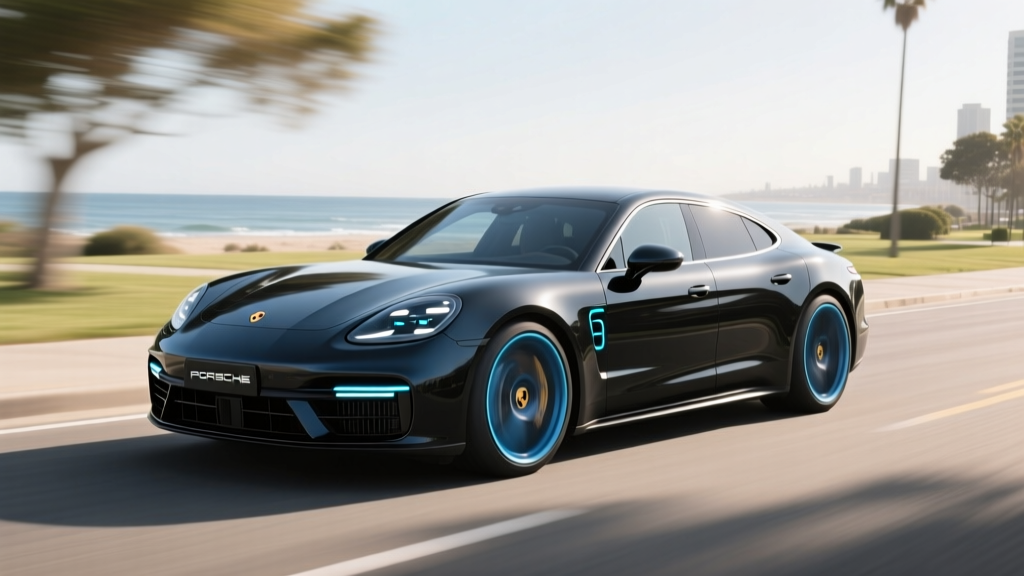
Quick Verdict: The Panamera E-Hybrid in 2026
The Porsche Panamera E-Hybrid occupies a narrow but compelling lane: a full-size luxury sport sedan that can handle school-dropoff and grocery runs on electric-only power, then wake up a twin-turbo V6 (or V8 in the Turbo variant) when you need autobahn-grade thrust. For the 2026 model year, Porsche continues the fourth-generation E-Hybrid architecture introduced in late 2023 — pairing a 25.9 kWh (gross) / 25.6 kWh (net usable) lithium-ion battery with a revised electric motor integrated into the 8-speed PDK dual-clutch transmission. The result is a plug-in hybrid (PHEV) that delivers roughly 25–29 miles of electric-only range and a combined system output ranging from 463 hp in the base E-Hybrid to 670 hp in the Turbo E-Hybrid.
But the Panamera E-Hybrid is not a disguised EV. It is a performance sedan with an electric assist that happens to offer meaningful zero-emission commuting capability. If your daily drive is under 25 miles and you can charge at home, you may go weeks without burning fuel. If you regularly exceed that, the V6 takes over seamlessly — and the combined fuel economy, while respectable for a 5,000-lb luxury car, won't rival a Prius. This guide breaks down exactly what you get, what it costs, and whether the E-Hybrid powertrain is the right call versus a full battery-electric vehicle (BEV) or the conventional gas-only Panamera.
HEV vs PHEV: Where the Panamera Fits
Before diving into specs, it is worth clarifying terminology because Porsche's naming can confuse shoppers:
Conventional Hybrid (HEV)
A conventional hybrid — like a Toyota Camry Hybrid — uses a small battery (typically 1–2 kWh) recharged solely by regenerative braking and the gasoline engine. You never plug it in. Electric-only driving is limited to very low speeds and short distances. The Panamera is not offered as a conventional HEV in the US market.
Plug-in Hybrid (PHEV)
A plug-in hybrid carries a significantly larger battery (the Panamera E-Hybrid uses 25.6 kWh usable) and can be plugged into a Level 2 home charger or public AC station. It offers a meaningful electric-only range — in this case roughly 25–29 miles — before the gas engine engages. The Panamera E-Hybrid is exclusively a PHEV.
The distinction matters for tax credits, daily driving behavior, and charging infrastructure needs. If you cannot install a home charger or access workplace charging, much of the E-Hybrid's efficiency advantage is lost.
Powertrain and Performance Specs
The 2026 Panamera E-Hybrid lineup spans multiple trims, each pairing Porsche's latest electric motor module (integrated into the PDK transmission housing) with either a 2.9L twin-turbo V6 or a 4.0L twin-turbo V8. The electric motor alone produces up to 190 hp (140 kW), and total system output varies significantly by trim.
| Spec | Panamera 4 E-Hybrid | Panamera 4S E-Hybrid | Panamera Turbo E-Hybrid |
|---|---|---|---|
| Gas Engine | 2.9L TT V6 | 2.9L TT V6 | 4.0L TT V8 |
| Engine HP (alone) | 300 hp | 353 hp | 523 hp |
| Electric Motor | 190 hp (140 kW) | 190 hp (140 kW) | 190 hp (140 kW) |
| Combined System HP | 463 hp | 559 hp | 670 hp |
| Combined Torque | 516 lb-ft | 590 lb-ft | 738 lb-ft |
| 0–60 mph | 4.1 sec | 3.5 sec | 3.0 sec |
| Top Speed | 174 mph | 180 mph | 200 mph |
| Battery (Gross / Net Usable) | 25.9 kWh / 25.6 kWh | ||
| Transmission | 8-speed PDK dual-clutch | ||
| Drivetrain | All-wheel drive (AWD) | ||
Acceleration figures are impressive across the board — the Turbo E-Hybrid's 3.0-second 0–60 time places it in supercar territory. But the more relevant number for daily driving is the electric motor's instant torque delivery, which makes the base 4 E-Hybrid feel significantly quicker off the line than its 4.1-second 0–60 suggests.
Electric-Only Range and Total Range
The EPA rates the 2026 Panamera 4 E-Hybrid at approximately 28 miles of electric-only range. Real-world results depend heavily on driving style, temperature, and terrain:
Range Reality Check
EPA Electric-Only: ~28 miles (4 E-Hybrid)
Real-World Expectation: 22–26 miles in mixed driving; as low as 18 miles at sustained highway speeds (70+ mph) or in cold weather below 35°F. City driving with frequent regen braking can push toward 30 miles.
Total Combined Range (Electric + Gas): Approximately 400–430 miles with a full tank and full battery, depending on trim and driving conditions.
For context, 28 miles of electric range covers the average American's one-way commute (roughly 16 miles, per Census data) with margin to spare — but only if you charge daily. The 18.0-gallon fuel tank ensures road trips are no different from a conventional Panamera.
Fuel Economy: EPA Numbers vs Real-World MPG
PHEV fuel economy is expressed in two ways: MPGe (miles-per-gallon-equivalent, measuring combined electric + gas efficiency) and MPG (gasoline-only operation once the battery is depleted). Here is how the 2026 lineup breaks down:
| Trim | MPGe (Combined) | MPG Gas-Only (City) | MPG Gas-Only (Hwy) | MPG Gas-Only (Combined) |
|---|---|---|---|---|
| Panamera 4 E-Hybrid | 52 MPGe | 22 | 27 | 24 |
| Panamera 4S E-Hybrid | 49 MPGe | 21 | 26 | 23 |
| Panamera Turbo E-Hybrid | 45 MPGe | 19 | 24 | 21 |
Source: fueleconomy.gov — verify exact figures for your trim and model year, as EPA ratings can shift with mid-year running changes.
Real-World MPG Notes
Like most PHEVs, the Panamera E-Hybrid's actual efficiency depends entirely on how often you drive within the electric-only envelope. Owners who charge nightly and commute under 25 miles report effectively using 1–2 gallons of fuel per week. Once the battery is depleted and you are driving on gasoline alone, expect the gas-only combined MPG figures above — which are reasonable for a 5,000-lb AWD performance sedan but not class-leading. Highway-heavy road trips with no charging will return 23–27 MPG in the V6 trims, consistent with the EPA highway estimates.
Charging: Speeds, Connectors, and Home Setup
The Panamera E-Hybrid charges via AC only — there is no DC fast charging capability. This is typical for PHEVs, whose smaller batteries do not justify the cost and weight of DC hardware. Here is what to expect:
| Charging Level | Power | Time (0–100%) | Notes |
|---|---|---|---|
| Level 1 (120V household) | ~1.4 kW | ~18 hours | Emergency/top-up only; impractical for daily use |
| Level 2 (240V home/public) | Up to 7.2 kW (onboard charger limit) | ~3.5–4 hours | Recommended for daily charging; full overnight fill |
| DC Fast Charge | N/A | N/A | Panamera E-Hybrid does not support DC fast charging |
Connector: The Panamera E-Hybrid uses a J1772 connector for AC charging (standard on all non-Tesla PHEVs in the US). No NACS adapter is needed since NACS is primarily relevant for DC Supercharger access, which this vehicle cannot use.
Home Charging Setup: A Level 2 home charger (240V, 32–40A circuit) is strongly recommended. With the 7.2 kW onboard charger, a full charge takes roughly 3.5 hours — easily completed overnight. Expect to spend $500–$1,500 on a quality Level 2 EVSE (ChargePoint Home Flex, Emporia Vue, or Porsche's own Mobile Charger Connect) plus $500–$2,000 for electrician installation depending on panel proximity and local permit costs. If your home electrical panel needs a service upgrade (200A+), add $1,500–$3,500.
Pricing, Trims, and Tax Credit Eligibility
The 2026 Porsche Panamera E-Hybrid lineup starts in the low six figures and climbs steeply with options. Here is the base MSRP by trim before destination charges:
| Trim | Base MSRP (approx.) |
|---|---|
| Panamera 4 E-Hybrid | $109,000 |
| Panamera 4S E-Hybrid | $127,000 |
| Panamera Turbo E-Hybrid | $195,000 |
Federal Tax Credit: §30D Eligibility
Under current IRS §30D rules, the Panamera E-Hybrid's federal tax credit eligibility is constrained by several factors:
- MSRP Cap: Sedans must have an MSRP at or below $55,000 to qualify. The Panamera E-Hybrid exceeds this cap in every trim — making it ineligible for the new-vehicle §30D credit.
- Battery Sourcing: Even if MSRP were within limits, critical mineral and battery component sourcing requirements must be met (phased in through 2029).
- Buyer Income Cap: Modified AGI must not exceed $150K (single) / $300K (joint) — though this is moot given the MSRP disqualification.
- Point-of-Sale Transfer: Available for qualifying vehicles, but again not applicable here.
Bottom line: The 2026 Panamera E-Hybrid does not qualify for the $7,500 federal EV tax credit due to its MSRP exceeding the $55,000 sedan cap. Some states may offer separate PHEV incentives — check your state's energy office or AFDC state incentive database for local programs. Always consult a tax professional for your specific situation.
Battery Warranty, Reliability, and Replacement Cost
Porsche High-Voltage Battery Warranty
Coverage: 8 years / 100,000 miles (whichever comes first)
Capacity Retention Threshold: Porsche warrants the high-voltage battery against defects and excessive capacity loss. If the battery falls below approximately 70% of its original capacity within the warranty period, Porsche will repair or replace it.
Out-of-Warranty Replacement Cost: Based on current dealer estimates, a full high-voltage battery replacement for the Panamera E-Hybrid runs approximately $15,000–$22,000 including parts and labor. This figure can vary by model year and whether individual modules can be replaced rather than the full pack.
Porsche's hybrid systems have proven generally reliable since the Cayenne and Panamera E-Hybrid refreshes. The PDK-integrated electric motor eliminates a separate belt-driven starter/alternator, reducing mechanical complexity. The high-voltage battery uses liquid cooling and active thermal management, which helps mitigate degradation compared to passively cooled packs.
For long-term ownership, note that hybrid battery degradation is gradual — most owners report losing 1–3% capacity per year under normal use. At 8 years, you might see 85–90% of original capacity retained, well above the warranty threshold. If you plan to keep the vehicle beyond 100,000 miles, budgeting for eventual battery replacement (or purchasing an extended warranty) is prudent.
Panamera E-Hybrid vs Full EV vs Gas: Who Should Choose What?
Choose the Panamera E-Hybrid (PHEV) if:
- Your daily commute is under 25 miles round-trip and you can charge at home nightly
- You want one vehicle that handles both zero-emission commuting and 500-mile road trips without range planning
- You value the Panamera's driving dynamics and luxury but want to reduce fuel consumption for local driving
- You are not ready to commit to a full EV due to charging access limitations or frequent long-distance travel
Choose a Full EV (like the Porsche Taycan or Tesla Model S) if:
- You have reliable home Level 2 charging and your daily driving is within the EV's range
- You want to eliminate gasoline costs entirely and minimize maintenance (no oil changes, fewer moving parts)
- You qualify for the $7,500 federal tax credit (many EVs under the $55K sedan / $80K SUV cap do)
- You rarely take trips beyond 250–300 miles without overnight stops
Choose the Gas-Only Panamera if:
- You cannot charge at home or work and would rarely use the electric range
- You want lower upfront cost (the gas Panamera starts roughly $20,000–$25,000 less than the E-Hybrid equivalent)
- Your driving is predominantly highway and long-distance, where the E-Hybrid's battery weight provides no efficiency benefit
The Panamera E-Hybrid makes the most sense as a "best of both worlds" proposition for luxury sedan buyers who have charging access but are not ready to go fully electric. The premium you pay over the gas Panamera — roughly $15,000–$20,000 depending on trim — is recouped through fuel savings only over many years of short, electric-commute-heavy driving. For most buyers, the E-Hybrid is a lifestyle and environmental choice as much as an economic one.
Pros and Cons
Pros
- 25–29 miles of electric-only range covers most daily commutes
- 463–670 hp combined output — genuine sports sedan performance
- Seamless transitions between electric and gas power; no compromise in driving feel
- 8-year/100,000-mile high-voltage battery warranty
- 400+ mile total range eliminates road-trip range anxiety
- Regenerative braking and E-Hold/E-Charge modes give driver control over battery usage
Cons
- No DC fast charging — AC-only at 7.2 kW max
- Ineligible for the $7,500 federal §30D tax credit (MSRP exceeds cap)
- $15,000–$22,000 out-of-warranty battery replacement cost
- Gas-only MPG (21–24 combined) is modest once battery depletes
- Significant price premium over gas-only Panamera trims
- Added weight from battery and motor (~500 lbs over gas equivalent) slightly impacts handling
Frequently Asked Questions
How many MPG does the Porsche Panamera E-Hybrid get?
With a full battery and regular charging, the Panamera 4 E-Hybrid achieves up to 52 MPGe combined. Once the battery is depleted and you drive on gasoline alone, expect 22 city / 27 highway / 24 combined MPG in the V6 trims, and 19/24/21 in the V8 Turbo E-Hybrid. Real-world results vary significantly based on how often you drive within the electric-only range.
How far can the Panamera E-Hybrid go on electric only?
The EPA rates the 2026 Panamera 4 E-Hybrid at approximately 28 miles of electric-only range. In real-world driving, expect 22–26 miles in mixed conditions, potentially dropping to 18 miles at sustained highway speeds or in cold weather. City driving with regenerative braking can stretch this to near 30 miles.
Does the Panamera E-Hybrid qualify for any tax credit?
No. Under current IRS §30D rules, the federal new clean vehicle credit requires sedans to have an MSRP at or below $55,000. The Panamera E-Hybrid starts at approximately $109,000, disqualifying it entirely. Some state-level PHEV incentives may apply — check your local programs. Always verify with a tax professional.
Is the Porsche Panamera E-Hybrid reliable, and what does a battery replacement cost?
Porsche's E-Hybrid powertrain has shown solid reliability since the current generation launched. The high-voltage battery carries an 8-year/100,000-mile warranty with a ~70% capacity retention threshold. Out-of-warranty replacement costs approximately $15,000–$22,000 depending on whether module-level or full-pack replacement is needed. Routine hybrid system maintenance is minimal — the electric motor requires no service.
Can the Panamera E-Hybrid charge at Tesla Superchargers?
No. The Panamera E-Hybrid supports AC charging only (J1772 connector, up to 7.2 kW) and has no DC fast-charge capability. Tesla Superchargers provide DC power, which the Panamera cannot accept. You will charge at home on a Level 2 station or at public AC chargers (ChargePoint, EVgo Level 2 stations, etc.).
Hybrid vs PHEV vs EV — which powertrain is right for me?
A conventional hybrid (HEV) requires no plug-in and offers modest efficiency gains — ideal if you lack charging access. A PHEV like the Panamera E-Hybrid offers meaningful electric-only range (25–29 mi) when plugged in regularly, plus a gas engine for longer trips — best for drivers with home charging who also take road trips. A full EV (BEV) eliminates gasoline entirely with 250–400+ miles of range but requires reliable charging access and route planning for long trips. The right choice depends on your charging access, daily mileage, and willingness to plan around charging.
How long does it take to charge the Panamera E-Hybrid at home?
On a 240V Level 2 home charger delivering the car's maximum 7.2 kW, a full 0–100% charge takes approximately 3.5–4 hours. On a standard 120V household outlet (Level 1), expect roughly 18 hours — practical only for overnight top-ups, not full charges. A Level 2 home installation is strongly recommended for any PHEV owner.