The 2023 Porsche Cayenne Turbo S E-Hybrid at a Glance
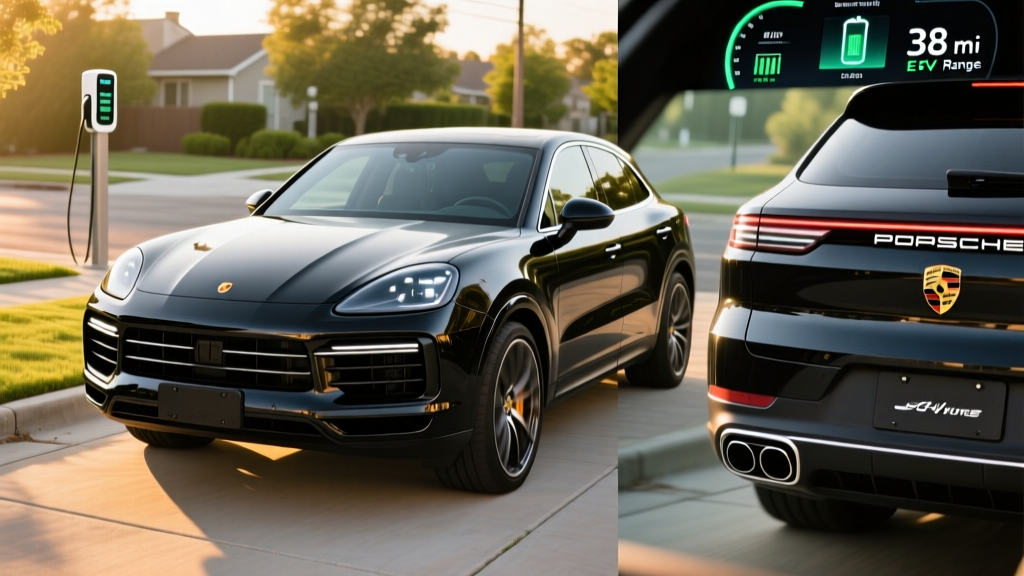
The 2023 Porsche Cayenne Turbo S E-Hybrid occupies a rare corner of the plug-in hybrid market: it pairs a twin-turbo V8 with an electric motor to produce 670 horsepower while still offering a modest electric-only driving range. It's a performance-first PHEV that prioritizes acceleration and chassis dynamics over maximizing efficiency — a trade-off that defines who this vehicle is actually for.
As of 2026, the 2023 model year represents the final iteration of Porsche's first-generation Cayenne E-Hybrid lineup before the significantly updated 2024+ models arrived with larger batteries and revised powertrains. That makes the 2023 Turbo S E-Hybrid both a benchmark and a baseline for understanding what Porsche's PHEV technology delivered before its next evolution.
| Specification | 2023 Cayenne Turbo S E-Hybrid |
|---|---|
| Combined HP | 670 hp (541 hp V8 + 134 hp electric motor) |
| Combined Torque | 663 lb-ft |
| 0–60 mph | 3.6 seconds (manufacturer) |
| Battery (usable) | 14.1 kWh (NMC lithium-ion) |
| EPA Electric-Only Range | 17 miles |
| EPA MPGe (combined) | 46 MPGe |
| EPA MPG (gas only, combined) | 19 MPG |
| Top Speed | 183 mph |
| DC Fast Charging | No (AC only) |
| Level 2 Charge Time (0–100%) | ~2.5 hours at 7.2 kW |
| Base MSRP (at launch) | $178,100 (Coupe: $183,500) |
| Battery Warranty | 8 years / 100,000 miles |
HEV vs PHEV: Where the Cayenne Turbo S E-Hybrid Fits
Understanding whether this Cayenne is the right electrified vehicle requires a clear distinction between hybrid types:
| Feature | Conventional Hybrid (HEV) | Plug-In Hybrid (PHEV) | Battery Electric (BEV) |
|---|---|---|---|
| Plugs in? | No | Yes | Yes |
| Electric-only range | 0–2 miles (low speed only) | 15–45 miles typical | 200–400+ miles |
| Gas engine | Yes (primary) | Yes (backup + performance) | No |
| Battery size | 1–2 kWh | 10–25 kWh typical | 60–130+ kWh |
| Federal tax credit | No | Up to $7,500 (varies) | Up to $7,500 (varies) |
| Example | Toyota RAV4 Hybrid | Cayenne Turbo S E-Hybrid | Porsche Taycan |
The 2023 Cayenne Turbo S E-Hybrid is a PHEV. It has a charge port, a 14.1 kWh battery pack, and the ability to drive approximately 17 miles on electricity alone before the twin-turbo 4.0-liter V8 engages. Unlike a conventional hybrid such as the Toyota Highlander Hybrid, you can plug it in — and to extract any meaningful efficiency benefit, you should plug it in regularly.
Fuel Economy: EPA Numbers vs Real-World Results
The EPA rates the 2023 Cayenne Turbo S E-Hybrid at 46 MPGe combined when operating in electric-assisted mode, and 19 MPG combined (17 city / 22 highway) once the battery is depleted and the vehicle runs as a conventional hybrid. According to fueleconomy.gov, these figures place it among the least efficient PHEVs on the market — but context matters.
| Driving Scenario | EPA Estimate | Real-World Expectation |
|---|---|---|
| Combined (charge-sustaining) | 19 MPG | 17–20 MPG |
| City (charge-sustaining) | 17 MPG | 16–19 MPG (regen helps in stop-and-go) |
| Highway (charge-sustaining) | 22 MPG | 19–21 MPG (aero drag and weight hurt at speed) |
| Combined (with daily charging) | 46 MPGe | 30–46 MPGe (depends on electric miles ratio) |
Real-world results depend heavily on your charging habits. Owners who plug in nightly and drive fewer than 17 miles per day may use almost no gasoline during the work week. Owners who never charge will see a heavy SUV deliver roughly 17–20 MPG — respectable for a 5,300-pound performance machine, but hardly frugal. The electric motor's primary role in this powertrain is performance augmentation, not efficiency maximization.
Electric-Only Range and Charging Details
The 14.1 kWh battery pack (approximately 11.3 kWh usable after buffer reserves) delivers an EPA-rated 17 miles of electric-only range. In real-world conditions — particularly in cold weather or at highway speeds — expect that figure to drop to 12–14 miles. The electric motor alone can propel the Cayenne to 84 mph before the gas engine must engage.
Charging happens exclusively via AC. The onboard charger accepts up to 7.2 kW on Level 2 (240V), which replenishes the battery from empty to full in approximately 2.5 hours. On a standard 120V Level 1 outlet (1.4 kW), a full charge takes roughly 8–9 hours — feasible overnight but slow. Notably, the 2023 Cayenne Turbo S E-Hybrid does not support DC fast charging. This is typical for PHEVs with smaller battery packs, as the added hardware cost and weight are difficult to justify for a 14 kWh battery.
Battery Warranty and Longevity
Porsche covers the high-voltage battery with an 8-year / 100,000-mile warranty, guaranteeing a minimum of 70% capacity retention during that period. The 14.1 kWh NMC (nickel-manganese-cobalt) battery is relatively small and typically cycles shallowly, which favors long-term longevity. Industry data on similar PHEV battery packs suggests 10–15 years of usable life before significant degradation. A full battery replacement out of warranty is estimated at $8,000–$14,000 depending on labor, though this is rarely needed within the vehicle's typical ownership window.
Powertrain Breakdown: 670 Horsepower Explained
The Turbo S E-Hybrid powertrain combines two sources:
- 4.0-liter twin-turbo V8: 541 hp and 567 lb-ft of torque
- Electric motor (integrated in 8-speed Tiptronic transmission): 134 hp and 295 lb-ft
- Combined system output: 670 hp and 663 lb-ft
This is not a Prius-style efficiency hybrid. The electric motor fills the torque gap while the turbos spool, eliminating lag and delivering instantaneous thrust. The result is a 3.6-second 0–60 mph time — quicker than many sports cars and remarkable for a luxury SUV weighing over 5,300 pounds.
Driving modes include E-Power (electric-only), Hybrid Auto (system-managed blending), E-Hold (preserves battery for later), and E-Charge (uses the engine to recharge the battery while driving). Sport and Sport Plus modes deploy both powertrains simultaneously for maximum performance.
Pricing, Tax Credits, and Ownership Economics
The 2023 Cayenne Turbo S E-Hybrid launched with a base MSRP of $178,100 for the SUV body style and $183,500 for the Coupe. With options — which Porsche buyers almost universally add — transaction prices frequently reached $195,000–$210,000.
Federal Tax Credit Eligibility
Under IRS §30D clean vehicle credit rules, the 2023 Cayenne Turbo S E-Hybrid does not qualify for the federal $7,500 tax credit. The reasons are twofold:
- MSRP cap: §30D limits SUV credits to vehicles with an MSRP at or below $80,000. The Cayenne Turbo S E-Hybrid's $178,100 base price far exceeds this threshold.
- Buyer income cap: Even if the price qualified, the credit phases out for buyers with modified adjusted gross incomes above $300,000 (joint) / $150,000 (single).
Some states offer separate PHEV incentives that are not bound by federal MSRP caps. Check your state's energy or environmental agency for current programs, as these vary widely and change annually.
Total Cost of Ownership Considerations
Beyond the purchase price, owners should budget for:
- Insurance: $3,500–$5,500 annually depending on location and driving record
- Maintenance: Porsche's prepaid maintenance plans run $2,500–$4,000 for 4 years; out-of-warranty service is premium-priced
- Fuel: Requires premium (91+ octane) gasoline; at 19 MPG and 12,000 miles/year, expect ~$3,800/year in fuel at $4.00/gallon
- Depreciation: Luxury PHEVs depreciate steeply; expect 40–50% value loss over 5 years
Who Should Choose This PHEV vs a Full EV or Gas Car
Pros
- 670 hp with instant electric torque delivery — supercar acceleration in an SUV
- No range anxiety: gas engine provides 350+ miles total range
- Quiet, emissions-free electric driving for short commutes
- Porsche build quality, chassis tuning, and resale desirability
- Practical cargo space (SUV body) with luxury interior
Cons
- Only 17 miles electric range — less than most PHEV competitors
- 19 MPG on gas alone is poor for a "hybrid"
- No DC fast charging capability
- $178K+ base price with no federal tax credit eligibility
- Heavy: 5,300+ lbs affects tire wear, braking, and handling limits
- Steep depreciation curve typical of six-figure luxury SUVs
Decision Framework
Choose the Cayenne Turbo S E-Hybrid if: You want Porsche performance and prestige, have home charging for daily top-ups, your commute is under 17 miles, and you need the flexibility of a gas engine for road trips. You view the electric motor primarily as a performance enhancer, not an efficiency tool.
Choose a full EV (e.g., Porsche Taycan, BMW iX) if: You want zero tailpipe emissions, have reliable home and destination charging, rarely drive more than 250 miles in a day, and want lower per-mile energy costs. You'll sacrifice the V8 soundtrack but gain 200+ miles of range and no oil changes.
Choose a conventional gas Cayenne (or Cayenne S) if: You lack home charging access, don't care about electric-only driving, and want a lower purchase price. The gas-only Cayenne S delivers 434 hp and 20 MPG combined for roughly $90,000 less.
Reliability and Long-Term Ownership
Porsche's hybrid systems have proven reasonably reliable since their introduction in the Panamera and Cayenne lineups. The 8-speed Tiptronic transmission and electric motor integration are mature technologies by 2023. The primary long-term risk areas are the high-voltage battery (covered for 8 years/100,000 miles) and the complex thermal management system that conditions both the battery and the twin-turbo V8.
According to NHTSA records, the 2023 Cayenne E-Hybrid lineup has had minimal safety recalls specific to the hybrid system. However, Porsche issued a voluntary recall for certain 2021–2023 Cayenne E-Hybrid models related to a potential high-voltage battery cell defect that could cause a short circuit — affected vehicles were serviced under warranty with battery module replacements.
For used buyers in 2026, a 2023 model will still be within its powertrain warranty (4 years/50,000 miles for the base warranty, 8 years/100,000 miles for the hybrid components). A pre-purchase inspection by a Porsche-certified technician is strongly recommended, with particular attention to battery state of health (SoH) readout via the onboard diagnostic system.
Frequently Asked Questions
How many MPG does the 2023 Cayenne Turbo S E-Hybrid get?
The EPA rates it at 19 MPG combined (17 city / 22 highway) when running on gasoline alone after the battery is depleted. With regular plug-in charging and short commutes, the effective MPGe rating is 46 MPGe combined. Real-world gas-only results typically fall between 17–20 MPG depending on driving style and conditions.
How far can it go on electric only?
The EPA rates the electric-only range at 17 miles. In real-world driving, expect 12–14 miles in cold weather or at highway speeds, and up to 16–17 miles in mild conditions at lower speeds. The electric motor can propel the vehicle up to 84 mph before the gas engine must engage.
Does the 2023 Cayenne Turbo S E-Hybrid qualify for any tax credit?
No. Under the IRS §30D federal clean vehicle credit, SUVs must have an MSRP at or below $80,000 to qualify. The Cayenne Turbo S E-Hybrid's $178,100 base price disqualifies it entirely. Some state-level incentives may still apply — check your local energy agency for current programs.
Is this hybrid reliable and what is battery replacement cost?
Porsche's E-Hybrid systems have demonstrated solid reliability. The high-voltage battery is warrantied for 8 years/100,000 miles at a minimum 70% capacity retention. Out-of-warranty battery replacement is estimated at $8,000–$14,000, though most PHEV batteries last 10–15 years before requiring replacement. The 2023 model also had a voluntary recall for certain battery cell defects, which were addressed under warranty.
Can it DC fast charge?
No. The 2023 Cayenne Turbo S E-Hybrid only supports AC charging — up to 7.2 kW on Level 2 (240V), taking about 2.5 hours for a full charge. Level 1 (120V) charging takes approximately 8–9 hours. DC fast charging is not available, which is typical for PHEVs with smaller battery packs.
Hybrid vs PHEV vs EV — which fits my lifestyle?
Choose a conventional hybrid (HEV) if you want better fuel economy with zero behavior change — no plugging in required. Choose a PHEV like this Cayenne if you want some electric-only driving for short commutes plus gas-engine flexibility for long trips, and you have home charging. Choose a full EV (BEV) if you want maximum efficiency, zero tailpipe emissions, and have reliable charging access — you'll eliminate gas station visits entirely but need to plan for longer trips around charging stops.
What is the total combined range?
With a full battery and a full 19.8-gallon fuel tank, the total combined range is approximately 380–400 miles — 17 miles on electricity plus roughly 375 miles on gasoline. This eliminates the range anxiety that some EV buyers experience on road trips.