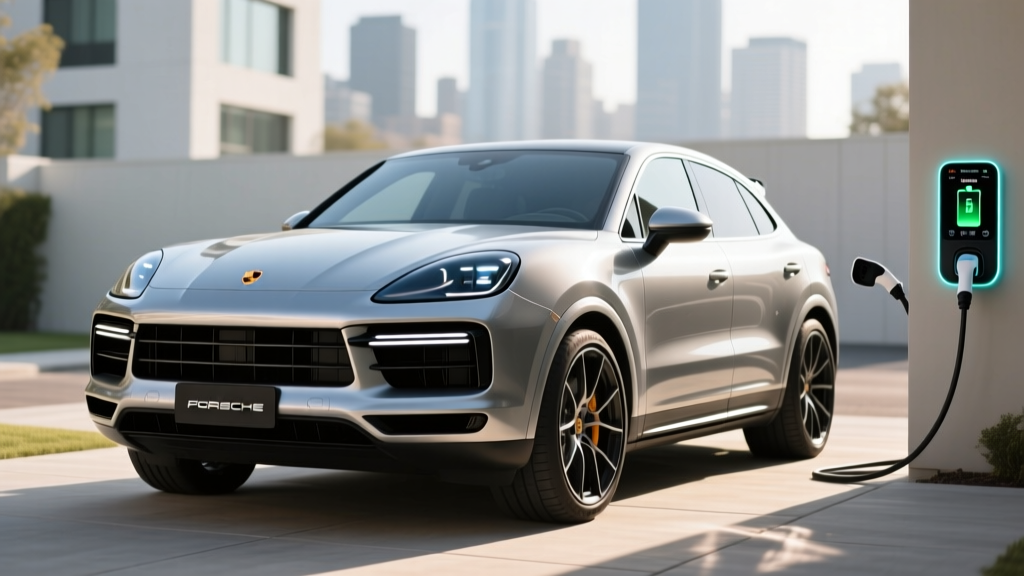
The 2026 Porsche Cayenne Turbo E-Hybrid sits at the intersection of supercar-SUV performance and daily-drivable electrification. With a combined 729 horsepower from its twin-turbo V8 and electric motor, it dispatches 0–60 mph in 3.5 seconds — yet it can also creep through school zones on battery power alone. For buyers who refuse to choose between a track-day toy and a grocery hauler, this plug-in hybrid (PHEV) attempts to be both.
But does the math actually work? Below, we break down the Cayenne Turbo E-Hybrid's real-world electric range, EPA fuel economy, charging requirements, battery longevity, and whether it qualifies for any federal tax incentives in 2026. If you're cross-shopping this against a full battery-electric SUV or a conventional hybrid, this guide will help you decide where your money goes furthest.
HEV vs PHEV vs EV: Where the Cayenne Turbo E-Hybrid Fits
Before diving into specs, it's worth clarifying the three electrification paths Porsche buyers typically consider:
| Type | How It Works | Plug In? | Electric-Only Driving |
|---|---|---|---|
| HEV (Conventional Hybrid) | Small battery recharges via regenerative braking and the gas engine. Toyota RAV4 Hybrid is a classic example. | No | Minimal — under 1 mile at very low speeds |
| PHEV (Plug-In Hybrid) | Larger battery that charges from a wall outlet or charger. Drives on electricity first, then the gas engine kicks in. The Cayenne Turbo E-Hybrid is a PHEV. | Yes | Typically 20–50 miles depending on model |
| BEV (Battery Electric) | No gas engine at all. Runs entirely on a large battery pack. Porsche Taycan is the BEV counterpart. | Yes — required | 200–300+ miles |
The Cayenne Turbo E-Hybrid is firmly in the PHEV camp. You can drive it without ever plugging in — the 4.0-liter twin-turbo V8 will power the car just fine — but doing so defeats much of the efficiency benefit. To extract maximum value, plan on plugging in nightly, ideally at a home Level 2 charger.
Powertrain and Performance Specs
| Specification | 2026 Cayenne Turbo E-Hybrid |
|---|---|
| Gas Engine | 4.0L Twin-Turbo V8, 591 hp |
| Electric Motor | Integrated in transmission, 174 hp (130 kW) |
| Combined System Output | 729 hp / 700 lb-ft torque |
| 0–60 mph | 3.5 seconds |
| Top Speed | 183 mph (electronically limited) |
| Transmission | 8-speed Tiptronic automatic, AWD |
| Battery Capacity (Gross / Usable) | 25.9 kWh gross / ~21.5 kWh usable |
| Battery Chemistry | NMC (Nickel Manganese Cobalt) |
| Drivetrain | All-wheel drive (Porsche Traction Management) |
The electric motor is sandwiched between the engine and the transmission inside a decoupler clutch, allowing pure-electric driving, engine-only driving, or blended operation. In E-Power mode, the Cayenne Turbo E-Hybrid operates as a rear-biased electric vehicle up to approximately 83 mph before the V8 awakens. In Sport and Sport Plus modes, both power sources deploy simultaneously for the full 729 hp.
Electric-Only Range and Total Range
Real-World Expectation: Expect 28–35 miles on electric-only in mixed driving. Highway speeds above 70 mph and cold weather (below 40°F) can reduce electric range by 20–30%, yielding roughly 22–28 miles. In warm city driving with frequent regenerative braking, you may approach or slightly exceed the EPA figure.
Total Combined Range (Electric + Gas): Approximately 400–440 miles with a full tank and full battery, depending on driving conditions.
The 25.9 kWh gross battery (roughly 21.5 kWh usable, as Porsche reserves a buffer to protect long-term cell health) is among the largest in any luxury PHEV SUV. For context, that's roughly double the battery size of the prior-generation Cayenne E-Hybrid and enough to cover most daily commutes without burning a drop of fuel.
Porsche offers multiple drive modes to manage this energy: E-Power (electric-first), Hybrid Auto (system decides), E-Hold (saves battery for later), and E-Charge (engine charges the battery while driving). For most owners, Hybrid Auto is the set-and-forget choice — the car intelligently deploys electric and gas power based on route and traffic data from the navigation system.
Fuel Economy: EPA MPG and Real-World Numbers
| Driving Mode | City | Highway | Combined |
|---|---|---|---|
| Charge-Sustaining (Gas Only, Battery Depleted) | ~17 mpg | ~22 mpg | ~19 mpg |
| MPGe (Blended Electric + Gas, EPA) | ~54 MPGe (estimated, based on battery charge) | ||
How to interpret these numbers: MPGe (miles per gallon equivalent) converts electricity consumption into a gasoline-equivalent figure. The ~54 MPGe rating assumes you start with a full battery and drive within the electric range. Once the battery depletes, the Cayenne Turbo E-Hybrid operates as a heavy, powerful V8 SUV, returning roughly 19 mpg combined — respectable for a 5,400+ lb vehicle with 729 hp, but not Prius territory.
Real-world MPG reality check: Owners who charge nightly and commute under 35 miles round-trip may go weeks without visiting a gas station, effectively achieving 50+ MPGe over time. Those who rarely charge and drive primarily on the highway will see numbers closer to 18–21 mpg. The EPA window sticker reflects a blended scenario — your actual experience depends entirely on charging habits. According to fueleconomy.gov, PHEV efficiency varies dramatically with plug-in frequency.
Charging: Speed, Connectors, and Home Setup
Unlike a conventional hybrid (HEV) that never needs to be plugged in, the Cayenne Turbo E-Hybrid's value proposition depends on regular charging. Here's what you need to know:
| Charging Level | Power (kW) | Time to Full (0–100%) | Connector |
|---|---|---|---|
| Level 1 (120V Household Outlet) | ~1.4 kW | ~16–18 hours | J1772 |
| Level 2 (240V Home/Public) | Up to 7.2 kW (onboard charger limit) | ~3.5–4 hours | J1772 (or NACS with adapter, 2025+ models) |
| DC Fast Charging | Not supported | N/A | N/A |
Key takeaway: The Cayenne Turbo E-Hybrid does not support DC fast charging. This is typical for PHEVs — the battery is small enough that Level 2 charging fills it in a few hours, and adding DC fast-charge hardware would increase cost and weight. For daily use, a home Level 2 charger (such as a Porsche Mobile Charger Connect or a third-party unit like the ChargePoint Home Flex) set to 32 amps will replenish the battery overnight.
kW vs kWh refresher: kW (kilowatts) measures the rate of charging — like water flow from a hose. kWh (kilowatt-hours) measures the battery's capacity — like the size of the tank. The Cayenne's 7.2 kW onboard charger means it can accept up to 7.2 kilowatts of power at a time; filling the ~21.5 kWh usable battery takes about 3 hours at that rate.
For 2025 and newer model years, Porsche has begun transitioning to the North American Charging Standard (NACS) port on some models. Verify your specific model year's connector with your dealer, as 2024 and earlier models use the J1772/CCS1 standard. Adapters are available for cross-compatibility.
Pricing, Trims, and Tax Credit Eligibility
The 2026 Porsche Cayenne Turbo E-Hybrid starts at an MSRP of approximately $157,700 (including destination). As with all Porsches, options can add tens of thousands quickly — a well-equipped example with the Premium Plus package, rear-axle steering, and Sport Chrono can approach $175,000–$185,000.
- MSRP Cap: SUVs must have an MSRP at or below $80,000. The Cayenne Turbo E-Hybrid at ~$157,700 exceeds this cap and does NOT qualify for the federal §30D new EV/PHEV credit.
- Buyer Income Cap: Even if the price qualified, adjusted gross income limits apply ($150K single / $300K joint).
- Battery Sourcing: Critical mineral and battery component sourcing requirements must be met. Porsche's supply chain compliance varies by model year — verify at IRS.gov.
- PHEV Minimum Battery: Must have at least 7 kWh of battery capacity. The Cayenne's 25.9 kWh pack clears this easily — but the MSRP cap is the disqualifier.
Battery Warranty, Reliability, and Replacement Cost
Estimated Battery Replacement Cost (Out of Warranty): $12,000–$18,000 for the high-voltage pack, based on current Porsche parts pricing and dealer labor rates. This is a worst-case scenario — PHEV batteries are smaller and less stressed than full BEV packs, and degradation data from the prior-generation Cayenne E-Hybrid (introduced in 2019) shows minimal capacity loss in normal use over 5+ years.
Reliability outlook: Porsche's hybrid powertrains have proven robust in the Panamera E-Hybrid and Cayenne E-Hybrid since 2017–2019. The twin-turbo V8 is a well-known architecture, and the electric motor adds fewer moving parts than a traditional transmission. The primary reliability concerns are shared with all complex luxury SUVs: air suspension, electronics, and cooling system components. Porsche's 4-year/50,000-mile limited warranty and 12-year corrosion warranty provide baseline coverage, and certified pre-owned (CPO) programs extend this further.
For context, hybrid battery replacement is rare before 150,000+ miles in most PHEVs. Toyota's decades of hybrid data suggest NMC and NiMH packs often retain 80%+ capacity at 10 years. Porsche's thermal management system (liquid cooling) helps preserve cell health by keeping the battery in its optimal temperature window.
Who Should Choose the Cayenne Turbo E-Hybrid?
Pros
- 729 hp with V8 soundtrack — genuine sports-car acceleration in an SUV
- 35–40 mi electric range covers most daily commutes gas-free
- Seamless transitions between electric and gas power
- Practical cargo space and 5-seat comfort for families
- 400+ mi total range eliminates road-trip charging anxiety
- Build quality, materials, and driving dynamics at the top of the segment
Cons
- $157,700+ MSRP — no federal tax credit due to price cap
- No DC fast charging — Level 2 only
- 19 mpg on gas alone when battery is depleted
- Heavy at 5,400+ lbs — felt in cornering vs. lighter Cayenne trims
- Options can push price above $180,000
- Requires consistent plug-in access to realize efficiency gains
Cayenne Turbo E-Hybrid vs Full EV vs Gas: Decision Framework
Choose the Cayenne Turbo E-Hybrid (PHEV) if:
- You want 35+ miles of daily electric commuting but also take 400+ mile road trips regularly
- You have home Level 2 charging access and can plug in nightly
- You prioritize V8 performance and don't want to compromise on power
- You live in an area with limited public DC fast-charging infrastructure
Choose a Full EV (e.g., Porsche Taycan Cross Turismo, BMW iX, Rivian R1S) if:
- Your daily driving exceeds 40 miles but stays under 250 miles
- You want zero tailpipe emissions and lower per-mile energy costs
- You have reliable home charging and access to DC fast chargers for road trips
- You want to minimize maintenance (no oil changes, no V8 complexity)
Choose a Conventional Gas Cayenne (e.g., Cayenne S or Turbo) if:
- You lack home charging access entirely
- You drive primarily long highway stretches where PHEV electric range is irrelevant
- You want to save $30,000–$40,000 vs. the Turbo E-Hybrid and don't need the hybrid system
Frequently Asked Questions
How many MPG does the Porsche Cayenne Turbo E-Hybrid get?
In charge-sustaining mode (battery depleted, running on gas only), expect approximately 17 mpg city / 22 mpg highway / 19 mpg combined. When you factor in electric driving from a full charge, the EPA rates it around 54 MPGe combined. Your real-world number depends entirely on how often you plug in — nightly chargers will see dramatically better effective economy than those who never plug in.
How far can the Cayenne Turbo E-Hybrid go on electric only?
The EPA estimates approximately 35–40 miles of electric-only range. In real-world mixed driving, expect 28–35 miles. Highway driving at 75+ mph and cold weather can reduce this to 22–28 miles. For a 30-mile round-trip commute, most owners can complete it entirely on electricity in moderate weather.
Does the Cayenne Turbo E-Hybrid qualify for a federal tax credit?
No. The federal §30D tax credit caps SUV eligibility at $80,000 MSRP. The Cayenne Turbo E-Hybrid starts at approximately $157,700, well above the threshold. Some state-level incentives may apply — check your state's energy office or the Alternative Fuels Data Center for local rebates.
Is the Porsche Cayenne Turbo E-Hybrid reliable?
Porsche's hybrid systems in the Cayenne and Panamera have shown solid reliability since 2017. The high-voltage battery is covered for 8 years/100,000 miles. The primary maintenance concerns are typical luxury-SUV items (air suspension, electronics) rather than hybrid-specific failures. Out-of-warranty battery replacement is estimated at $12,000–$18,000, though replacement before 150,000 miles is uncommon based on industry-wide PHEV data.
Can I charge the Cayenne Turbo E-Hybrid at a Tesla Supercharger?
Not directly. The Cayenne Turbo E-Hybrid uses a J1772 connector (or NACS on 2025+ models). Tesla Superchargers use the NACS connector. If your Cayenne has a NACS port, you can use Tesla Superchargers for any AC charging, but note that the Cayenne does not support DC fast charging, so Supercharger stalls won't provide meaningful speed advantages over a standard Level 2 public charger. For NACS-equipped models, the Tesla destination charging network (Level 2) is fully compatible.
What's the difference between the Cayenne Turbo E-Hybrid and the regular Cayenne E-Hybrid?
The standard Cayenne E-Hybrid pairs a 3.0L turbo V6 with an electric motor for approximately 463 combined hp and a lower starting price (~$95,000). The Turbo E-Hybrid uses the 4.0L twin-turbo V8 for 729 hp, a 3.5-second 0–60 time, and significantly more performance headroom. Both share the same 25.9 kWh battery architecture and electric-only range, but the Turbo variant is substantially heavier, resulting in slightly lower charge-sustaining MPG.
The 2026 Porsche Cayenne Turbo E-Hybrid is an engineering showcase — a 729-hp V8 SUV that can silently glide through neighborhoods on electric power. It's not for budget-conscious buyers, and it won't qualify for federal tax incentives. But for those who want the performance ceiling of a supercar, the practicality of a family SUV, and enough electric range to handle weekday commutes without gas, it occupies a niche that few vehicles can fill. Just make sure you have a Level 2 charger at home — this PHEV's brilliance depends on it.