Quick Verdict: The Porsche Cayenne E-Hybrid at a Glance
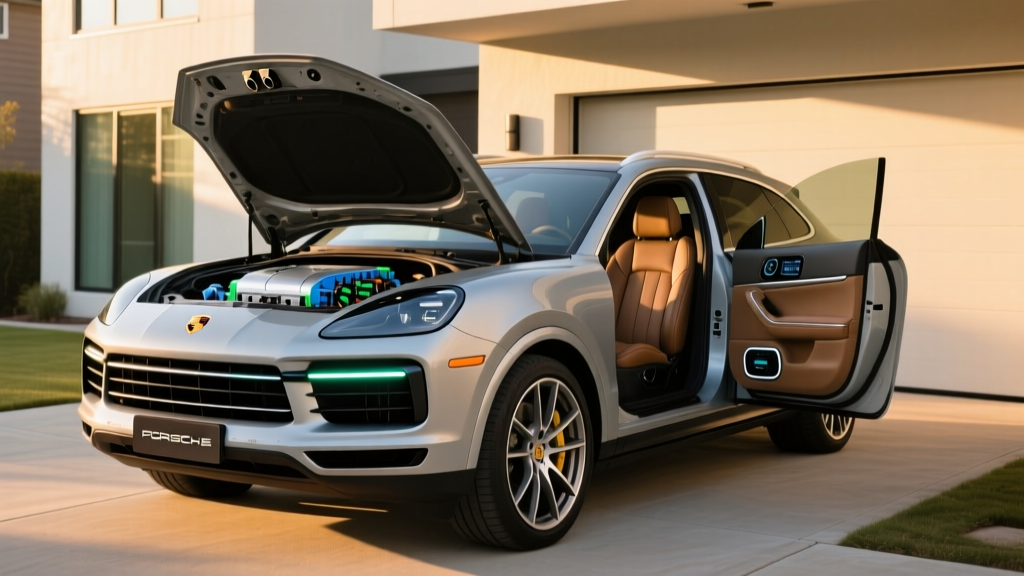
The 2026 Porsche Cayenne E-Hybrid occupies a rare niche: a luxury performance SUV that can handle school-dropoff duty on electric power alone, then unleash 463 combined horsepower when you merge onto the highway. It is exclusively a plug-in hybrid (PHEV) — there is no conventional hybrid (HEV) Cayenne — which means you can plug it in to charge, but you never have to. The gasoline V6 engine and regenerative braking keep the battery topped up when you skip the plug.
For buyers cross-shopping the Cayenne E-Hybrid against fully electric luxury SUVs like the BMW iX or the Porsche Macan EV, the value proposition is straightforward: you get Porsche driving dynamics and daily electric-only commuting without any range anxiety on road trips. The trade-off is a smaller electric-only range than a full BEV, and a fuel tank you'll still visit on longer drives.
| Spec | Value |
|---|---|
| Powertrain | 3.0L Turbo V6 + electric motor (PHEV) |
| Combined Horsepower | 463 hp |
| Combined Torque | 479 lb-ft |
| 0–60 mph | 4.6 seconds |
| Battery (usable) | 25.9 kWh (Lithium-ion, NMC chemistry) |
| EPA Electric-Only Range | ~30 miles (est.) |
| Total Combined Range | ~440 miles (electric + gasoline) |
| EPA MPGe (electric mode) | ~46 MPGe (est.) |
| EPA MPG (gasoline, combined) | ~21 MPG (est.) |
| Level 2 Charging (7.2 kW onboard) | ~3.5 hours (0–100%) |
| DC Fast Charging | Not available |
| Base MSRP (Cayenne E-Hybrid) | $91,700 |
| Battery / Powertrain Warranty | 8 years / 100,000 miles (hybrid components) |
Note: Specs reflect the current-generation Cayenne E-Hybrid platform introduced for the 2024 model year and carried forward. Always verify final 2026 figures on fueleconomy.gov or Porsche's official configurator, as EPA certifications can shift slightly by model year.
HEV vs PHEV: Why the Cayenne Is Plug-In Only
Porsche does not offer a conventional hybrid (HEV) Cayenne. The lineup splits cleanly between the standard gasoline Cayenne and the Cayenne E-Hybrid, which is a PHEV. Here's what that distinction means in practice:
| Feature | HEV (e.g., Toyota RAV4 Hybrid) | PHEV (Porsche Cayenne E-Hybrid) |
|---|---|---|
| Plug-in charging | No — battery charges via engine + regen | Yes — can plug in for full electric range |
| Battery size | 1–2 kWh | 25.9 kWh usable |
| Electric-only range | 0–1 mile at low speed | ~30 miles at highway speeds |
| Fuel economy benefit | Consistent MPG improvement everywhere | Best when charged daily; reverts to gas MPG if not |
| Tax credit eligible | No | Potentially — see §30D rules below |
The Cayenne E-Hybrid's larger 25.9 kWh battery is the key differentiator. When charged, it lets you drive roughly 30 miles without burning a drop of fuel — enough for most daily commutes and errands. When the battery depletes, the 3.0L turbocharged V6 takes over seamlessly, and you drive it like a conventional vehicle. You never need to plug in if you don't want to, but you lose the electric-range benefit if you skip charging.
Fuel Economy and Electric-Only Range
| Mode | City | Highway | Combined |
|---|---|---|---|
| Electric-only (MPGe) | ~48 MPGe | ~44 MPGe | ~46 MPGe |
| Gasoline-only (MPG) | ~19 MPG | ~23 MPG | ~21 MPG |
How many MPG does the Cayenne E-Hybrid get?
When the battery is depleted and you're running on gasoline alone, expect roughly 21 MPG combined. That's modest for a hybrid, but context matters: the Cayenne is a 5,000+ pound performance SUV with 463 horsepower. Compared to the non-hybrid Cayenne (which returns around 19 MPG combined), the E-Hybrid's advantage comes mostly from those electric-only miles you log before the engine fires up.
How far can it go on electric only?
The EPA estimates approximately 30 miles of electric-only range. In real-world conditions, expect 24–28 miles in mixed driving, and potentially as low as 20 miles in cold weather (below 40°F) when the cabin heater draws heavily from the battery. Highway-speed electric driving at 70+ mph also shortens range compared to city stop-and-go, where regenerative braking recaptures energy.
EPA estimate: ~30 miles electric-only
Real-world expectation: 24–28 mi (mild weather), 18–22 mi (cold weather / sustained highway)
Total combined range (electric + 19.8-gallon tank): ~440 miles
If your daily round-trip commute is under 25 miles and you charge at home nightly, you may go weeks without visiting a gas station. On a 400-mile road trip, the gasoline engine handles the bulk of the distance, and you'll refuel once — no charging stops required.
Powertrain and Performance
The Cayenne E-Hybrid pairs a 3.0-liter turbocharged V6 (producing approximately 348 hp on its own) with an electric motor integrated into the 8-speed Tiptronic S transmission (contributing roughly 174 hp). The combined system output is 463 hp and 479 lb-ft of torque, routed through Porsche's all-wheel-drive system.
The result is a 0–60 mph sprint in 4.6 seconds — quicker than the base gasoline Cayenne and genuinely rapid for an SUV of this size. The electric motor fills in torque instantly at low RPMs, eliminating the turbo lag you might feel in a gas-only Cayenne launching from a stoplight. Porsche's E-Hybrid system also allows electric-only driving at speeds up to 84 mph, meaning you can sustain highway speeds on battery power alone if your range holds.
Drive modes include E-Power (electric priority), Hybrid Auto (system manages gas/electric blend), E-Hold (reserves battery for later), and E-Charge (engine charges the battery while driving — useful before entering a zero-emission city zone, though it reduces fuel economy).
Charging: Level 2 at Home, No DC Fast Charging
The Cayenne E-Hybrid comes with a 7.2 kW onboard charger, which is the maximum rate it can accept from a Level 2 home or public AC charger. Here's what that means in practice:
| Charging Level | Power | Time (0–100%) | Typical Use Case |
|---|---|---|---|
| Level 1 (120V household) | ~1.4 kW | ~18 hours | Emergency / occasional top-up |
| Level 2 (240V, 32A) | 7.2 kW (max) | ~3.5 hours | Daily home charging |
| DC Fast Charging | Not supported | N/A | N/A |
The lack of DC fast charging is typical for PHEVs in this class — the battery is small enough that Level 2 replenishes it fully overnight (or during a workday). You'll want a Level 2 home charger installed (a 240V / 32A circuit is ideal) to take advantage of the full 7.2 kW rate. Expect a home Level 2 installation to cost $800–$2,000 depending on your electrical panel and wiring run — budget for a licensed electrician and any necessary panel upgrades.
Charging the 25.9 kWh battery from empty to full at 7.2 kW requires roughly 3.5 hours. At the average US electricity rate of ~$0.16/kWh, a full charge costs approximately $4.14 — compared to roughly $15–$18 for a gallon-equivalent of premium gasoline the Cayenne requires.
Pricing, Tax Credits, and Ownership Costs
The 2026 Porsche Cayenne E-Hybrid starts at approximately $91,700 MSRP (including destination). The Cayenne E-Hybrid Coupe variant starts around $96,000. Options packages — Premium, Sport Chrono, air suspension, larger wheels — can push a well-equipped build past $115,000.
Does the Cayenne E-Hybrid qualify for a federal tax credit?
Under IRS §30D, the federal plug-in vehicle credit (up to $7,500) has strict requirements. Here's where the Cayenne E-Hybrid stands for 2026:
- MSRP cap: SUVs must be under $80,000 — the Cayenne E-Hybrid at ~$91,700 exceeds this cap and does NOT qualify for the new-vehicle §30D credit.
- Buyer income cap: Even if MSRP qualified, AGI limits apply ($300K joint / $225K HOH / $150K single).
- Battery sourcing / critical minerals: Additional requirements on where battery components and minerals are sourced — irrelevant here since MSRP alone disqualifies it.
- Point-of-sale transfer: Available for qualifying vehicles, but again, the Cayenne does not meet the MSRP threshold.
Bottom line: The Cayenne E-Hybrid does not qualify for the federal §30D new-vehicle tax credit due to its MSRP exceeding the $80,000 SUV cap. Verify current rules at IRS.gov, as legislation can change.
Some states offer their own PHEV incentives that may not carry MSRP caps — check your state's energy office or DMV for current programs. Additionally, if you purchase a used Cayenne E-Hybrid, the §25E used clean vehicle credit (up to $4,000 or 30% of sale price, whichever is less) may apply if the sale price is under $25,000 and you meet income requirements — though finding a used Cayenne E-Hybrid at that price is unlikely in the current market.
Reliability, Battery Warranty, and Replacement Cost
Hybrid battery coverage: 8 years / 100,000 miles (whichever comes first)
Capacity retention threshold: Battery warranted to retain ≥70% of original capacity during the warranty period
Powertrain warranty: 4 years / 50,000 miles (Porsche's standard new-vehicle limited warranty)
Is the Cayenne E-Hybrid reliable?
Porsche's hybrid powertrains have proven robust in the Cayenne and Panamera lineups since the early 2010s. The current-generation E-Hybrid system is simpler than early iterations, with fewer failure points. The 8-speed Tiptronic transmission is a proven ZF design used across the industry. Main reliability concerns tend to involve electronics and infotainment rather than the hybrid powertrain itself.
The high-voltage battery uses NMC (nickel-manganese-cobalt) chemistry, which offers high energy density but is more sensitive to sustained high temperatures and frequent 100% charges than LFP chemistry. Porsche's thermal management system actively cools and heats the battery to mitigate degradation. Expect roughly 5–8% capacity loss over the first 5 years under normal use — meaning your 30-mile electric range may shrink to ~27–28 miles by year five.
What does a hybrid battery replacement cost?
Out-of-warranty replacement for the Cayenne E-Hybrid's high-voltage battery is estimated at $12,000–$18,000 including labor, based on Porsche dealer service pricing for the current-generation pack. This is a significant sum, but the 8-year/100,000-mile warranty provides substantial coverage. Most PHEV batteries outlast their warranty periods — many first-generation Cayenne S E-Hybrid models (2015–2018) are still running on original packs at 100K+ miles, albeit with reduced electric range.
Who Should Choose the Cayenne E-Hybrid?
- You have home Level 2 charging and a daily commute under 30 miles
- You want electric daily driving but regularly take road trips over 300 miles
- Performance and driving dynamics matter — the instant electric torque fills turbo lag
- You want a luxury badge without committing to a full BEV's charging-dependency
- Your daily driving exceeds 40+ miles and you want to avoid gasoline entirely
- You want access to DC fast charging for road trips
- You want to minimize maintenance (no oil changes, no gasoline engine service)
- You lack home charging access and won't plug in regularly
- The ~$12,000 price premium for E-Hybrid doesn't justify your fuel savings
- You prioritize cargo space (the E-Hybrid's battery slightly reduces under-floor storage)
The Cayenne E-Hybrid makes the most financial sense for owners who will actually plug in daily. If the vehicle sits in a garage without a charger and runs exclusively on gasoline, you're carrying 600+ pounds of battery and electric motor for no efficiency gain — and paying a premium for the privilege. Charge daily, and the math flips: at 25 electric miles per day, five days a week, you'll save roughly $1,200–$1,500 annually in fuel versus the gas-only Cayenne (assuming premium at $4.50/gal and electricity at $0.16/kWh).
- 463 hp with instant electric torque — 4.6s to 60 mph
- ~30 mi electric-only range covers most daily commutes
- No range anxiety — 440+ mi total range with gas engine
- 8-year / 100,000-mi hybrid battery warranty
- Quiet, smooth electric mode in residential areas
- $91,700+ MSRP — exceeds §30D tax credit cap
- No DC fast charging capability
- Gas-only MPG (~21 combined) is modest when battery is depleted
- Must plug in daily to realize efficiency benefits
- Battery replacement cost ($12K–$18K) out of warranty
Frequently Asked Questions
How many MPG does the Porsche Cayenne E-Hybrid get?
On gasoline alone (after the battery depletes), the Cayenne E-Hybrid returns approximately 21 MPG combined (19 city / 23 highway). When factoring in electric-only miles, your effective fuel consumption depends entirely on how often you charge. Owners who charge nightly and commute under 30 miles may use gasoline only on weekend road trips.
How far can the Cayenne E-Hybrid go on electric only?
The EPA estimates roughly 30 miles of electric-only range. Real-world range is typically 24–28 miles in mild weather, dropping to 18–22 miles in cold conditions or at sustained highway speeds above 70 mph. The electric motor can propel the Cayenne up to 84 mph before the gasoline engine must engage.
Hybrid vs PHEV vs EV — which fits me?
A conventional hybrid (HEV) requires no plug and offers modest MPG gains — ideal if you lack charging access. A PHEV like the Cayenne E-Hybrid gives you ~30 miles of electric range when plugged in, plus a gas engine for longer trips — ideal if you can charge at home but don't want range limitations. A full EV (BEV) eliminates gasoline entirely but requires reliable charging infrastructure and acceptance of 250–350 mile range limits. For a luxury SUV buyer with home charging who road-trips regularly, the PHEV is the pragmatic middle ground.
Is the Cayenne E-Hybrid reliable, and what is battery replacement cost?
Porsche's hybrid systems have proven reliable across two generations of the Cayenne E-Hybrid. The high-voltage battery is warranted for 8 years / 100,000 miles at ≥70% capacity retention. Out-of-warranty battery replacement costs approximately $12,000–$18,000. Most owners will not need a replacement within typical ownership periods, and degradation is gradual rather than sudden.
Does the Porsche Cayenne E-Hybrid qualify for any tax credit?
No — the Cayenne E-Hybrid's MSRP of approximately $91,700 exceeds the IRS §30D cap of $80,000 for SUVs, making it ineligible for the federal new-vehicle tax credit regardless of buyer income or battery sourcing. Some state-level PHEV incentives may still apply. Check IRS.gov and your state energy office for current programs.
Can the Cayenne E-Hybrid charge while driving?
Yes. In E-Charge mode, the gasoline engine actively charges the high-voltage battery while you drive — useful if you want to save electric range for a zero-emission zone later in your trip. Regenerative braking also recaptures energy during deceleration in all drive modes. However, engine-charging reduces overall fuel economy and is less efficient than plugging in.
What's the difference between the Cayenne E-Hybrid and the Cayenne S E-Hybrid?
For the current generation, Porsche simplified the lineup to a single Cayenne E-Hybrid trim. Previous model years offered an S E-Hybrid with a more powerful 2.9L V6 and higher combined output (~512 hp). If you encounter a used S E-Hybrid, it offers more power but shares the same battery architecture and electric-only range.