Quick Verdict: The Cayenne E-Hybrid in One Paragraph
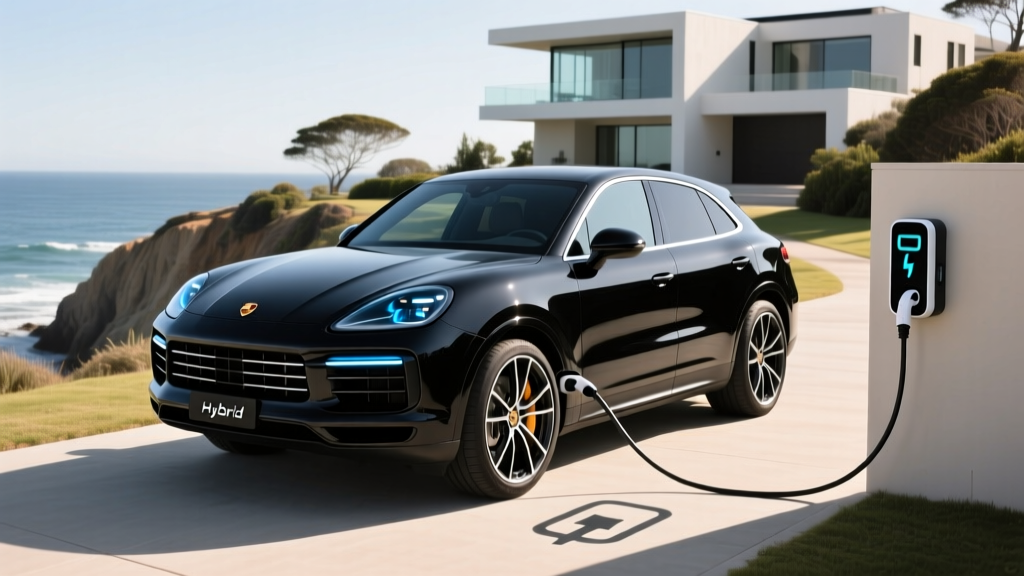
The 2026 Porsche Cayenne E-Hybrid is a plug-in hybrid (PHEV) that pairs a turbocharged V6 with a 130 kW electric motor and a 25.9 kWh battery to deliver 463 combined horsepower and roughly 30 miles of electric-only driving. It is not a conventional hybrid (HEV) — it must be plugged in to unlock its full efficiency and electric range. For buyers who want Porsche performance, daily electric commuting, and a gas engine for road trips without range anxiety, the Cayenne E-Hybrid occupies a narrow but compelling niche. Just don't expect federal tax credit help: at a starting MSRP well above the §30D cap and with battery sourcing rules tightening, this PHEV is a full-price luxury purchase.
HEV vs PHEV: Where the Cayenne Fits
Before diving into specs, a critical distinction. The Porsche Cayenne lineup currently offers a plug-in hybrid (PHEV) variant — badged as the Cayenne E-Hybrid. Porsche does not sell a conventional hybrid (HEV) Cayenne that self-charges through regenerative braking alone.
Conventional Hybrid (HEV)
- Small battery (typically 1–2 kWh)
- No plug — recharges via regen and engine
- Electric motor assists at low speeds; cannot drive on electricity alone for meaningful distance
- Example: Toyota RAV4 Hybrid
Plug-In Hybrid (PHEV) — Cayenne E-Hybrid
- Larger battery: 25.9 kWh (usable capacity approximately 22–23 kWh)
- Must be plugged in to recharge the battery fully
- Can drive ~30 miles on electricity alone before the gas engine engages
- After battery depletion, operates like a conventional hybrid
If you cannot charge at home or at work, the Cayenne E-Hybrid will still function as a heavy hybrid — but you'll sacrifice most of its efficiency advantage and pay a premium for battery weight you're not utilizing.
Powertrain and Performance Specs
| Specification | 2026 Cayenne E-Hybrid |
|---|---|
| Engine | 3.0L Turbocharged V6 |
| Electric Motor | 130 kW (174 hp) integrated into 8-speed transmission |
| Combined Horsepower | 463 hp |
| Combined Torque | 479 lb-ft |
| 0–60 mph | 4.7 seconds (with Launch Control) |
| Top Speed | 157 mph |
| Battery Capacity | 25.9 kWh gross (~22–23 kWh usable) |
| Battery Chemistry | NMC (Nickel Manganese Cobalt) |
| Drivetrain | All-wheel drive (AWD) |
| Transmission | 8-speed Tiptronic automatic |
| Towing Capacity | 7,700 lbs (braked) |
| Base MSRP | $91,900 (before destination) |
The 130 kW electric motor is substantial — it can propel the Cayenne E-Hybrid to 84 mph on electricity alone, making it viable for highway merging and suburban driving without ever engaging the V6. When both power sources work together, 463 hp moves this 5,200-lb SUV with genuine urgency.
Electric-Only Range and Total Range
EPA Electric-Only Range: ~30 miles (estimated based on 2025 carryover specs)
Real-World Electric Range: Expect 22–28 miles in mixed driving. Highway speeds above 70 mph, cold weather below 40°F, and aggressive acceleration will push you toward the lower end. In mild weather with city driving and regen braking, 28–30 miles is achievable.
Total Combined Range (Electric + Gas): Approximately 430–460 miles with a full tank and full battery, depending on driving style and conditions.
Thirty miles of electric range is enough to cover the average American's daily round-trip commute (approximately 16 miles each way per FHWA data). Charge nightly at home, and you'll burn very little gasoline on weekdays. Weekend road trips rely on the V6 and the 19.8-gallon fuel tank.
MPG and Efficiency: EPA Numbers vs Real World
| Mode | City | Highway | Combined |
|---|---|---|---|
| Charge-Sustaining (Hybrid Mode, battery depleted) | ~21 MPG | ~24 MPG | ~22 MPG |
| MPGe (with full battery, combined) | ~46 MPGe (EPA estimated) | ||
| Electric Energy Consumption | ~51 kWh/100 mi | ||
Real-world note: Once the battery is depleted, the Cayenne E-Hybrid operates as a heavy hybrid SUV. Expect 20–22 MPG combined in real-world mixed driving — competitive with a base V6 Cayenne but not dramatically better. The efficiency payoff comes from maximizing electric-only miles. If 80% of your weekly driving falls within the 30-mile electric window and you charge daily, your effective fuel consumption drops significantly — potentially into the 60+ MPGe territory on a weekly average.
Hybrid-mode city driving can slightly exceed EPA estimates thanks to regenerative braking recapturing energy in stop-and-go traffic. Highway driving at 75+ mph will fall short of EPA numbers, as aerodynamic drag dominates and the electric motor provides less benefit.
Charging: How, How Fast, and at What Cost
| Charging Level | Power | Time (0–100%) | Notes |
|---|---|---|---|
| Level 1 (120V household outlet) | ~1.4 kW | ~17–18 hours | Emergency/trickle only |
| Level 2 (240V home charger) | 7.2 kW (onboard charger max) | ~3.5–4 hours | Recommended for daily use |
| DC Fast Charging | Not available | N/A | Cayenne E-Hybrid does not support DC fast charging |
The Cayenne E-Hybrid's 7.2 kW onboard AC charger is the bottleneck. A full Level 2 charge takes roughly 3.5–4 hours — perfectly adequate for overnight charging at home or topping up during a workday. However, the lack of DC fast charging means you cannot rapidly replenish the battery on a road trip. Once the electric range is used up on the highway, you're running on the V6 until you can plug in at your destination.
For home Level 2 charging, budget $500–$1,200 for a quality 32A–40A wall-mounted charger (Porsche recommends the Porsche Mobile Charger Connect or an equivalent J1772 unit), plus $800–$2,500 for professional electrician installation depending on your panel capacity and run length. A 200-amp electrical panel is typically sufficient; older homes with 100-amp service may need a panel upgrade ($1,500–$3,000).
Cost to charge: At the US average residential electricity rate of ~$0.16/kWh (EIA data), a full 25.9 kWh charge costs roughly $4.14 — or about $0.14 per electric mile. Compare that to gasoline at $3.40/gallon and 22 MPG, which costs ~$0.15 per mile. The per-mile cost advantage is modest; the real savings come from reduced engine wear, fewer oil changes, and the ability to use off-peak electricity rates (often $0.08–$0.10/kWh with time-of-use plans).
Pricing, Tax Credits, and Ownership Costs
The 2026 Porsche Cayenne E-Hybrid starts at approximately $91,900 (before the $1,650 destination charge). With popular options — Premium Plus package, air suspension, Sport Chrono, larger wheels — expect transaction prices between $100,000 and $115,000.
Federal §30D Tax Credit Eligibility (2026 Rules)
- MSRP Cap: SUVs must be under $80,000 MSRP — the Cayenne E-Hybrid exceeds this cap. Not eligible.
- Buyer Income Cap: $300,000 joint / $150,000 single filer MAGI
- Battery Sourcing: Critical minerals and battery component requirements (phasing in through 2026)
- Point-of-Sale Transfer: Available for qualifying vehicles — but moot here since the Cayenne doesn't qualify
Source: IRS §30D Clean Vehicle Credit. Consult a tax professional for individual eligibility.
No federal purchase credit applies. Some states offer their own PHEV incentives (Colorado, for example, has offered credits for PHEVs), but these vary by jurisdiction and change frequently — check your state's energy office or DOE AFDC incentive database for current local programs.
Insurance: Expect annual premiums of $2,800–$4,200 depending on your profile, location, and coverage levels — typical for a luxury performance SUV in this price range.
5-Year Estimated Ownership Cost:
| Category | Estimated 5-Year Cost |
|---|---|
| Depreciation | $38,000–$45,000 |
| Fuel (assuming 50% electric / 50% gas) | $6,500–$8,500 |
| Insurance | $15,000–$20,000 |
| Maintenance | $4,500–$6,000 |
| Home Charger Install (one-time) | $1,500–$3,000 |
| Total (approx.) | $65,500–$82,500 |
Reliability and Battery Warranty
Hybrid Battery Warranty: 8 years / 100,000 miles (whichever comes first), covering defects and capacity loss below a defined threshold (typically 70% state of health).
Powertrain Warranty: 4 years / 50,000 miles
Limited Vehicle Warranty: 4 years / 50,000 miles
Porsche's NMC battery pack is liquid-cooled with active thermal management — critical for longevity in a performance-oriented PHEV that sees high charge and discharge rates. NMC chemistry in thermally managed packs typically degrades 1.5–2.5% per year under normal use, meaning you can expect roughly 85–90% of original capacity after 8 years.
Battery replacement cost: If out of warranty, a full Cayenne E-Hybrid battery replacement runs approximately $12,000–$18,000 (parts and labor) at a Porsche dealer. Individual module replacement may be possible for partial failures, reducing cost. In practice, widespread battery failures in modern liquid-cooled PHEV packs are uncommon within the first 10–12 years.
Porsche's overall reliability ratings are mid-pack among luxury brands. J.D. Power typically scores Porsche above the luxury segment average in dependability studies, though the complexity of a turbocharged V6 + electric motor + 8-speed transmission means more potential failure points than a simpler BEV or conventional car. Regular maintenance (oil changes every 10,000 miles or annually, coolant system checks, transmission fluid service) is essential and should not be deferred.
Who Should Buy the Cayenne E-Hybrid — and Who Shouldn't
Choose the Cayenne E-Hybrid if:
- You can charge at home (Level 2) every night
- Your daily commute is under 30 miles round-trip, and you want to drive mostly on electricity
- You take regular long road trips where a full EV's charging stops would be inconvenient
- You want Porsche driving dynamics and build quality in a luxury SUV
- You need towing capacity (7,700 lbs) that most EVs in this class don't match
Choose a full EV (e.g., Porsche Taycan Cross Turismo, BMW iX, Tesla Model X) if:
- You want zero gasoline use and zero engine maintenance
- You have reliable access to DC fast charging for road trips
- Your daily driving exceeds 30 miles and you want all-electric operation
- You want to minimize long-term complexity (no engine, no transmission fluid, no oil)
Choose a conventional hybrid (e.g., BMW X5 xDrive50e PHEV competitor, Lexus RX Hybrid HEV) if:
- You want hybrid efficiency without plugging in (HEV option only — Lexus RX 500h)
- Budget is a primary concern and you want something under $60,000
Pros
- Genuine performance: 463 hp, 0–60 in 4.7 sec
- ~30 mi electric range covers most daily commutes
- No range anxiety — V6 takes over seamlessly
- 7,700-lb towing capacity
- Porsche build quality, interior materials, and driving dynamics
- Electric-only driving up to 84 mph
Cons
- No federal tax credit (MSRP exceeds $80K cap)
- No DC fast charging — road trip battery replenishment is slow
- Heavy: ~5,200 lbs impacts handling and tire wear
- Modest fuel economy once battery is depleted (~22 MPG)
- High starting price ($91,900+) and expensive options
- Battery replacement cost ($12K–$18K) out of warranty
Frequently Asked Questions
How many MPG does the Cayenne E-Hybrid get?
Once the battery is depleted, expect approximately 21 city / 24 highway / 22 combined MPG in hybrid mode. With regular charging and short commutes, your effective MPGe can reach 46 or higher. Real-world highway driving at 75+ mph typically returns 20–21 MPG in hybrid mode.
How far can the Cayenne E-Hybrid go on electric only?
The EPA-estimated electric-only range is approximately 30 miles. In real-world conditions — highway speeds, cold weather, or aggressive driving — expect 22–28 miles. Mild city driving can stretch it to 30 miles.
Does the Cayenne E-Hybrid qualify for a federal tax credit?
No. The IRS §30D Clean Vehicle Credit caps SUV MSRP at $80,000. The Cayenne E-Hybrid starts at $91,900, disqualifying it regardless of income or battery sourcing. Check your state for potential local PHEV incentives.
Is the Cayenne E-Hybrid reliable? What does battery replacement cost?
Porsche's hybrid systems have proven reasonably reliable in the Macan and Panamera E-Hybrid predecessors. The 8-year/100,000-mile battery warranty provides coverage. Out-of-warranty battery replacement costs $12,000–$18,000. The liquid-cooled NMC pack is designed for longevity, and most owners report minimal degradation in the first 5–7 years.
Can the Cayenne E-Hybrid DC fast charge?
No. The Cayenne E-Hybrid supports only AC charging — Level 1 (120V) and Level 2 (240V) at a maximum of 7.2 kW. A full Level 2 charge takes about 3.5–4 hours. DC fast charging is not available on this model.
Hybrid vs PHEV vs EV — which is right for me?
If you can charge at home and your daily driving is under 30 miles, the PHEV gives you electric commuting with gas-engine backup for road trips — the Cayenne E-Hybrid's sweet spot. A conventional HEV (no plug) is simpler but offers no meaningful electric-only range. A full EV eliminates gasoline entirely but requires planning for longer trips and access to charging infrastructure. Your choice depends on charging access, daily mileage, and willingness to manage a gas engine alongside electric driving.
What happens if I never plug in the Cayenne E-Hybrid?
The car will still drive normally — the V6 engine and regenerative braking maintain a small buffer charge. However, you'll get only about 22 MPG combined, essentially paying a premium for a heavy hybrid that never uses its electric potential. Porsche engineers this vehicle around the assumption you'll plug in regularly.