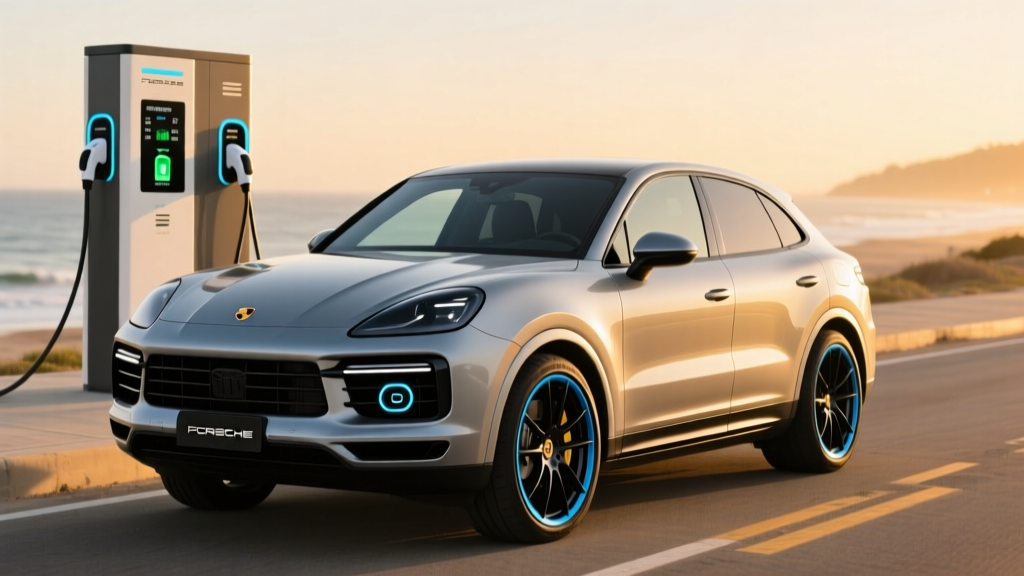
If you are shopping for a Porsche SUV hybrid, the 2026 Cayenne E-Hybrid is the centerpiece of Porsche's electrified lineup. It pairs a turbocharged V6 with a larger battery than its predecessor, delivering meaningful electric-only commuting range without sacrificing the performance DNA Porsche buyers expect. Below, we break down the real-world efficiency, charging logistics, powertrain specs, and ownership economics you need before signing a purchase order.
2026 Porsche Cayenne E-Hybrid: Quick Specs at a Glance
| Spec | 2026 Cayenne E-Hybrid | 2026 Cayenne S E-Hybrid |
|---|---|---|
| Powertrain | 3.0L Turbo V6 + E-Motor | 3.0L Turbo V6 + E-Motor (higher output) |
| Combined Horsepower | 470 hp / 479 lb-ft | 512 hp / 553 lb-ft |
| 0–60 mph | 4.5 sec | 4.2 sec |
| Battery (usable) | 25.7 kWh (NMC) | 25.7 kWh (NMC) |
| EPA Electric Range | ~30 mi | ~28 mi |
| EPA MPGe (electric + gas) | ~46 MPGe | ~44 MPGe |
| EPA MPG (gas-only, combined) | ~21 MPG | ~20 MPG |
| AC Charging (Level 2) | 7.2 kW onboard | 7.2 kW onboard (11 kW optional) |
| DC Fast Charge | Not supported | Not supported |
| 100% Level 2 Charge Time | ~3.5 hr @ 7.2 kW | ~2.5 hr @ 11 kW (optional) |
| Starting MSRP | $97,550 | $110,250 |
Source: Porsche USA, fueleconomy.gov. EPA figures are estimates; real-world results vary with driving style, terrain, and climate.
HEV vs PHEV: What the Cayenne E-Hybrid Actually Is
It is critical to understand that the Cayenne E-Hybrid is a plug-in hybrid (PHEV), not a conventional hybrid (HEV). Here is the distinction:
- HEV (conventional hybrid): Charges its small battery (~1–2 kWh) exclusively through regenerative braking and the engine. You never plug it in. Examples: Toyota RAV4 Hybrid, Honda CR-V Hybrid.
- PHEV (plug-in hybrid): Has a much larger battery (25.7 kWh in the Cayenne) that you plug into a wall outlet or Level 2 charger. It can drive on electric power alone for a meaningful distance before the gas engine kicks in.
The Cayenne E-Hybrid operates as a pure EV for roughly 30 miles, then seamlessly transitions to hybrid mode, blending the V6 and electric motor for the remainder of your drive. If you never plug it in, it functions as a heavy, less-efficient hybrid — you are leaving the best part of the powertrain on the table.
Electric-Only Range and Total Driving Range
The 2026 Cayenne E-Hybrid's 25.7 kWh battery delivers an EPA-estimated ~30 miles of electric-only range. That number is enough to cover most daily commutes and errands without burning a drop of fuel, provided you charge overnight at home.
- EPA electric-only: ~30 miles
- Real-world (mild weather, mixed driving): 25–30 miles
- Cold weather (below 32°F, cabin heat on): 18–22 miles
- Highway-only at 75 mph: 20–24 miles (higher speeds drain the battery faster)
Once the battery depletes, the gas engine engages and you get approximately 400+ miles of total combined range between the battery and the 19.8-gallon fuel tank.
Fuel Economy: EPA MPG and Real-World Results
| Driving Mode | EPA City | EPA Highway | EPA Combined | Real-World Expectation |
|---|---|---|---|---|
| Charge-depleting (MPGe) | — | — | ~46 MPGe | 38–48 MPGe depending on regen use |
| Charge-sustaining (gas only) | ~19 MPG | ~23 MPG | ~21 MPG | 18–22 MPG (heavy SUV, performance tires) |
Source: fueleconomy.gov
The Cayenne E-Hybrid's fuel economy story is two chapters. When you start with a full battery and drive within the electric range, efficiency is outstanding — essentially zero liquid fuel consumed for those 25–30 miles. Once the battery depletes, you are moving a ~5,200-lb luxury SUV with a turbocharged V6, and the MPG reflects that weight. Owners who charge nightly and commute under 30 miles may go weeks between fill-ups. Those who rarely charge will see fuel economy similar to a non-hybrid Cayenne, negating the PHEV's purpose.
Charging the Cayenne E-Hybrid: What You Need at Home
The Cayenne E-Hybrid uses a standard J1772 connector for AC charging. It does not support DC fast charging — this is a common limitation among PHEVs, whose smaller batteries are not designed for high-power DC input.
| Charging Level | Power (kW) | Time to Full (0–100%) | Where |
|---|---|---|---|
| Level 1 (120V household) | ~1.4 kW | ~18 hours | Standard outlet |
| Level 2 (240V, base onboard) | 7.2 kW | ~3.5 hours | Home wallbox, public Level 2 |
| Level 2 (240V, optional 11 kW) | 11 kW | ~2.5 hours | Home wallbox (48A+ circuit) |
For daily use, a Level 2 home charger is essential. A 7.2 kW wallbox on a 40-amp circuit will fully replenish the battery overnight in about 3.5 hours — more than enough to wake up to a full charge every morning. The optional 11 kW onboard charger ($660) is worthwhile if your home electrical panel supports a 48-amp or 60-amp dedicated circuit. Installation costs for a Level 2 home charger typically range from $800 to $2,500 depending on panel proximity and local permitting, according to the U.S. Department of Energy.
Powertrain Deep Dive: Engine, Motor, and Combined Output
The 2026 Cayenne E-Hybrid pairs a 3.0-liter turbocharged V6 (producing approximately 348 hp on its own) with an electric motor integrated into the 8-speed Tiptronic S transmission. The motor contributes roughly 174 hp. Combined system output is 470 horsepower and 479 lb-ft of torque in the base E-Hybrid, and 512 hp / 553 lb-ft in the S E-Hybrid variant.
Porsche's hybrid system is performance-oriented. The electric motor provides instant torque fill at low RPM, eliminating turbo lag and delivering the responsive acceleration Porsche is known for. The E-Motor also handles regenerative braking, recapturing energy during deceleration to extend electric range. The transition between electric and gas power is well-managed — most drivers will not notice the handoff during normal driving.
Pricing, Trims, and Federal Tax Credit Eligibility
The 2026 Cayenne E-Hybrid starts at $97,550 (including destination), while the S E-Hybrid begins at $110,250. Options packages, wheels, and interior upgrades can push well-past $130,000.
- The Cayenne E-Hybrid's MSRP exceeds the $80,000 SUV cap for the federal §30D new EV/PHEV credit. As a result, it does not qualify for the up-to-$7,500 federal tax credit under current IRS rules.
- Even if MSRP were under the cap, buyers must meet income thresholds ($150K single / $300K joint AGI) and the battery must satisfy critical-mineral and component sourcing requirements.
- Some states (notably California, Colorado, New York, and others) offer additional PHEV rebates that may apply — check your state energy office for current programs.
- Tax rules change. Consult a tax professional and review IRS §30D guidance before relying on credit eligibility.
Battery Warranty, Reliability, and Replacement Costs
- High-voltage battery: 8 years / 100,000 miles (whichever comes first)
- Capacity retention threshold: Warranty covers defects if battery falls below ~70% of original capacity
- Hybrid components (inverter, E-motor): 8 years / 100,000 miles
- Basic vehicle warranty: 4 years / 50,000 miles
Porsche's hybrid battery uses NMC (nickel-manganese-cobalt) chemistry, which offers high energy density suitable for the Cayenne's performance targets. Real-world degradation data on the current-generation 25.7 kWh pack is still accumulating, but Porsche's prior-generation E-Hybrid batteries have shown modest degradation — typically 5–10% capacity loss over 5 years based on owner reports.
If out-of-warranty replacement is needed, expect a high-voltage battery replacement to cost between $12,000 and $18,000 including parts and labor at a Porsche dealer. This is a significant figure, though the 8-year/100,000-mile warranty provides substantial coverage during peak ownership years.
Cayenne E-Hybrid vs. Full EV vs. Gas Cayenne: Which Fits You?
- Your daily commute is under 30 miles and you can charge at home
- You want electric commuting but need gas-engine range for road trips
- You want Porsche performance without full-EV range limitations
- You are not ready to rely on public charging infrastructure
- You have reliable home Level 2 charging
- You want zero tailpipe emissions and minimal maintenance
- You drive mostly in urban/suburban areas with charging access
- You want lower per-mile fuel costs (electricity vs. premium gas)
- You cannot install a home charger (apartment, no garage)
- You tow frequently (gas models have simpler powertrain cooling)
- You want lower upfront cost and simpler long-term maintenance
- You drive mostly highway miles where PHEV electric range is less useful
Frequently Asked Questions
How many MPG does the Porsche Cayenne E-Hybrid get?
In charge-sustaining (gas-only) mode, the EPA rates the Cayenne E-Hybrid at approximately 19 city / 23 highway / 21 combined MPG. When starting with a full battery and driving within the electric range, it achieves roughly 46 MPGe combined. Real-world gas-only MPG typically falls between 18–22 depending on driving style and conditions.
How far can the Cayenne E-Hybrid go on electric only?
The EPA estimates approximately 30 miles of electric-only range. In real-world conditions, expect 25–30 miles in mild weather, 18–22 miles in freezing temperatures, and 20–24 miles at sustained highway speeds. Total combined range (electric + gas) exceeds 400 miles.
Does the Cayenne E-Hybrid qualify for any tax credit?
Under current IRS §30D rules, the Cayenne E-Hybrid does not qualify for the federal tax credit because its MSRP exceeds the $80,000 cap for SUVs. Some state-level incentives may still apply. Always verify current eligibility with a tax professional and the IRS website.
Can the Cayenne E-Hybrid DC fast charge?
No. The Cayenne E-Hybrid supports only AC charging — up to 7.2 kW standard (or 11 kW with the optional onboard charger). DC fast charging is not available on this PHEV, which is typical for plug-in hybrids with smaller battery packs.
Is the Cayenne E-Hybrid reliable? What about battery replacement cost?
Porsche's hybrid system has proven generally reliable, with the high-voltage battery covered by an 8-year/100,000-mile warranty. Out-of-warranty battery replacement is estimated at $12,000–$18,000. The NMC chemistry shows moderate degradation (~5–10% over 5 years) based on prior-generation owner data.
Do I need to plug in the Cayenne E-Hybrid?
You do not have to, but you should. Without plugging in, the Cayenne E-Hybrid operates as a conventional hybrid with reduced efficiency (~21 MPG combined). The 30-mile electric range — the main value proposition — is only accessible by charging the battery via a Level 1 or Level 2 outlet. If you cannot charge at home or work, a gas-only Cayenne may be a better fit.