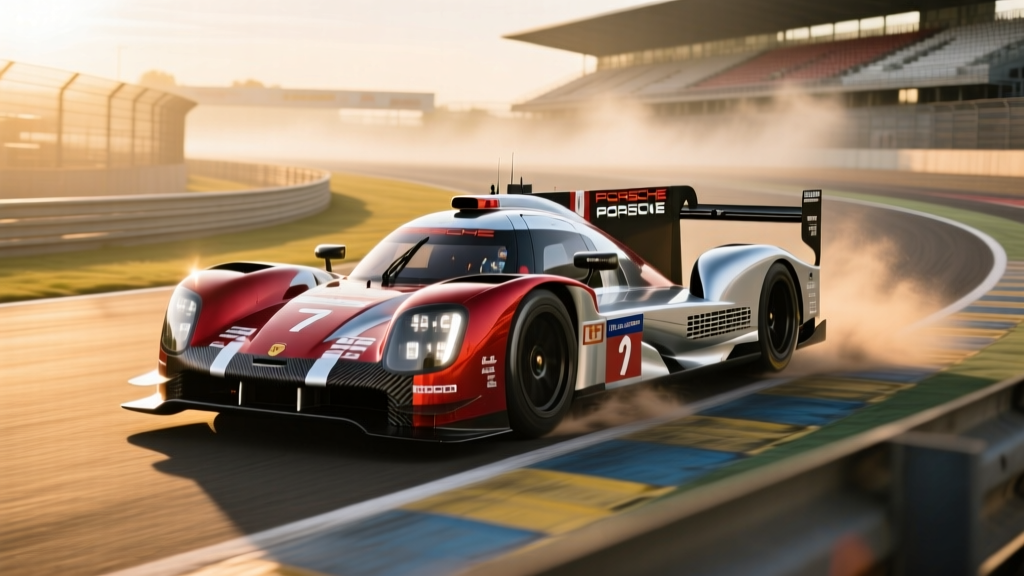
The Porsche 919 Hybrid isn't a car you'll find on a dealer lot or commute in on Tuesday mornings. It's a Le Mans Prototype 1 (LMP1) race car — one of the most technologically sophisticated hybrid machines ever built, and the direct ancestor of the electrified hypercars now reaching showrooms. If you've searched for "919 hybrid" to understand what makes this machine tick, you've landed in the right place.
Between 2014 and 2017, the 919 Hybrid won three consecutive 24 Hours of Le Mans races, two World Endurance Championship constructors' titles, and set a Nürburgring lap record that stood for years. More importantly for road-car buyers, it served as Porsche's rolling laboratory for the hybrid powertrain technology now found in the Cayenne E-Hybrid, Panamera Turbo S E-Hybrid, and the upcoming Mission X hypercar.
This guide breaks down the 919 Hybrid's powertrain architecture, energy-recovery systems, and battery specs — then connects those innovations to the plug-in hybrids (PHEVs) and hypercars you can actually buy today.
Race Car, Not Road Car: Understanding the 919 Hybrid's Purpose
Before diving into kilowatts and megajoules, a critical distinction: the Porsche 919 Hybrid is a purpose-built LMP1-H race car, not a production vehicle. It was designed under FIA World Endurance Championship (WEC) regulations that mandated hybrid energy recovery and deployment. You cannot buy one, register one, or drive one on public roads.
However, the 919 Hybrid is deeply relevant to anyone researching hybrid and PHEV technology because:
- It pioneered the dual energy-recovery system (brake + exhaust) now adapted for road-car PHEVs.
- Its battery chemistry and thermal management directly informed Porsche's Taycan and Panamera PHEV battery packs.
- Its successor regulations (Hypercar/LMDh) govern the road-to-race cars arriving from Porsche, BMW, and Toyota in 2024–2027.
Context: Race Hybrid vs. Road Hybrid vs. PHEV
| Feature | Porsche 919 Hybrid (LMP1) | Conventional HEV (e.g., Toyota Prius) | PHEV (e.g., Cayenne E-Hybrid) |
|---|---|---|---|
| Plugs in? | No — energy recovered on-track | No — regenerative braking + engine | Yes — Level 2 AC charging |
| Battery size | ~2.2 kWh usable (8.49 MJ class) | ~1.0–1.3 kWh | 17.9–25.9 kWh |
| Electric-only range | N/A (deployed in bursts) | ~1 mile at low speed | 14–48 miles (EPA) |
| Combined output | ~1,160 hp (ICE + ERS) | 121–196 hp | 389–729 hp |
| Purpose | 24-hour endurance racing | Fuel-economy commuting | Electric commute + gas road trips |
Powertrain Architecture: Twin Recovery, Four-Wheel Deployment
The 919 Hybrid's powertrain is a masterclass in extracting energy from two sources that most cars waste entirely: braking heat and exhaust gas.
Internal Combustion Engine
The heart of the 919 is a 2.0-liter turbocharged V4 — remarkably small for a top-tier prototype. This engine produces approximately 500 horsepower on its own, driving the rear wheels through a 7-speed sequential gearbox. Porsche chose the compact V4 for weight savings and packaging efficiency, freeing space for the hybrid system's electronics and battery.
Energy Recovery System (ERS): Two Sources, One Battery
What made the 919 revolutionary was its dual recovery architecture:
- Kinetic ERS (KERS): A motor-generator on the front axle recovers kinetic energy under braking — converting deceleration force into electrical energy stored in the battery. This is conceptually identical to the regenerative braking in your road-going PHEV, but at vastly higher power levels (up to 400 hp equivalent recovery).
- Exhaust ERS (MGU-H analog): A second motor-generator mounted in the exhaust stream recovers thermal energy from exhaust gases — essentially a turbo-compounding system that harvests waste heat that would otherwise exit the tailpipe. This technology is now being adapted in Formula 1 and is under study for future road applications.
Combined, the electric motor on the front axle delivers approximately 400 horsepower to the front wheels, making the 919 an all-wheel-drive car under deployment. Total system output: roughly 1,160 horsepower.
Battery, Energy Class, and the 8 MJ Strategy
The 919 Hybrid competed in the WEC's highest energy-recovery class: 8 megajoules per lap (at Le Mans). This regulated cap determined how much recovered energy the car could deploy per lap of the 8.47-mile Circuit de la Sarthe.
| Specification | Value |
|---|---|
| ICE | 2.0L turbo V4, ~500 hp |
| Electric Motor (Front Axle) | ~400 hp (300 kW) |
| Combined Output | ~1,160 hp |
| Battery Chemistry | Lithium-ion (A123 Systems cells) |
| Battery Capacity | ~2.2 kWh usable (8 MJ class) |
| Battery Weight | ~70 kg (with housing) |
| Min. Race Weight | 870 kg (LMP1-H regulation) |
| 0–62 mph (est.) | ~2.2 seconds |
| Top Speed (Le Mans low-drag) | ~229 mph |
| Le Mans Lap Record | 3:14.791 (Kamui Kobayashi, 2017 qualifying) |
| Production Status | Retired (2017); not road-legal |
The battery pack used A123 Systems lithium-ion pouch cells, chosen for their high discharge/charge C-rates rather than energy density. In road-car terms, the 919's battery prioritized power (kW) over capacity (kWh) — it needed to absorb and release enormous energy in seconds during braking zones and acceleration, not sustain electric-only driving for miles.
This is a fundamentally different engineering philosophy than a road-going PHEV like the Porsche Cayenne E-Hybrid, which carries a 25.9 kWh battery optimized for 30+ miles of electric commuting.
How 919 Hybrid Technology Reached the Road
The 919 program didn't just win races — it built the engineering muscle that Porsche now applies to production electrified vehicles. Here's the technology transfer pipeline:
Thermal Management and Battery Cooling
The 919's battery operated under extreme thermal stress — charge/discharge cycles at 400+ kW in ambient track temperatures exceeding 120°F. The liquid-cooling architecture Porsche developed for the 919 directly informed the thermal management system in the Taycan and the latest-generation Panamera Turbo S E-Hybrid, both of which use active liquid cooling to sustain repeated high-power acceleration without battery derating.
800-Volt Architecture
While the 919 itself did not use an 800V system, the high-voltage engineering expertise gained from the LMP1 program contributed to Porsche's decision to adopt an 800-volt architecture for the Taycan — enabling DC fast charging at up to 320 kW (on the latest Taycan models) and reducing current-related heat losses.
Dual-Motor AWD Deployment
The 919's front-axle electric motor driving the front wheels while the ICE drives the rear is now standard architecture in Porsche's E-Hybrid lineup. The Cayenne and Panamera PHEVs use a similar (if less extreme) layout: an electric motor integrated with the transmission supplementing the combustion engine, with torque-vectoring AWD distributing power.
From 919 to Hypercar: The 963 LMDh and Mission X
The 919 Hybrid's retirement in 2017 didn't end Porsche's hybrid racing ambitions — it evolved them. The Porsche 963 LMDh, which began competing in the IMSA WeatherTech SportsCar Championship and WEC in 2023, is the 919's spiritual successor. Built under the LMDh regulations (a cost-capped hybrid prototype formula shared with Cadillac, BMW, and Acura), the 963 uses a standardized Bosch motor-generator unit and Williams Advanced Engineering battery — but Porsche's own twin-turbo V8 and systems-integration expertise.
On the road side, the Porsche Mission X concept (unveiled 2023, with production under evaluation as of 2026) is positioned as a road-legal hypercar inheriting the 919's philosophy: lightweight construction, hybrid powertrain, and extreme performance. Porsche has indicated it would need to exceed the Nürburgring lap record for road cars to justify production — a benchmark the 919 Evo (an unrestricted variant) obliterated with a 5:19.55 lap in 2018.
What This Means for Hybrid and PHEV Buyers Today
If you're researching the 919 Hybrid because you're considering a hybrid or PHEV purchase, here's how the race car's legacy maps to your decision:
Which Electrified Porsche Fits You?
Choose a conventional hybrid (HEV) if: You want fuel savings without changing your habits. No plug, no range planning. The Porsche Cayenne Hybrid (non-plug-in, available in some markets) delivers modest electric assist around town.
Choose a PHEV if: You have home charging and a commute under 30 miles. The Cayenne E-Hybrid offers an EPA-estimated 30 miles of electric range and a combined 389 hp, switching seamlessly to hybrid mode for road trips. Battery warranty covers 8 years/100,000 miles.
Choose a full BEV if: You want zero tailpipe emissions, minimal maintenance, and access to the fastest DC charging in production (Taycan: 320 kW peak, 10–80% in ~18 minutes on 800V infrastructure).
Wait for the Mission X if: You want the closest road-legal analog to the 919 Hybrid — a lightweight hybrid hypercar with track-bred energy recovery. Expect a price north of $1.5 million and limited production, if approved.
Tax Credits and Incentives for Porsche PHEVs
The 919 Hybrid itself, as a race car, has no consumer tax-credit relevance. But if the 919's technology lineage has you eyeing a Porsche PHEV, here's what applies under current IRS §30D rules for the 2026 tax year:
- MSRP cap: SUVs (Cayenne) must be under $80,000; sedans (Panamera) under $55,000. Most Cayenne E-Hybrid trims and all Panamera E-Hybrid trims exceed these caps, making them ineligible for the federal credit.
- Income cap: Modified AGI must not exceed $300,000 (joint), $225,000 (head of household), or $150,000 (individual).
- Battery sourcing: Critical minerals and battery components must meet phased-in domestic/FNA content thresholds. Porsche's supply chain has not consistently met these thresholds.
- Point-of-sale transfer: If eligible, the credit can be applied at purchase rather than claimed on your tax return.
Bottom line: Most Porsche PHEVs do not qualify for the federal §30D credit due to MSRP and sourcing constraints. Always verify current eligibility at fueleconomy.gov and consult a tax professional before relying on credit estimates.
Frequently Asked Questions
Is the Porsche 919 Hybrid a road car I can buy?
No. The 919 Hybrid is an LMP1 race car built exclusively for the FIA World Endurance Championship. It is not street-legal and was never offered for consumer sale. Porsche built approximately 10 chassis between 2014 and 2017. The unrestricted "919 Evo" variant set lap records at Spa and the Nürburgring in 2018 but is also not road-legal.
How much horsepower does the 919 Hybrid produce?
Approximately 1,160 hp combined: ~500 hp from the 2.0L turbo V4 driving the rear wheels, and ~400 hp (300 kW) from the front-axle electric motor fed by the kinetic and exhaust energy recovery systems. Deployment is regulated by the 8 MJ/lap class limit at Le Mans.
What battery does the 919 Hybrid use?
A lithium-ion pouch-cell battery pack built with A123 Systems cells, with approximately 2.2 kWh of usable capacity. The battery is optimized for extreme charge/discharge rates (high C-rate) rather than energy density — it's designed to absorb massive regenerative braking energy and deploy it in seconds, not to sustain electric-only driving.
How did the 919 Hybrid influence Porsche's road cars?
Directly: the 919's thermal management, high-voltage engineering, and dual-motor AWD architecture informed the Taycan's 800V system, the Panamera E-Hybrid's powertrain integration, and the Porsche 963 LMDh race car. Indirectly, the engineering team and simulation tools developed for the 919 program now underpin all of Porsche's electrified vehicle development.
Hybrid vs. PHEV vs. EV — which Porsche should I buy?
It depends on your driving pattern. If you charge at home and commute under 30 miles, a PHEV like the Cayenne E-Hybrid gives you electric weekdays and gas-engine flexibility for road trips (total range ~450+ miles). If you want the lowest running costs and have reliable charging access, the Taycan (BEV) offers 320 kW DC fast charging and zero tailpipe emissions. A conventional HEV makes sense only if you cannot charge at home and want modest fuel savings without lifestyle change.
What is the Porsche 919 Hybrid's Nürburgring record?
The unrestricted 919 Evo, driven by Timo Bernhard, lapped the Nürburgring Nordschleife in 5:19.55 on June 29, 2018 — obliterating Stefan Bellof's 35-year-old record of 6:11.13 set in a Porsche 956. This remains the absolute lap record for the full Nordschleife circuit as of 2026.
Why the 919 Hybrid Matters
- Proved hybrid powertrains can win the world's toughest endurance race
- Dual ERS (kinetic + exhaust) was an industry first at this performance level
- Engineering talent and technology directly transferred to Taycan, Panamera PHEV, and 963 LMDh
- 919 Evo's Nürburgring record (5:19.55) may stand for decades
Limitations to Understand
- Not a consumer product — no MSRP, no EPA rating, no ownership path
- Battery capacity (~2.2 kWh) is tiny by road-car standards; optimized for power, not range
- WEC hybrid regulations have since evolved (LMDh uses spec hybrid components)
- Road-going successors (Mission X) remain unconfirmed for production as of 2026
The Porsche 919 Hybrid isn't a car you buy — it's the reason the electrified Porsches you can buy perform the way they do. Understanding its architecture gives you a sharper lens for evaluating any hybrid or PHEV on the market: look at energy recovery sources, battery C-rate capability, thermal management sophistication, and how the manufacturer translates motorsport investment into road-car reliability. The 919 proved that hybrid doesn't mean compromise — it means more power, more efficiency, and faster laps. That philosophy is now sitting in dealer showrooms.