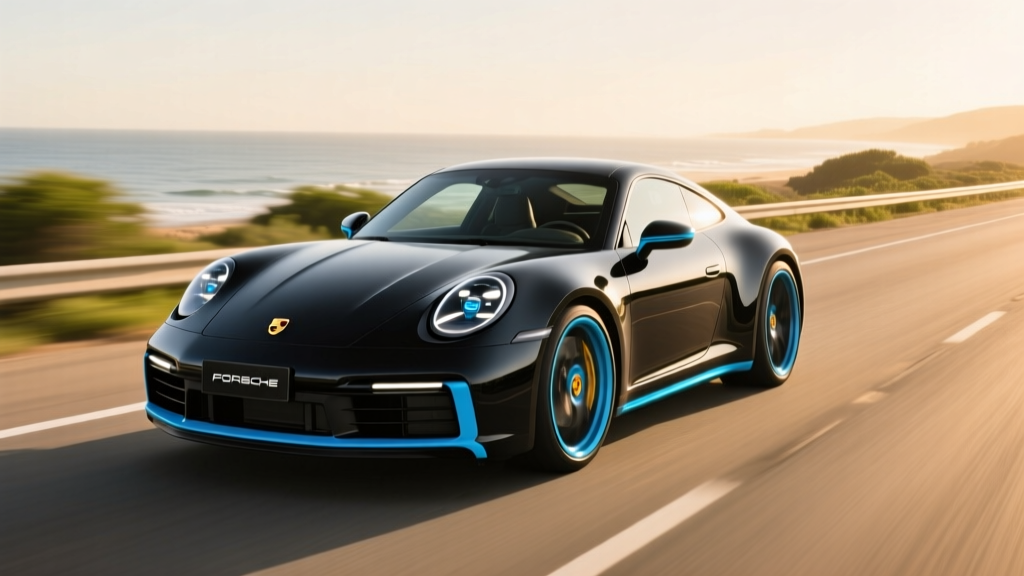
Porsche's first hybridized 911 isn't a plug-in efficiency play—it's a performance hybrid built around the new T-Hybrid (Turbo Hybrid) powertrain. Introduced for the 2025 model year on the 911 Carrera GTS, this system uses a compact electric motor integrated into the eight-speed PDK transmission and a high-voltage battery to eliminate turbo lag and sharpen throttle response. The result is a 911 that hits 0-60 mph in 2.9 seconds while posting better fuel economy than its predecessor. Here's everything buyers need to know about the 911 T-Hybrid's real-world efficiency, ownership costs, and where it fits in Porsche's lineup.
What Exactly Is the 911 T-Hybrid System?
The T-Hybrid is a conventional hybrid (HEV)—not a plug-in hybrid (PHEV). You cannot charge it from a wall outlet or public charger. The system recovers energy through regenerative braking and the integrated electric motor-generator, storing it in a compact high-voltage battery mounted under the rear shelf where the rear seats used to be in some configurations.
HEV vs PHEV: Where the 911 T-Hybrid Fits
| Feature | 911 T-Hybrid (HEV) | Typical PHEV (e.g., Cayenne E-Hybrid) |
|---|---|---|
| Plug-in charging | No | Yes (Level 1/Level 2) |
| Electric-only range | 0 miles | 15–45 miles |
| Battery size | ~1.9 kWh | 17–25 kWh |
| DC fast charging | Not available | Varies by model |
| Primary goal | Performance + efficiency assist | Electric commuting + gas range |
| Federal §30D tax credit | Not eligible | Eligible if criteria met |
The electric motor in the T-Hybrid system contributes up to 54 hp and 110 lb-ft of torque on its own, but its main job is filling the torque gap while the turbocharger spools. Porsche calls this an "electric turbo" effect—the motor spins a compressor that pre-charges intake air before exhaust gases arrive, virtually eliminating the lag that characterized the outgoing twin-turbo 3.0L flat-six.
Powertrain Specs: 532 Horsepower, Explained
| Specification | 2025 Porsche 911 Carrera GTS T-Hybrid |
|---|---|
| Engine | 3.6L turbocharged flat-six |
| Electric motor | Integrated in PDK, up to 54 hp / 110 lb-ft |
| Combined output | 532 hp / 450 lb-ft |
| Transmission | 8-speed PDK dual-clutch |
| 0-60 mph | 2.9 seconds (coupé, with Sport Chrono) |
| Top speed | 188 mph |
| High-voltage battery | ~1.9 kWh (lithium-ion) |
| Drivetrain | RWD (Coupé) / AWD (Cabriolet, Targa) |
| Curb weight | ~3,527 lbs (Coupé) |
The displacement bump from 3.0L to 3.6L (achieved via a longer stroke) gives the engine more inherent low-end torque, while the electric motor-generator handles transient response. Porsche also fitted a lighter lithium-ion 12V starter battery that communicates with the high-voltage system, shaving roughly 15 lbs from the nose.
Fuel Economy: EPA MPG and Real-World Expectations
| Driving Cycle | EPA Estimate | Real-World Expectation |
|---|---|---|
| City | 19 MPG | 18–21 MPG |
| Highway | 25 MPG | 23–27 MPG |
| Combined | 21 MPG | 20–24 MPG |
For context, the outgoing 2024 911 Carrera GTS (non-hybrid, 473 hp) returned an EPA combined 19 MPG. The T-Hybrid's 21 MPG combined represents roughly a 10% improvement—modest in absolute terms but meaningful for a 532-hp sports car. According to fueleconomy.gov, the annual fuel cost estimate sits around $3,150 based on 15,000 miles driven at current premium gasoline prices.
Real-world nuance: Hybrids typically overperform their EPA city estimates because stop-and-go driving maximizes regenerative braking. On the highway, the electric motor's contribution diminishes, and the 3.6L flat-six carries most of the load. Drivers who commute in urban traffic may see 22–23 MPG combined, while aggressive canyon driving or sustained Autobahn-speed cruising will drop figures into the mid-teens.
Does the 911 T-Hybrid Qualify for a Federal Tax Credit?
No. The 911 T-Hybrid is a conventional hybrid (HEV), and the IRS §30D Clean Vehicle Credit applies only to plug-in electric vehicles (BEVs and qualifying PHEVs) with sufficient battery capacity and compliant sourcing. Since the T-Hybrid cannot be plugged in and its battery falls well below the 7 kWh threshold, it is not eligible for the federal EV tax credit.
Some states offer modest incentives for conventional hybrids, but these are rare and typically small (a few hundred dollars at most). Check your state's energy office or the Alternative Fuels Data Center for current state-level programs. Federal hybrid incentives that existed under earlier legislation (like the original Energy Policy Act credits) expired years ago for most manufacturers.
Reliability, Battery Warranty, and Replacement Cost
Porsche Hybrid Battery Coverage
- Hybrid battery warranty: 8 years / 100,000 miles (whichever comes first)
- Powertrain warranty: 4 years / 50,000 miles
- Limited vehicle warranty: 4 years / 50,000 miles
- Expected battery lifespan: 10–15 years under normal use
The ~1.9 kWh high-voltage battery in the T-Hybrid is small by PHEV or BEV standards, which works in its favor for longevity. Smaller batteries undergo fewer deep discharge cycles, and Porsche's thermal management system keeps cell temperatures within optimal ranges during hard driving. The 8-year/100,000-mile hybrid component warranty aligns with industry standards for hybrid systems.
Should the high-voltage battery require replacement outside of warranty, Porsche has not published an official parts cost for the T-Hybrid module specifically. However, comparable high-voltage battery replacements in the Porsche Cayenne Hybrid and Panamera Hybrid range from $4,000 to $7,000 including labor. The T-Hybrid's smaller pack may fall on the lower end of that spectrum, but 911-specific packaging could add labor complexity. The electric motor-generator integrated into the PDK is covered under the hybrid warranty and is not expected to be a common failure point based on Porsche's track record with the Panamera and Cayenne hybrid systems.
On reliability broadly, Porsche's hybrid powertrains in the Cayenne and Panamera have proven robust over multiple model years. The 911 T-Hybrid's system is newer and more performance-oriented, but it uses proven component architectures. Long-term data for this specific application will take several years to accumulate.
Pricing and Trim Availability
| Configuration | Base MSRP (2025) | Drivetrain |
|---|---|---|
| 911 Carrera GTS Coupé | $164,900 | RWD |
| 911 Carrera GTS Cabriolet | $178,400 | AWD |
| 911 Targa 4 GTS | $183,500 | AWD |
All three body styles of the Carrera GTS now come exclusively with the T-Hybrid powertrain—Porsche did not offer a non-hybrid GTS for 2025. Options like the Lightweight Package, carbon-ceramic brakes (PCCB), and Sport Chrono can push a well-equipped Coupé past $190,000. Porsche's destination charge adds approximately $1,650.
According to Porsche's official configurator, the T-Hybrid system adds roughly 100 lbs compared to the outgoing GTS, but the lower center of gravity from the rear-mounted battery and the elimination of turbo lag more than offset the mass penalty in Porsche's track testing.
911 T-Hybrid vs Full EV vs Gas: Which Fits You?
Who Should Choose the 911 T-Hybrid?
Choose the 911 T-Hybrid if:
- You want a 911 with sharper throttle response and marginally better fuel economy than the previous generation
- You have no home charging access and don't want to rely on public infrastructure
- Track days and driving engagement matter more than electric-only commuting
- You want to avoid the weight penalty of a large PHEV or BEV battery pack
Consider a full EV (e.g., Taycan) if:
- You have reliable Level 2 home charging and want zero tailpipe emissions
- Daily commuting is your primary use case and you want lower per-mile energy costs
- You value instant torque delivery and near-silent operation
Consider a PHEV (e.g., Cayenne E-Hybrid) if:
- You want 20–40 miles of electric-only commuting with gas-car range flexibility
- You need SUV practicality with a plug-in efficiency benefit
- You want to potentially qualify for the §30D federal tax credit
The 911 T-Hybrid occupies a narrow lane: it's a performance-first hybrid that uses electrification to sharpen an already exceptional sports car, not to enable electric commuting. If your goal is to reduce fuel consumption dramatically or drive emission-free in the city, a Taycan or a PHEV from another brand will serve you better. But if you want a 911 that is objectively faster and more responsive than its predecessor while sipping slightly less premium fuel, the T-Hybrid delivers.
Pros and Cons at a Glance
Pros
- 532 hp with near-instant torque fill from the electric motor
- 0-60 mph in 2.9 seconds—quickest Carrera GTS ever
- ~10% fuel economy improvement over the outgoing GTS
- No plug-in charging required—refuel like any gas car
- Lighter high-voltage system than a PHEV (~100 lbs added vs 400+ lbs)
- 8-year/100,000-mile hybrid battery warranty
Cons
- No electric-only driving capability whatsoever
- Not eligible for federal §30D tax credit
- Starting price of $164,900 before options
- Rear-seat delete (battery packaging) reduces practicality
- Only available on GTS trim—no base Carrera T-Hybrid yet
- Real-world highway MPG drops significantly under hard driving
Frequently Asked Questions
How many MPG does the 911 T-Hybrid get?
The EPA rates the 2025 911 Carrera GTS T-Hybrid at 19 city / 25 highway / 21 combined MPG. Real-world combined figures typically range from 20–24 MPG depending on driving style, with city driving sometimes exceeding the EPA estimate thanks to regenerative braking.
Can I plug in the 911 T-Hybrid to charge?
No. The 911 T-Hybrid is a conventional hybrid (HEV), not a plug-in hybrid (PHEV). The high-voltage battery charges exclusively through regenerative braking and the engine-driven generator. There is no charge port.
How far can the 911 T-Hybrid go on electric power alone?
Zero miles. The electric motor assists the gasoline engine but cannot propel the car independently for any meaningful distance. This is fundamentally different from a PHEV, which offers 15–45 miles of electric-only range.
Is the 911 T-Hybrid reliable, and what does a battery replacement cost?
Porsche's hybrid systems in the Cayenne and Panamera have demonstrated strong reliability over multiple generations. The T-Hybrid's high-voltage battery is covered for 8 years/100,000 miles. Out-of-warranty replacement is estimated at $4,000–$7,000 based on comparable Porsche hybrid service costs, though 911-specific pricing has not been published.
Does the 911 T-Hybrid qualify for any tax credit?
No federal tax credit applies. The IRS §30D Clean Vehicle Credit requires plug-in capability and minimum battery capacity thresholds that the T-Hybrid does not meet. Some states may offer small hybrid incentives—check the Alternative Fuels Data Center for your jurisdiction.
Will Porsche expand the T-Hybrid to other 911 trims?
Porsche has not announced T-Hybrid availability below the GTS trim as of the 2025 model year. The Carrera, Carrera S, and Turbo models continue with their existing powertrains. Given the performance and efficiency benefits, broader adoption across the 911 range in future model years is plausible but unconfirmed.