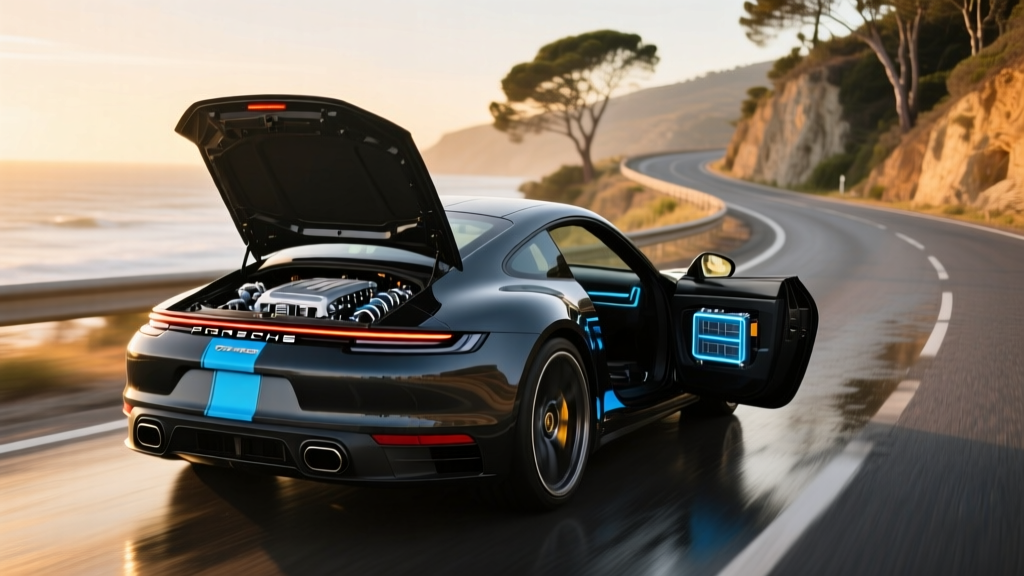
The 2026 Porsche 911 GTS T-Hybrid is not a Prius in a sports car suit. Porsche's first hybridized 911 uses a 1.87 kWh lithium-ion battery and an electric motor integrated into the eight-speed PDK transmission to fill turbo lag, harvest energy under braking, and deliver 532 combined horsepower. This is a conventional hybrid (HEV), not a plug-in — you never plug it in, and it has no electric-only driving range. The goal is sharper performance and marginal efficiency gains, not zero-emission commuting.
Below, we break down every spec that matters: real-world MPG, the T-Hybrid powertrain architecture, how it compares to PHEVs and full EVs, battery longevity, and whether the $166,395 base price makes sense in 2026.
What Exactly Is the 911 GTS T-Hybrid Powertrain?
Porsche calls it "T-Hybrid" (Turbo-Hybrid), but don't confuse it with a plug-in hybrid or a range-extending system. The architecture pairs a reworked 3.6-liter twin-turbocharged flat-six engine with two electric components:
- Electric motor in the PDK transmission: 54 hp (40 kW), providing instant torque fill below 3,000 RPM where turbos are still spooling.
- Electric exhaust turbocharger: An e-turbo with its own small motor that spools the turbocharger electrically, eliminating traditional turbo lag almost entirely.
- High-voltage battery: 1.87 kWh usable capacity, mounted under the rear decklid, charged exclusively through regenerative braking and engine power — never from a wall outlet.
Combined output is 532 horsepower and 465 lb-ft of torque, sent to the rear wheels through the eight-speed PDK dual-clutch automatic. The 0-60 mph time drops to 2.9 seconds (Porsche's figure; independent tests often clock 2.7-2.8s), compared to 3.2 seconds for the previous non-hybrid GTS.
| Specification | Value |
|---|---|
| Combined Horsepower | 532 hp |
| Combined Torque | 465 lb-ft |
| Engine | 3.6L twin-turbo flat-six |
| Electric Motor (PDK) | 54 hp / 40 kW |
| Battery Capacity (usable) | 1.87 kWh |
| Battery Type | Lithium-ion (high-voltage) |
| 0-60 mph | 2.9 sec (manufacturer) |
| Top Track Speed | 196 mph |
| Drivetrain | Rear-wheel drive, 8-speed PDK |
| Plug-In Capable? | No (HEV, not PHEV) |
| Base MSRP (Coupe) | $166,395 |
| Base MSRP (Cabriolet) | $179,195 |
Fuel Economy: EPA MPG and Real-World Expectations
Here's where expectations need calibration. The T-Hybrid system was engineered for performance, not hypermiling. The EPA estimates for the 2025/2026 911 GTS T-Hybrid (rear-wheel-drive coupe) are:
| Cycle | EPA Estimate | Real-World Expectation |
|---|---|---|
| City | 21 MPG | 19-22 MPG (regen helps in stop-and-go) |
| Highway | 27 MPG | 24-26 MPG (sustained high-speed driving) |
| Combined | 23 MPG | 20-24 MPG (mixed driving) |
How many MPG does this hybrid get? Around 23 combined per the EPA — a modest improvement over the previous-generation 992.1 GTS, which returned roughly 19-20 MPG combined. The hybrid system's efficiency gains are real but small: roughly 2-3 MPG combined, primarily from regenerative braking recapturing energy that would otherwise be lost as heat, and the electric motor reducing the engine's load during low-speed acceleration.
For context, a Toyota Prius returns 57 MPG combined. The 911 GTS T-Hybrid will cost approximately $2,600-$3,100 per year in fuel at 15,000 miles driven and $3.75/gallon premium (required). The previous GTS without hybrid assist would run $3,000-$3,500 annually. You're saving a few hundred dollars a year — not the point of this car.
According to fueleconomy.gov, the annual fuel cost for the 911 GTS T-Hybrid is approximately $2,850 based on 15,000 miles per year at current fuel prices.
HEV vs. PHEV vs. EV: Which Fits Your Garage?
The 911 GTS T-Hybrid is a conventional hybrid (HEV). This distinction matters because buyers often assume "hybrid" means plug-in capability. Here's how the three electrified categories break down:
HEV (Conventional Hybrid) — What the 911 GTS T-Hybrid Is
- No plug. Charges via regenerative braking and engine.
- Electric-only range: effectively zero (motor assists only at low speeds for brief moments).
- Small battery (1.87 kWh here).
- Goal: performance enhancement and slight MPG improvement.
PHEV (Plug-In Hybrid) — What the 911 GTS T-Hybrid Is NOT
- Plugs into a wall outlet or charger (Level 1 or Level 2).
- Electric-only range: typically 20-50 miles depending on model.
- Larger battery (usually 10-25 kWh).
- Examples: Toyota RAV4 Prime, Jeep Wrangler 4xe, Porsche Cayenne E-Hybrid.
- May qualify for federal §30D tax credit (up to $7,500) if battery sourcing and income requirements are met.
BEV (Battery Electric Vehicle)
- No internal combustion engine. 100% electric.
- Range: 200-400+ miles EPA depending on model.
- Large battery (60-130+ kWh).
- Examples: Porsche Taycan, Tesla Model S, BMW i4.
- Eligible for §30D credit if all requirements met.
Who should choose the 911 GTS T-Hybrid over a PHEV or EV? Drivers who want a sports car first and an efficiency story second. If your priority is electric-only commuting, zero tailpipe emissions, or federal tax credits, look at the Porsche Taycan (BEV) or Cayenne E-Hybrid (PHEV). The 911 GTS T-Hybrid is for buyers who want the 911's driving dynamics with the responsiveness that hybrid torque fill provides — and who accept 23 MPG as the trade-off.
Does the 911 GTS T-Hybrid Qualify for a Tax Credit?
No. Under current IRS §30D rules, the federal Clean Vehicle Credit requires a vehicle to be a plug-in electric vehicle (PHEV or BEV) with a battery capacity of at least 7 kWh. The 911 GTS T-Hybrid's 1.87 kWh battery and lack of plug-in capability disqualify it entirely from:
- The $7,500 new clean vehicle credit (§30D)
- The $4,000 used clean vehicle credit (§25E)
- The commercial clean vehicle credit (§45W)
- Any state-level EV/PHEV rebate programs (which universally require plug-in capability)
Per the IRS guidelines on clean vehicle credits, conventional hybrids without plug-in capability have not qualified for federal purchase incentives since the original hybrid credits expired years ago. You pay the full $166,395 MSRP (before options, destination, and dealer adjustments) with no federal offset.
Battery Warranty, Reliability, and Replacement Cost
Hybrid battery anxiety is understandable — replacement costs on older hybrids have historically been a concern. However, the 911 GTS T-Hybrid's high-voltage battery is small, lightly stressed, and built to Porsche's durability standards.
Battery & Hybrid System Warranty
- High-voltage battery warranty: 8 years / 100,000 miles (whichever comes first)
- Hybrid-specific components (e-turbo, PDK motor): 8 years / 100,000 miles
- New vehicle limited warranty: 4 years / 50,000 miles
- Capacity retention threshold: Porsche warrants the battery against defects and abnormal degradation; specific SoH thresholds are defined in the warranty booklet
Is this hybrid reliable and what is battery replacement cost? The 992.2-generation 911 is new for the 2025/2026 model year, so long-term reliability data is limited. However, Porsche's hybrid components benefit from lessons learned with the Panamera E-Hybrid and Cayenne E-Hybrid programs. The 1.87 kWh battery is small and operates within a narrow state-of-charge window (it never fully depletes or fully charges), which reduces stress and extends cycle life.
If the high-voltage battery does require replacement out of warranty, expect a cost in the range of $5,000-$9,000 for the battery module alone, plus labor. This is less than a full EV battery replacement (often $12,000-$22,000) because the capacity is far smaller. The 8-year/100,000-mile warranty provides substantial coverage, and most 911 owners will sell or trade the car well before the battery reaches end-of-life.
The e-turbocharger is a newer component with less track record. It's covered under the hybrid warranty, but its long-term durability in high-heat exhaust environments remains to be proven at scale. Porsche's official 911 GTS specification page details the full powertrain warranty terms.
How the T-Hybrid System Drives: Real-World Impressions
The numbers tell one story; the driving experience tells another. The T-Hybrid system's primary contribution is responsiveness, not raw power addition. Here's what the hybrid components do on the road:
- Turbo lag elimination: The electric e-turbo spools to operating speed in milliseconds, so boost pressure is available almost instantly. In practice, throttle response feels more like a naturally aspirated engine than a turbocharged one.
- Torque fill below 3,000 RPM: The PDK-integrated electric motor provides the 54 hp gap while the flat-six builds revs. The result is seamless, uninterrupted acceleration from any speed.
- Regenerative braking: Up to 150 kW of regen capacity (briefly), which recharges the 1.87 kWh battery aggressively during deceleration. The brake pedal feel transitions smoothly between regen and the mechanical carbon-ceramic brakes (optional, $9,220).
- Weight penalty: The hybrid system adds approximately 110 lbs (50 kg) compared to the non-hybrid GTS. In a 3,400-lb sports car, this is perceptible in tight corners but offset by the performance gains.
The battery is never "empty" in any meaningful sense — the car's power management system keeps it in a 40-80% state-of-charge window at all times, ensuring power is always available for acceleration and that the battery isn't stressed by deep cycles.
Pricing, Options, and What the GTS T-Hybrid Costs in 2026
| Configuration | Base MSRP | Typical As-Tested |
|---|---|---|
| 911 GTS T-Hybrid Coupe (RWD) | $166,395 | $185,000-$200,000 |
| 911 GTS T-Hybrid Cabriolet (RWD) | $179,195 | $198,000-$215,000 |
| 911 GTS T-Hybrid Coupe (AWD, Carrera 4 GTS) | $171,895 | $190,000-$210,000 |
Porsche's options structure pushes real transaction prices well above MSRP. Common additions for the GTS include:
- Carbon ceramic brakes (PCCB): $9,220
- Rear-axle steering: $2,090
- Front axle lift system: $2,770
- Sport Chrono package (included on GTS)
- Lightweight package (carbon roof, thinner glass): ~$8,000
- Premium package (ventilated seats, ambient lighting): ~$3,500
A realistically equipped GTS T-Hybrid coupe lands between $185,000 and $200,000 before taxes and registration. With no federal tax credit available, this is the full out-of-pocket cost.
Decision Framework: Should You Buy the 911 GTS T-Hybrid?
Choose the 911 GTS T-Hybrid if:
- You want a 911 with the sharpest throttle response Porsche has ever delivered in a non-Turbo model.
- You value the 532 hp output and sub-3-second 0-60 time without stepping up to the $233,000+ 911 Turbo S.
- You don't need plug-in charging capability or electric-only range.
- You accept 23 MPG combined as the cost of 532 hp in a sports car.
- You plan to keep the car within the 8-year/100,000-mile hybrid warranty period.
Look elsewhere if:
- You want federal tax credits — the T-Hybrid qualifies for none. Consider the Cayenne E-Hybrid (PHEV) or Taycan (BEV).
- Electric-only commuting is a priority — this car has zero EV range.
- You want maximum fuel efficiency — 23 MPG is better than the old GTS, but a BMW i4 or Tesla Model 3 costs pennies per mile by comparison.
- You prefer a manual transmission — the T-Hybrid is PDK only (the hybrid system requires the dual-clutch gearbox).
- Budget is under $160,000 — the base MSRP is $166,395 before any options.
Frequently Asked Questions
How many MPG does the 911 GTS T-Hybrid get?
The EPA rates it at 21 city / 27 highway / 23 combined. Real-world driving typically yields 20-24 MPG combined, with city driving benefiting slightly from regenerative braking. Expect to spend roughly $2,600-$3,100 per year on premium fuel at 15,000 miles annually.
How far can the 911 GTS T-Hybrid go on electric only?
It can't. This is a conventional hybrid (HEV), not a plug-in hybrid (PHEV). The 1.87 kWh battery and 54 hp electric motor assist the engine during acceleration but cannot propel the car independently at meaningful speeds or distances. There is no EV mode and no electric-only range.
Hybrid vs PHEV vs EV — which fits my needs?
If you want a sports car with sharper throttle response and don't care about plug-in charging, the 911 GTS T-Hybrid (HEV) is the right choice. If you want electric-only commuting with a gas engine backup, look at a PHEV like the Porsche Cayenne E-Hybrid (up to ~30 miles EV range). If you want zero tailpipe emissions and are ready for full electric, the Porsche Taycan offers up to 318 miles of EPA range with DC fast charging to 270 kW.
Is the 911 GTS T-Hybrid reliable and what is battery replacement cost?
The 992.2 generation is new, so multi-year reliability data isn't available yet. Porsche covers the high-voltage battery and hybrid components for 8 years/100,000 miles. Out-of-warranty battery replacement is estimated at $5,000-$9,000 — less than a full EV battery due to the small 1.87 kWh capacity. The e-turbocharger is the newest, least-proven component and is also covered under the hybrid warranty.
Does the 911 GTS T-Hybrid qualify for any tax credit?
No. Federal §30D clean vehicle credits require plug-in capability and a minimum 7 kWh battery. The 911 GTS T-Hybrid has a 1.87 kWh battery and no plug, so it qualifies for no federal EV/PHEV credits and no state-level electric vehicle rebates. You pay the full purchase price with no incentive offsets.
Do I need to plug in the 911 GTS T-Hybrid to charge it?
No. Conventional hybrids charge their batteries exclusively through regenerative braking and engine power. There is no charge port, no plug, and no home charging setup required. You fuel it with premium gasoline (91 octane recommended) like any other sports car.
What's the difference between the GTS T-Hybrid and the 911 Turbo S?
The Turbo S produces 640 hp from a 3.7L twin-turbo flat-six (no hybrid system), hits 0-60 in approximately 2.5 seconds, and starts around $233,000. The GTS T-Hybrid makes 532 hp, hits 0-60 in 2.9 seconds, starts at $166,395, and offers sharper low-RPM response due to electric torque fill. The Turbo S is faster in a straight line; the GTS T-Hybrid is more responsive in real-world driving and significantly less expensive.