The State of Plug-In Hybrid Honda Models in 2026
Honda's electrification strategy has taken a different path than Toyota's or Hyundai's. While competitors have rolled out multiple plug-in hybrid (PHEV) options across their lineups, Honda has been more selective — and for US buyers searching for a plug in hybrid Honda, the options in 2026 require careful navigation. Honda discontinued the Clarity Plug-In Hybrid after the 2021 model year, and as of the 2026 model year, the US market relies primarily on the conventional hybrid (HEV) lineup across the Accord, CR-V, and Civic. However, Honda's global e:PHEV technology — available in the CR-V e:PHEV in select markets — signals where the brand may be heading.
This guide breaks down exactly what Honda offers US buyers in the hybrid and plug-in hybrid space for 2026, how the powertrains work, real-world efficiency data, and whether a Honda hybrid, a competitor's PHEV, or a full battery-electric vehicle (BEV) is the right call for your situation.
HEV vs PHEV: What Honda Buyers Need to Understand
Before evaluating specific models, it's critical to understand the fundamental difference between Honda's conventional hybrids and plug-in hybrids available in other markets.
| Feature | Conventional Hybrid (HEV) | Plug-In Hybrid (PHEV) |
|---|---|---|
| Plugs in? | No — charges via regenerative braking and engine | Yes — has a larger battery you charge from a wall outlet or charger |
| Battery size | ~1.0–1.5 kWh (small buffer) | ~13–18 kWh (enables electric-only driving) |
| Electric-only range | None (motor assists engine at low speeds only) | 25–50 miles typically |
| When battery depletes | N/A — always hybrid mode | Operates as a conventional hybrid |
| Federal tax credit | No | Potentially up to $7,500 under IRS §30D (eligibility varies) |
| Ideal for | Drivers without home charging access | Drivers with home charging and short commutes |
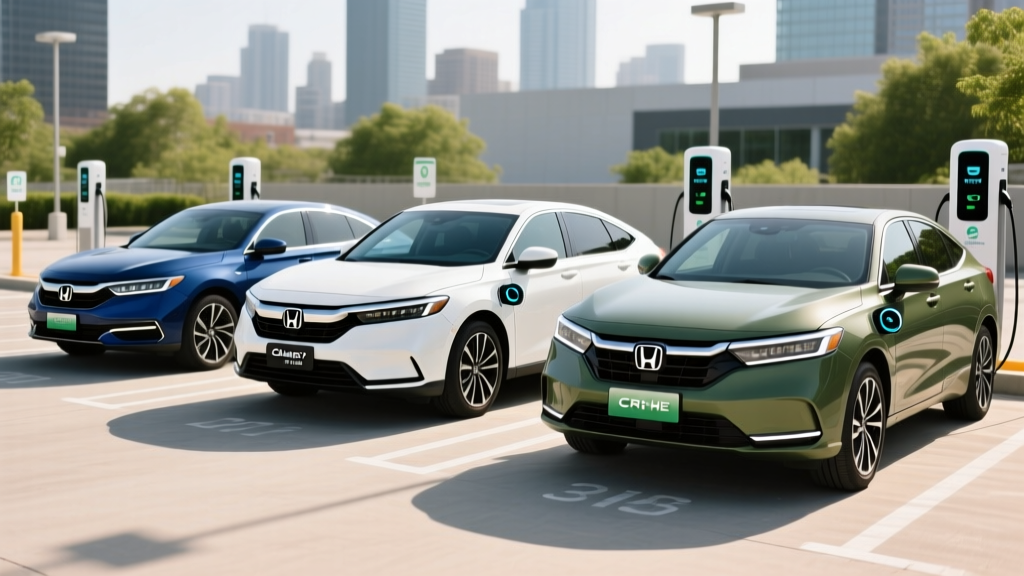
Honda's current US hybrid lineup — the Accord Hybrid, CR-V Hybrid, and Civic Hybrid — are all conventional HEVs. You never plug them in. They use a small lithium-ion battery paired with electric motors and a gasoline engine to achieve excellent fuel economy without any change to your fueling routine.
2026 Honda Hybrid Lineup: MPG, Specs, and Pricing
Here is a detailed look at the hybrid models Honda offers US buyers for the 2026 model year. These are self-charging hybrids — no plug required.
| Model | Powertrain | Combined HP | EPA City | EPA Hwy | EPA Combined | Base MSRP |
|---|---|---|---|---|---|---|
| 2026 Accord Hybrid | 2.0L 4-cyl + 2 electric motors (e:HEV) | 204 hp | 51 MPG | 44 MPG | 48 MPG | ~$34,500 |
| 2026 CR-V Hybrid | 2.0L 4-cyl + 2 electric motors (e:HEV) | 204 hp | 43 MPG | 36 MPG | 40 MPG | ~$37,500 |
| 2026 Civic Hybrid | 2.0L 4-cyl + 2 electric motors (e:HEV) | 200 hp | 50 MPG | 47 MPG | 49 MPG | ~$30,500 |
Source: fueleconomy.gov and Honda Newsroom. MSRP figures are approximate base hybrid trim pricing including destination; actual pricing varies by dealer and options.
Real-World MPG vs EPA Estimates
Honda's e:HEV two-motor hybrid system excels in city driving, where the electric motors handle most low-speed propulsion and the engine acts primarily as a generator. In real-world testing and owner reports, the Accord Hybrid and Civic Hybrid frequently exceed their EPA city ratings in stop-and-go traffic — sometimes hitting 53–55 MPG in warm-weather urban driving.
Highway efficiency tells a different story. At sustained 70–80 mph speeds, the engine drives the wheels directly through a single-gear clutch, and real-world highway fuel economy typically falls 2–4 MPG below the EPA highway figure. Expect roughly 40–42 MPG highway in the Accord Hybrid and 32–34 MPG in the CR-V Hybrid on flat interstate terrain. Cold weather (below 40°F) further reduces efficiency by approximately 5–10% due to increased engine operation for cabin heating and reduced battery efficiency.
The Honda PHEV Situation: What About a Plug-In Hybrid Honda?
If you specifically want a plug in hybrid Honda — one you can charge at home for electric-only commuting — the US options are currently limited. Here is the landscape:
Honda Clarity Plug-In Hybrid (Discontinued)
The Clarity PHEV was Honda's most compelling plug-in offering, featuring a 17 kWh battery, 47 miles of EPA-rated electric-only range, and 44 MPG combined once the battery was depleted. Honda discontinued the Clarity after 2021. If you find a used Clarity PHEV, it remains a solid option — but it is no longer available new, and the used EV tax credit (up to $4,000 under §25E) may apply if you purchase one from a dealer for under $25,000 and meet income requirements.
CR-V e:PHEV (Global Markets — Not US)
Honda sells the CR-V e:PHEV in China and Europe with a larger battery pack (approximately 17.7 kWh) offering roughly 40–50 miles of electric-only range under WLTP testing. This model uses Honda's fourth-generation i-MMD system with a 2.0L direct-injection Atkinson-cycle engine and dual motors producing a combined 204 hp. As of the 2026 model year, Honda has not confirmed US availability for the CR-V e:PHEV.
What US Buyers Can Do
If you want a Honda and need plug-in capability today, your realistic options are:
- Buy a used Clarity PHEV — check the IRS §25E used EV credit for eligibility
- Buy a Honda HEV (Accord, CR-V, or Civic Hybrid) and accept excellent fuel economy without plug-in capability
- Consider a competitor's PHEV — Toyota RAV4 Prime (42 mi EV range), Hyundai Tucson PHEV (33 mi), or Jeep Wrangler 4xe (22 mi)
Battery Warranty, Reliability, and Replacement Costs
Honda Hybrid Battery Warranty
All 2026 Honda hybrid models come with a hybrid battery warranty of 8 years / 100,000 miles (10 years / 150,000 miles in California and states that follow CARB emissions standards). This covers capacity loss below a defined threshold and defects.
Long-Term Reliability
Honda's e:HEV (also branded as i-MMD in earlier generations) hybrid system has proven highly reliable. The two-motor architecture is mechanically simpler than some competitors' planetary-gear-based systems — there is no traditional transmission, just a direct-drive clutch that engages at highway speeds. Consumer Reports and J.D. Power data consistently rank the Accord Hybrid and CR-V Hybrid as above-average in predicted reliability.
The hybrid battery packs in Honda's HEVs are relatively small (~1.0–1.5 kWh usable), meaning they undergo fewer deep charge-discharge cycles than a PHEV or BEV battery. Real-world data from earlier-generation Insight and Accord Hybrid owners suggests these batteries often last well beyond 150,000 miles without significant degradation.
Battery Replacement Cost
If a Honda hybrid battery does fail outside of warranty, replacement costs are significantly lower than a full EV battery. Current estimates for Honda HEV battery replacement range from $2,000 to $4,000 (parts and labor), depending on the model and whether you use a dealership or independent hybrid specialist. This is a fraction of the $10,000–$20,000+ cost associated with large BEV battery packs.
Hybrid vs PHEV vs Full EV: Which Fits Your Driving Life?
Choosing between a Honda hybrid, a competitor's PHEV, or a full battery-electric vehicle depends on your charging access, commute patterns, and budget. Here is a practical decision framework:
Choose a Honda HEV (Accord/CR-V/Civic Hybrid) if:
- You do not have access to home or workplace charging
- You want maximum simplicity — no plug, no apps, no charging planning
- Your driving is a mix of city and highway with no predictable short-commute pattern
- You want a lower purchase price (hybrids start $3,000–$5,000 less than comparable PHEVs)
Choose a competitor PHEV (RAV4 Prime, Tucson PHEV) if:
- You have Level 2 home charging and a commute under 35 miles round-trip
- You want to drive electric daily but take gas-powered road trips without range anxiety
- You want potential federal tax credit eligibility (up to $7,500 under §30D, subject to sourcing, income, and MSRP rules — see IRS clean vehicle credits)
Choose a full BEV (Tesla Model Y, Hyundai Ioniq 5, Honda Prologue) if:
- You have reliable home Level 2 charging
- Your daily driving is under 250 miles and you can plan road-trip charging
- You want the lowest per-mile fuel cost (electricity at $0.12/kWh ≈ $0.04/mile vs. gas at $3.50/gal ≈ $0.12/mile for a 30 MPG car)
- You want to eliminate oil changes and reduce maintenance
Tax Credits and Incentives for Honda Hybrids
This is where the distinction between HEV and PHEV matters enormously for your wallet:
| Credit / Incentive | Honda HEV (Accord/CR-V/Civic) | PHEV (if available) |
|---|---|---|
| Federal §30D New Clean Vehicle Credit | Not eligible (no plug) | Up to $7,500 — subject to MSRP cap ($55,000 sedans / $80,000 SUVs), buyer income limits ($150K single / $300K joint), and battery critical-mineral/sourcing requirements |
| Federal §25E Used EV Credit | Not eligible | Up to $4,000 on qualifying used PHEVs (sale price ≤$25,000, income limits apply) |
| State incentives | Varies — some states offer rebates for HEVs (check your state energy office) | Varies widely — California, Colorado, and others offer additional PHEV rebates |
Important: Federal tax credit rules under §30D are complex and subject to change. Battery sourcing requirements tightened significantly under the Inflation Reduction Act, and many PHEVs from non-US-manufactured brands have lost partial or full credit eligibility. Always verify current rules at irs.gov and consult a tax professional before relying on credit eligibility in your purchase decision.
Pros: Honda Hybrid Lineup
- Class-leading city MPG — Accord Hybrid hits 51 city, Civic Hybrid 50 city
- No plug required — works with any gas station, no charging infrastructure needed
- Proven reliability of e:HEV two-motor system with 8yr/100K-mi battery warranty
- Lower purchase price than PHEV competitors
- Smooth, quiet electric-driven acceleration at low speeds
- Strong resale value — Honda hybrids retain value well
Cons: Honda Hybrid Lineup
- No current plug-in hybrid option in the US market
- No federal tax credit eligibility for conventional HEVs
- Highway MPG falls below EPA sticker in real-world 75+ mph driving
- CR-V Hybrid MPG (40 combined) trails the Toyota RAV4 Hybrid (41 combined) marginally
- Engine drone under hard acceleration — the e:HEV system can sound disconnected from vehicle speed
- No DC fast charging capability (not applicable — HEVs don't plug in)
Frequently Asked Questions
How many MPG does the 2026 Honda Accord Hybrid get?
The 2026 Accord Hybrid achieves an EPA-rated 51 MPG city, 44 MPG highway, and 48 MPG combined. In real-world city driving, owners frequently report exceeding 51 MPG, while sustained highway driving at 75+ mph typically yields 40–42 MPG — slightly below the EPA highway figure.
Does Honda make a plug-in hybrid for the US market in 2026?
As of the 2026 model year, Honda does not sell a new plug-in hybrid in the US. The Clarity Plug-In Hybrid was discontinued after 2021. Honda offers the CR-V e:PHEV in China and Europe, but it has not been confirmed for the US market. US buyers seeking a Honda with electrified powertrains can choose from the Accord Hybrid, CR-V Hybrid, or Civic Hybrid — all conventional HEVs.
How far can a Honda plug-in hybrid go on electric only?
The discontinued Honda Clarity PHEV offered 47 miles of EPA-rated electric-only range from its 17 kWh battery. The global-market CR-V e:PHEV offers approximately 40–50 miles (WLTP) on electric power. Neither is available new in the US for 2026. For comparison, the Toyota RAV4 Prime offers 42 miles of EV range and is available in the US.
Are Honda hybrids reliable, and what does battery replacement cost?
Honda's e:HEV hybrid system has a strong reliability track record. The hybrid battery is covered by an 8-year/100,000-mile warranty (10 years/150,000 miles in CARB states). Out-of-warranty battery replacement typically costs $2,000–$4,000 — substantially less than a full EV battery replacement. Many Honda hybrid batteries last well beyond 150,000 miles without significant issues.
Does any Honda hybrid qualify for a federal tax credit?
No. Conventional hybrids (HEVs) like the 2026 Accord Hybrid, CR-V Hybrid, and Civic Hybrid do not qualify for the federal §30D clean vehicle tax credit because they cannot be plugged in. Only plug-in hybrids (PHEVs) and battery-electric vehicles (BEVs) are potentially eligible, subject to MSRP caps, buyer income limits, and battery sourcing requirements. A used Clarity PHEV may qualify for the §25E used EV credit (up to $4,000) if purchased from a dealer for under $25,000.
Should I buy a Honda hybrid or a full EV like the Honda Prologue?
It depends on your charging situation. If you have Level 2 home charging and drive under 250 miles daily, the Honda Prologue (EPA range ~296 miles, starting ~$43,000) offers lower fueling costs and near-zero maintenance. If you lack home charging, frequently drive long distances in rural areas, or want a lower purchase price, a Honda HEV (Accord, CR-V, or Civic Hybrid) is the more practical choice. The Prologue may qualify for the full $7,500 federal credit via point-of-sale transfer, significantly narrowing the price gap — verify eligibility at irs.gov.