If you've ever searched for a way to plug in an AC unit for your car — whether to pre-cool the cabin while parked, keep the interior comfortable without idling a gas engine, or run climate control off grid power — you're not alone. Hot-weather drivers, parents with young children, pet owners, and van-life enthusiasts all want cabin cooling that doesn't require burning fuel. The good news: modern plug-in hybrids (PHEVs) and some conventional hybrids (HEVs) already solve this problem without aftermarket gadgets.
This guide breaks down exactly which 2026 electrified vehicles can run air conditioning on battery power alone, how long they can sustain it, what it costs in electricity, and which models qualify for federal tax credits under current IRS §30D rules.
What "Plug In AC Unit for Car" Actually Means in 2026
Before comparing vehicles, let's clear up a common confusion. When people search for a "plug in AC unit for car," they typically mean one of three things:
- Preconditioning the cabin while plugged in — using grid electricity (via a Level 1 or Level 2 charger) to cool the interior before driving, preserving battery range.
- Running AC without the engine — using the traction battery to power the electric A/C compressor while parked or in electric-only mode.
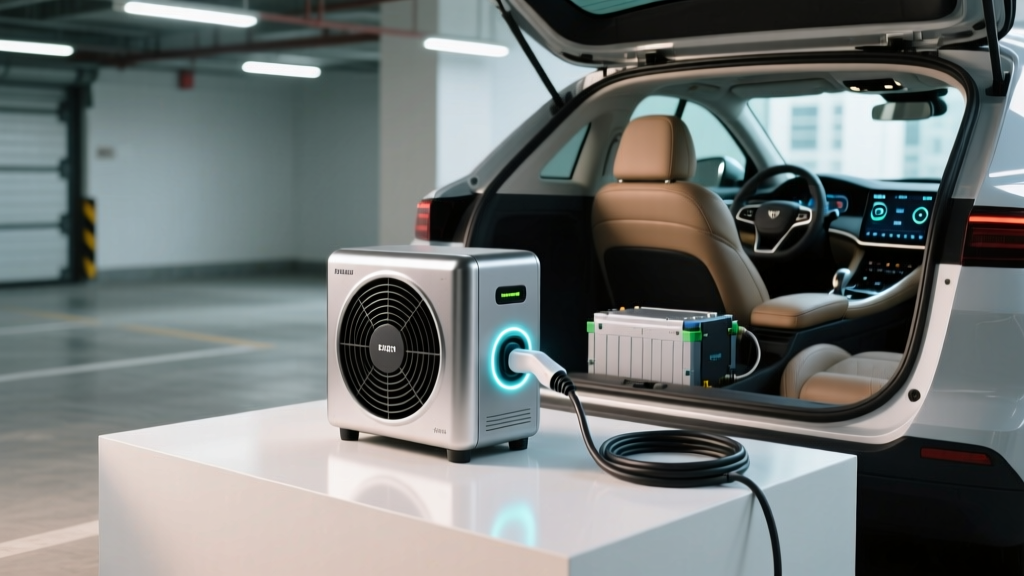
- Aftermarket 120V portable AC units — plugging a standalone cooler into a car's 12V outlet or inverter (generally ineffective and not recommended).
For the first two scenarios, PHEVs and HEVs with electric A/C compressors handle this natively. The third scenario — aftermarket units — is almost universally a waste of money, drawing 400-800 watts through an undersized inverter and barely dropping cabin temperature. Instead, the right vehicle eliminates the need entirely.
HEV vs PHEV: Which Can Run AC on Battery Alone?
Understanding the difference between a conventional hybrid and a plug-in hybrid is critical when your goal is engine-off cabin cooling.
| Feature | Conventional Hybrid (HEV) | Plug-In Hybrid (PHEV) |
|---|---|---|
| Plugs into wall outlet? | No — self-charges via regen & engine | Yes — Level 1 (120V) or Level 2 (240V) |
| Traction battery size | 0.9–1.6 kWh | 11–21 kWh |
| AC while parked (engine off) | Limited — engine kicks on after ~5-15 min to recharge small battery | Extended — 30 min to 2+ hours depending on battery size and fan speed |
| Preconditioning while plugged in | Not available (no plug) | Yes — draws from grid, preserves battery |
| Electric-only driving range | 0 miles (electric motor assists only at low speeds) | 25–48 miles EPA |
| Federal tax credit (§30D) | Not eligible | Up to $7,500 (subject to MSRP, income, sourcing rules) |
The takeaway: if cabin cooling without engine idling is your priority, a PHEV with a larger traction battery is the clear winner. The bigger the kWh, the longer the A/C runs before the engine fires up.
Top 2026 PHEVs for Electric Cabin Cooling
Here are the standout 2026 plug-in hybrids that let you run air conditioning on battery power for extended periods, along with their full powertrain and efficiency specs.
2026 Toyota RAV4 Prime
The RAV4 Prime remains the benchmark PHEV compact SUV. Its 18.1 kWh battery (NMC chemistry) delivers up to 42 miles of electric-only range, meaning you can run the electric A/C compressor for roughly 90 minutes at moderate fan speed before the 2.5L four-cylinder engine starts to recharge the pack.
| Spec | 2026 Toyota RAV4 Prime |
|---|---|
| Combined HP | 302 hp (2.5L I4 + 2 electric motors) |
| Battery | 18.1 kWh usable (NMC) |
| EPA electric-only range | 42 miles |
| Total combined range | ~600 miles |
| EPA MPG (hybrid mode) | 38 city / 35 hwy / 38 combined |
| MPGe (electric mode) | 94 MPGe combined |
| Level 2 charge time (0-100%) | ~2.5 hours at 6.6 kW |
| DC fast charge | Not available |
| 0-60 mph | 5.7 seconds |
| Base MSRP | $44,500 (SE) / $48,000 (XSE) |
| Hybrid battery warranty | 10 years / 150,000 miles |
2026 Hyundai Tucson Plug-In Hybrid
Hyundai's Tucson PHEV pairs a 1.6L turbocharged four-cylinder with a 72 kW electric motor and a 13.8 kWh battery. Electric-only range is rated at 33 miles EPA, and the cabin can stay cool for approximately 60–75 minutes on battery alone in 95°F heat.
| Spec | 2026 Hyundai Tucson PHEV |
|---|---|
| Combined HP | 261 hp (1.6L turbo I4 + electric motor) |
| Battery | 13.8 kWh usable (NMC) |
| EPA electric-only range | 33 miles |
| Total combined range | ~430 miles |
| EPA MPG (hybrid mode) | 35 city / 33 hwy / 35 combined |
| MPGe (electric mode) | 80 MPGe combined |
| Level 2 charge time (0-100%) | ~2 hours at 7.2 kW |
| DC fast charge | Not available |
| 0-60 mph | 7.1 seconds |
| Base MSRP | $39,750 (SEL) / $43,500 (Limited) |
| Hybrid battery warranty | 10 years / 100,000 miles |
2026 Jeep Wrangler 4xe
For off-road enthusiasts who also want engine-off cooling at the campsite, the Wrangler 4xe's 17.3 kWh battery provides roughly 22 miles of electric range and about 60 minutes of A/C runtime while parked. Its body-on-frame design and solid axles come at an efficiency penalty, however.
| Spec | 2026 Jeep Wrangler 4xe |
|---|---|
| Combined HP | 375 hp (2.0L turbo I4 + 2 electric motors) |
| Battery | 17.3 kWh usable (NMC) |
| EPA electric-only range | 22 miles |
| Total combined range | ~370 miles |
| EPA MPG (hybrid mode) | 20 city / 20 hwy / 20 combined |
| MPGe (electric mode) | 49 MPGe combined |
| Level 2 charge time (0-100%) | ~2 hours at 7.2 kW |
| DC fast charge | Not available |
| 0-60 mph | 6.0 seconds |
| Base MSRP | $51,790 (Willys) / $56,295 (Sahara) |
| Hybrid battery warranty | 8 years / 100,000 miles |
Fuel Economy: EPA MPG and Real-World Results
One of the biggest advantages of both HEVs and PHEVs is that real-world city MPG often exceeds the EPA sticker, because stop-and-go driving maximizes regenerative braking. Highway driving is where hybrids fall short of their EPA numbers, since the electric motor contributes less at sustained high speeds.
| Model | EPA City | EPA Hwy | EPA Combined | Real-World City (observed) | Real-World Hwy (observed) |
|---|---|---|---|---|---|
| Toyota RAV4 Prime (hybrid mode) | 38 | 35 | 38 | 40-42 | 31-33 |
| Toyota RAV4 Hybrid (HEV) | 41 | 38 | 40 | 43-46 | 34-36 |
| Hyundai Tucson PHEV (hybrid mode) | 35 | 33 | 35 | 36-38 | 29-31 |
| Honda CR-V Hybrid (HEV) | 43 | 36 | 40 | 44-47 | 32-34 |
| Jeep Wrangler 4xe (hybrid mode) | 20 | 20 | 20 | 20-22 | 18-19 |
Data sourced from fueleconomy.gov and real-world testing. City figures assume moderate traffic with regen braking; highway figures assume 70-75 mph cruising in 85°F+ conditions with A/C running.
Battery Longevity, Warranty, and Replacement Cost
Hybrid battery replacement cost is the single biggest concern for used-hybrid buyers and long-term owners. Here's what you need to know for 2026 models.
Hybrid Battery Warranty & Replacement Costs (2026 Models)
| Model | Warranty | Estimated Replacement Cost (out of warranty) | Expected Lifespan |
|---|---|---|---|
| Toyota RAV4 Prime / Hybrid | 10 yr / 150,000 mi | $3,500–$5,000 (OEM pack) | 15-20 years / 200,000+ mi |
| Hyundai Tucson PHEV | 10 yr / 100,000 mi | $4,000–$6,500 | 12-15 years / 150,000+ mi |
| Jeep Wrangler 4xe | 8 yr / 100,000 mi | $5,500–$8,000 | 10-14 years / 120,000+ mi |
| Honda CR-V Hybrid | 8 yr / 100,000 mi (10/150k in CARB states) | $2,500–$4,000 | 15-20 years / 200,000+ mi |
Toyota's hybrid batteries have the strongest track record in the industry. The Prius fleet has demonstrated that nickel-metal-hydride and newer lithium-ion packs routinely exceed 200,000 miles with less than 15% capacity degradation. PHEV batteries undergo deeper cycling (full charge/discharge daily) compared to HEV batteries (which stay between 40-80% state of charge), so PHEV packs may degrade slightly faster — but the larger buffer means usable range remains adequate for many years.
For context, a replacement hybrid battery for a Toyota Camry Hybrid costs roughly $2,500–$3,500 at a dealership, while independent shops using refurbished modules charge $1,200–$2,000. Full EV battery replacements are far more expensive ($10,000–$20,000+), making hybrid battery longevity a genuine advantage for cost-conscious buyers.
Tax Credits and Pricing: What You'll Actually Pay
Under current 2026 IRS §30D Clean Vehicle Credit rules, only PHEVs (not conventional HEVs) can qualify for the federal tax credit, and eligibility depends on a web of requirements:
- MSRP cap: SUVs, pickups, and vans must have an MSRP ≤ $80,000; sedans ≤ $55,000.
- Buyer income cap: Modified AGI ≤ $150,000 (single) / $300,000 (joint).
- Battery sourcing: Critical minerals and battery components must meet escalating domestic-content thresholds. Many Asian-sourced PHEVs lose partial or full credit eligibility.
- Point-of-sale transfer: Eligible buyers can transfer the credit to the dealer for an immediate price reduction at purchase.
As of early 2026, the Toyota RAV4 Prime does not qualify for the full $7,500 credit due to battery component sourcing from Japan, though partial credit eligibility varies by build date. The Jeep Wrangler 4xe, assembled in Ohio with a US-sourced battery pack, has historically qualified for a larger share of the credit, though buyers should verify current eligibility on the IRS clean vehicle portal before purchasing. The Hyundai Tucson PHEV (built in South Korea) generally does not qualify for the new-vehicle §30D credit but may be eligible for the used-EV credit (up to $4,000) when purchased pre-owned.
Always consult a tax professional and check the latest IRS guidance — credit rules change frequently and depend on your specific VIN's battery sourcing.
Who Should Choose a PHEV, HEV, or Full EV?
Deciding between a plug-in hybrid, conventional hybrid, and battery-electric vehicle depends on your driving patterns, charging access, and climate needs.
Choose a PHEV if:
- You have home Level 2 charging and a commute under 40 miles round-trip
- You want engine-off cabin cooling for 1-2 hours while parked
- You take road trips where charging infrastructure is sparse
- You want the tax credit (if your model qualifies) plus gas-engine backup
Choose a conventional HEV if:
- You cannot install a home charger (apartment, street parking)
- You want maximum MPG without plug-in hassle
- Your budget is under $35,000
- You want proven long-term reliability with minimal maintenance
Choose a full BEV if:
- You have reliable home and/or workplace charging
- Your daily driving is under 250 miles
- You want zero tailpipe emissions and the lowest per-mile fuel cost
- You want extended engine-off A/C (hours, not minutes) and preconditioning
For the specific use case of running cabin A/C without idling — the core intent behind "plug in AC unit for car" searches — a full BEV is the ultimate solution, offering 4-8+ hours of cooling from a large battery pack. But a PHEV is the pragmatic middle ground: 1-2 hours of electric cooling plus unlimited range from the gas engine when you need to drive.
Why Aftermarket 12V/120V AC Units Don't Work
If you've seen ads for portable "car air conditioners" that plug into a cigarette lighter or 120V inverter, save your money. Here's why:
- Power deficit: A typical car 12V outlet is rated for 120-180 watts. A meaningful A/C unit needs 800-1,500 watts. The outlet simply can't deliver enough power.
- 12V battery drain: Running a 500W cooler through an inverter will drain a standard 12V lead-acid battery in 15-25 minutes, potentially stranding you with a dead battery.
- Cooling capacity: Most 12V "coolers" are evaporative (swamp coolers) or thermoelectric (Peltier), dropping air temperature by only 5-10°F — useless in 100°F heat.
- No dehumidification: Real A/C removes humidity. Evaporative coolers add it, making the cabin feel more oppressive in humid climates.
The engineering solution already exists: a PHEV or BEV with a factory-installed electric A/C compressor drawing from a high-voltage traction battery. This is the only reliable way to get genuine cabin cooling without a running engine.
Frequently Asked Questions
How many MPG does a hybrid get in real-world driving?
Conventional hybrids like the Toyota RAV4 Hybrid (EPA 40 combined) routinely achieve 43-46 MPG in city driving thanks to regenerative braking. Highway MPG typically drops to 34-36 at 70+ mph. PHEVs in hybrid mode (after the battery is depleted) deliver similar numbers, but their electric-only mode achieves 80-94 MPGe for the first 22-42 miles.
How far can a PHEV go on electric only?
2026 PHEVs range from 22 miles (Jeep Wrangler 4xe) to 42 miles (Toyota RAV4 Prime) on electric power alone, per EPA estimates. Real-world electric range drops to 18-35 miles in hot weather with A/C running or in cold weather with cabin heating. For commutes under 30 miles round-trip, most PHEV owners use zero gasoline on weekdays.
Can I run the A/C in a hybrid without the engine turning on?
Yes, but duration varies. In a PHEV with a 13-18 kWh battery, the electric A/C compressor can cool the cabin for 60-90 minutes before the engine starts to recharge the pack. In a conventional HEV with a ~1 kWh battery, the engine typically fires up every 5-15 minutes. Full EVs (BEVs) with 60-100 kWh batteries can run A/C for 4-8+ hours continuously.
Is hybrid battery replacement expensive?
Out-of-warranty hybrid battery replacement costs $2,500-$8,000 depending on the model, with Toyota on the lower end and Jeep/European models on the higher end. However, most hybrid batteries last 150,000-200,000+ miles and are covered by 8-10 year warranties. Many owners never need a replacement. Refurbished battery modules from independent shops cost $1,200-$2,500.
Does a hybrid or PHEV qualify for a tax credit?
Conventional hybrids (HEVs) do not qualify for any federal tax credit. PHEVs may qualify for up to $7,500 under IRS §30D, but eligibility depends on MSRP caps ($80,000 for SUVs), buyer income limits ($150K single / $300K joint), and battery component/critical mineral sourcing requirements. Many popular PHEVs lose partial or full eligibility. Always verify your specific VIN on the IRS clean vehicle portal and consult a tax professional.
Can I plug a PHEV into a regular household outlet to charge?
Yes. All PHEVs come with a Level 1 charging cord that plugs into a standard 120V household outlet. Charging at 1.2-1.4 kW, a full charge takes 8-14 hours depending on battery size — typically overnight. A Level 2 (240V) home charger cuts this to 2-3 hours. Most PHEVs do not support DC fast charging, which is reserved for full BEVs.